Cost suite overview
Allocate, analyze, and reduce ACK cluster resource costs with FinOps-based governance tools.
Background
Cloud-native technologies reduce IT spending through resource sharing, isolation, and scaling, making them a preferred choice for enterprise IT transformation. However, the 2021 CNCF FinOps Kubernetes Report found that 68% of respondents spent more on compute after they migrated to Kubernetes, with 36% reporting increases above 20%. This surge stems from improper use of cloud-native technologies and inadequate cost controls.
To address these issues, ACK provides the cost management suite, a FinOps-based cost governance solution with features such as resource waste check and resource cost forecasting. By combining bill analysis, usage statistics, and real-time price inquiries, the suite produces accurate per-pod cost estimates, which support cluster resource cost allocation, utilization improvement, and cost reduction.
See the official FinOps document .
FinOps-based cost governance solution
The solution analyzes resource costs across physical dimensions (nodes, node pools, resource groups) and logical dimensions (pods, workloads, namespaces) to build a comprehensive cost profile. FinOps visualizes IT spending across business, O&M, and finance, tracing responsibilities rather than liabilities to continuously reduce costs.
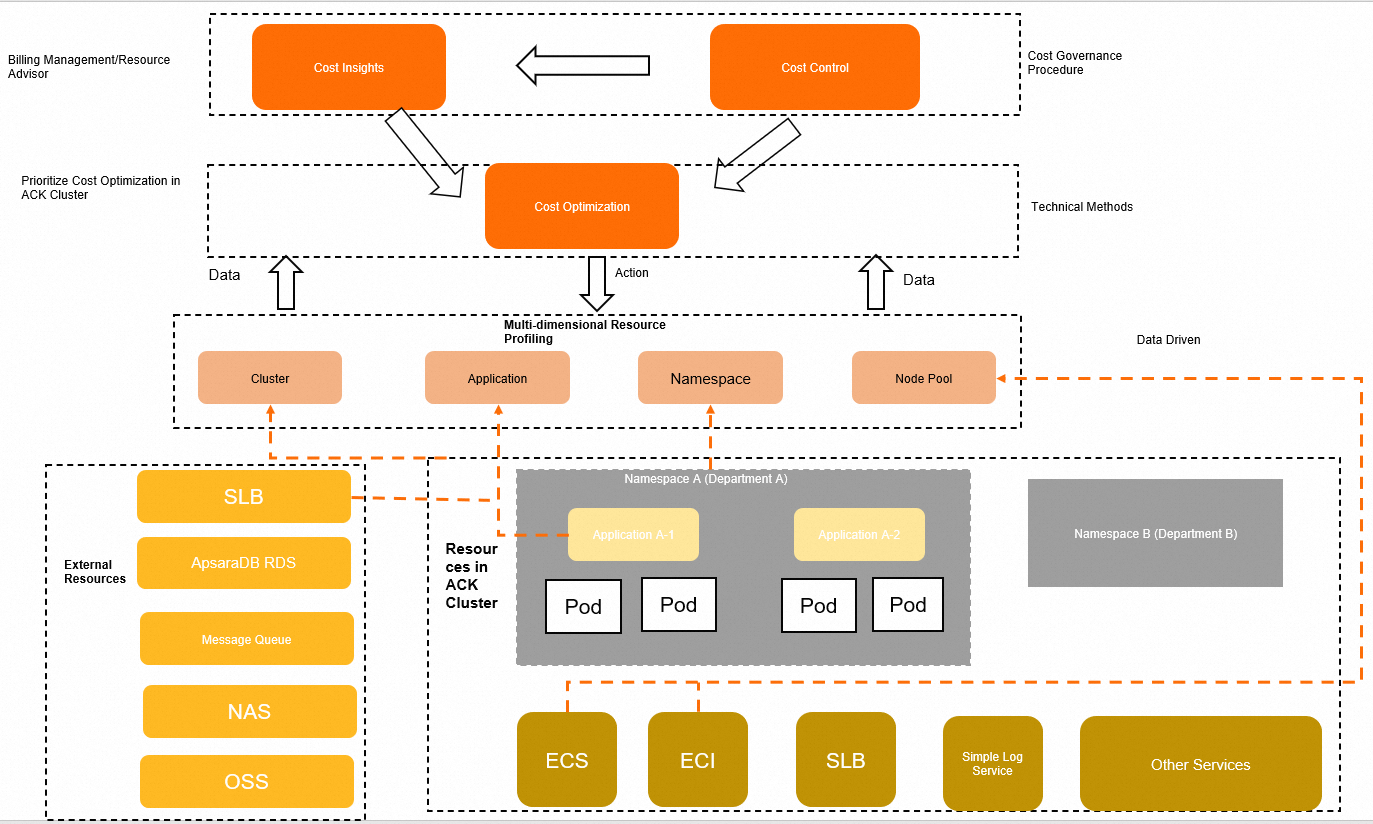
ACK governs IT spending through FinOps across three areas: cost insights, cost optimization, and cost control.
Cost insights
FinOps provides cost allocation models and intelligent cost profiling for metering, billing, and container cost allocation across cluster, namespace, node pool, and application dimensions.
-
The cluster dimension provides insights into overall resources and costs, highlighting trends and anomalies. If cluster spending fluctuations deviate from expectations, troubleshoot and identify the cause.
-
The namespace dimension filters and displays resource and cost data per namespace. Classify departments or business systems by namespace to view allocated costs by department or business system.
-
The node pool dimension provides cost insights at the node pool level. Most cluster costs come from ECS instances managed by O&M engineers. Use these insights to analyze node pool resource costs and choose a proper billing method.
-
Filter applications by label wildcards to view their costs and resources. Application cost insights focus on scenario-specific cost optimization. For example, label all applications in a pipeline to monitor interdependent applications and analyze the costs of the entire pipeline.
Cost optimization
Cost optimization provides strategies to identify and minimize resource waste. Use cost insights to monitor trends, then select and enforce optimization strategies.
Common cost optimization strategies include:
-
Choose a proper billing method, such as savings plans, for your cloud resources.
-
Use application scaling features, such as automatic node scaling, serverless scaling, ECS instance and elastic container instance scaling, and horizontal pod scaling.
-
Use pod scheduling and rescheduling policies to optimize costs.
-
Use time-sharing colocation or preemptible-instance colocation.
-
Optimize performance with non-uniform memory access (NUMA) or vCore binding.
Create resource profiles for Kubernetes-native workloads. The feature analyzes historical resource usage and recommends container resource specifications, simplifying request and limit configuration. See Resource profiling.
Cost control
Cost control covers budget management, quota management, cost forecasting, and cost alerting, and supports multi-cloud and hybrid cloud scenarios.
Cost insights and cost control are the most efficient FinOps measures for cost governance. IT supervisors and infrastructure teams use cost insights to identify resource waste and cost control to reduce it. The business team handles cost optimization, selecting strategies based on their expertise. However, improper optimization strategies may incur technical debt, making cost insights and cost control more reliable for achieving governance goals.
Cost governance procedure

Enterprise IT cost governance typically involves three roles: IT supervisor or financial analyst, IT O&M engineer, and R&D engineer.
-
IT supervisor or financial analyst: ensures IT costs remain within budget and contacts IT O&M engineers if the costs exceed the budget.
-
IT O&M engineer: analyzes cost overrun causes, designs optimization strategies, and drives business teams to implement them.
-
R&D engineer: implements optimization strategies and reports their effectiveness.
Cost governance includes the following steps:
-
View the cluster cost dashboard and check for resource waste.
-
If the dashboard shows resource waste, identify the responsible department or business and locate the cause. Analyze by namespace, node pool, or application — these typically correspond to departments, resources, and businesses.
-
After locating the cause, contact the relevant business team to optimize costs.
-
View the cluster cost dashboard or dimension-specific dashboard to confirm cost governance results.