Multi-Cluster Agent Sandbox
ACK One Multi-Cluster Fleet provides Multi-Cluster Agent Sandbox, a multi-cluster sandbox computing solution that extends single-cluster Agent Sandbox for production-grade AI agents. A unified multi-cluster management plane (Fleet) manages multiple ACK clusters to break single-cluster capacity and failure-domain limits, and multi-cluster scheduling improves resource utilization and sandbox startup efficiency.
Architecture overview
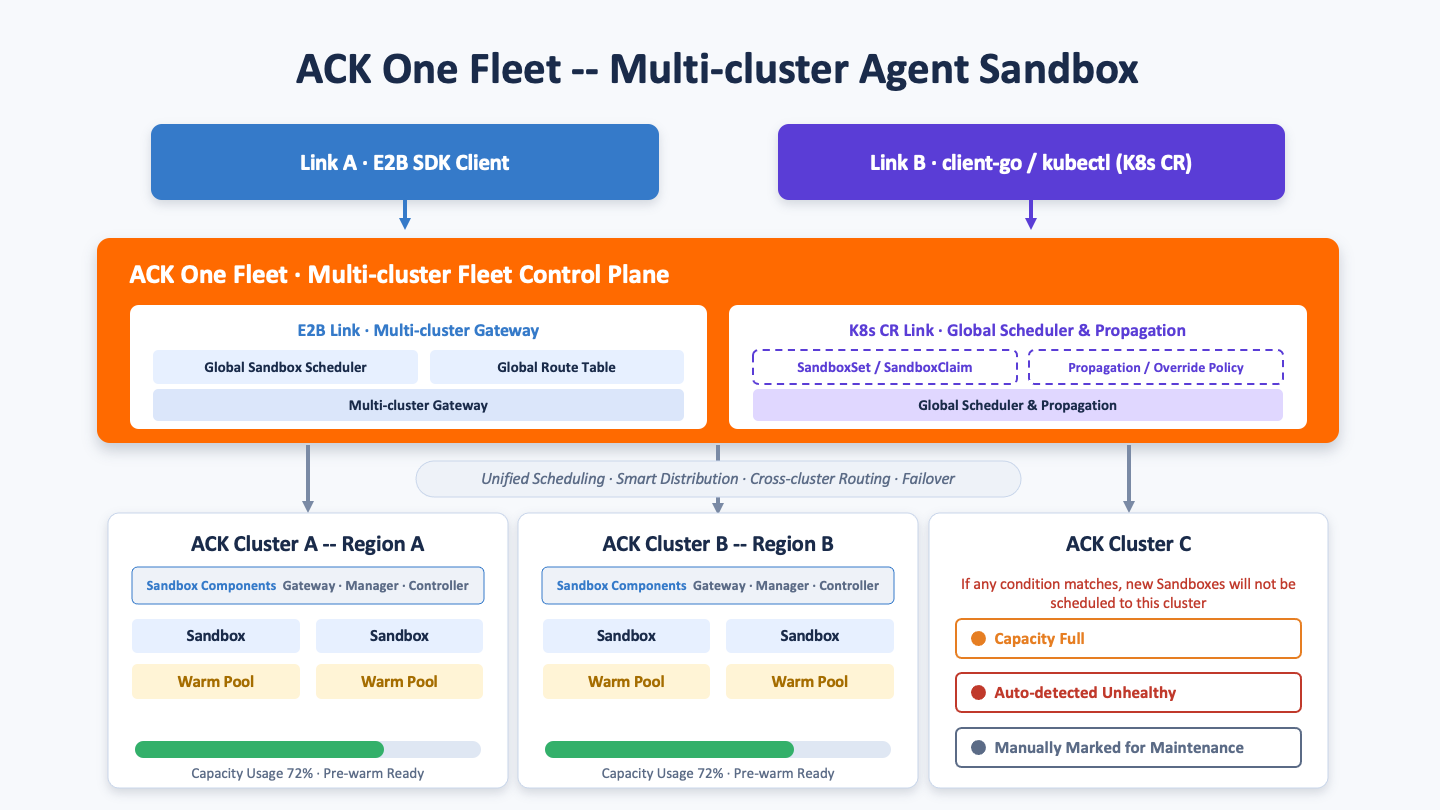
Agent Sandbox can be accessed in two typical ways: the E2B SDK link and the Kubernetes custom resource (CR) link. ACK One Fleet extends both links to the multi-cluster scope, and businesses can upgrade smoothly without changing their architecture.
One of the core designs of the E2B link in Multi-Cluster Agent Sandbox is the separation of Sandbox control plane traffic and data plane traffic: Fleet proxies only the Sandbox control plane traffic and is responsible only for Agent Sandbox lifecycle management, while data plane traffic is handled by member clusters themselves. This design keeps the control plane stable and lightweight and allows the data plane to deliver peak network performance.
Core capabilities
E2B link
The E2B link supports the following core capabilities:
Single-cluster capacity control: Each member cluster is configured with a maximum number of Sandboxes that can run (Capacity). When the limit is exceeded, the scheduler automatically schedules new Sandboxes to other clusters that still have capacity, preventing a single cluster from being overloaded.
Utilization-balanced scheduling: By default, Sandboxes are evenly distributed based on the current Sandbox usage level of each cluster, to maximize multi-cluster resource utilization.
Warm pool awareness and affinity scheduling: The scheduler prefers clusters with sufficient prewarmed Sandboxes, ensuring that Sandboxes start as fast as possible and improving agent startup speed. This is highly valuable in popular reinforcement learning (RL) training scenarios.
Multi-cluster rate-limit scheduling: The rate at which Create Sandbox requests are sent to each member cluster can be individually controlled to avoid overloading the control plane of member clusters. Whenever possible, requests are scheduled to clusters that still have traffic headroom. This can be configured in the cluster scheduling configuration file
sandbox-e2b-scheduler-config.Persistent Volume (PV) creation follows Sandbox scheduling: If each Sandbox requires a dedicated PV, PVs can be created at the fleet level, and region-aware scheduling based on the region of the PV is supported. After the Global Sandbox Scheduler schedules a Sandbox, the PV is created in the target cluster as well. This reduces the cost of managing PVs across multiple clusters. Meanwhile, PVs in member clusters that are not used by any Sandbox are automatically garbage-collected (GC).
Multi-cluster failover: When a cluster becomes abnormal, new Sandbox creation requests can be scheduled to healthy clusters. Both manual and automatic switching are supported. Manual switching is particularly suitable for cluster O&M: it ensures that new Sandbox creation requests are not scheduled to the cluster under maintenance and do not affect normal access to existing Sandboxes on that cluster (such as Connect, hibernation and wake-up, and code execution).
Kubernetes (SandboxClaim) link
The Kubernetes link supports the following core capabilities:
Single-cluster capacity control: Each member cluster is configured with a maximum number of Sandboxes that can run (Capacity). When the limit is exceeded, the scheduler automatically schedules new Sandboxes to other clusters that still have capacity, preventing a single cluster from being overloaded.
Utilization-balanced scheduling: By default, Sandboxes are evenly distributed based on the current Sandbox usage level of each cluster, making full use of multi-cluster resources.
Cluster priority scheduling: Clusters can be divided into priority groups. Sandboxes are first scheduled to the specified clusters (groups), and when resources are insufficient, they are automatically downgraded to the clusters (groups) of the next priority level.
Warm pool awareness and affinity scheduling: The scheduler prefers clusters with sufficient prewarmed Sandboxes, ensuring that Sandboxes start as fast as possible and improving agent startup speed. This is highly valuable in popular RL training scenarios.
Multi-cluster failover: When a cluster becomes abnormal, new Sandbox creation requests can be scheduled to healthy clusters. Both manual and automatic switching are supported. Manual switching is particularly suitable for cluster O&M: it ensures that new Sandbox creation requests are neither scheduled to the cluster under maintenance nor affect normal access to existing Sandboxes on that cluster (such as Connect, hibernation and wake-up, and code execution).
Usage limits and billing
ACK One Multi-Cluster Fleet remains free of charge. The Kubernetes link consists of managed components and incurs no additional charges. The E2B link requires Multi-Cluster Agent Sandbox to be enabled. After it is enabled, the fleet has one Classic Load Balancer (CLB) instance and six Container Compute Service (ACS) instances by default (four performance-oriented 8c16GiB instances and two general-purpose 1c2GiB instances). Calculate costs based on Billing of ACS. Agent Sandbox ultimately still runs in member clusters. For pricing, refer to Billing of Agent Sandbox.