Security Posture Report - December 2025
1. Platform attack and defense posture
Default platform protection level
Default protection is a fundamental defense capability of the Alibaba Cloud platform. It is designed to block large-scale attacks from malicious groups that target cloud customers. This protection leverages extensive cloud security threat intelligence and works out of the box without requiring any configuration.
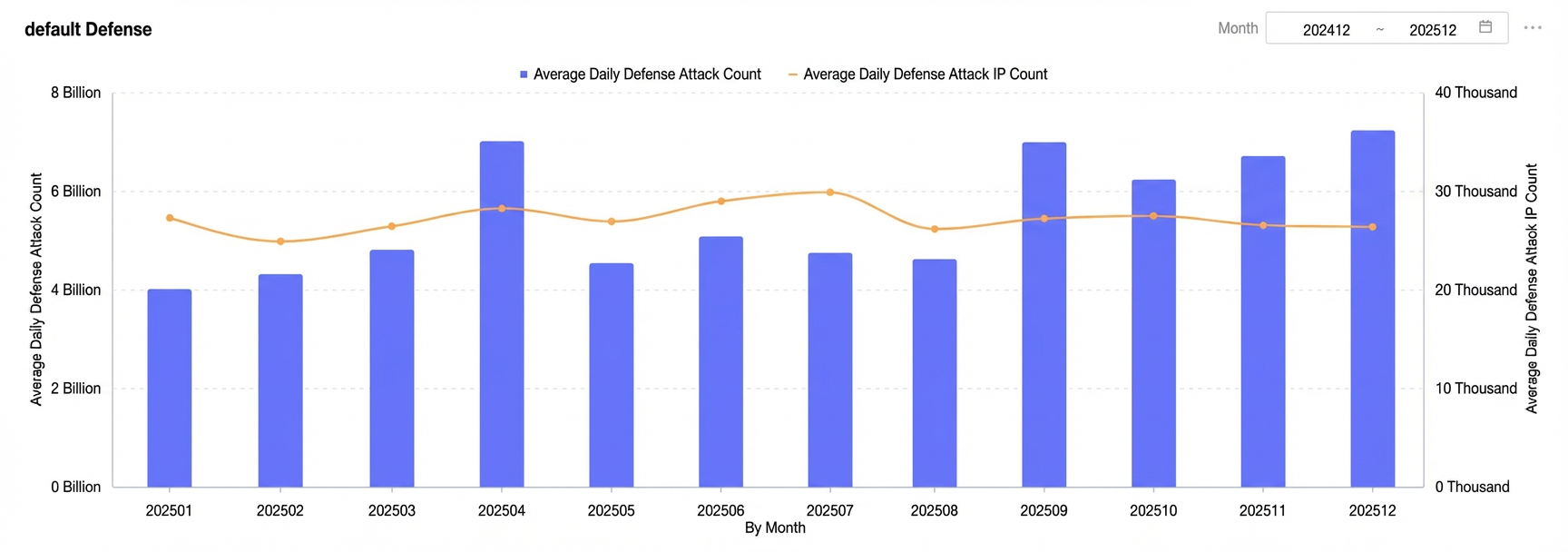
In December 2025, the cloud platform's daily average for customers
Blocked 7.228 billion attacks, a 7.65% increase from November.
Blocked 26,400 attacking IPs, which is about the same as in November.
DDoS attack interception
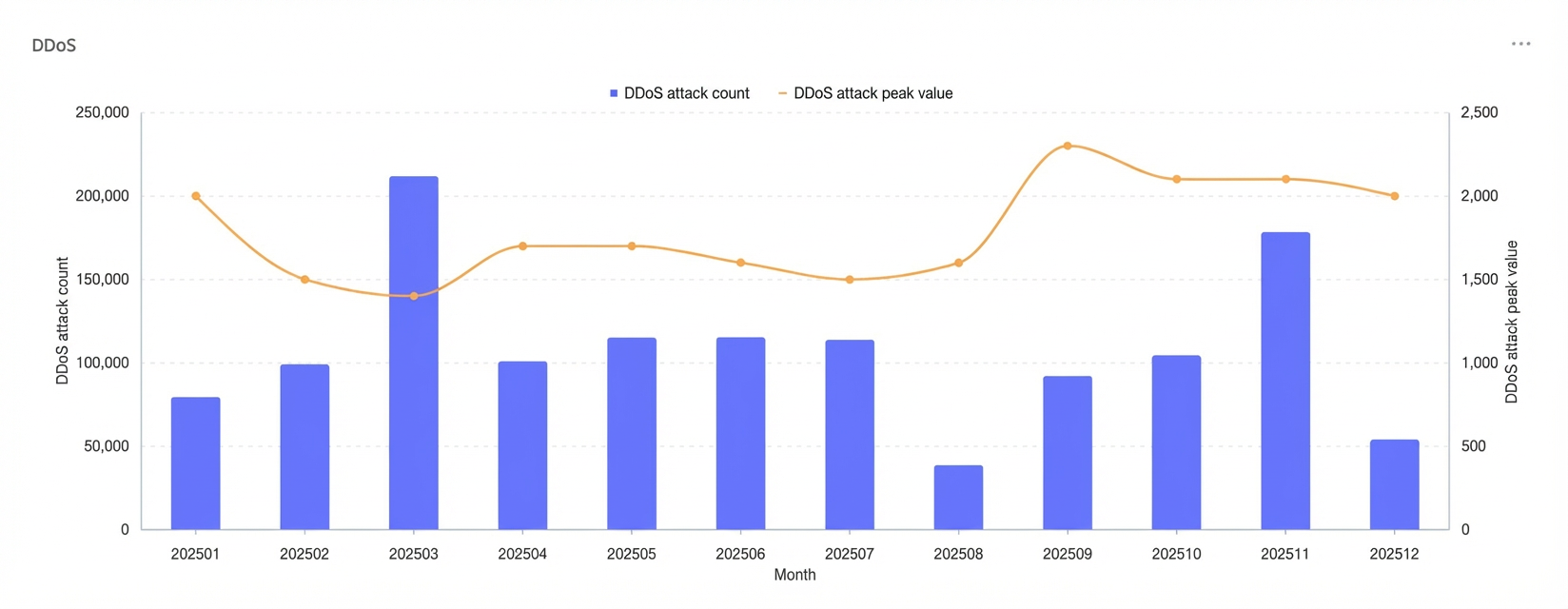
In December, the Alibaba Cloud platform detected and intercepted a total of:
54,000 DDoS attacks, a 69.71% decrease from November.
A peak DDoS attack of 2000 Gbps, a 4.76% decrease from November.
2. Recent attack methods and trends
Malicious groups use Next.js RCE vulnerability for large-scale cloud attacks
On December 4, 2025, the Meta React core team and the Vercel Next.js team jointly published security notices that disclosed two critical vulnerabilities: CVE-2025-55182 (affects React) and CVE-2025-66478 (affects Next.js).
React is an open source frontend JavaScript library for building user interfaces (UIs). The Flight protocol used by React Server Components (RSC) contains a deserialization bug. This bug allows an attacker to craft a malicious request and execute arbitrary system commands on the server without authorization, which constitutes a remote code execution (RCE) vulnerability. Because Next.js is deeply integrated with and heavily relies on the RSC feature of React, it is also affected.
On December 5, the Alibaba Cloud security team observed multiple malicious groups begin to exploit this vulnerability in batch attacks. The malicious activities included host ransomware, malicious mining, and DDoS attacks.
The Alibaba Cloud security team responded immediately:
Used default protection to block the source IPs of the malicious groups and warned cloud tenants about the security risk.
Published detection rules for the Next.js vulnerability (CVE-2025-66478) in the Security Center Free Edition to help users promptly detect the threat.
We observed two clear trends during this attack:
Vulnerability weaponization is significantly faster
Less than two hours passed between the public release of the vulnerability's proof of concept (PoC) and the launch of large-scale attacks by malicious groups. This indicates that attackers have significantly improved their ability to weaponize and deploy exploits.
Attack strategies are more targeted
After the first group of attackers exploited the vulnerability, other groups quickly followed suit. They abandoned their usual attack payloads and redirected their resources to scan for and exploit the Next.js vulnerability. This demonstrates more advanced tactical adjustment and targeting.
Related Indicators of Compromise (IOCs)
The following are the hashes of the primary malicious samples planted by the attacking groups:
521cc9595a6fed1b19781da268cc7db9
38ddf1d7429253fb8564b2067c2cc478
72a37a2fa588e013eafd695b8b5b0e61
c119c77a1822c524eb1ffab6b21fcbbd
74d235f5a647f76e4e2535ace4c4b560
88ba93cc81c2f2c175fc7b521e94fc00
3506f50d0f3ac773aa42292b7e34b873
Remediation recommendations
If you detect related IOCs on your host, or if your application uses Next.js components such as Dify, Lobechat, or NextChat, check for this vulnerability and remediate it immediately:
Upgrade: Immediately upgrade React and Next.js to the latest secure versions. This is the most effective method of protection.
Temporary mitigation: If you cannot immediately upgrade, you can configure rules in Web Application Firewall (WAF) or Cloud Firewall to block malicious traffic that exploits the vulnerability and sever the attack path.
3. Vulnerabilities frequently attacked recently
(1) New important vulnerabilities
MongoDB Zlib heap memory leak vulnerability (CVE-2025-14847)
MongoDB is a high-performance, scalable database for web applications. MongoDB recently disclosed a heap memory information leak vulnerability (CVE-2025-14847) in its Zlib compression protocol. This vulnerability does not require identity authentication. A remote attacker can connect to a vulnerable MongoDB service and cause the server to leak memory fragments, which can lead to the exposure of sensitive data.
A proof of concept (PoC) for this vulnerability has been publicly released, and the threat level is high. Multiple versions of MongoDB Server, from 3.6 to 8.2, are affected. We recommend that you promptly check for and address this threat.
Remediation recommendations
If you have deployed a vulnerable version of the MongoDB service on Alibaba Cloud, you must immediately upgrade to a secure version.
If you cannot immediately upgrade, you can disable zlib compression as a temporary mitigation measure.
You can do this by specifying the
networkMessageCompressors(command line) ornet.compression.compressors(configuration file) option when you startmongodormongos. You must explicitly excludezlib.Examples of secure values include `snappy`, `zstd`, or `disabled` to completely disable compression.
If the MongoDB service stores sensitive data, you should shut down or strictly limit public network access to reduce your attack surface.
(2) List of other vulnerabilities frequently attacked recently
Security Center provides free detection for some of these vulnerabilities. For more comprehensive detection, you can use Security Center Enterprise Edition to perform deep scans and continuous monitoring.
No. | Vulnerability | ID | Free detection available |
1 | DataGear platform SpEL expression injection vulnerability | No | |
2 | xxl-job remote code execution vulnerability | No | |
3 | Docker daemon API unauthorized access vulnerability | No | |
4 | PHP CGI remote code execution vulnerability on Windows | Yes | |
5 | php < 7.1.32 PHP-FPM misconfiguration remote code execution vulnerability | No | |
6 | Redis unauthorized access vulnerability | Yes | |
7 | PostgreSQL arbitrary code execution vulnerability | No | |
8 | Apache ActiveMQ remote code execution vulnerability | Yes |