Security Posture Report - July 2025
The Alibaba Cloud Platform Security Posture Report for July 2025.
1. Platform attack and defense posture
Default defense level of the cloud platform
Daily average for July 2025
Defended against 4.7 billion attacks, a 6.7% decrease from June.
Defended against 30,000 attacking IP addresses, a 3.1% increase from June.

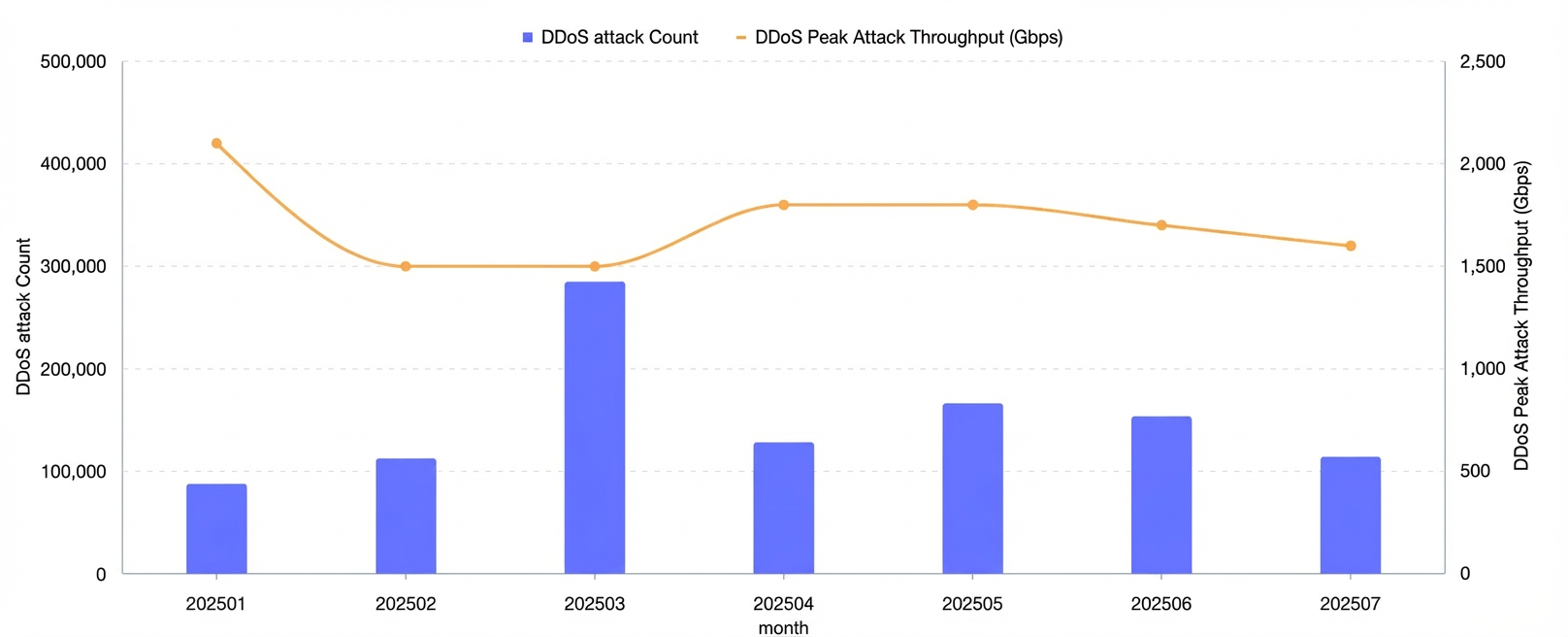
DDoS attack interceptions
In July, the Alibaba Cloud platform detected and blocked a total of
114,000 DDoS attacks, a 25.9% decrease from the previous month.
Peak DDoS attack traffic of 1600 Gbps, a 5.88% decrease from the previous month.
2. Recent attack methods and trends
Trend 1: New threat actor group uses distributed brute-force strategy to infect hosts
Recently, the Alibaba Cloud security team detected a new mining worm group on the cloud platform. This group primarily spreads through Secure Shell (SSH) brute-force attacks. Unlike typical worms, this group uses a distributed brute-force strategy to enhance its propagation capabilities. Based on its Indicators of Compromise (IOCs), we have named this group Luotuoxiangzi.
Attack method
Luotuoxiangzi first compromises a host through an SSH brute-force attack. It then downloads a program named ddaemon, which acts as a loader for subsequent operations. This loader performs the following actions:
Establishes persistence on the system by registering itself as a system service.
Downloads a mining configuration script and starts cryptocurrency mining.
Downloads a scanning tool to attack other targets for self-propagation.
Unlike traditional worms, Luotuoxiangzi does not carry its own dictionary for brute-forcing passwords or randomly generate attack targets. Instead, it:
Downloads brute-force dictionaries and target lists from a central server to perform distributed brute-force attacks.
Frequently changes the target list and regularly updates the dictionary, making the attacks more flexible and powerful.
This method allows Luotuoxiangzi to conduct many diverse brute-force attempts in a short time, which makes it spread faster and harder to defend against than traditional worms.
IOCs
1) Related samples:
bfa742a7971ee767136a506cbd9dac48
ff5de82d58353f5bfe6257a4105beb29
c5c3fcdaed9b76e1f186c797be3d9d04
21b12dbf8795d2fcdd1ad1dbdc4fb80a
e958c454e3599726b2863670054ce0dd
2) C2 addresses:
db.luotuoxiangzi.cc
dow.luotuoxiangzi.cc
Security recommendations
Use Alibaba Cloud SSH key pairs to log on to Linux instances. This improves the security of remote access.
If you must use passwords for business reasons, use complex security tokens that include numbers, letters, and symbols. Avoid exposing security groups to the public network. If you receive a weak security token alert from an Alibaba Cloud security assessment, it means the password strength for the instance is too low or the password has been compromised. Change the password immediately.
If Alibaba Cloud detects a suspected intrusion threat on a host, it sends a security alert that contains keywords such as "hacker intrusion". Follow the instructions in the alert to address the issue immediately.
Trend 2: Cybercriminals use phishing with O&M tools to steal Elastic Compute Service logon credentials in batches
Recently, the Alibaba Cloud security team has observed a group named "Yexiao" expanding its activities on the cloud platform. This group primarily uses highly convincing phishing websites to trick users into downloading malware. This allows the group to gain control of servers and use these compromised servers for broader network attacks or illegal activities.
Attack method
The attackers use phishing websites and malicious scripts disguised as Baota Panel, a server management software. The attack proceeds as follows:
Trick users into downloading a malicious installation script: The attackers create a phishing website that looks nearly identical to the official Baota Panel website and promote it through search engines. When users search for "Baota", they might mistakenly click this fake site and download a seemingly normal installation script.
Execute the malicious script: Once a user executes the malicious script, it downloads and runs virus files, such as
lcsys, on the user's server. These files attempt to hide themselves and are configured to start automatically to maintain persistence.Establish a back door connection: The malware communicates with a remote control server through a heartbeat mechanism. This allows attackers to control the infected server at any time. The program also sends sensitive information from the server, such as the Baota Panel username and password, to specific malicious domain names.
Continuous monitoring and propagation: In addition to causing direct damage, the attackers may use the compromised server as a springboard to attack other targets or add it to a botnet. The botnet can then be used to launch additional network attacks or perform mining activities.
IOCs
1) Related samples
f68db8a062ed1ca03f2a90eaebf5c83e
4d5fd87abdcaaecee225f02a7db6a47e
2) C2 addresses
xz.appdoner.com
bt.jcjydzsw.cn
btlude.appokset.com
lilforfdwes14dffljiul.com
3) Phishing websites (partial list)
skqq.jcjydzsw.cn
dolowdeopen.com
Security recommendations
Improve your network security awareness. Download and install software only from official and trusted sources to prevent malware infections.
Alibaba Cloud will continue to monitor the spread of this group. If you receive a security alert that contains keywords such as "hacker intrusion", follow the instructions in the alert to address the issue immediately.
3. Vulnerabilities frequently attacked recently
Based on attack data analytics, the Alibaba Cloud security team has identified the vulnerabilities that were most frequently scanned and exploited on the cloud platform recently. If your assets are affected, we recommend that you detect and fix these vulnerabilities or implement protective measures immediately.
The following vulnerabilities were frequently attacked on Alibaba Cloud in July:
No. | Vulnerability | ID | Free detection available |
1 | ThinkPHP 5.x arbitrary code execution vulnerabilities | Partially supported | |
2 | PHP-FPM unauthorized access vulnerability | No | |
3 | Apache Log4j2 JNDI remote command execution | Yes | |
4 | Fastjson deserialization vulnerabilities | Partially supported | |
5 | Hadoop YARN REST API command execution vulnerability | No | |
6 | Apache HTTPd 2.4.49/2.4.50 path traversal and command execution vulnerability | Yes | |
7 | F5 BIG-IP request smuggling unauthorized RCE | No | |
8 | Confluence OGNL RCE | Yes | |
9 | RocketMQ arbitrary code execution vulnerability | Yes | |
10 | Apache ActiveMQ arbitrary code execution vulnerability | Yes |
Free detection is available for most of these vulnerabilities. You can go to the Alibaba Cloud Security Center console and enable the free security assessment to scan for emergency vulnerabilities.
For more security information, subscribe to the Cloud Security Guide channel.