Unified Kernel Fault Event Framework (UKFEF)
Alibaba Cloud Linux 3 (starting from kernel version 5.10.60-9.al8.x86_64) introduces the Unified Kernel Fault Event Framework (UKFEF). UKFEF collects system anomalies that may pose risks and generates event reports in a unified format. This topic describes the events collected by UKFEF, the format of the event reports, and the interfaces used to control UKFEF.
Background information
An operating system may show certain signs or messages before serious problems occur. During Operations and Maintenance (O&M), you can use this information to predict faults and perform preventive operations. However, this information is scattered across different system modules and is available in various formats. As a result, you may face the following issues when collecting system anomalies:
Parsing anomalies and their potential impacts requires specialized knowledge.
The various formats of anomalies complicate automated O&M. This requires format matching during information collection, followed by data cleaning.
To solve these problems, Alibaba Cloud Linux 3 includes UKFEF at the kernel layer. UKFEF collects various system anomalies that may pose risks, automatically determines the event severity, and generates event reports in a unified format. The reports include the scenarios in which the problems occurred and the recommended risk levels. This simplifies the identification of system anomalies during O&M. UKFEF also classifies known anomalies and provides system risk reports that were not available in previous kernel versions.
UKFEF generates reports based on multiple dimensions, such as the type, impact, and statistics of anomalies. This helps you efficiently diagnose system anomalies during O&M. In addition, event reports are generated through multiple methods to prevent data loss.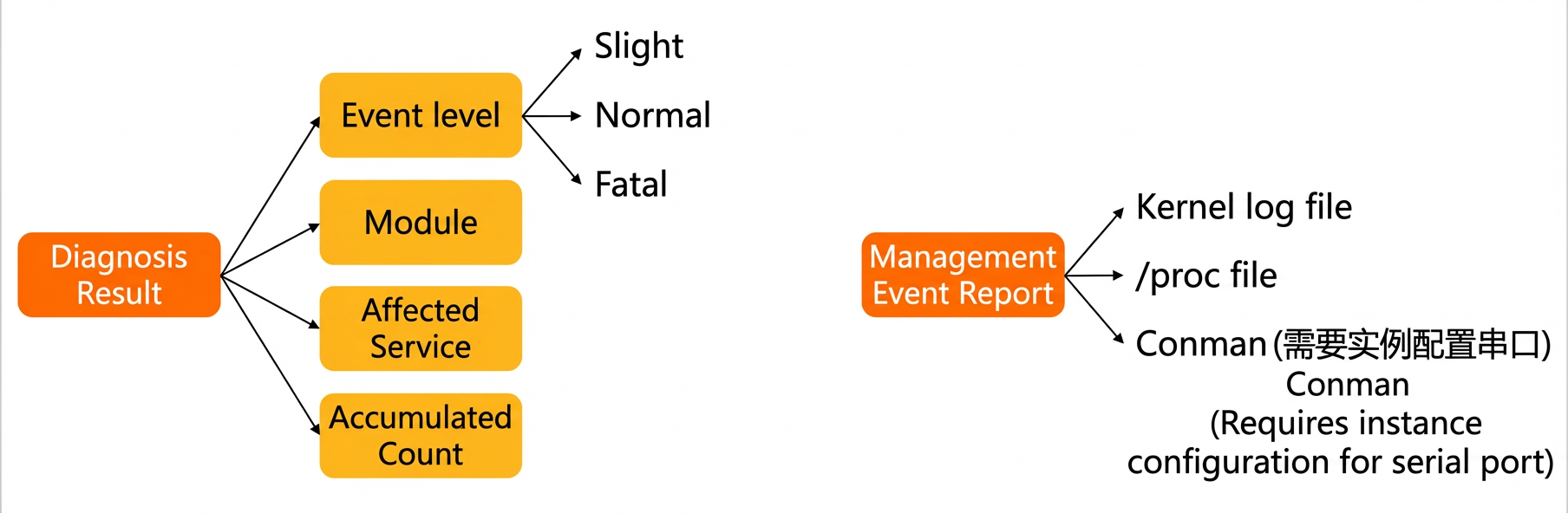
Event description
The following table describes the event types, event levels, and report formats that UKFEF uses.
Event information | Description |
Event type | UKFEF collects the following common operating system kernel events:
|
Event level | UKFEF classifies anomaly events into three levels:
|
Event report | UKFEF outputs event reports in the following ways:
|
Control interfaces
Interface | Description |
| Controls whether to enable or disable UKFEF. Valid values:
|
| Controls whether UKFEF outputs event reports. Valid values:
|
| Controls whether to trigger the operating system's Panic mechanism when a Fatal event occurs. Valid values:
|