Producers
This topic describes producers in ApsaraMQ for RocketMQ. It covers their definition, role in the messaging model, internal attributes, version compatibility, and usage recommendations.
Definition
A producer is a runtime entity in ApsaraMQ for RocketMQ that builds and sends messages to the server.
Producers are typically integrated into business systems. They package business data into ApsaraMQ for RocketMQ messages and send them to the server.
A producer defines the following delivery behaviors:
Transmission mode: A producer can set the message transmission mode using an API operation. ApsaraMQ for RocketMQ supports synchronous and asynchronous transmission. For more information, see Message transmission modes.
Transactional behavior: ApsaraMQ for RocketMQ supports transactional messages. For these messages, the producer must perform transaction checks to ensure eventual consistency. For more information, see Transactional messages.
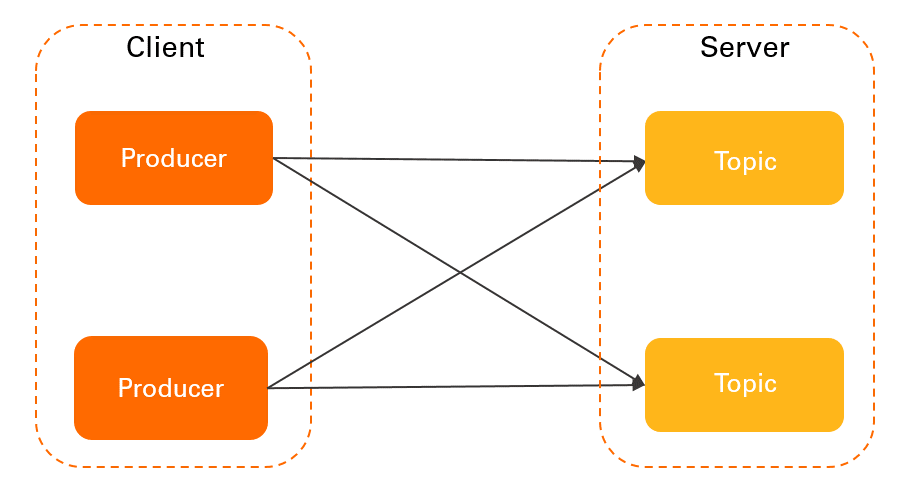
Producers and topics have a many-to-many relationship. A single producer can send messages to multiple topics. Therefore, in platform-based scenarios, you do not need to create a producer for each topic. A single topic can also receive messages from multiple producers. This design allows for horizontal scaling and disaster recovery for producers.
Model relationship
The following figure and steps illustrate the role and data flow of a producer in the ApsaraMQ for RocketMQ domain model: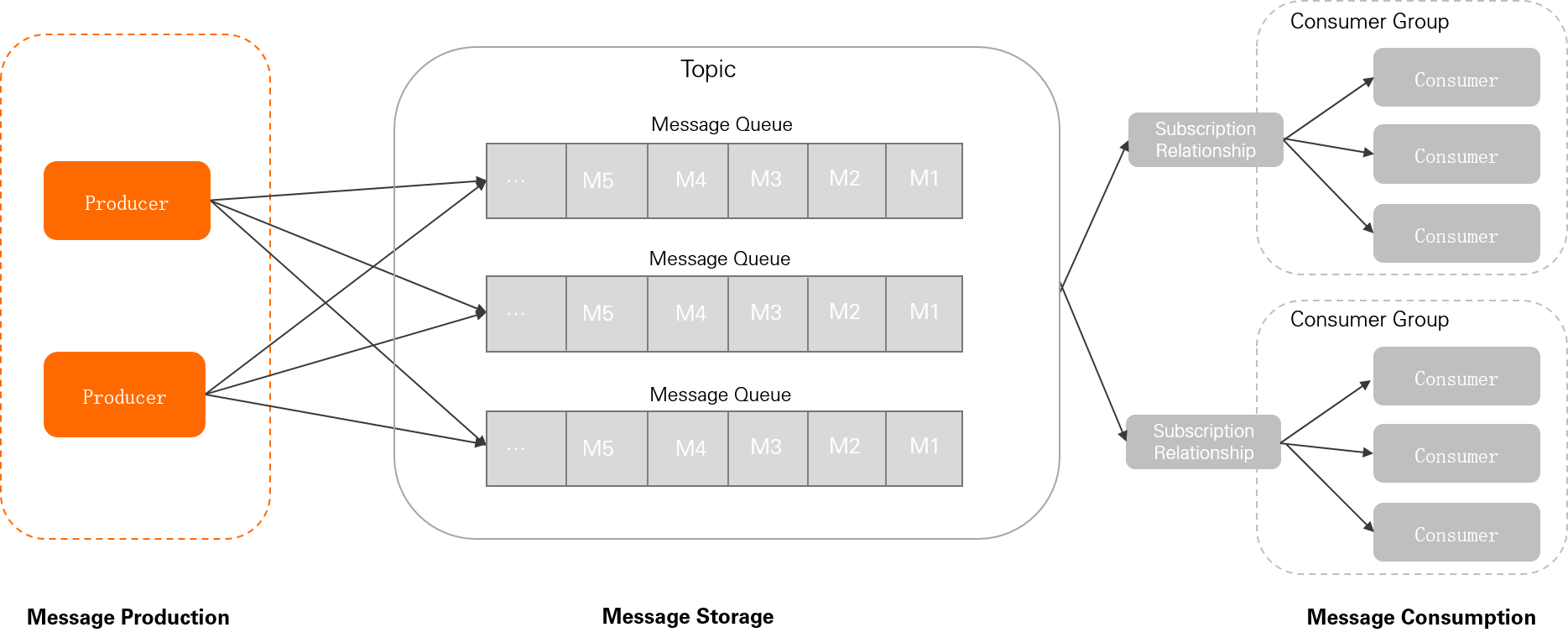
- Producers produce and send messages to the ApsaraMQ for RocketMQ broker.
- The ApsaraMQ for RocketMQ broker stores the messages in the queue that is specified by the topic in the order in which the messages are received.
- Consumers obtain and consume messages from the ApsaraMQ for RocketMQ broker based on the specified subscriptions.
Internal attributes
- Endpoint (required): the address that is used by a client to access the ApsaraMQ forRocketMQ broker. The endpoint is used to identify the cluster on the broker.
You must configure an endpoint in the specified format. We recommend that you use a domain name instead of an IP address to prevent hotspots from failing to be migrated during node changes.
- Identity authentication (optional): the credentials that are used to verify the identity of the client.
This parameter is required only when the identity authentication feature is enabled on the broker.
- Request timeout period (optional): the timeout period for client requests. For information about the valid values of the request timeout period parameter, see Parameter limits.
Send retry policyDefinition: The retry policy for a producer when a message fails to be sent. For more information, see Message sending retry mechanism.
Version compatibility
Starting from ApsaraMQ for RocketMQ V5.x, producers are anonymous. You do not need to manage producer groups. For server-side versions 3.x and 4.x, you can discard existing producer groups without affecting your business.
Usage recommendations
Do not create many producers in a single process
In ApsaraMQ for RocketMQ, producers and topics have a many-to-many relationship. A single producer can send messages to multiple topics. Therefore, you should reuse producers as much as possible and avoid creating a separate producer for each topic.
Do not create and destroy producers frequently
A producer in ApsaraMQ for RocketMQ is a reusable underlying resource, similar to a database connection pool. Do not create a producer each time you send a message and then destroy it afterward. This practice generates many short-lived connection requests on the server and severely affects system performance.
Correct example
Producer p = ProducerBuilder.build();
  for (int i =0;i<n;i++)
    {
      Message m= MessageBuilder.build();
      p.send(m);
    }
p.shutdown();
Incorrect example
for (int i =0;i<n;i++)
  {
    Producer p = ProducerBuilder.build();
    Message m= MessageBuilder.build();
    p.send(m);
    p.shutdown();
  }