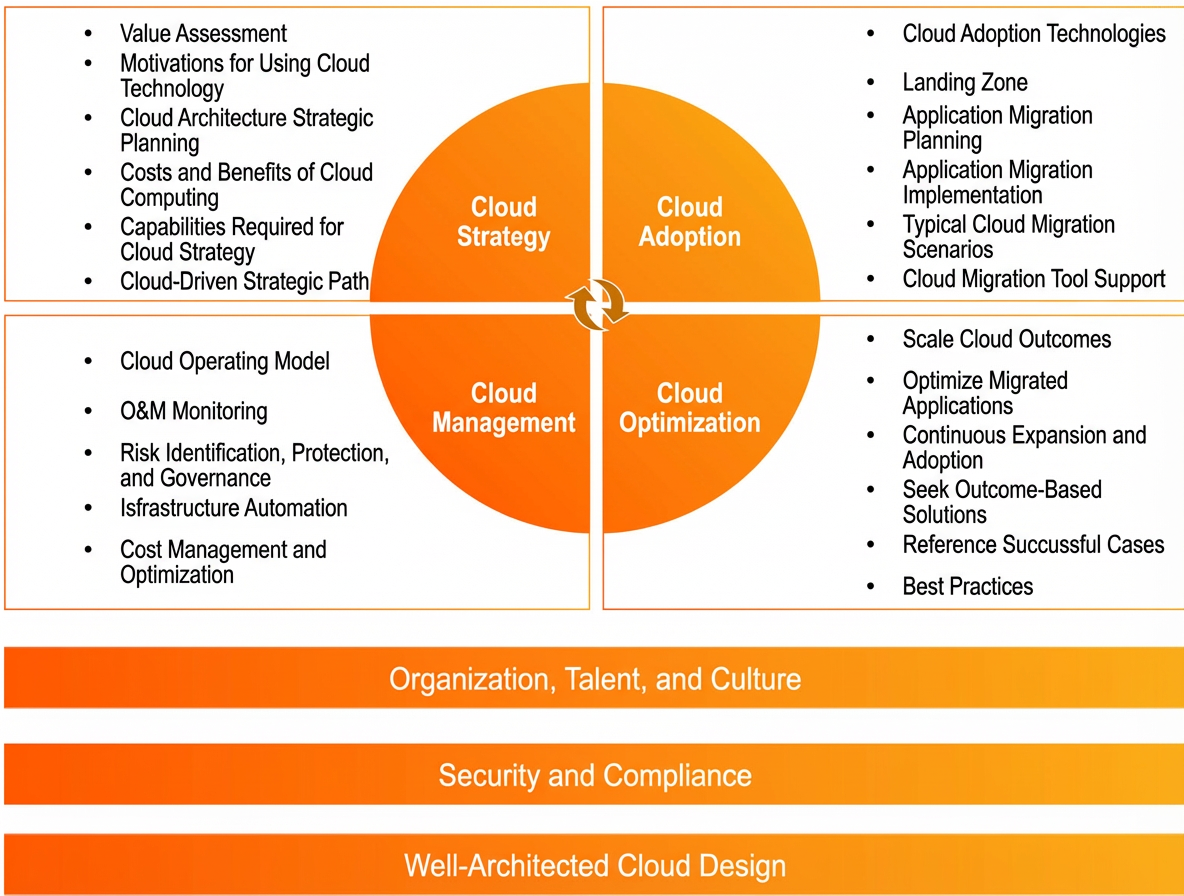
Cloud Adoption Framework overview
The digital economy is sweeping across the globe, and leading enterprises in various industries are becoming increasingly proactive in their digital transformation. The spread of the COVID-19 pandemic has further accelerated this transformation process.
In this context, cloud computing has become one of the key drivers of enterprise digital transformation. Enterprises have shown significantly increased enthusiasm for cloud migration and adoption. We are seeing more companies actively exploring and implementing a "Cloud First Strategy."
Through years of practical experience, Alibaba Cloud has helped leading enterprises in multiple industries successfully implement the Cloud First Strategy, providing methodologies and best practices that support broader cloud adoption.
The Cloud Adoption Framework is built on extensive experience from cloud transformation initiatives, offering strategic and technical guidance principles and best practices to help enterprises:
Develop a clear cloud strategy
Adopt the cloud effectively
Use the cloud efficiently
Manage the cloud properly
Achieve their business goals
ITIL as a foundation
The Information Technology Infrastructure Library (ITIL) is a classic methodology for IT service management, widely adopted by enterprises. At its core, ITIL emphasizes IT services, which are technical services that support business development.
The full lifecycle of an IT service includes five stages:
Service strategy: Defines the service, clarifies its value, and establishes the relationship between service management and business objectives.
Service design: Defines service goals, elements, models, and risks, and establishes processes for managing the service.
Service transition: Provides the capabilities needed to develop and improve services, then deliver them into the operational stage.
Service operation: Ensures efficiency and effectiveness in service delivery and support, delivering value to customers.
Continual service improvement: Focuses on continuous improvement of services based on feedback and performance data.
Cloud services and lifecycle management
Cloud services are among the most popular IT services today. Their full lifecycle should follow the above methodology.
Similarly, our Cloud Adoption Framework is guided by this theoretical foundation, defining four key stages in the application of cloud services:
Stage 1: Cloud strategy
Formulate a cloud strategy based on the overall business strategy, and provide clear goals and guidelines for subsequent implementation and realization.
Stage 2: Adopt cloud effectively
In the initial phase of cloud adoption, develop a comprehensive solution by combining cloud strategy planning with requirements from all relevant areas.
Stage 3: Use cloud efficiently
During the ongoing implementation process, expand horizontally and vertically, refer to proven practices, and maximize the value of the cloud.
Stage 4: Manage cloud properly
Identify and resolve issues and risks during operations and maintenance, address them appropriately, and continuously improve service quality.
Horizontal support across the lifecycle
Throughout the implementation of the cloud strategy, there are several horizontal support components that are essential to achieving the desired outcomes.
Among these, three modules are particularly critical, forming the three foundational pillars of the cloud adoption strategy:
Pillar 1: Organization, culture, and talent
Establish a structured organizational framework that supports cloud adoption, cultivate a culture aligned with cloud-based strategies, and ensure the right talent is in place to enable successful implementation.
Pillar 2: Security and compliance
Clarify the compliance credentials of cloud service providers and define the security boundaries between the provider and the enterprise. Use cloud products to address any gaps in the enterprise's internal security infrastructure.
Pillar 3: Strong cloud architecture design
Focus on common architectural patterns throughout the cloud adoption process to ensure a robust and scalable cloud architecture that continuously supports the implementation of the cloud strategy.