This topic describes the system architecture of Cloud Contact Center.
Background
Building an on-premises call center can require hundreds of thousands of CNY in capital expenditure. Most of this cost comes from purchasing multiple servers for application services, storage, load balancing, redundancy, and disaster recovery. Software licenses for interactive voice response (IVR) systems and the development of an integrated solution also add to the cost. In addition, Private Branch Exchange (PBX) hardware, routers, and switches are fundamental hardware investments required for inbound and outbound calls and Internet connectivity.
The cloud changes how you provision and use IT resources through resource sharing. A multi-tenant architecture is built on virtual resources. Each tenant can use these resources as needed and quickly scale based on business volume. Because of this, the cloud helps customers significantly reduce operational costs.
Advantages
Compared to an on-premises call center, Cloud Contact Center has the following advantages:
Fast and easy setup: Quickly activate the service with just a computer, a microphone, and network access. The service is ready to use out-of-the-box.
Pay-as-you-go: No upfront investment is required. Operational costs are low. You can choose between pay-as-you-go and subscription billing as needed.
No O&M overhead: No dedicated IT facility maintenance is needed. Alibaba Cloud handles all related hardware and infrastructure maintenance and upgrades.
Easy scaling: Easily scale in or scale out to handle changing business demands.
System components
Cloud Contact Center is an optimized version of the internal call center system developed by Alibaba Group over many years. Its core service stability has been proven through years of Double 11 shopping festivals. Cloud Contact Center is provided as a Software as a Service (SaaS) solution and consists of the following four subsystems:
Alibaba Cloud Management Console and agent console: Provides tools to create, destroy, and configure Cloud Contact Center instances, and manage agents, skill groups, phone numbers, IVRs, recordings, reports, and monitoring. It also provides voice services, such as answering and making calls.
Cloud Contact Center core service: Provides core VoIP-based call services, including IVR and Automatic Call Distribution (ACD).
Alibaba Cloud middleware: OSS provides nearly unlimited storage for recordings. This middleware also offers additional services such as monitoring, intelligent quality inspection, business intelligence, and the AliMe intelligent chatbot.
Alibaba Communications: Provides phone number resources and carrier access services.
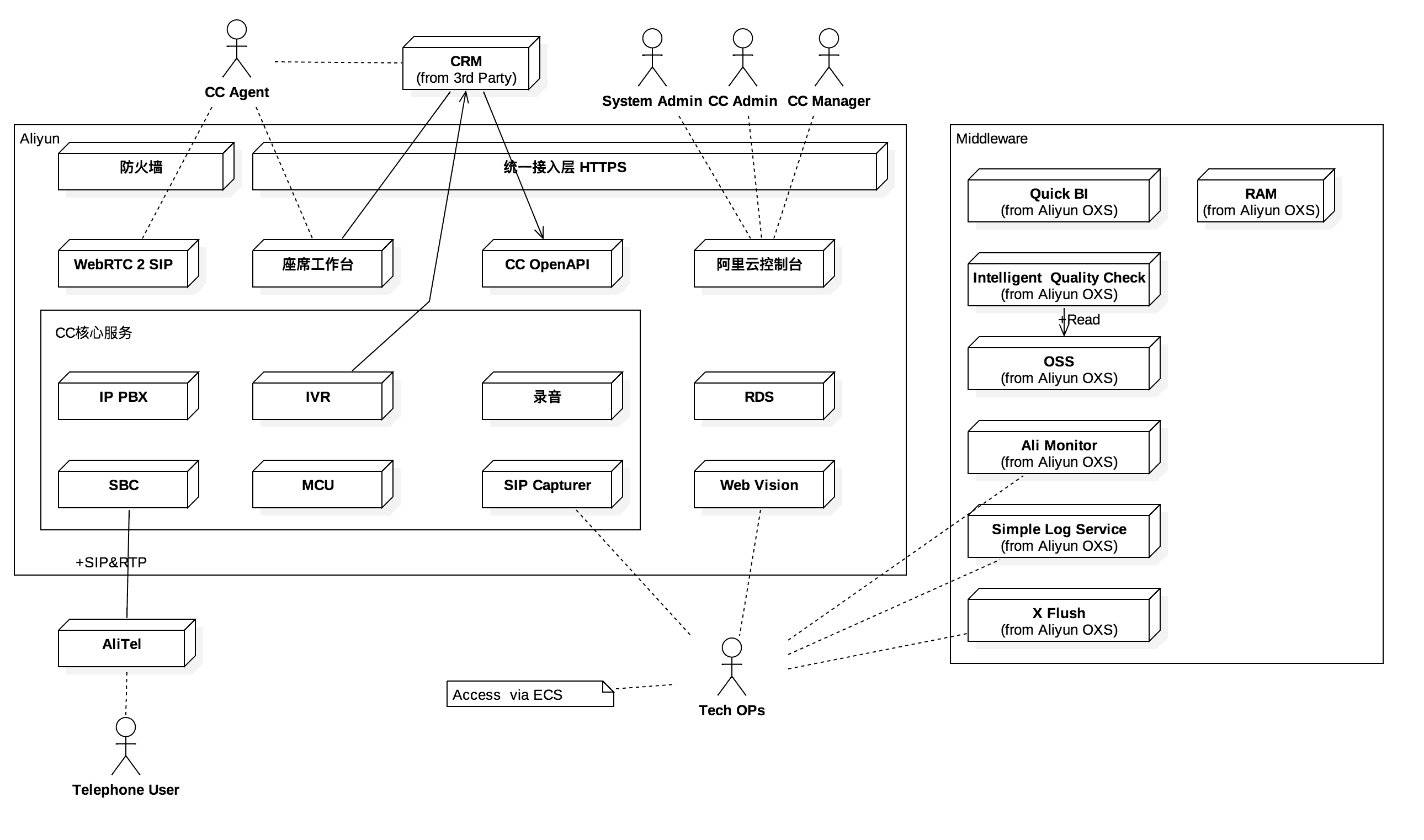
The unified access layer is the front-end and most fundamental service in Alibaba's business architecture. It handles all HTTP and HTTPS requests from users across the network. The underlying VIPServer provides powerful high availability (HA) and load balancing features. In addition, the unified access layer enables Web Application Firewall (WAF). WAF is based on big data security capabilities. It defends against common Open Web Application Security Project (OWASP) attacks, such as SQL injection, cross-site scripting (XSS), vulnerabilities in common web server plugins, Trojan uploads, and unauthorized access to core resources. WAF filters massive amounts of malicious traffic to ensure website security and availability.
Business integration
In addition to the Alibaba Cloud Management Console and the agent workbench, Cloud Contact Center provides Open APIs for integration with your business systems. Integration methods include the following:
OAuth 2.0-based single sign-on: OAuth is an open authorization standard, currently at version 2.0. It allows users to grant third-party applications, such as your own business systems, access to their private resources on a website, such as Cloud Contact Center, without providing their username and password to the third-party application. Instead of credentials, users provide a token to access their data stored with a specific service provider. Each token authorizes a specific website to access specific resources for a specific period. This way, OAuth allows users to authorize third-party websites to access some, but not all, of their information stored with another service provider.
Agent workbench integration: Cloud Contact Center encapsulates the agent workbench features into a JavaScript (JS) web component, which is a softphone software development kit (SDK). You can embed this web component into your CRM system's pages. The CRM system can then call the interfaces provided by the web component to perform actions, such as making calls. The CRM system can also listen for events generated by the Cloud Contact Center agent workbench web component and handle them accordingly.
IVR flow: The IVR can call your business system's interfaces through Function Compute.
Call Open APIs: Your business system can directly call Cloud Contact Center Open APIs to implement features such as predictive dialing and intelligent outbound calls. You can also use interfaces for agent skill groups to achieve deep integration with your own systems and synchronize accounts between the two systems.
The WebRTC2SIP service provides a browser-based client that uses HTML5 technology. This makes user access more convenient and enhances voice quality.