Alibaba Cloud Embodied AI Network Whitepaper
Abstract
Embodied artificial intelligence (AI) is moving from the laboratory to industrial applications. Embodied AI, in forms such as humanoid robots, autonomous driving, quadruped robots, and industrial robots, is reshaping industries such as manufacturing, logistics, and services. Driven by both policy support and technological advancements, a hierarchical "brain-cerebellum" architecture has become the mainstream technical approach. The entire lifecycle, which includes data collection, model training, simulation, evaluation, and inference deployment, relies heavily on a high-quality network infrastructure.
However, embodied AI places unprecedented demands on networks. Gradient synchronization in simulation training requires over 100 Gbps of bandwidth and microsecond-level latency. Humanoid robot interaction needs a low-jitter network with latency under 20 ms. Autonomous driving vehicle-cloud collaboration requires cross-region network acceleration and over 99.95% availability. Traditional network architectures struggle to meet these diverse and extreme requirements simultaneously.
Alibaba Cloud's network solutions address the end-to-end needs of embodied AI. We integrate core products such as Cloud Enterprise Network (CEN), Transit Router (TR), Global Accelerator (GA), Application Load Balancer (ALB), Network Load Balancer (NLB), and PrivateLink to build a network solution that covers the entire process of data collection, simulation, training, and inference. This whitepaper systematically explains the industry trends and network challenges of embodied AI. It also details Alibaba Cloud's all-scenario network solutions to help enterprises build a solid network foundation for the embodied AI race.
1 Background: The paradigm shift from standalone intelligence to device-cloud collaborative intelligence in the era of embodied AI
1.1 Policy-driven: Countries compete to position themselves as embodied AI enters a new era
Major economies have designated embodied AI as a future strategic direction, and the market is growing rapidly. IDC predicts that user spending on embodied AI robots in China will exceed USD 1.4 billion by 2025 and soar to USD 77 billion by 2030, with a staggering compound annual growth rate (CAGR) of 94%.
Domestic policy promotion: The "Guiding Opinions on New Quality Productive Forces" (State Council, 2024) explicitly calls for "accelerating the industrialization of cutting-edge technologies such as embodied AI and general-purpose robotics." The Ministry of Industry and Information Technology's "Guiding Opinions on the Innovative Development of Humanoid Robots" encourages "the construction of embodied AI cloud platforms and the provision of high-reliability, low-latency network services." The "15th Five-Year Plan" further lists humanoid robots as a key development direction, promoting the construction of embodied AI cloud platforms and strengthening the development of high-speed networks and edge nodes. In terms of development goals, an innovation system for humanoid robots is planned to be established by 2025. A secure and reliable industrial and supply chain system will be formed by 2027, and mass production lines will be built by 2030. According to the Chinese Institute of Electronics, the market size of humanoid robots in China is projected to grow from about CNY 2.7 billion in 2024 to over CNY 870 billion in 2030.
International strategic layout: The United States is promoting the integration of AI and embodied AI through the National Robotics Initiative 3.0, strengthening the research and development of a unified cloud-edge-device architecture. The European Union is promoting the unification of embodied AI technology standards and the interconnection of cloud infrastructure across member states through the "Horizon Europe" program. Japan is implementing its "New Capitalism" digital investment strategy, focusing on the commercialization of service robots and strengthening the support of 5G and cloud platforms for real-time control.
1.2 Technology-driven: World models will become the strongest support for embodied AI
Currently, three major technological trends are accelerating the industrialization of embodied AI:
Multimodal large models drive integration, from passive to active. The unified modeling of vision, language, and action allows robots to shift from passive response to active perception and decision-making. Multimodal large models integrate multi-source data such as vision, voice, and force, significantly improving environmental understanding. They enable cross-modal reasoning through a unified semantic space, giving robots more complex task planning capabilities. Pre-trained models significantly reduce the cost of scene migration, accelerating deployment and adaptation in diverse environments.
Cloud-edge-device collaborative architecture forms an efficient closed loop. The distribution of computing power is being restructured to form an efficient closed loop of "cloud training, edge inference, and device execution." The cloud is responsible for large-scale model training and data processing. Edge nodes handle real-time instructions to meet high real-time requirements. The device side completes lightweight inference and execution. This layered architecture places different demands on network bandwidth, latency, and reliability.
A closed loop for digital twin simulation. High-fidelity modeling integrated with physics engines supports the concurrent operation of thousands of virtual scenes, enabling safe simulation of dangerous scenarios. The closed-loop feedback mechanism accelerates algorithm optimization and can shorten the cycle from simulation to real-world deployment.
In the long term, language is not everything, and multimodality is just a transition. The final form of embodiment may be a digital twin of the physical world, capable of "understanding" the physical world, deducing and perceiving any surrounding environment, accurately planning optimal solutions, executing them automatically, and predicting and revising errors.
1.3 "Brain-cerebellum" architecture: The core technical route of embodied AI
Humanoid robots are an important form of embodied AI, consisting of a humanoid body and an intelligent agent. The intelligent agent is software-based and is developed around a hierarchical "brain-cerebellum" architecture:
Brain: The brain, led by large model companies, uses multimodal large model algorithms to enable high-level perception, cognition, and decision-making. It also drives compatibility and interaction with the cerebellum.
Cerebellum: The cerebellum, led by robot body manufacturers, is responsible for real-time execution tasks such as motion control and gait planning. It also continuously explores deeper at the brain level.
The iteration of the "brain" and "cerebellum" requires massive amounts of high-quality data. Its core business process includes: data collection (real-time collection of environmental data by sensors) → data transfer for training (massive data transferred at high speed to the cloud platform) → simulation and iteration (closed-loop verification in a digital twin environment) → edge inference (models deployed to the edge for real-time decision-making). Each link places different and demanding requirements on the network.
1.4 Core business interaction flow of the "brain-cerebellum" and its network requirements

Data collection and transfer: Device sensors collect environmental data in real time and rely on a highly reliable network to upload it to the cloud, ensuring the integrity and synchronization of the original data. Massive amounts of data are transferred at high speed to the cloud platform for large model training, which requires a stable transmission link with low latency and high bandwidth.
Model training: Model training requires a unified, high-bandwidth network for computing power and data. This network must support efficient cross-region data flow and provide massive elastic network interface (ENI) scalability in the post-training stage.
Simulation and iteration: Algorithms are verified through closed-loop simulation in a digital twin environment, which requires cloud-edge collaboration to support large-scale parallel computing and real-time feedback.
Edge inference: Models are deployed to the edge for real-time decision-making, which relies on a deterministic network to ensure low jitter and high availability of control commands.
1.5 The essence of network bottlenecks: Computing power silos, data barriers, and uncontrollable latency
Traditional network architectures face three core challenges:
Challenge 1: Computing power silos. GPU and CPU resources distributed across different regions and Internet data centers (IDCs) cannot be uniformly scheduled and efficiently coordinated. Training tasks require bringing heterogeneous computing resources from different regions into the same network plane, but a unified global networking capability is often lacking.
Challenge 2: Data flow bottlenecks. The volume of data for embodied AI grows exponentially from pre-research to mass production. Massive amounts of training data, simulation data, and real-world data need to flow efficiently between on-premises and cloud environments, along with between domestic and international locations. Traditional public network transmission faces problems such as insufficient bandwidth, high latency, and poor security.
Challenge 3: Uncontrollable end-to-end latency. The entire link from the embodied device to cloud inference involves multiple stages, including device access, edge forwarding, backbone transmission, and inference computation. Latency jitter in any of these stages can lead to robot control failure.
Different business scenarios have vastly different network requirements:
Business scenario | Latency requirement | Bandwidth requirement | Availability | Core network dependency |
Industrial robot control | ≤ 1 ms (hard real-time) | 10–100 Mbps | 99.9999% | Time-Sensitive Networking (TSN) |
Humanoid robot interaction | ≤ 20 ms | 100–500 Mbps | 99.99% | Low-jitter edge network |
Autonomous driving vehicle-cloud collaboration | ≤ 50 ms | 1–2 Gbps | 99.95% | Global Accelerator |
Simulation training gradient synchronization | ≤ 100 μs | 100 Gbps+ | 99.9% | Remote Direct Memory Access (RDMA) (RoCEv2) |
Sensor Data Reporting | ≤ 1 s | 10–100 Mbps per device | 99% | High upstream bandwidth + compression |
1.6 The breakthrough: Building a cloud network for the entire embodied AI lifecycle
To overcome these challenges, the key is to build a cloud network that covers the entire process of data collection, simulation, training, and inference.
Core technical directions:
A unified global computing power network: Build a global AI computing power interconnection network based on CEN and TR to break down computing power silos.
On-demand last-mile access: Provide various access methods such as leased lines, VPNs, 4G/5G dedicated cards, and APN private networks to adapt to all scenarios from the laboratory to mass production.
End-to-end latency optimization: Use GA, affinity deployment, and high-performance VPC networks to control latency from the device to inference.
Elastic and secure network: Use ALB, NLB, PrivateLink, and Cloud Firewall to ensure both elastic scaling and security compliance.
Implementation phases:
Pre-research phase: Environmental perception and teleoperation data transfer, cloud-based data processing, task simulation, and reinforcement learning require a unified network for cross-domain computing power.
Mass production phase: Identity registration and logon, inference requests, third-party tool calls, data transfer and storage, over-the-air (OTA) updates, and status monitoring.
Large-scale phase: Global multi-region deployment and massive concurrent devices require a large-scale elastic network for support.
2 Cloud network technology upgrades: Breaking through "network bottlenecks" with a full-stack product portfolio
Alibaba Cloud continuously builds network capabilities in five key areas to meet the lifecycle needs of embodied AI:
2.1 Global computing power interconnection: A unified AI network
You can build a global, unified network for AI computing power and data using Cloud Enterprise Network (CEN) and Transit Router (Transit Router instances). To use an analogy, CEN is like a national highway system, TR is like an interchange hub between cities, and the various VPCs (Virtual Private Clouds) are like industrial parks in different regions. The highway system (CEN) and interchange hubs (TR) connect these industrial parks (VPCs) to form a unified private network.
CEN provides cross-region, ultra-low-latency, and on-demand networking capabilities. A single TR instance can connect to over 2,000 VPCs, and the cross-region bandwidth plan can support up to Tbps. As a central hub, TR enables fine-grained routing control and traffic scheduling, supporting up to 10,000 routes. It integrates heterogeneous CPU and GPU computing power, on-cloud resources in different regions (such as Beijing, Shanghai, and Silicon Valley), and on-premises computing power in different IDCs. This securely connects to service-based computing resources such as PAI and databases, allowing data to flow efficiently.
2.2 Elastic public network access: Extreme elasticity and massive scale
You can use a combination of EIP, NAT Gateway, and Internet Shared Bandwidth to provide flexible internet ingress and egress for embodied devices. NAT Gateway provides SNAT (Source NAT) and DNAT (Destination NAT) capabilities. SNAT allows resources within a VPC to access the internet through a unified egress, and DNAT forwards internet traffic to specified resources within a VPC. A single instance supports a maximum of 1 million concurrent connections. This solution supports millions of queries per second (QPS), hundreds of millions of concurrent connections, and terabit-level bandwidth. The network automatically scales with your business needs to ensure business continuity while optimizing costs.
2.3 Application delivery and service invocation: High-performance load balancing and private network peering
Application Load Balancer (ALB) and Network Load Balancer (NLB) build the ingress for your service clusters. ALB operates at Layer 7 (HTTP/HTTPS) and acts as an intelligent traffic director, performing fine-grained routing based on request content such as the URL path and domain name. NLB operates at Layer 4 (TCP/UDP) and acts as a high-speed traffic distributor. It forwards traffic quickly without inspecting the data content, and a single instance can support hundreds of millions of concurrent connections. They satisfy the demands of production workloads such as registration, logon, and inference requests. PrivateLink enables use cases, such as bots invoking upstream tools or agent applications, to run entirely on the Alibaba Cloud private network. This is equivalent to opening a dedicated private channel between two VPCs. This design ensures that data never leaves the Alibaba Cloud network, making it both secure and cost-effective.
2.4 Global acceleration and edge optimization: End-to-end low latency
Global Accelerator (GA) ingests user traffic from the nearest access point and accelerates its transmission to backend services. GA provides a global network of over 60 access points and uses the premium Alibaba Cloud backbone network to reduce cross-border transmission delays by 30% to 50%. For example, the end-to-end delay from Beijing to Silicon Valley can be reduced from over 180 ms on the public network to 80 to 90 ms. When combined with solutions such as Access Point Name (APN) private networks and Generic Routing Encapsulation (GRE) tunnels, GA provides end-to-end control for ultra-low latency from embodied terminals to cloud inference.
2.5 High-performance network for GPU clusters: Breaking through training bandwidth bottlenecks
The simulation and large model training for embodied AI require ultra-high bandwidth and ultra-low latency networks both within and between GPU clusters. Alibaba Cloud provides the HPN 7.0 high-performance network architecture for AI training. Based on self-developed switches and elastic Remote Direct Memory Access (eRDMA) technology, it achieves near-bare-metal network performance within a VPC. The network bandwidth of a single machine can reach 3.2 Tbps, and the communication latency between GPU nodes within a cluster is as low as the microsecond level. The Lingjun Intelligent Computing Service (EGS) cluster supports RDMA over Converged Ethernet v2 (RoCEv2) networks, and the effective training ratio of a 10,000-card cluster can reach over 90%. For gradient synchronization scenarios (AllReduce) in distributed training, eRDMA can reduce communication overhead by more than 60% compared to traditional TCP, significantly accelerating the convergence speed of embodied AI world models.
3 Industry solution landscape
3.1 Solution overview
The Alibaba Cloud embodied AI network solution covers five major stages: data collection, data processing, model training, simulation and evaluation, and model inference. It provides end-to-end network solutions for both the development and production phases.
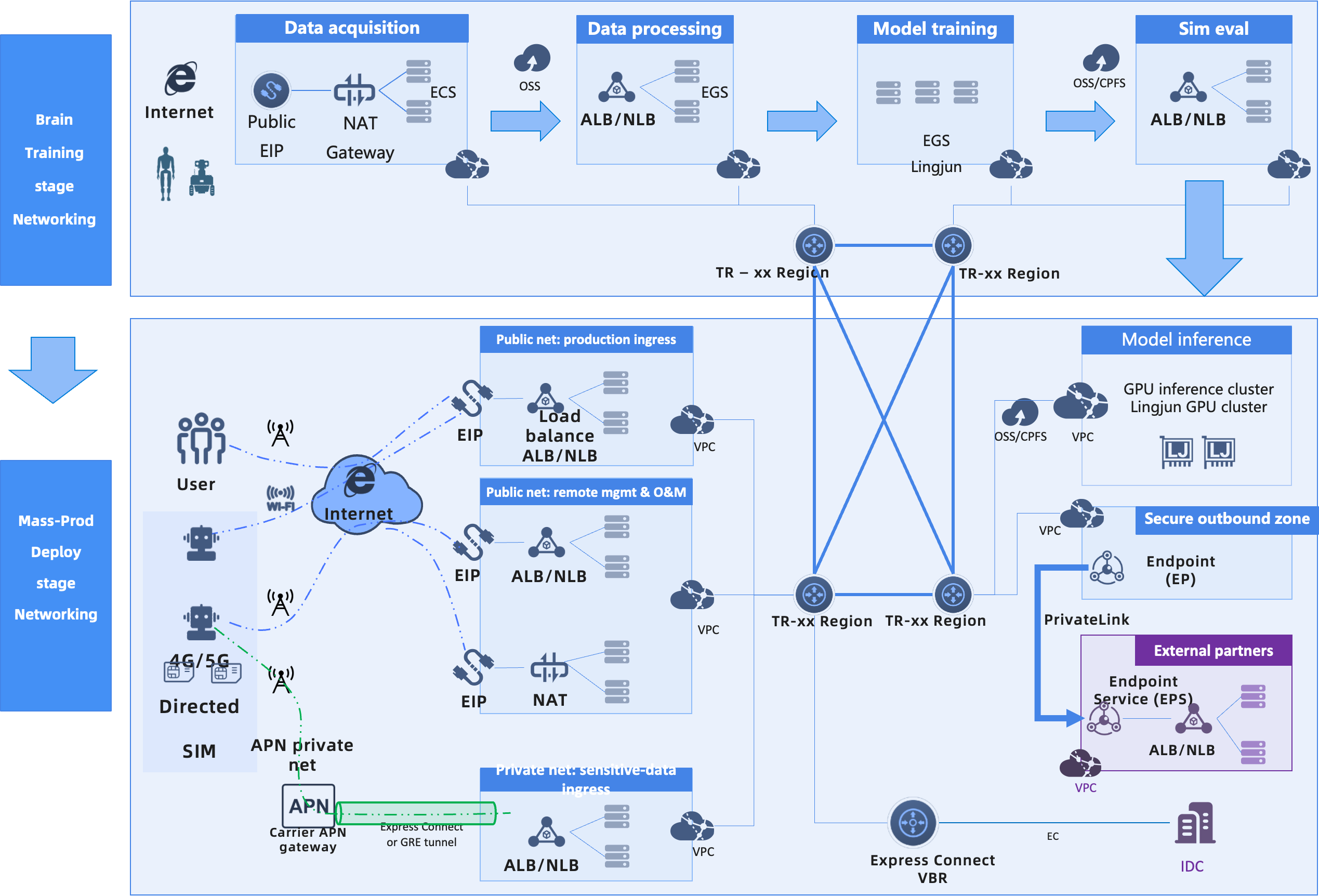 Solution architecture description:
Training phase networking: Application clusters, IDCs, and on-cloud training and inference GPU resources are all connected through CEN and TR to form a large private network, with traffic management and scheduling as needed. EGS/Lingjun GPU clusters and ECS/ACK CPU clusters are interconnected across domains through TR.
Mass production deployment networking: The production interaction endpoint (registration, logon, inference requests) is built using ALB/NLB and EIP. Ecosystem tool calls are completed through PrivateLink over a private network. Remote O&M is managed through NAT and SNAT rules. Sensitive data is uploaded to the cloud through an APN private network.
Core advantages of the solution: Covers the entire process of data collection, simulation, training, and inference. Provides a unified global private network. Offers extreme elasticity and massive scale. Creates a unified AI network.
3.2 Data collection network solution
3.2.1 Scenario requirements and challenges
Data collection for embodied AI has a pyramid structure. The bottom layer consists of open-source Internet datasets such as Ego4D and LAION-5B. The middle layer consists of high-quality human videos and synthetic simulation data. The top layer consists of data collected from real machines and data transferred back from mass-produced devices. The core challenges are as follows: data sources are scattered globally and are of various types, large-scale collection faces the risk of IP blocking, real-machine data needs to be securely uploaded to the cloud from indoor Wi-Fi or outdoor 4G/5G environments, and the mass production stage needs to support the continuous transfer of data from many devices.
3.2.2 Solution architecture
Internet data collection offers four solution models: a NAT rotation solution (NAT Gateway + EIP address pool for random public IP allocation), a self-built proxy solution (customer-built proxy servers to maintain IP mappings), a private network proxy IP call solution (third-party IP proxy provider + PrivateLink for private network transfer), and a private network data delivery solution (data provider delivers data directly to the customer's OSS via PrivateLink).

Real-machine data upload to the cloud offers four access solutions: IPsec VPN tunnel to the cloud (suitable for the pre-research stage, with fast deployment and pay-as-you-go billing), physical leased line to the cloud (suitable for fixed locations in the testing and mass production stages, with high bandwidth and stability), IoT GRE tunnel to the cloud (suitable for outdoor scenarios in the mass production stage), and CCIoT gateway to the cloud (direct transfer using IoT dedicated cards, with simple configuration and low latency).
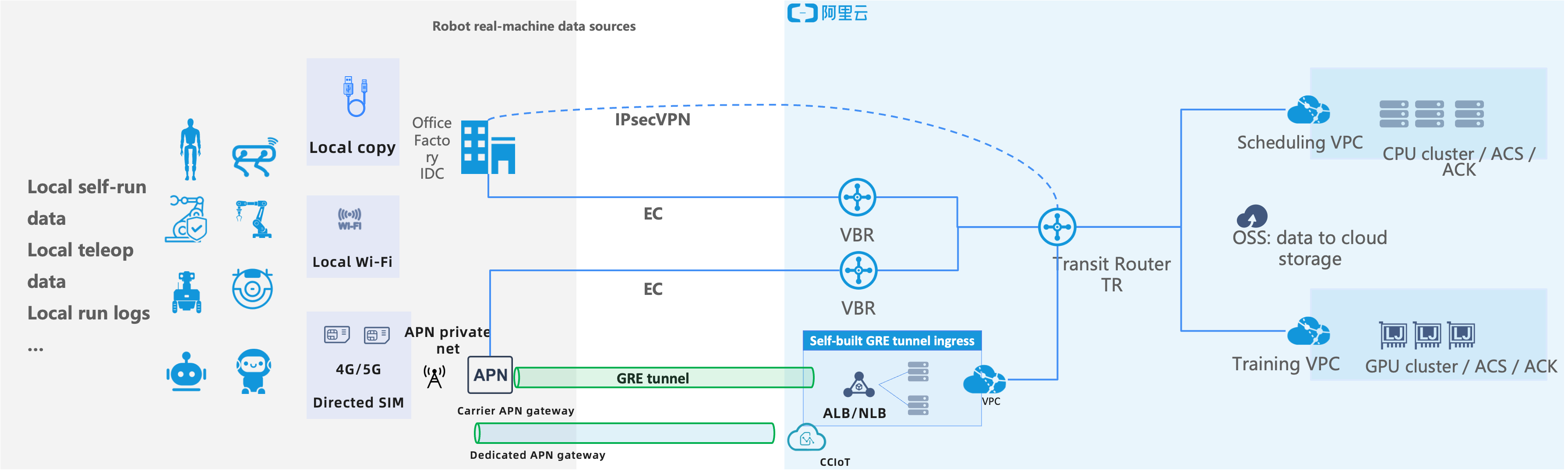
3.2.3 Solution design points
IP management for multi-source data collection: For Internet data collection scenarios, we recommend using a combination of an EIP address pool and NAT Gateway. Use SNAT rules to achieve random rotation of outbound IPs to avoid single IP blocking. For high-frequency collection scenarios, we recommend accessing a third-party proxy IP service provider through PrivateLink to obtain a dynamic IP pool.
Secure transmission of real-machine data: In the pre-research stage, when the data volume is small, we recommend IPsec VPN (short deployment cycle, pay-as-you-go). For fixed locations in the mass production stage, we recommend physical leased lines (high bandwidth, high stability). For outdoor mobile scenarios, we recommend 4G/5G dedicated cards with GRE tunnels or the CCIoT solution.
Integration with Tongyi large models for data processing: After the collected data is stored in OSS, it can be integrated with Tongyi large models for data cleaning, structuring, labeling, and filtering. Text data is processed using the Qwen-Max/Plus/Flash series for key knowledge extraction and risk control identification. Visual data is processed using Qwen3-VL-Plus/Flash for keyframe labeling of videos and information extraction from long videos.
3.2.4 Implementation path
Phase 1 (Preparation, 1–2 weeks): Assess the types of data sources and the scale of collection. Plan the VPC network architecture and IP resource pool. Confirm the real-machine deployment environment and the method for cloud upload.
Phase 2 (Implementation, 2–4 weeks): Deploy the data collection program and network links. Configure network resources such as NAT, EIP, and PrivateLink. Establish a data transfer pipeline and an OSS storage policy.
Phase 3 (Optimization, ongoing): Monitor collection efficiency and network quality metrics. Dynamically scale out network resources based on business growth. Optimize the data processing flow and costs.
3.2.5 Customer value
Full-source coverage: Four Internet collection solutions and four real-machine cloud upload solutions adapt to the needs of all stages from pre-research to mass production.
Secure and low-cost: PrivateLink private network transfer is more efficient and cost-effective than public network transmission.
Elastic and scalable: The EIP address pool and shared bandwidth support on-demand scaling to smoothly handle data volume growth.
3.3 Unified AI computing power network solution
3.3.1 Scenario requirements and challenges
Model training and simulation evaluation for embodied AI require large-scale heterogeneous computing resources. GPU intelligent computing power is distributed in different on-cloud regions and off-cloud IDCs. CPU general-purpose computing power is used for data pre-processing and scheduling orchestration. Training data is stored on different media in various locations. The core challenges are as follows: cross-region computing resources cannot be uniformly scheduled, integrating heterogeneous card resources (different GPU models) is difficult, and the efficiency of large-scale data flow across domains is low.
3.3.2 Solution architecture
Integrate key services such as Cloud Enterprise Network (CEN), TR, Express Connect, PrivateLink, and ALB/NLB to build a global network for AI computing power and data. In the cloud, TR connects Virtual Private Clouds (VPCs) across multiple Regions, such as Beijing, Ulanqab, Silicon Valley, and Singapore. On-premises IDCs connect to CEN via leased lines and VBRs. PaaS services such as PAI and Tongyi/Model Studio are securely called via PrivateLink.
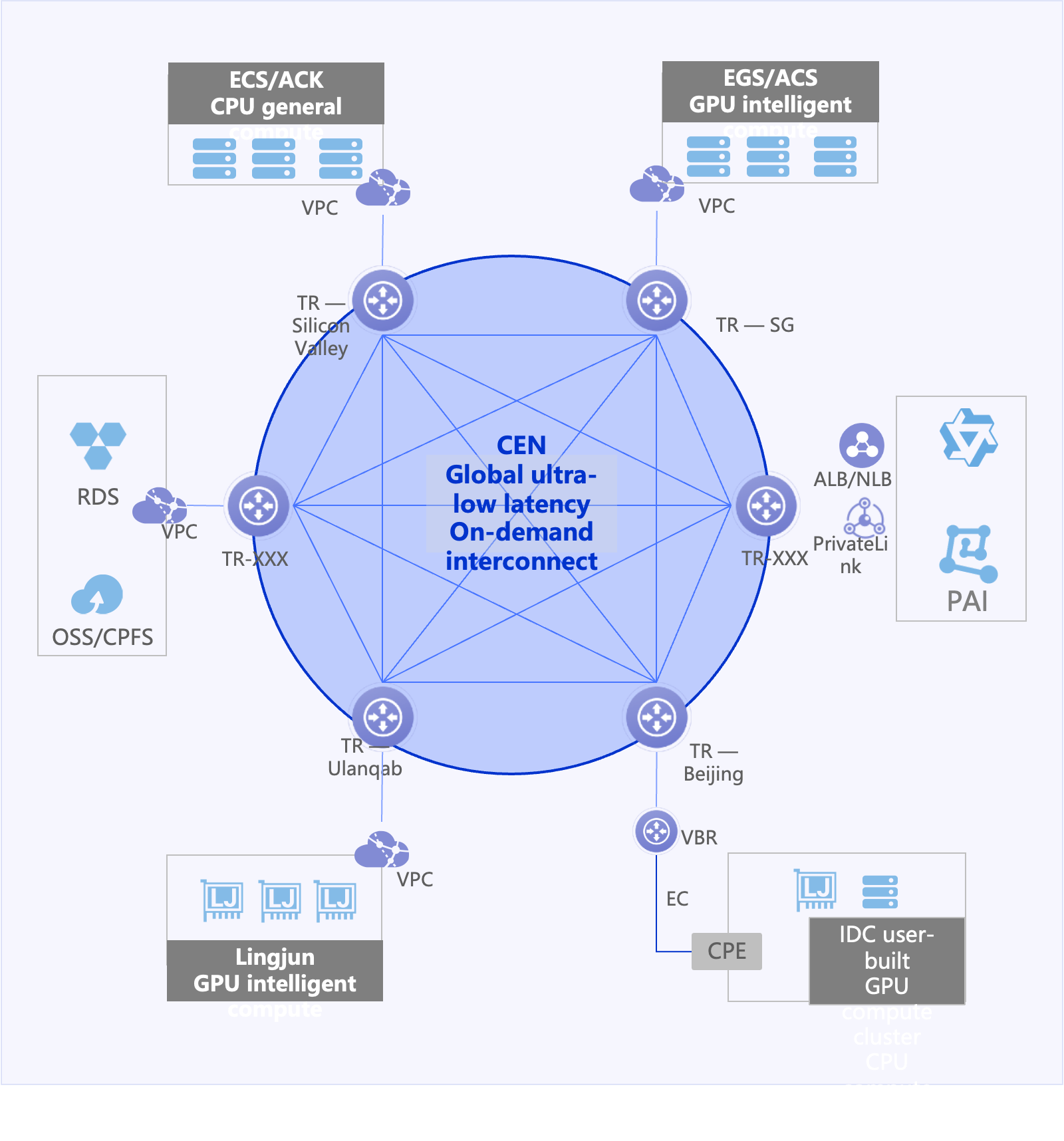
3.3.3 Solution design points
Global computing power integration: Achieve "east-to-west data transfer for computing" and "south-to-north data transfer for computing" through CEN cross-region connections. Quickly connect heterogeneous CPU and GPU computing resources, on-cloud resources in different regions, and on-premises computing power in different IDCs.
High-bandwidth data transport: CEN provides high-bandwidth transport capabilities, supporting the orderly mixed operation of multiple services such as training, inference, production, and testing. Use QoS policies to prevent business contention.
Secure service invocation: PaaS, SaaS, and other service-based computing power are securely invoked through PrivateLink to prevent external intrusion and data leakage.
3.3.4 Implementation path
Phase 1 (Preparation, 2–4 weeks): Take stock of computing resources and network status in each region. Plan the global network topology and IP address segments for CEN and TR.
Phase 2 (Implementation, 4–8 weeks): Deploy CEN and TR. Establish cross-domain VPC interconnection and leased line access. Configure QoS policies and routing management.
Phase 3 (Optimization, ongoing): Monitor cross-domain bandwidth utilization and mixed business operation. Scale out cross-domain bandwidth as needed. Optimize routing policies.
3.3.5 Customer value
Massive transport capacity: High-bandwidth transport capability enables efficient data transmission and supports east-to-west data transfer for computing.
Flexible scheduling: Multiple services run in an orderly mixed manner, with training, inference, production, and testing not interfering with each other.
Secure invocation: Secure network channels prevent external intrusion and data leakage, and PaaS/SaaS service-based computing power is securely invoked.
3.4 Global collaborative office network solution
3.4.1 Scenario requirements and challenges
Most embodied AI startup teams have an international background, with offices in multiple locations worldwide (such as the US West, Singapore, and Shenzhen), and require efficient cross-border collaborative work. At the same time, domestic offices need to access overseas tool platforms (such as GitHub and WandB), and on-cloud GPU/CPU development environments also need to download overseas models and datasets. The core challenges are high latency for cross-border communication between multiple sites, unstable access to overseas tool platforms from within China, and high maintenance costs for multiple network links.
3.4.2 Solution architecture
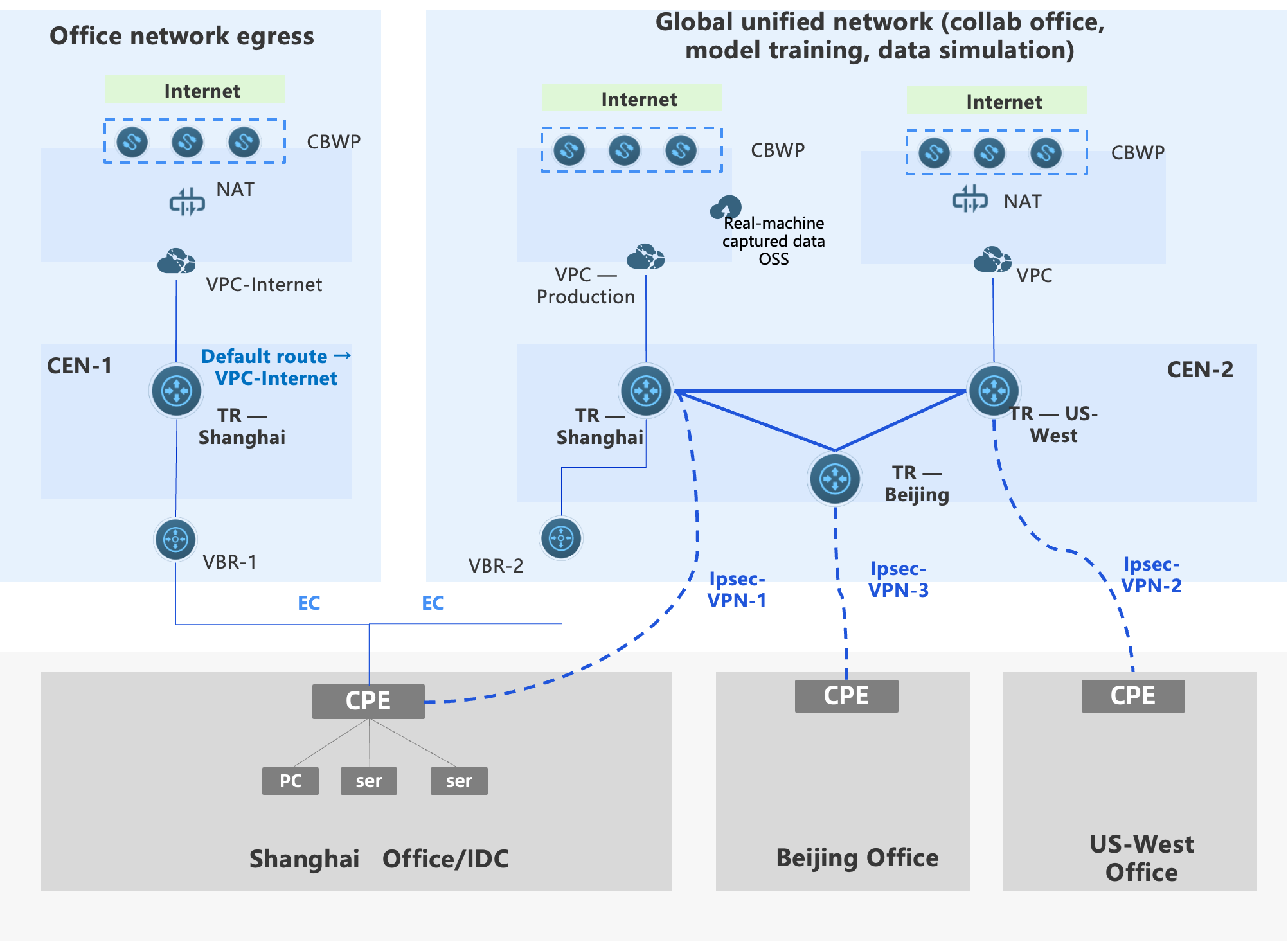
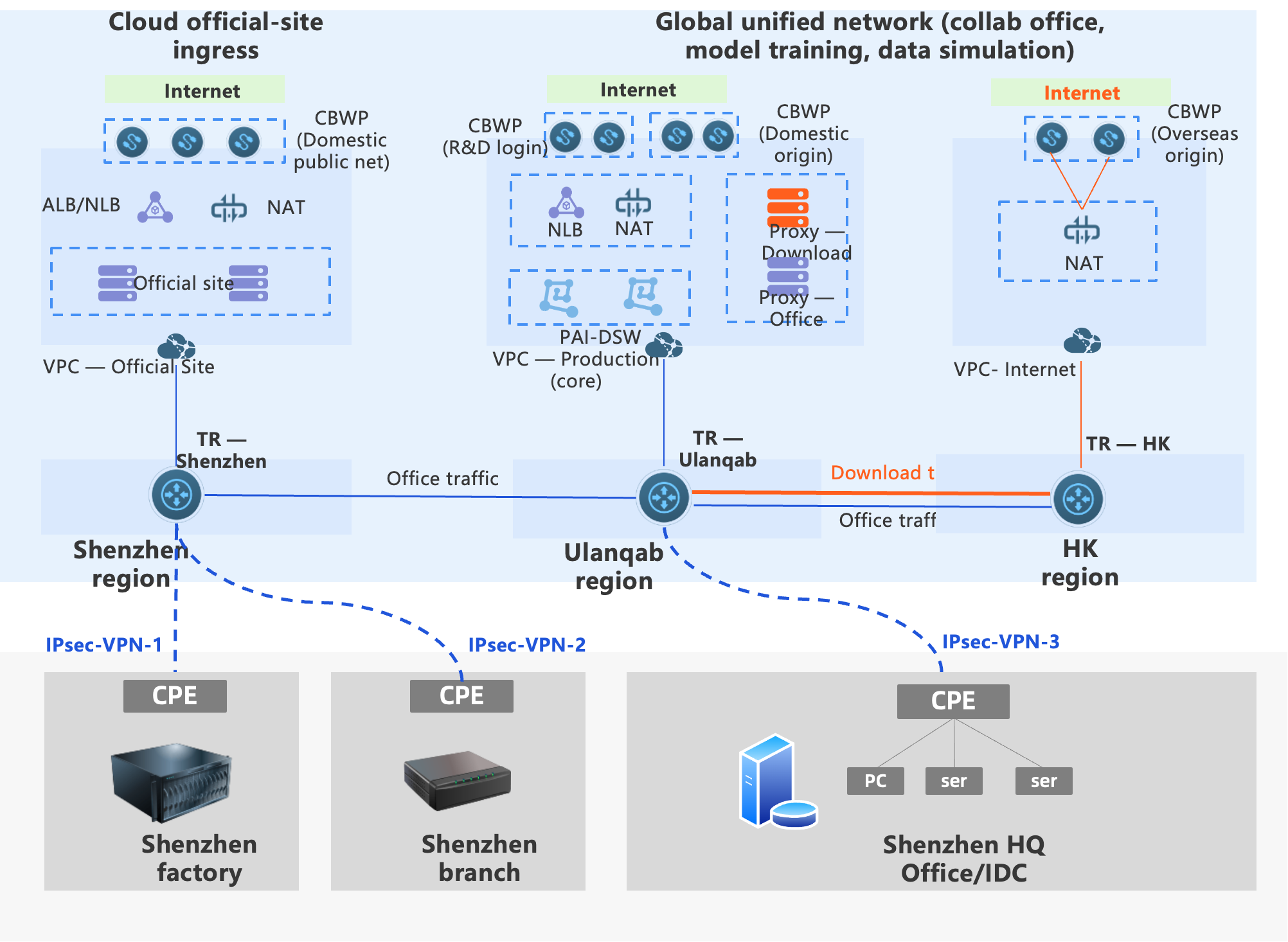
Leverage Alibaba Cloud's global underlying network to build a unified global private network using CEN. Offices, IDCs, and heterogeneous cloud resources around the world access Alibaba Cloud through leased lines and IPsec VPNs from the nearest location. The office network egress uses a hybrid cloud data center solution, allowing offices to use the high-quality Internet egress on the cloud. The on-cloud development environment uses NAT Gateway for cross-region mounting and TR for fine-grained routing control to achieve stable access to overseas tool platforms from the domestic environment.
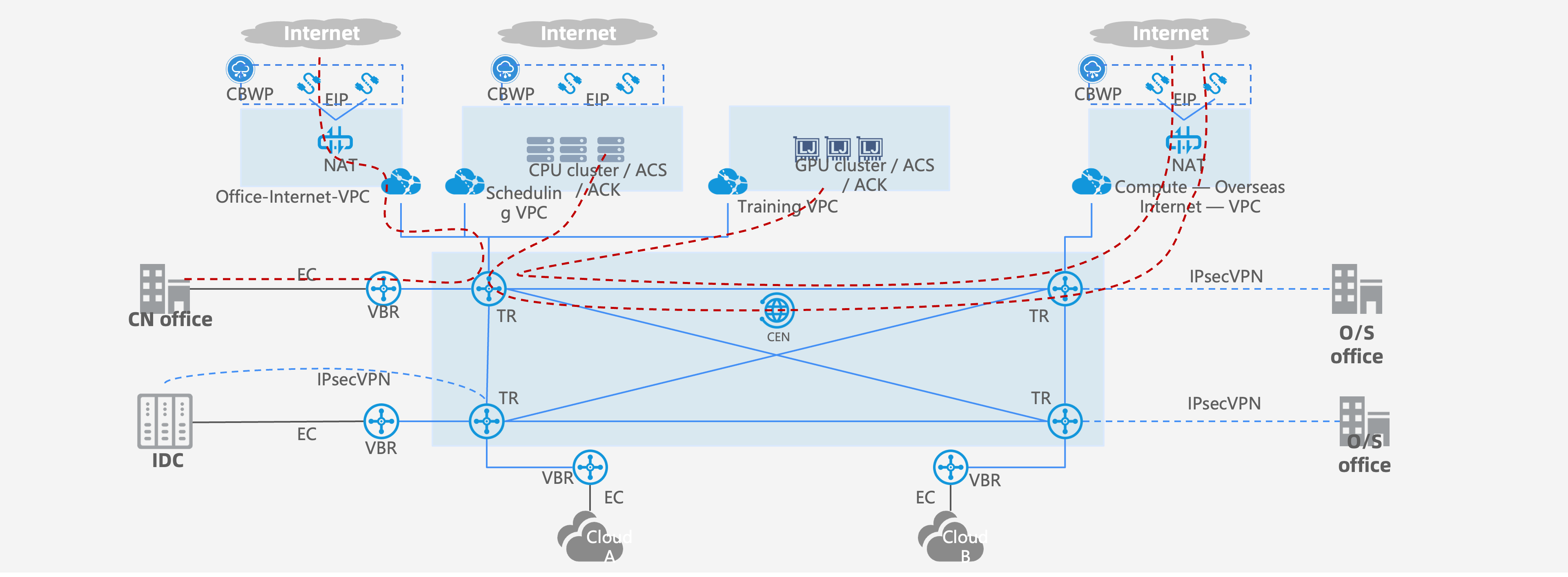
3.4.3 Solution design points
Office network egress optimization: Offices access Alibaba Cloud CEN through leased lines or IPsec VPNs and use NAT Gateway with a bound local IP as the overseas egress. Reuse the existing global AI computing power network to route traffic through the Alibaba Cloud private network. Overseas nodes can self-build a proxy and use NAT Gateway for public network egress.
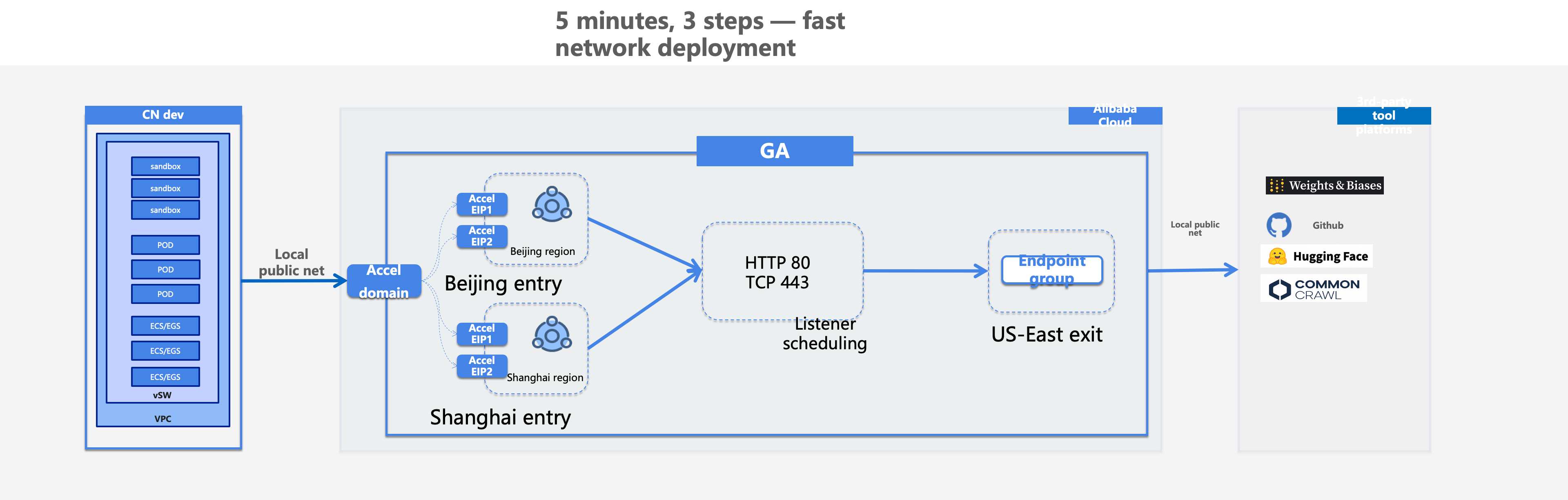
Cross-border tool access acceleration: Three solution models are available: CEN + NAT forward proxy, GA + PrivateZone reverse proxy (recommended), and CEN + self-built proxy.
Solution | Deployment complexity | End-to-end delay | Domain name limit | Compliance | Monthly cost range | Recommended scenario |
GA + PrivateZone (Recommended) | Low (3 steps, 5 minutes) | Low (backbone network acceleration) | Unlimited | Compliant China Unicom line | CNY 5,000–20,000 | Preferred solution, suitable for most scenarios |
CEN + NAT forward proxy | Medium | Low | Unlimited | Compliant China Unicom line | CNY 3,000–15,000 | Reuse an existing CEN backbone network |
CEN + Self-built proxy | High (requires self-built O&M) | Medium | Dependent on proxy capacity | Egress node | CNY 2,000–10,000 + O&M costs | For special customization needs |
The GA solution uses a Global Accelerator instance to direct domestic traffic to the nearest access point and accelerate its transmission to an overseas egress point. It works with PrivateZone or by modifying the hosts file to achieve domain name resolution redirection. The three specific steps are: Step 1 - Create a GA instance and configure the accelerated bandwidth. Step 2 - Create a listener (TCP/443) and an endpoint group (pointing to the overseas target service IP). Step 3 - Configure the target domain name in PrivateZone to resolve to the GA access address, or add a mapping in the client's hosts file.
3.4.4 Implementation path
Phase 1 (Preparation, 1–2 weeks): Review the global office distribution and access needs. Confirm the list of overseas tool domains that need acceleration.
Phase 2 (Implementation, 2–4 weeks): Deploy the unified global CEN network and access for each site. Configure GA or NAT cross-border acceleration links. Configure PrivateZone or hosts resolution.
Phase 3 (Optimization, ongoing): Monitor cross-border access latency and stability. Add accelerated domains and optimize routing as needed.
3.4.5 Customer value
Unified global networking: A single CEN private network covers global offices, IDCs, and on-cloud resources for unified management.
Rapid deployment: The GA solution can complete cross-border acceleration configuration in 5 minutes and is ready to use immediately.
Secure and compliant: Uses compliant China Unicom lines. CEN cross-region QoS ensures isolation between download and office traffic.
3.5 Inference acceleration network solution
3.5.1 Scenario requirements and challenges
The core scenarios in the mass production stage include the following: real-machine inference fetching from the brain (interactive inference, where user experience depends on end-to-end latency), remote teleoperation (teleoperation data collection, emergency fault handling, remote assistance), and remote OTA updates. The core challenges are that embodied devices are deployed in various environments worldwide (such as warehouses, logistics, homes, and outdoors), with significant differences in network conditions. Interactive inference is extremely sensitive to end-to-end latency, and teleoperation requires deterministic low latency and high reliability.
3.5.2 Solution architecture
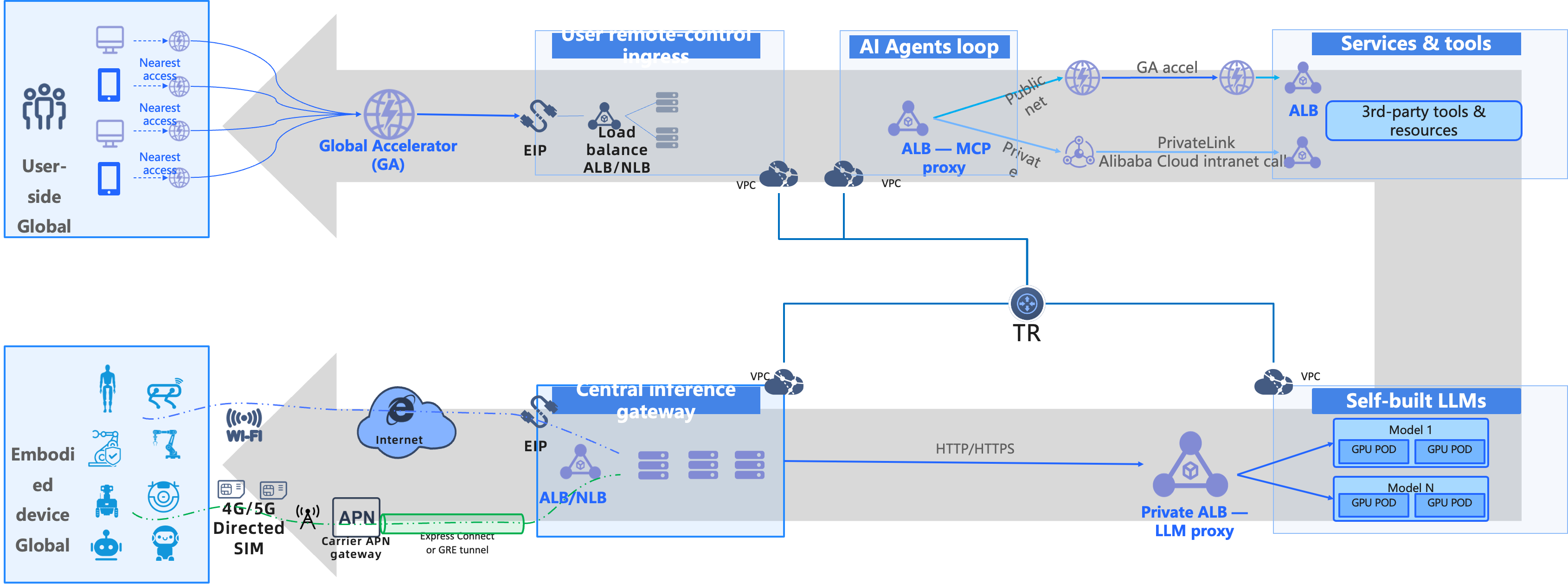
Build an end-to-end low-latency network from the user end and the embodied device to the cloud for inference. The user end uses GA for nearby access to the control platform. The embodied device accesses the cloud through GRE tunnels, CCIoT dedicated cards, or leased lines. On the cloud, ALB/NLB is used to build the inference gateway entry. Self-built LLMs and GPU inference clusters achieve region-level, zone-level, and gateway-level affinity deployment through TR. Agent business calls to third-party tools are proxied through the ALB intelligent version's MCP service. Link acceleration uses GA to accelerate non-Alibaba Cloud services and PrivateLink to accelerate services on Alibaba Cloud.
3.5.3 Solution design points
Extreme end-to-end latency: Deploy GA on the user end for nearby access to the control platform. Build dedicated GRE tunnels and use CCIoT on the embodied device for fast access. Reduce detours for cloud resources through region-level affinity, zone-level affinity, and gateway-level affinity.
Low-latency solution for remote teleoperation: Embed an SDK on the device side so that the embodied device, regardless of its network environment, chooses the optimal path for nearby access to the on-cloud gateway. The device side has the ability to perceive weak network environments and switch automatically. The cloud side monitors the operational status of the device side in real time.
Cloud inference efficiency improvement: High-performance VPC networks and high instance bandwidth ensure the network performance of the GPU inference cluster. ALB/NLB achieve intelligent load balancing and routing of inference requests.
3.5.4 Implementation path
Phase 1 (Preparation, 2–4 weeks): Assess the deployment environment and network conditions of the embodied devices. Plan the region and zone deployment strategy for the inference cluster. Determine the access method.
Phase 2 (Implementation, 4–6 weeks): Deploy GA acceleration and the cloud gateway entry. Establish the embodied device access link (GRE, CCIoT, or leased line). Deploy the ALB/NLB inference gateway and GPU cluster.
Phase 3 (Optimization, ongoing): Monitor end-to-end latency metrics. Optimize the affinity deployment strategy. Scale out network and inference resources based on device growth.
3.5.5 Customer value
Extreme latency: End-to-end low-latency optimization across the entire link ensures a good user experience for interactive inference.
Weak network adaptation: The device-side SDK automatically perceives the network environment and selects the optimal access path.
Elastic scaling: ALB/NLB and the GPU cluster support on-demand elastic scaling to cope with the growth in device scale during the mass production stage.
3.6 Industry benchmark cases
Case 1: A rising star in humanoid robotics
This company uses 3D generative AI, simulation, and machine learning to drive AI-powered robot development. It has deployed network solutions for multiple sub-scenarios: a unified cross-border office network (connecting global multi-region collaboration through leased lines, CEN, TR, and IPsec), cross-border tool access acceleration (TR + NAT solution for domestic training clusters to access overseas SaaS platforms), office network egress (hybrid cloud DC solution), real-machine data upload to the cloud (leased line + TR to open up the data transfer link), and a unified AI computing power network (CEN + TR to enable collaboration between multi-region GPU/CPU computing power). After implementation, the data synchronization latency from China to Silicon Valley was reduced from 210 ms to 85 ms (a 60% reduction). Cross-domain model training efficiency increased by about 40%. The network O&M team was reduced from 5 people to 2.
Case 2: A general-purpose embodied AI large model company
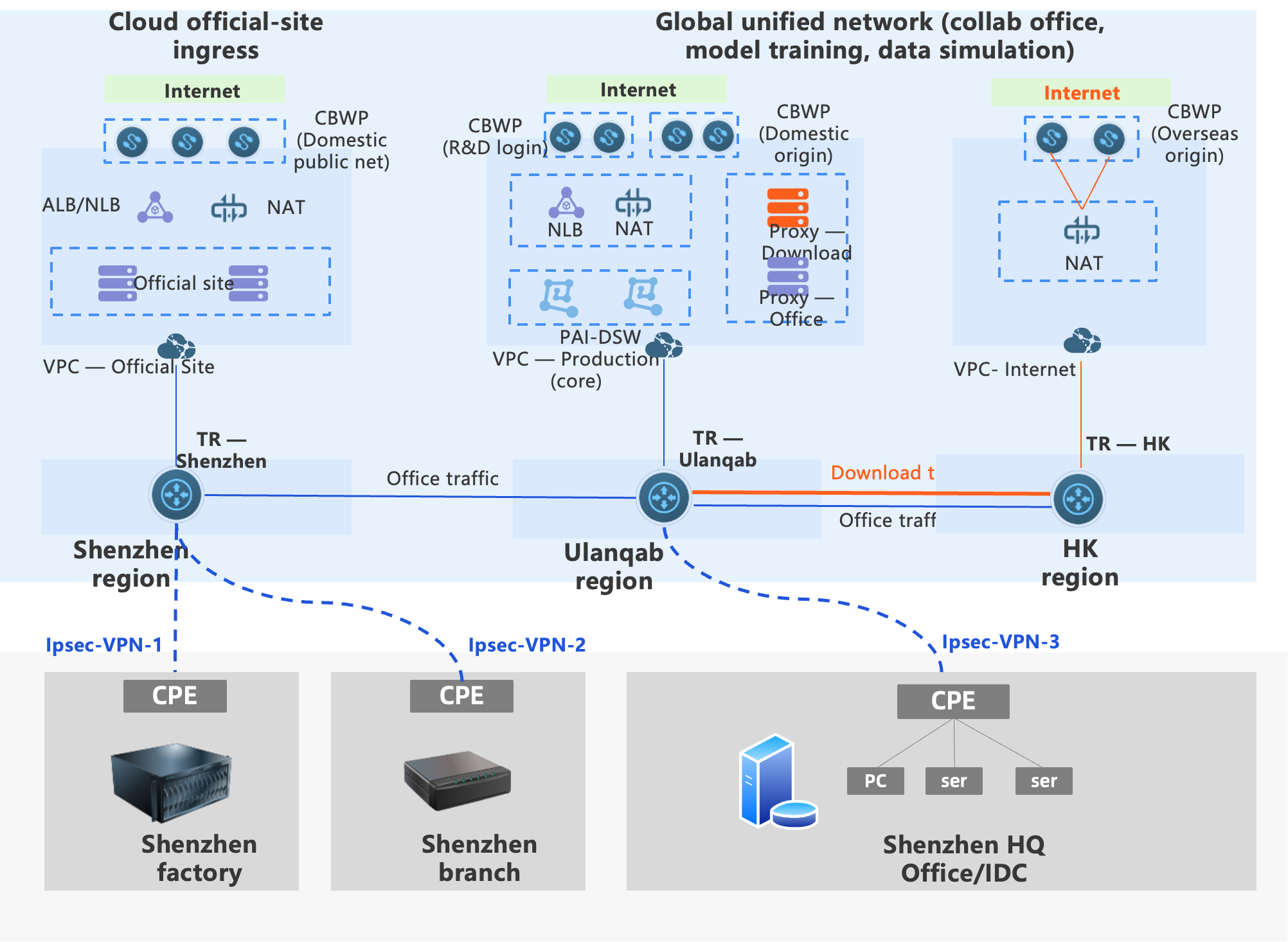
This company focuses on self-developed general-purpose embodied AI large models to build general-purpose robots with fine manipulation capabilities. Implemented solutions include the following: hybrid cloud office networking (TR + IPsec VPN to connect headquarters, factories, and branches with the cloud environment), AI computing power scheduling networking (CEN to connect business applications and GPU computing power across regions), cross-border acceleration networking (CEN compliant lines + NAT with multiple EIPs + QoS isolation), and public network application deployment (NLB + NAT to distinguish public network requests for different scenarios). After implementation, the success rate of cross-border tool access increased from 72% to 99.5%. The cross-domain transmission bandwidth for training data increased by 3 times. The annual network infrastructure cost was reduced by about 25% (by replacing multiple independent leased lines with a unified CEN backbone network).
Case 3: A leading domestic embodied AI company
This company is one of the main players in embodied AI in China and has achieved large-scale mass production. Deployed solutions include the following: a unified AI computing power pool network (CEN connecting local IDCs and Ulanqab GPU computing power across domains), data collection and upload to the cloud from headquarters (leased line + QoS to schedule offline and online data), office network interconnection (third-party SD-WAN + on-cloud networking), and cross-border tool access acceleration (TR + NAT solution to access platforms like Hugging Face). The results: daily data transfer volume increased from 500 GB to 5 TB (a 10-fold increase). The model training cycle was shortened by 35% after cross-domain GPU computing power collaboration. The availability of the data collection and cloud upload link increased from 97% to 99.9%.
4 Product and service matrix
4.1 Core product capabilities and key specifications
Product category | Core product | Key capability | Key specification | Scenario |
Global interconnection | CEN + TR | Cross-region VPC peering, fine-grained routing control, QoS traffic scheduling | Single TR supports attaching 200+ VPCs, max 100 Gbps cross-region bandwidth plan, 10,000 routes | Unified AI computing power network, collaborative office |
Public network access | EIP + NAT Gateway + Internet Shared Bandwidth | Elastic public network ingress/egress, SNAT/DNAT, bandwidth sharing | Max 1 million concurrent connections per NAT instance, max 200 EIPs per region, max 2 Gbps shared bandwidth | Data collection, remote management |
Application delivery | ALB + NLB | Layer 7/Layer 4 load balancing, smart routing, MCP proxy | ALB supports millions of QPS (Layer 7), NLB supports max 10 million concurrent connections per instance (Layer 4), can reach hundreds of millions with multiple instances | Inference entry, business cluster |
Global acceleration | GA | Nearby access, cross-border acceleration, distributed acceleration network | 60+ access points worldwide, reduces cross-border latency by 30%–50% | Cross-border tool access, teleoperation |
Private network peering | PrivateLink | Private access between VPCs, secure invocation of cloud services | Max 20,000 concurrent connections per endpoint, secure access across accounts and VPCs | Ecosystem tool invocation, model download |
Hybrid cloud access | Express Connect (VBR) + IPsec VPN | Physical leased line/encrypted tunnel access | Max 100 Gbps for leased lines, IPsec VPN supports dual-tunnel hot standby, AES-256 encryption algorithm | IDC to cloud, office networking |
IoT access | CCIoT + APN private network | Dedicated cards, GRE tunnels, private network to cloud | Single CCIoT instance supports 100,000 cards, 4G/5G dedicated cards use carrier private networks, bypassing the public network | Real-machine data transfer, sensitive data |
4.2 SLA guarantee matrix
The following table compares the availability requirements of the business scenarios in Section 1.4 with the official SLA commitments of Alibaba Cloud products:
Business scenario | Availability requirement | Corresponding product combination | Achievement strategy |
Industrial robot control | 99.9999% | Dual redundant leased lines | Dual leased lines + local edge degradation |
Humanoid robot interaction | 99.99% | NLB + multi-AZ deployment | Redundant deployment across multiple Availability Zones (AZs), NLB cross-AZ disaster recovery |
Autonomous driving vehicle-cloud collaboration | 99.95% | GA + CEN | GA multi-node hot standby + CEN cross-domain redundant paths |
Simulation training gradient synchronization | 99.9% | eRDMA + HPN | In-cluster network self-healing + checkpoint fault tolerance |
Sensor data transfer | 99% | CCIoT / IPsec VPN | Local data caching + resumable upload |
4.3 Product selection suggestions
Scenario | Recommended product combination | Description |
Data upload to the cloud in the pre-research phase | IPsec VPN + OSS | Fast deployment, pay-as-you-go, suitable for periodic upload of small data volumes |
Fixed locations in the mass production phase | Leased line + VBR + TR + OSS | High bandwidth, high stability, suitable for factories, hospitals, etc. |
Mobile scenarios in the mass production phase | CCIoT / GRE + APN private network | Suitable for outdoor scenarios such as express delivery, logistics, and agriculture |
Global computing power interconnection | CEN + TR + Leased line | Cross-domain computing power pooling, efficient data flow |
Cross-border tool access | GA + PrivateZone | Fast deployment in 5 minutes, ready to use immediately |
Inference interaction endpoint | ALB/NLB + EIP + GA | End-to-end low latency, elastic scaling |
5 Best practices summary
5.1 Architecture design best practices
Plan the network architecture in phases: In the pre-research phase, prioritize flexibility and low cost (IPsec VPN, pay-as-you-go). In the testing phase, transition to prioritizing stability (leased line + TR). In the mass production phase, fully consider elasticity, security, and scale (global CEN networking + APN private network + GA acceleration).
Isolate training and production networks: Use multiple CEN instances and TR routing policies to logically isolate the training and production networks, preventing training traffic from impacting production services. Use Quality of Service (QoS) policies to assign bandwidth priorities to different services.
Use private networks for sensitive data transmission: For data involving user privacy or special scenarios, avoid using the public network. Use an APN private network to connect to Alibaba Cloud via a leased line or GRE tunnel for processing and storage.
5.2 High availability and disaster recovery design
Multi-AZ redundant deployment: Deploy core business components (ALB/NLB, inference clusters, databases) across at least two AZs. NLB supports automatic cross-AZ failover with a switchover time of less than 30 seconds. The inference cluster uses ALB health checks to automatically remove faulty nodes, with a recovery time objective (RTO) of less than 1 minute.
Cross-region disaster recovery: Use CEN to build an active-standby region interconnection. Synchronize core data to the disaster recovery region in real time. When an unrecoverable failure occurs in the primary region, use DNS to switch traffic to the disaster recovery region. The recovery point objective (RPO) is less than 5 minutes, and the RTO is less than 30 minutes.
Link redundancy design: For leased line access, we recommend using dual redundant links (active-standby or load balancing). When one leased line fails, the switchover is completed within 50 ms. GA instances support multi-access-point hot standby. When one access point becomes unavailable, it automatically switches to the next best path. CEN cross-domain links support equal-cost multi-path (ECMP) load balancing. A single link failure does not affect overall connectivity.
Failover matrix:
Failure type | Impact scope | Switchover mechanism | Switchover time | Recovery policy |
Single AZ failure | Some inference nodes are unavailable | ALB/NLB automatic cross-AZ switchover | < 30s | Automatic recovery |
TR instance failure | Cross-domain routing is interrupted | TR active-active redundancy, automatic route convergence | < 1 min | Automatic recovery |
Leased line interruption | Link from IDC to cloud is disconnected | Dual leased line active-standby switchover, or downgrade to IPsec VPN | < 50 ms (dual link) / < 5 min (VPN downgrade) | Manually recover the leased line |
GA access point failure | Acceleration fails in some areas | GA multi-node hot standby, automatic switchover | < 1 min | Automatic recovery |
Single region failure | All services in the primary region are unavailable | DNS switchover to the disaster recovery region | < 30 min | Failback after the failed region recovers |
5.3 Security architecture design
The security requirements for embodied AI scenarios cover multiple dimensions, including the network layer, transport layer, application layer, and data layer.
Network-layer protection: Use Cloud Firewall to achieve network-wide traffic visualization and intrusion prevention/detection (IPS/IDS). Configure security groups and network access control lists (ACLs) to implement least privilege network access control. For public-facing inference endpoints in the mass production stage (ALB/NLB + EIP), deploy Anti-DDoS Pro instances (supporting terabit-level scrubbing capabilities) to defend against large-scale DDoS attacks.
Transport-layer encryption: Use MACsec for link-layer encryption on leased lines. IPsec VPN supports AES-256 encryption and IKEv2 key exchange. Enforce TLS 1.3 / Mutual TLS (mTLS) for all communication from the device to the cloud to ensure end-to-end data transmission encryption.
Application-layer security: Enable Web Application Firewall (WAF) protection on the ALB at the inference endpoint to block common attacks such as SQL injection and XSS. Use API Gateway for identity authentication and rate limiting of inference requests. Agent calls to external tools should go through PrivateLink over a private network to avoid public network exposure.
Data-layer security: Environmental data and user behavioral data collected by embodied devices are sensitive information. Use APN private network encrypted channels for transmission. Use server-side encryption (SSE-KMS) in Object Storage Service (OSS) for storage. Audit all network configuration changes and data access operations through ActionTrail to meet MLPS Level 3 and cross-border data transmission compliance requirements.
Zero-trust access (evolutionary direction): For identity management of massive numbers of embodied devices in the mass production stage, we recommend gradually introducing a zero-trust network architecture. Each device is authenticated through a digital certificate. All access requests are dynamically authorized based on the principle of "never trust, always verify," with access control decisions made based on multiple dimensions of information, including device status, network environment, and behavioral baselines.
5.4 Observability system
End-to-end monitoring metrics: Build an end-to-end observability system with Network Intelligence Service (NIS) and Cloud Monitor to monitor the following key metrics:
Monitoring dimension | Key metric | Recommended alert threshold | Corresponding scenario |
Cross-domain latency | CEN cross-domain RTT (P50/P99, meaning 50%/99% of requests are within this latency) | Alert if P99 > 50 ms | Computing power interconnection, collaborative office |
Bandwidth utilization | CEN cross-domain bandwidth utilization | Warning at > 80%, critical at > 90% | Training data transmission |
Inference link latency | End-to-end inference latency (P50/P99/P999) | Alert if P99 > 30 ms | Inference acceleration |
Load balancer health | Percentage of healthy backend instances for ALB/NLB | Alert if < 80% | Inference cluster |
Leased line availability | VBR link status, Border Gateway Protocol (BGP) neighbor status | Alert immediately if link is DOWN | IDC to cloud |
GA acceleration effect | GA instance latency, packet loss rate | Alert if packet loss rate > 0.1% | Cross-border acceleration |
NAT connections | NAT Gateway concurrent connections, port utilization | Warning if port utilization > 70% | Data collection |
Alert leveling and escalation strategy: Alerts are divided into four levels: fatal (response within 5 minutes), critical (response within 15 minutes), warning (response within 1 hour), and notice (handled the next business day). Fatal and critical alerts automatically notify on-call personnel and trigger predefined emergency response scripts, such as automatic scaling or switching to a backup link.
SLA dashboard: We recommend creating a separate SLA dashboard for each business scenario to display core metrics such as latency (P50/P99/P999), availability percentage, throughput, and error rate in real time, along with historical trends and period-over-period comparisons.
5.5 Implementation best practices
Use CEN to build a unified global network: Whether for computing power interconnection, collaborative office work, or data transfer, we recommend building a unified backbone network based on CEN and TR to avoid the management complexity of multiple independent networks.
Prioritize the GA solution for cross-border access: Compared to self-built proxy solutions, the GA solution is simple to configure (3 steps: create a GA instance → configure a listener and endpoint group → modify DNS resolution or hosts file to point to the GA access address), uses compliant China Unicom lines, is secure and compliant, and supports multi-domain acceleration. It usually takes less than 5 minutes from initiating the acceleration configuration to it taking effect.
Flexibly choose access methods for data collection: Choose the most suitable cloud upload method based on the robot's deployment environment and data volume characteristics. Leased lines are preferred for indoor fixed locations, while CCIoT or GRE tunnels are preferred for outdoor mobile scenarios.
5.6 Automated O&M practices
Infrastructure as Code (IaC): Use Terraform or Resource Orchestration Service (ROS) to manage network infrastructure. Recommended IaC practices include the following: defining the global network topology of CEN, TR, and VPC as a code template and managing versions with Git. When adding a new region or VPC, use the template for one-click deployment to avoid manual configuration errors. A typical Terraform module structure includes four layers: a VPC module, a CEN interconnection module, a security group module, and a load balancing module.
Canary release for network changes: Use the routing policy feature of CEN to first verify the effect of a routing change in a testing environment. After confirming it is correct, gradually roll it out to the production environment. Critical configuration changes, such as modifying a TR route table or adjusting a QoS policy, must go through a change review process and be audited with ActionTrail.
Elastic bandwidth management: Use shared bandwidth and the pay-as-you-go billing method to dynamically adjust the bandwidth of each link. We recommend setting up an automatic scaling policy. When the bandwidth utilization exceeds 80% for 5 consecutive minutes, trigger automatic scaling. After the peak, automatically scale in to control costs.
Automated inspection: We recommend configuring scheduled inspection scripts to regularly check key O&M items such as CEN route table consistency, leased line BGP neighbor status, security group rule compliance, and certificate expiration dates. Abnormal items should automatically generate a ticket to notify the O&M team.
6 Investment analysis and strategic recommendations
6.1 TCO estimation for typical scenarios
The following table estimates the annualized investment level for network infrastructure for three typical enterprise sizes (excluding GPU computing power costs, including only network product costs):
Enterprise size | Number of devices | Core network solution | Monthly cost range | Annualized investment estimate | Main cost components |
Small team (pre-research phase) | < 10 instances | IPsec VPN + EIP + NAT + OSS | CNY 3,000–8,000 | CNY 40,000–100,000 | Pay-as-you-go VPN Gateway, EIP bandwidth fees |
Medium-sized enterprise (testing to early mass production) | 50–200 | CEN + TR + Leased line + GA + ALB/NLB | CNY 30,000–80,000 | CNY 400,000–1,000,000 | CEN cross-region bandwidth plan (main cost), leased line monthly rent |
Large enterprise (large-scale mass production) | 500–5,000 | CEN + TR + Multiple leased lines + GA + APN + ALB/NLB + eRDMA | CNY 150,000–500,000 | CNY 2,000,000–6,000,000 | CEN large bandwidth plan, multiple leased lines, APN private network |
Return on investment reference: According to benchmark customer practices, replacing multiple independent leased lines and VPNs with a unified CEN backbone network can reduce network costs by an average of 20% to 30%. Replacing a self-built proxy with GA acceleration can reduce annual maintenance costs by about 60%. Network automation (IaC + automated inspection) can reduce O&M labor investment by about 50%. The network investment from the pre-research phase to the mass production phase increases by about 10 to 20 times. We recommend including the network Total Cost of Ownership (TCO) in the overall AI infrastructure budget planning during the pre-research phase. Network investment typically accounts for 5% to 15% of the total AI infrastructure investment.
6.2 Network investment decision framework
CTOs can make network architecture upgrade decisions based on the following quantitative triggers:
Trigger conditions | Upgrade action | Estimated investment increment |
Number of devices > 10, or deployment across > 2 regions | Upgrade from IPsec VPN to a unified CEN + TR network | +CNY 20,000–30,000/month |
Cross-domain data transmission volume > 5 TB/month | Start using leased line access instead of VPN transmission | +CNY 10,000–30,000/month (including leased line monthly rent) |
Inference latency requirement < 50 ms | Introduce GA | +CNY 5,000–20,000/month |
Devices deployed in outdoor/mobile scenarios | Introduce CCIoT or APN private network | +CNY 3,000–10,000/month |
Training cluster > 100 GPU cards | Deploy eRDMA + HPN 7.0 high-performance network | Included in the Lingjun cluster fee |
Increased public network exposure (inference endpoint goes online) | Deploy Anti-DDoS + WAF + Cloud Firewall | +CNY 5,000–30,000/month |
6.3 Recommendations for CTOs
Plan the network architecture early: The network requirements for embodied AI change dramatically from pre-research to mass production. We recommend planning the global network architecture based on CEN and TR during the pre-research phase, reserving room for expansion to avoid large-scale restructuring during mass production. Based on benchmark cases, planning 6 to 12 months in advance can effectively reduce architecture restructuring costs by more than 30%.
Incorporate the network into the AI computing power strategy: The network is a key bottleneck that affects the performance of AI computing power. When evaluating GPU resources, you should also evaluate the network interconnection capabilities to ensure that the planning of a "unified computing power network" proceeds in sync with computing power procurement. We recommend that the annual budget for network infrastructure be no less than 8% of the total AI infrastructure budget.
Focus on data security and compliance: The data collected by embodied robots involves user privacy and environmental information. The network architecture must include dedicated data transmission channels, such as an APN private network, to meet MLPS Level 3 and cross-border data transmission compliance requirements. We recommend including security and compliance requirements in the product design phase to avoid retrofitting later.
6.4 Recommendations for architects
Plan for the entire lifecycle of data collection, simulation, training, and inference: The network architecture should cover the complete process of data collection, simulation and iteration, model training, and inference deployment to avoid network fragmentation caused by independent construction of each link.
Fully leverage the advantages of Alibaba Cloud's global network: CEN's low-latency backbone network covering the globe is an important infrastructure for embodied AI enterprises. We recommend unifying the management of global offices, IDCs, and multi-cloud resources under CEN.
Adopt a layered access strategy: Choose access methods in layers based on the deployment location and network conditions of the embodied devices: leased lines (for fixed, high-bandwidth needs), IPsec VPN (for flexible, low-cost needs), and 4G/5G + CCIoT/GRE (for mobile scenarios).
6.5 Recommendations for O&M teams
Establish a network baseline and monitoring system: Use NIS and Cloud Monitor to establish network baseline metrics. Focus on monitoring key metrics such as cross-domain latency, bandwidth utilization between GPU clusters, and end-to-end latency of the inference link.
Develop an elastic scaling plan: The scale of devices may grow rapidly during the mass production phase. Develop plans for bandwidth scaling, EIP pool scaling, and load balancer scaling in advance to ensure that the network can smoothly handle business growth.
Automate network O&M: Use Terraform or ROS to manage network resources with IaC, reducing manual configuration errors and improving change efficiency and traceability.
7 Future outlook
7.1 Technology development trends
As World Models mature, embodied AI will evolve from "understanding language" to "understanding the physical world." This will place higher demands on the network: larger-scale parallel simulation computing will require stronger cross-domain computing power interconnection capabilities. Finer real-time control will require deterministic networks and microsecond-level latency. Wider device deployment will require more intelligent edge access solutions.
7.2 Industry application prospects
The application of embodied AI will expand from the current industrial manufacturing and logistics distribution to broader scenarios such as medical care, home services, and agricultural exploration. Each new scenario means a new network environment and new access requirements. The elasticity, coverage, and intelligence of the cloud network will become the key infrastructure supporting the large-scale implementation of the industry.
7.3 Ecosystem building
Alibaba Cloud will continue to deepen its cooperation with the embodied AI industry chain. We will work with ecosystem partners such as large model companies, robot body manufacturers, and simulation platform vendors to build a cloud network solution system for the entire lifecycle of embodied AI. Through standardized network access solutions and open product capabilities, we will lower the network construction threshold for embodied AI enterprises and accelerate the industrialization process.
Appendix
A. Glossary
Term | English | Description |
Embodied AI | Embodied AI | Embedding AI into a physical entity, allowing it to perceive, decide, and act in the physical world |
Brain | Brain | The module in embodied AI responsible for high-level perception, cognition, and decision-making |
Cerebellum | Cerebellum | The module in embodied AI responsible for motion control and real-time execution |
World Model | World Model | An AI model that can understand and simulate the physical world |
Teleoperation | Teleoperation | Remotely controlling a robot to perform tasks |
Digital Twin | Digital Twin | A digital representation of a physical entity in a virtual space |
VPC | Virtual Private Cloud | An isolated, dedicated network space for users on Alibaba Cloud |
Region | Region | An independent data center cluster deployed by Alibaba Cloud globally |
AZ | Availability Zone | A physical area within a region with independent power and networking |
IDC | Internet Data Center | An Internet data center (IDC) is a server room that is self-built or hosted for an enterprise. |
CEN | Cloud Enterprise Network | Alibaba Cloud's global backbone network for cross-region VPC peering |
TR | Transit Router | Alibaba Cloud's central hub for CEN, enabling routing control and traffic scheduling |
GA | Global Accelerator | Alibaba Cloud service for nearby access and accelerated cross-domain/cross-border network transmission |
ALB | Application Load Balancer | Alibaba Cloud's Layer 7 (HTTP/HTTPS) traffic distribution service |
NLB | Network Load Balancer | Alibaba Cloud's Layer 4 (TCP/UDP) traffic distribution service |
PrivateLink | PrivateLink | Alibaba Cloud's secure private access channel between VPCs or to cloud services |
EIP | Elastic IP Address | A public IP address that can be purchased and held independently |
NAT Gateway | NAT Gateway | A network address translation gateway that provides SNAT (for outbound public access) and DNAT (for inbound public access) capabilities |
SNAT/DNAT | Source/Destination NAT | Source Network Address Translation/Destination Network Address Translation, used for private resources to access the public network and for the public network to access private resources, respectively |
CCIoT | Cloud Connector for IoT | Alibaba Cloud service that allows IoT devices to directly access the cloud via dedicated cards |
APN | Access Point Name | Used for mobile network private access, allowing traffic to bypass the public network and go directly to the cloud |
QoS | Quality of Service | Using policies to assign priorities and bandwidth to different business traffic |
RDMA | Remote Direct Memory Access | Transfers data directly between network interface controllers, bypassing the CPU, for extremely low latency |
eRDMA | Elastic RDMA | The RDMA network capability provided by Alibaba Cloud within a VPC |
RoCEv2 | RDMA over Converged Ethernet v2 | An RDMA protocol based on converged Ethernet, used for high-performance communication in GPU clusters |
HPN | High Performance Network | Alibaba Cloud's large-scale cluster network architecture for AI training |
GRE | Generic Routing Encapsulation | A tunneling protocol used to establish a virtual private network over the public network |
VBR | Virtual Border Router | The virtual routing device on the Alibaba Cloud side for a physical leased line |
OSS | Object Storage Service | Alibaba Cloud's massive data storage service |
ACK | China Kubernetes | Alibaba Cloud Container Service for Kubernetes |
EGS | Elastic GPU Service | Lingjun Intelligent Computing Service, Alibaba Cloud's elastic GPU cluster for AI training |
SDK | Software Development Kit | Software development kit |
OTA | Over-The-Air | Technology for remotely upgrading device firmware or software wirelessly |
MCP | Model Context Protocol | A standard interface for agents to call external tools |
SD-WAN | Software-Defined WAN | Centralized management and intelligent scheduling of a wide area network through software |
IaC | Infrastructure as Code | Defining and managing IT infrastructure through code |
ROS | Resource Orchestration Service | Alibaba Cloud's infrastructure automation and orchestration tool |
PaaS | Platform as a Service | Platform as a Service |
SaaS | Software as a Service | Software as a Service |
QPS | Queries Per Second | A metric for measuring system processing capacity |
TSN | Time-Sensitive Networking | A deterministic, low-latency Ethernet standard for industrial control |
WAF | Web Application Firewall | Protects against application-layer attacks such as SQL injection and XSS |
mTLS | Mutual TLS | Mutual TLS authentication, where both communicating parties verify each other's identity |
RTO | Recovery Time Objective | The maximum allowed time for a system to recover to normal after a failure |
RPO | Recovery Point Objective | The maximum acceptable amount of data loss (in time) after a system failure |
TCO | Total Cost of Ownership | The full lifecycle cost, including purchase, deployment, and O&M |
ROI | Return on Investment | Return on investment |
SLA | Service Level Agreement | A quantified commitment by a cloud service provider on service availability |
BGP | Border Gateway Protocol | Border Gateway Protocol (BGP) exchanges routing information between different networks. |
ECMP | Equal-Cost Multi-Path | Using multiple equal-cost paths simultaneously to share traffic |