Background and goals
Built on UModel from Observability 2.0, DevOps flow enrichment for microservices introduces UModel entities for development and publishing. These entities enable end-to-end data modeling from code development to container deployment and integrate deeply with existing application performance monitoring (APM) and Kubernetes (K8s) observability systems.
Core value
1. End-to-end traceability
-
Code to service: Traces the complete path from the code repository and code publishing to the running APM service.
-
Image to deployment: Tracks the full process from container image building to K8s deployment.
-
Accountability: Clearly identifies the owner for each stage to quickly locate issues.
2. Cross-domain data fusion
-
DevOps domain: Focuses on development flows and artifact management.
-
APM domain: Application performance monitoring and service administration.
-
K8s domain: Container orchestration and infrastructure management.
-
Unified view: Associates cross-domain data using EntitySetLink.
3. AI-friendly data structure
-
Structured relationships: Provides a clear Entity Relationship Diagram for AI analysis.
-
Semantic modeling: Supports intelligent analysis based on business semantics.
-
End-to-end context: Provides complete business context information for AI.
Entity domain design
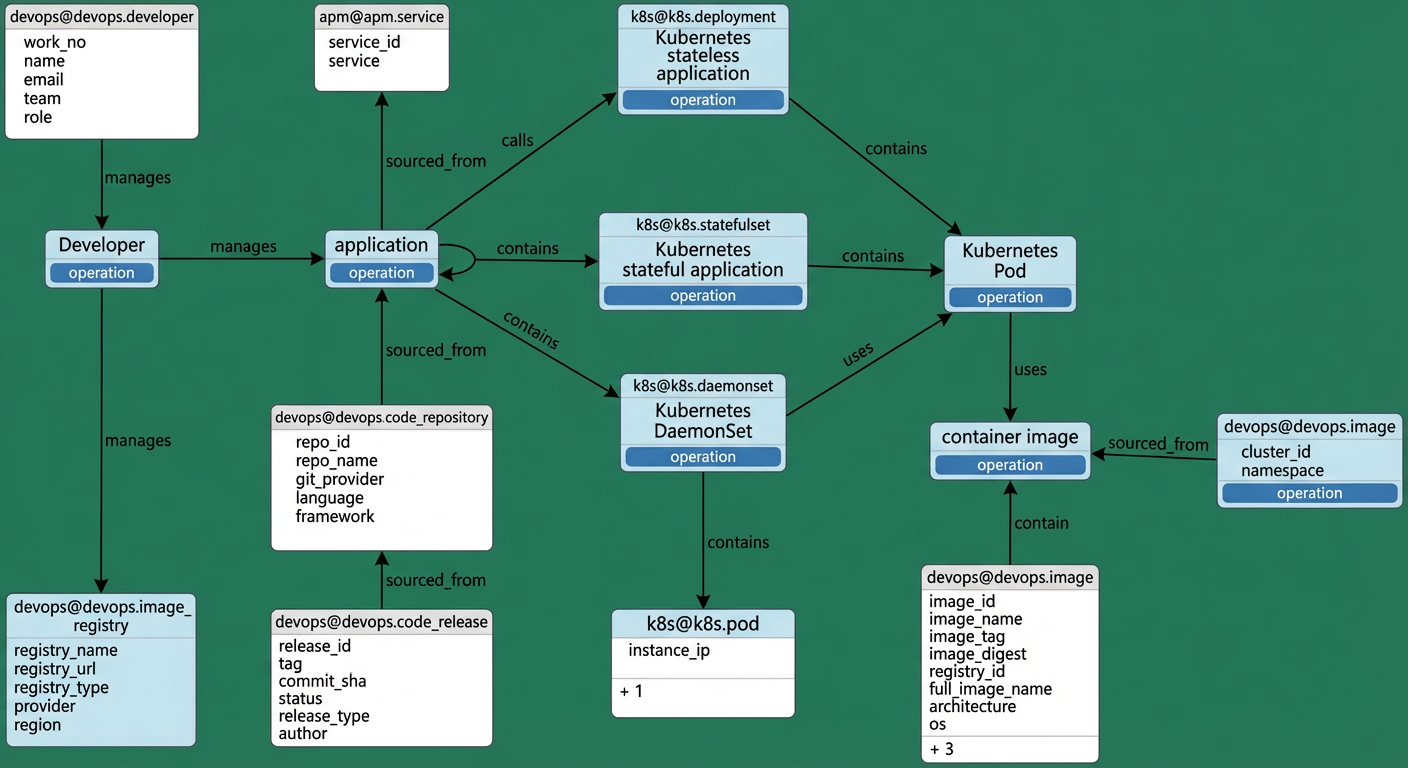
-
Note: The following architecture and implementation are examples. You can adjust and optimize them for your specific business scenarios.
DevOps domain (devops)
|
Entity type |
Purpose |
Core fields |
Business value |
|
Developer |
Manages developer information, including roles such as developer, tester, O&M engineer, and product manager. |
Employee ID, Name, Team, Role |
Accountability, team collaboration analysis |
|
Code repository |
Manages code repositories. |
Repository ID, Name, Language, Frame |
Technology stack analysis, code quality tracking |
|
Code publishing |
Manages publishing records. |
Publish ID, Tag, Commit SHA, Publish time |
Version management, publish quality tracking |
|
Image repository |
Manages container image repositories. |
Repository ID, Name, Type, Provider |
Centralized image management, security compliance |
|
Container image |
Container image information |
Image name, Tag, Summary, Build time |
Image version management, deployment tracking |
Integration with existing domains
APM domain integration
-
Service traceability: Traces APM services back to specific code repositories and published versions.
-
Accountability: Identifies the developer responsible for the service.
-
Version association: Quickly locates the specific code change that caused a service performance issue.
K8s domain integration
-
Image association: Links workloads such as pods, deployments, and StatefulSets to specific images.
-
Deployment tracking: Traces the full path from code publishing to container deployment.
-
O&M visibility: Lets O&M engineers quickly view the version and owner of a deployed service.
Relationship modeling design
Internal relationships in the DevOps domain
Developer ──manages──► Code repository
Developer ──manages──► Image repository
Code publishing ──sourced_from──► Code repository
Container image ──sourced_from──► Code publishing
Image repository ──contains──► Container image
Cross-domain relationships
Association with the K8s domain
K8s Pod ──uses──► Container image
K8s Deployment ──uses──► Container image
K8s StatefulSet ──uses──► Container image
Association with the APM domain
APM Service ──sourced_from──► Code repository
APM Service ──sourced_from──► Code publishing
Developer ──manages──► APM Service
Scenarios
1. Root cause analysis for failures
When an APM service has a performance issue:
-
You can quickly locate the responsible developer.
-
You can trace the issue back to a specific code change and published version.
-
You can analyze whether the issue is related to a recent image update.
2. Version impact analysis
Before publishing code:
-
You can analyze which APM services the release will affect.
-
You can predict the K8s workloads that might be affected.
-
You can develop rollback policies and risk contingency plans.
-
You can notify the relevant developers and O&M engineers.
3. Security and compliance management
A complete data link lets you:
-
Audit the entire code change flow.
-
Track the image building and distribution procedure.
-
Ensure that the source of deployed images is trusted.
-
Implement end-to-end security administration.
4. Performance analysis and optimization
Using rich associated data, you can:
-
Analyze the delivery performance of development teams.
-
Identify bottlenecks in the code-to-deployment process.
-
Optimize CI/CD flow configurations.
-
Improve overall delivery quality.
Technical implementation
Data collection
-
Code repository data: Obtained through the Git API or webhooks, including repository information and publishing records.
-
Image data: Collected through the Container Registry API, covering image building and storage details.
-
Developer data: Retrieved through integration with an HR system or LDAP.
-
Relationships: Established using CI/CD configuration files and deployment records.
Data storage
-
EntityStore: Stores entity data and relational data.
-
Real-time/Near-real-time updates: Maintained through event-driven or scheduled full-data synchronization mechanisms.
Value and benefits
Immediate benefits
-
Data unification: Provides a unified DevOps data view.
-
Relationship transparency: Clearly shows the dependencies between code, images, and services.
-
Clear accountability: Quickly locates the owner and scope of an issue.
Mid-term benefits
-
Intelligent analysis: Enables in-depth association analysis based on the graph structure.
-
Performance improvement: Identifies and optimizes bottlenecks in the DevOps flow.
-
Proactive risk identification: Detects potential deployment and service threats before they escalate.
Long-term benefits
-
Knowledge accumulation: Captures DevOps best practices as reusable knowledge.
-
Intelligent decision-making: Drives informed decisions based on historical data and relationship analysis.
-
Ecosystem extension: Provides a unified data foundation for more DevOps tools and flows.