Case study materials
Download the materials for this use case: umodel-full-devops.zip.
Background and challenges
As AI becomes integral to software development, traditional DevOps processes are evolving toward an AI-native approach. From AI-assisted coding to intelligent O&M, the entire software lifecycle requires a unified system that integrates AI capabilities across every stage, from code development to production operations.
Core pain points
1. Data silos across multiple systems
|
Problem type |
Description |
Impact |
|
Scattered development toolchains |
Code repositories, CI/CD platforms, and issue tracking systems operate independently. |
Fragmented data prevents a unified view. |
|
Fragmented O&M monitoring |
Application monitoring, infrastructure monitoring, and business monitoring lack a unified view. |
Troubleshooting is inefficient. |
|
Difficulty associating data |
Code changes, deployment events, and runtime exceptions cannot be effectively associated. |
Root cause analysis is difficult. |
2. Inconsistent data formats
|
Problem type |
Description |
Impact |
|
Inconsistent schemas |
Different systems use different data formats and field definitions. |
Data integration costs are high. |
|
Semantic conflicts |
The same concepts have different names and representations across systems. |
Semantic understanding becomes inconsistent. |
3. Difficulty retrieving runtime data
|
Problem type |
Description |
Impact |
|
Lack of real-time data |
Updates to critical runtime status information are delayed. |
Abnormal events cannot be addressed quickly. |
|
Missing relationships |
The relationships between services, instances, and code cannot be quickly identified. |
Problems are harder to identify. |
|
Loss of context |
No complete system status snapshot is available when a failure occurs. |
Failures are difficult to reproduce and analyze. |
4. Obstacles to AI understanding and analysis
|
Problem type |
Description |
Impact |
|
Large amount of unstructured data |
Logs and alert information are mostly in text format. |
AI struggles to understand and process this data. |
|
Implicit relationship information |
Dependencies between system components are unclear. |
Analysis accuracy is reduced. |
|
Lack of a semantic layer |
Data lacks standardized descriptions of business and technical semantics. |
AI analysis lacks context. |
Solutions
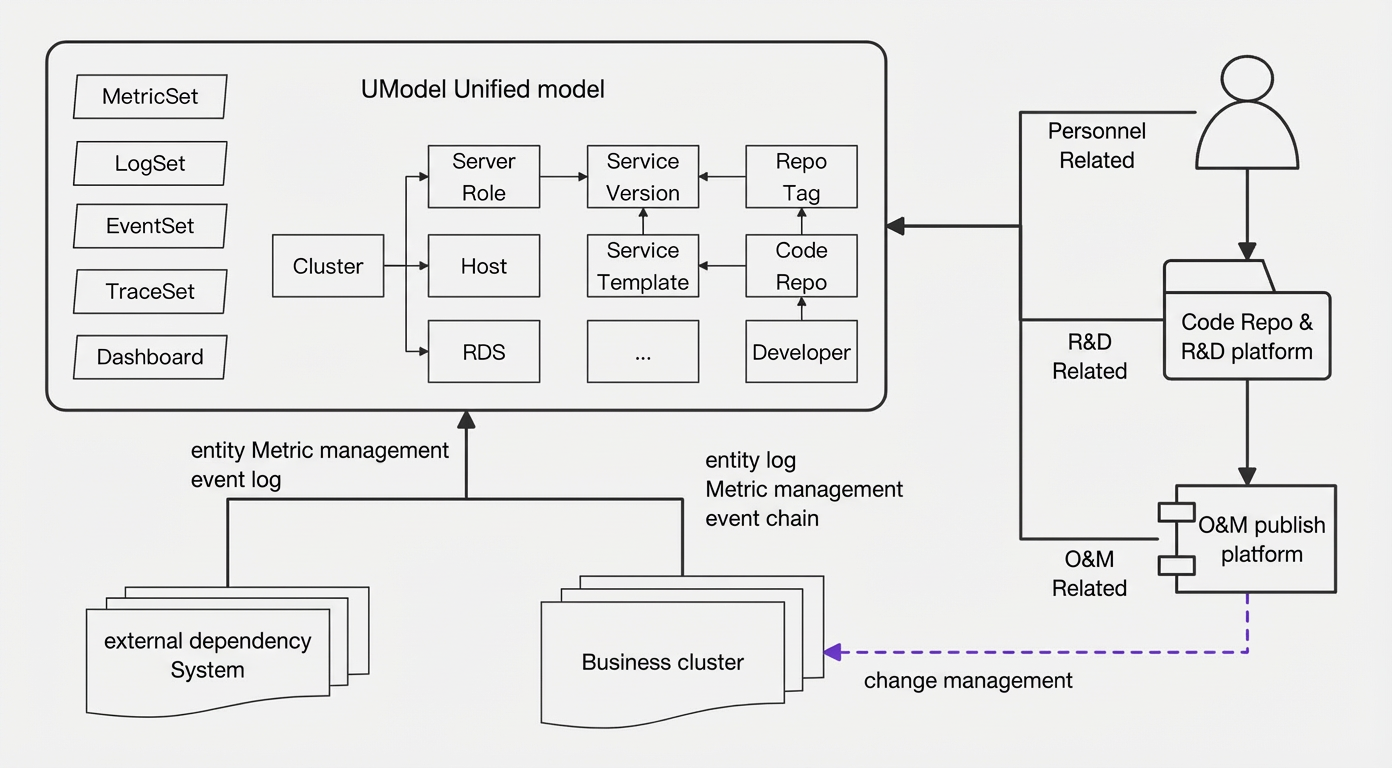
The UModel-based observability solution for end-to-end DevOps addresses these challenges with the following objectives:
Core objectives
-
Unify multiple systems: Consolidate personnel efficiency analysis, operational analysis, troubleshooting, and O&M control into a single platform to reduce tool-switching overhead.
-
Unify development and operations: Model data from the development (Dev) and operations (Ops) stages in a unified way to enable end-to-end analysis.
-
Improve overall efficiency: Integrate AI deeply into every stage to achieve truly intelligent DevOps. The expected overall efficiency improvement is over XX%.
Example of UModel solution architecture
-
Note: The following architecture and implementation are examples. Adjust them for your business scenarios as needed.
1. Unified representation with a graph model
UModel uses a graph model to represent the complete system architecture:
Development domain (organization)   O&M domain (ops)
┌─────────────────┐         ┌─────────────────┐
│  AI tool         │◄────────┤  Cluster          │
│  Developer       │         │  Host             │
│  Code repository │◄────────┤  Server role      │
│  Code release    │         │  Service template │
└─────────────────┘         │  Service version  │
                            └─────────────────┘
Core attributes:
-
Reflects architectural changes by updating the system topology in real time.
-
Exposes structured relationship data to AI.
-
Supports multi-dimensional views.
2. Cross-domain data fusion
Use EntitySetLink to create cross-domain associations:
|
Association type |
Source entity |
Target entity |
Relationship type |
Business meaning |
|
Version tracing |
|
|
|
The service version originates from the code repository. |
|
Release association |
|
|
|
The service version corresponds to a code release. |
|
Development ownership |
|
|
|
A developer is responsible for a server role. |
|
AI usage |
|
|
|
A developer uses an AI tool. |
3. AI-friendly data structure
Standardized schema design
-
Consistency: All entities follow uniform field naming and type specifications.
-
Semantics: Field names and descriptions provide rich business semantics.
-
Extensibility: Supports dynamic fields and custom properties.
Knowledge graph construction
-
Named Entity Recognition: Automatically detect and classify business entities.
-
Relationship extraction: Mine implicit relationships between entities.
-
Semantic inference: Perform knowledge inference based on the graph structure.
Entity domain design
Organization domain (organization)
|
Entity type |
Purpose |
Core fields |
Associated relationships |
|
Developer |
Manage developer information |
Employee ID, name, department, position |
Direct report relationships, managed services |
|
Code repository |
Manage code repositories |
Project ID, project path, project URL |
Source of releases |
|
Code release |
Manage release records |
Build ID, commit ID, release notes |
Source repository, associated developers |
|
AI tool |
Track AI tool usage statistics |
Tool name |
Used by developers |
O&M domain (ops)
|
Entity type |
Purpose |
Core fields |
Associated relationships |
|
Cluster |
Manage cluster information |
Cluster name, region, number of machines |
Contains hosts and server roles |
|
Host |
Manage host resources |
Hostname, IP address, zone |
Contained in a cluster, used by a server role |
|
Server role |
A service that runs in a cluster |
Role name, template information |
Contains hosts and versions, developer owner |
|
Service template |
Deployment template for a specific service |
Template name, description, type |
Contains service versions |
|
Service version |
A specific version of a service |
Template name, commit information, MD5 |
Originates from code repositories and releases |
Relationship modeling design
Contains relationship (contains)
Cluster ──contains──► Host
Cluster ──contains──► Server role
Server role ──contains──► Host
Server role ──contains──► Service version
Service template ──contains──► Service version
Source relationship (sourced_from)
Service version ──sourced_from──► Code repository
Service version ──sourced_from──► Code release
Code release ──sourced_from──► Code repository
Usage and management relationships
Developer ──use──► AI tool
Developer ──manage──► Server role
Developer ──direct──► Developer (direct report relationship)
Service invocation relationship
Server role ──calls──► Server role (inter-service invocation)
Scenarios
1. Analysis of AI coding efficiency improvements
-
Personnel dimension: Analyze AI tool usage and code submission efficiency by individual and department.
-
Tool dimension: Compare how different AI tools improve development efficiency.
-
Project dimension: Evaluate AI-assisted development effectiveness at the project level.
2. End-to-end DevOps process integration
-
Alert association: Link alerts directly to specific service entities and their owners.
-
Troubleshooting: Quickly identify problems by using the UI, DoraAI, MCP, and other methods.
-
Change tracking: Trace from observability data back to specific code changes and releases.
-
Impact analysis: Assess the potential impact of code changes on online services.
3. End-to-end observability
-
Developer view: See the services and code that a developer is responsible for.
-
Service view: Inspect a service's dependencies and runtime status.
-
Code repository view: Track a repository's deployment status and operational performance.
Value and benefits
Immediate benefits
-
Unified data: Eliminate data silos and establish a unified data view.
-
Transparent relationships: Clarify dependencies between system components.
-
Fast identification: Quickly identify the specific service and owner from an alert.
Mid-term benefits
-
Intelligent analysis: Perform in-depth association analysis based on the graph structure.
-
Performance measurement: Quantify how AI tools improve development efficiency.
-
Process optimization: Identify bottlenecks and areas for improvement in the DevOps process.
Long-term benefits
-
Knowledge accumulation: Transform experience into a reusable knowledge graph.
-
Intelligent decision-making: Make intelligent decisions based on historical data and relationship analysis.
-
Ecosystem expansion: Provide unified data modeling capabilities for more business scenarios.