PPU
PPU is a purpose-built chip that accelerates AI applications. It is designed for ease of use in training and inference scenarios for a wide range of large and traditional models. It supports mainstream AI frameworks and deep learning models, provides a compiler, various open-source acceleration libraries, and a complete toolchain to help you migrate applications quickly and cost-effectively. The PPU software stack supports a broad range of AI training and inference applications. You can use the PPU SDK to maximize compute power and significantly improve computational efficiency.
Core competencies
|
Fully proprietary
|
High price-performance
|
High ease of use
|
Use cases
|
Multimodal large model training and inference Fully compatible with popular open-source large models such as Qwen and LLaMa. You can seamlessly migrate from common training and inference frameworks, including Megatron, DeepSpeed, and vllm. |
Autonomous driving model training Verified to be compatible with over 50 common autonomous driving models. It delivers a performance advantage of more than 50% on a single machine across various model architectures, such as perception, prediction, and end-to-end models. |
Product specifications
|
Product |
Zhenwu 810E |
|
Thermal design power (TDP) (W) |
400 |
|
Form factor |
OAM |
|
Bus interface |
PCIe 5.0x16 |
|
Memory type |
HBM2e |
|
Memory capacity (GB) |
96 |
|
Memory bandwidth (GB/s) |
2765 |
|
Inter-chip interconnect type |
ICN |
|
Inter-chip interconnect bandwidth (GB/s) |
700 |
Software stack
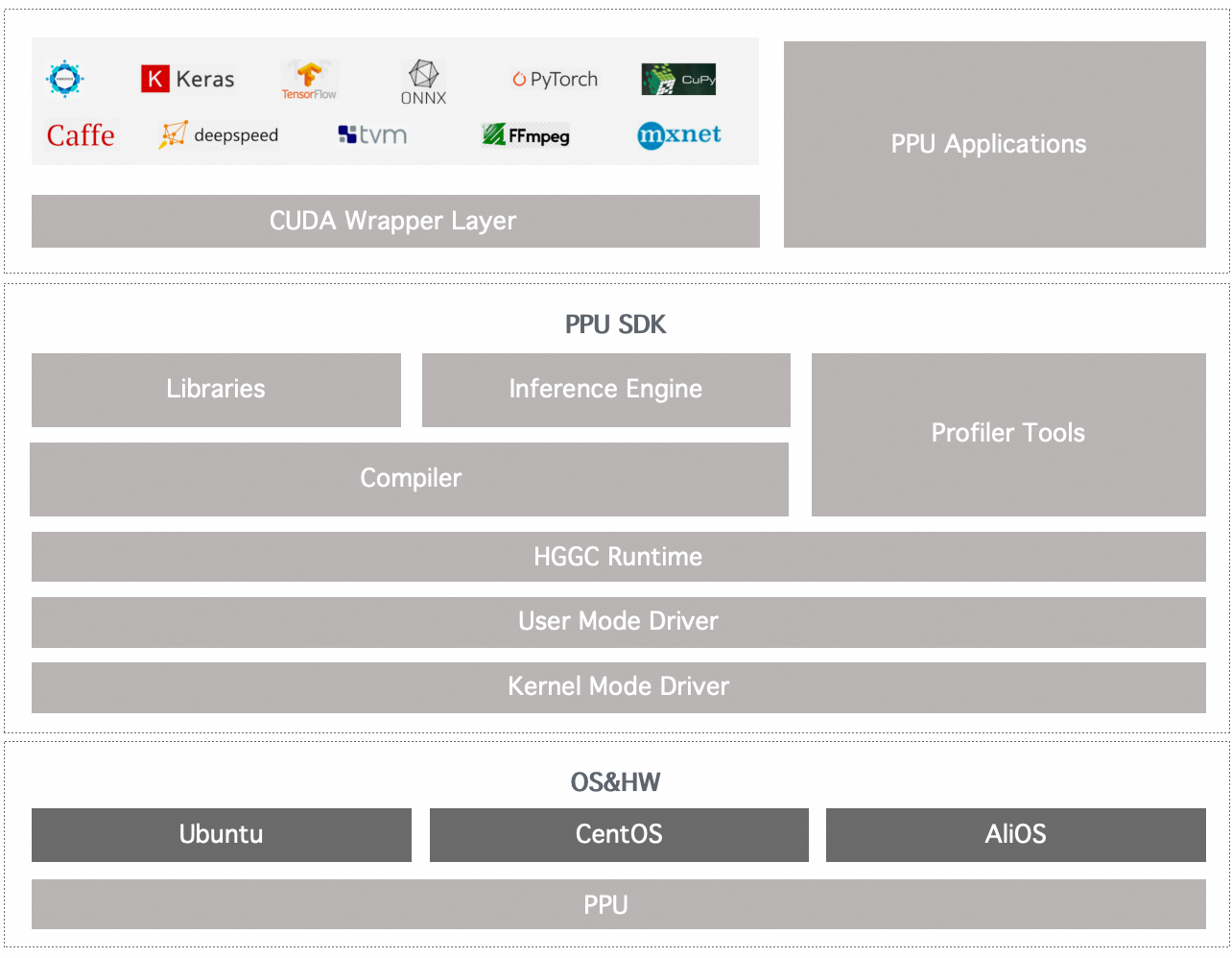
The PPU software stack consists of an application layer, a conversion and adaptation layer, and a PPU SDK layer. You can directly call the PPU SDK for newly developed applications, or use the conversion and adaptation layer to allow existing applications to call the PPU SDK indirectly.
-
Provides general-purpose GPU programming APIs and various acceleration libraries for deep learning. It offers libraries with interfaces compatible with popular APIs, such as CudaRT, CuDNN, CuBlas, NCCL, CuSolver, NVML, NVTX, FFMPEG, Nvcuvid, and Nvjpegd. You can replace the libraries in your existing applications or use the adaptation layer for compatibility.
-
Provides a complete toolchain for rapid service deployment and optimization. The toolchain includes PPU-SMI for device monitoring, Asight System as an application performance analysis suite, Asight Compute for application kernel analysis, and a GDB-based kernel debugger.
How to use PPU
Method | Usage | Scenarios |
Create a Lingjun resource cluster in Container Compute Service (ACS) and select a PPU-specific image. Then, submit model training or model deployment jobs by using the ACS console or a command-line tool such as kubectl. | This method is ideal for users who are familiar with container technology and use the console or a command-line tool like kubectl to deploy containerized model training and inference jobs. It provides powerful container management capabilities, including automated application deployment, scaling, and management. |