Tunnels and agents
Alibaba Cloud Data Online Migration cannot directly access a data source located in a self-managed data center, on a local server, or in a private network connected by a leased line or VPN. To enable access, you must deploy an agent program on an ECS instance. The agent acts as a secure, high-speed bridge that connects the data source to Data Online Migration.
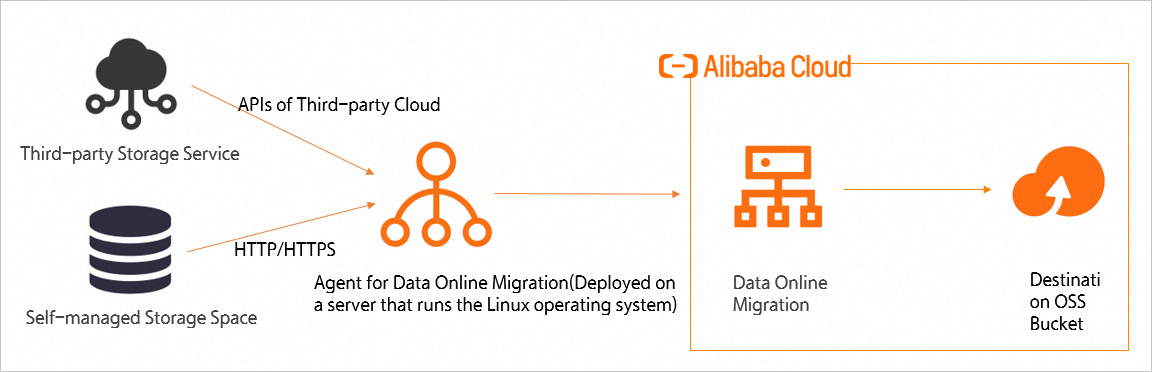
Tunnels and agents work together. Their relationship is as follows:
Tunnel: A virtual transmission path for data migration. Its main purpose is to apply unified traffic shaping, such as bandwidth and queries per second (QPS) limits, to all associated agents. A tunnel can be associated with multiple agents.
Agent: A program deployed on your ECS instance. It reads data from the source and transmits it to the Data Online Migration service. An agent can only be associated with one tunnel at a time. Its performance, such as available bandwidth, is constrained by the traffic limit of its tunnel.
Configure a tunnel
Configure a tunnel to define the virtual transmission path for data migration and set a unified bandwidth and QPS limit for all agents on this path. This ensures stable and controllable data transmission.
If the tunnel's traffic limit is too low, or if the total traffic limit for the tasks significantly exceeds the tunnel's limit, the migration will fail due to traffic shaping.
Tunnel ID: The unique ID of the tunnel.
Bandwidth limit: The maximum total bandwidth that all agents in the tunnel can use. The available bandwidth depends on the actual bandwidth of the network link.
If you leave this field empty, the default value is 0, which means no bandwidth limit.
QPS: The maximum total number of queries per second that all agents in the tunnel can send to the source. Carefully evaluate this value based on the capacity of your source storage system. A value that is too high can affect normal business operations.
If you leave this field empty, the default value is 0, which means no QPS limit.
Configure an agent
Before you configure an agent, ensure that you have completed the required Tunnel configuration. An agent is a component deployed on an ECS instance that retrieves data from local storage or other restricted network environments and transmits it to the migration service.
Name: The name of the agent.
The agent name cannot be empty. It must be 3 to 63 characters long.
It can contain lowercase letters, digits, and the special characters hyphen (-) and underscore (_).
Network type: The network connection method for the agent. It includes the following two types:
VPC (recommended): The agent connects to the Data Online Migration service using a VPC. This method requires that the machine where the agent is deployed can access the internal same-region endpoint of Data Online Migration for the corresponding region. For example, if you use the migration service in the China (Beijing) region, the agent machine must be able to access the internal same-region endpoint {TunnelId}.cn-beijing.mgw-tc-internal.aliyuncs.com. Deploy the agent on an ECS instance in the same region as the Data Online Migration console.
Internet: The agent connects to the Data Online Migration service over the Internet. This method requires that the machine where the agent is deployed can access the Internet domain name of Data Online Migration for the corresponding region. For example, if you use the migration service in the China (Beijing) region, the agent machine must be able to access the Internet domain name {TunnelId}.cn-beijing.mgw-tc.aliyuncs.com.
NoteTunnelId represents the Tunnel ID.
Use the ping command to test connectivity from the agent to the migration service.
Deployment method: The deployment method for the agent. Currently, only deployment as a standalone process is supported.
Tunnel: Select the tunnel to associate with the agent. An agent can be associated with only one tunnel. The agent's bandwidth is constrained by the total bandwidth of the tunnel.
For example, a tunnel named tunnel-1 has a maximum bandwidth of 10 Gbit/s. If tunnel-1 is associated with three agents, agent-1, agent-2, and agent-3, the sum of the bandwidth for all three agents cannot exceed 10 Gbit/s.