Analyze business processes
Generally, users can obtain sufficient business data in business systems through tracking or daily accumulation. To sort out the logical relationships between data and the data flow directions for a user, you must first understand the user's business process and the data systems involved in the business process.
- Know the data generated for each business and the database that stores the data.
- Know the data generated for each phase of a business process.
- Know the circumstances under which data is updated and the logic that the update follows.
- Specify a granularity. Before you analyze the events of a business process, you need to determine the degree and scope of each analysis to specify a granularity.
- Design a dimension table. After you specify a granularity, design a dimension table based on this granularity for grouping and filtering data during analysis. When you design a dimension table, you must specify dimension attributes.
- Specify the metrics to be measured.
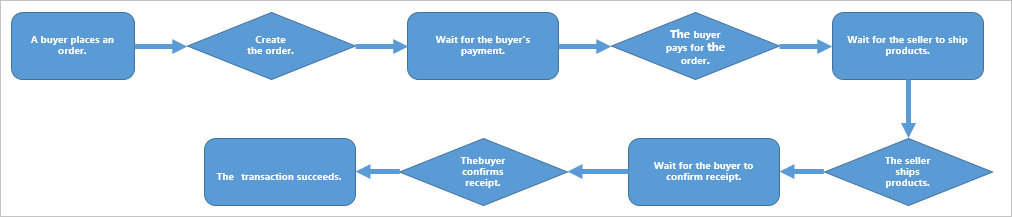
The preceding figure shows a typical business process of an e-commerce transaction. This business process consists of four key phases: order placement, payment by the buyer, shipping goods by the seller, and confirming the receipt of goods. Confirming the receipt of goods indicates that the transaction is successful. You can focus on the analysis of this phase.
After you learn the business process, you can divide data domains for the business that needs to be analyzed and create a specific business process in the corresponding data domain.
For more information about how to create a business process, see Create business processes.