Changes for integrating with ACK
This topic describes the changes and considerations for using new ACK clusters after the integration of AKS with ACK managed clusters.
AKS is compatible with both new ACK clusters and existing AKS clusters, allowing them to coexist. The product capabilities of existing AKS clusters are not affected.
As of August 15, 2020, all new clusters created on Alibaba Cloud are ACK managed clusters by default.
Background information
Container Service for Kubernetes (ACK) provides high-performance and scalable management for the full lifecycle of enterprise-grade containerized applications. ACK integrates the virtualization, storage, network, and security capabilities of Alibaba Cloud to create an optimal application runtime environment in the cloud.
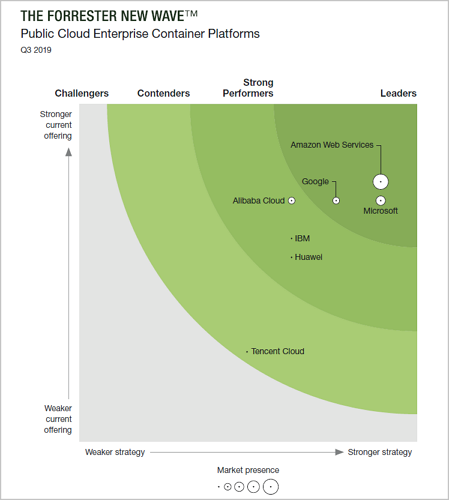
In 2019, the global market research firm Forrester released its first report on enterprise public cloud container platforms. In this report, Alibaba Cloud Container Service ranked among the top three globally and first in China, entering the Strong Performers quadrant.
Customer value
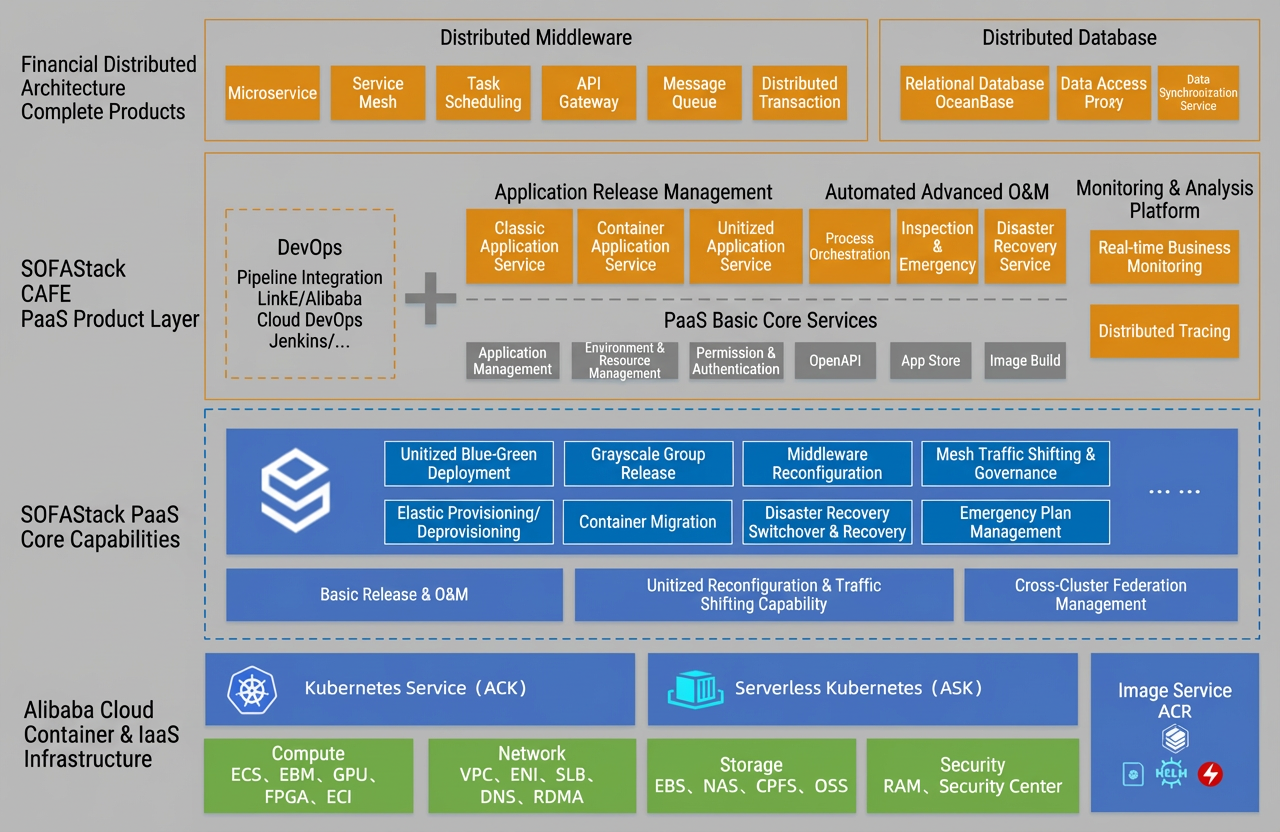
The deep integration of AKS with ACK managed clusters provides the following business value:
Maximizes the use of the powerful ecosystem and product capabilities of ACK.
Allows you to easily import existing ACK clusters to maximize the use of your cloud resources.
Basic cluster operations and maintenance (O&M) and feature evolution are handled by ACK. This allows SOFAStack AKS to focus on upper-layer workloads, resulting in a more efficient and user-friendly platform for the development and operations of enterprise-grade distributed applications.
Feature evolution
AKS will integrate with ACK's product capabilities in phases. The first phase includes the following ACK features:
Basic features such as cluster creation, scale-out, node import, and node deletion.
Features related to containers, services, and PersistentVolumes (PVs).
Integration with Alibaba Cloud CloudMonitor for monitoring ACK native workloads and basic resources.
The following features are planned for the second phase:
Full cluster lifecycle management, including cluster import, release, deletion, and update.
Cluster add-on component management.
Addressing the existing key limitations.
Integration flow
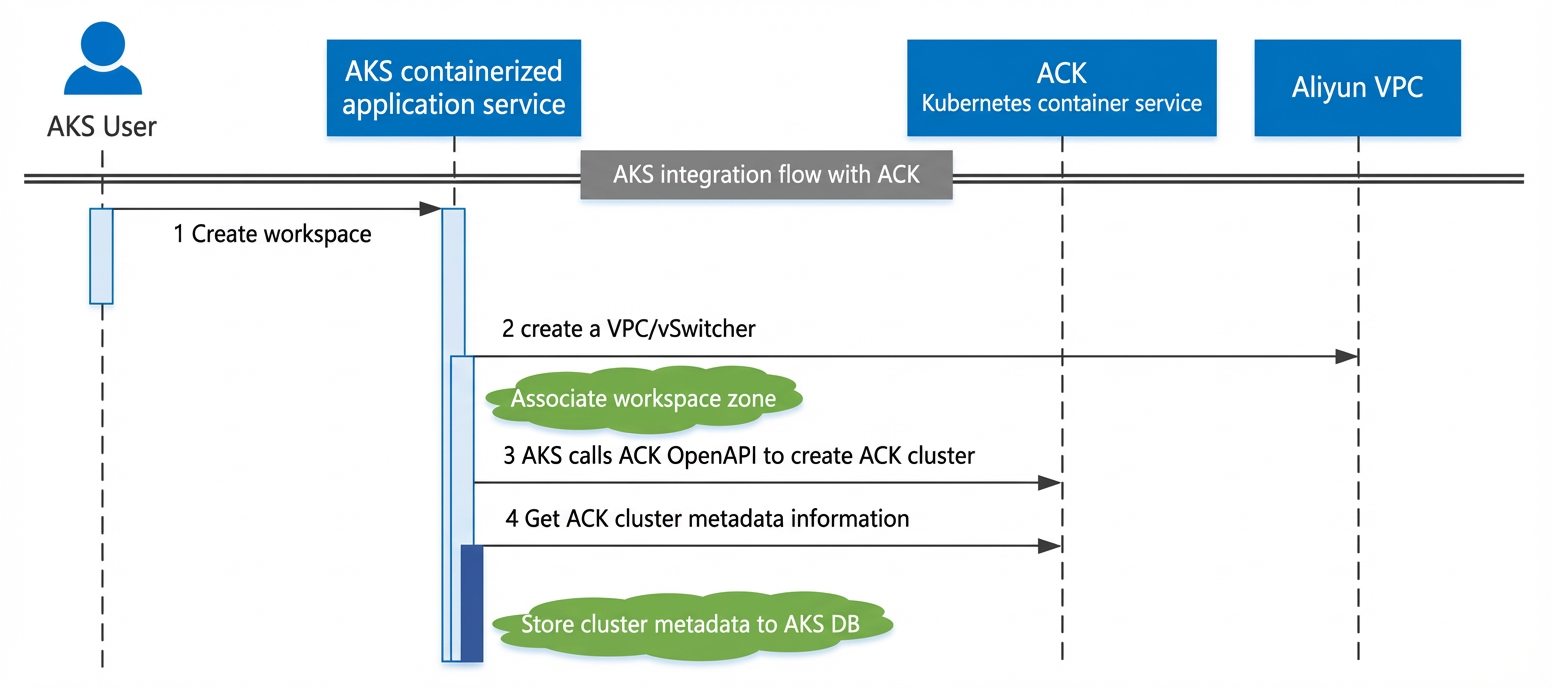
A 1:1:1 relationship between a VPC, a workspace, and an ACK cluster is maintained. You can create only one ACK managed cluster per workspace.
When you create a workspace, you also create a VPC and associate it with a zone and a vSwitch. After the workspace is created, you can create an ACK cluster within it. The following figure shows this integration flow.
Limitations and changes
After the integration with ACK clusters, the following limitations and changes apply to the original AKS product capabilities:
Currently, you cannot create ACK clusters in Zone B and Zone D of the Hangzhou Gold region.
The ACK Event Center feature is no longer fully supported. The system defaults to the native event center, and events are not stored persistently.
ACK cluster monitoring and native workload monitoring are directly integrated with Alibaba Cloud CloudMonitor. Monitoring of pod containers for application services is temporarily unavailable. The corresponding pages are hidden in the console for ACK cluster scenarios.
The Cluster Autoscaler (CA) and Horizontal Pod Autoscaler (HPA) features are unavailable in ACK clusters. The console menus for these scaling features are automatically hidden.
The KubeConfig and public network access features are not currently supported. To use these features, you must retrieve the access information from the ACK console.
The in-place upgrade feature has limited support. It now only supports image change scenarios. In other scenarios, the IP address is not guaranteed to remain unchanged.
Cluster-level permissions are still integrated with the existing SOFAStack permission system (FullAccess and ReadOnly). For more information, see Access policy.
When you use an ACK cluster for the first time, you must grant SOFAStack the permissions to operate ACK resources and access other cloud resources. You must enable the services and grant the required permissions in the ACK and ESS consoles. For more information, see Use Container Service for Kubernetes for the first time and Enable and authorize services.
You cannot scale out nodes across multiple zones in an ACK cluster in parallel.
You can create PVs and services only using YAML. Creating them using the form is not currently supported.
Notes
If you have an existing AKS cluster and need to create a new cluster, note the following:
As of August 15, 2020, all new clusters created on Alibaba Cloud are ACK clusters by default.
FAQ
Q: What are the billing standards for AKS clusters and ACK clusters under the same tenant?
A: ACK clusters are sold independently. The resources you use, such as clusters, bandwidth, storage, and computing, are billed and invoiced separately. They also have a separate Service-Level Agreement (SLA). AKS is currently free of charge. In the future, AKS is planned to be billed independently based on cluster size. The billing standards for AKS clusters and ACK clusters follow the SOFAStack Pricing and ACK Pricing rules, respectively.