Low-cost cross-border file transfer
Updated at:
This topic describes how to use a combination of Serverless Workflow, Function Compute, Object Storage Service, Virtual Private Cloud, Elastic Compute Service, and Elastic IP Address to achieve low-cost cross-border file transfer.
Scenarios
- Cross-border data transfer for Object Storage Service.
- Strict cost control for cross-border data transfer.
- Low sensitivity to file synchronization latency and tolerance for delays from network jitter.
- An elastic and extensible system to handle large-scale file writes.
Solution overview
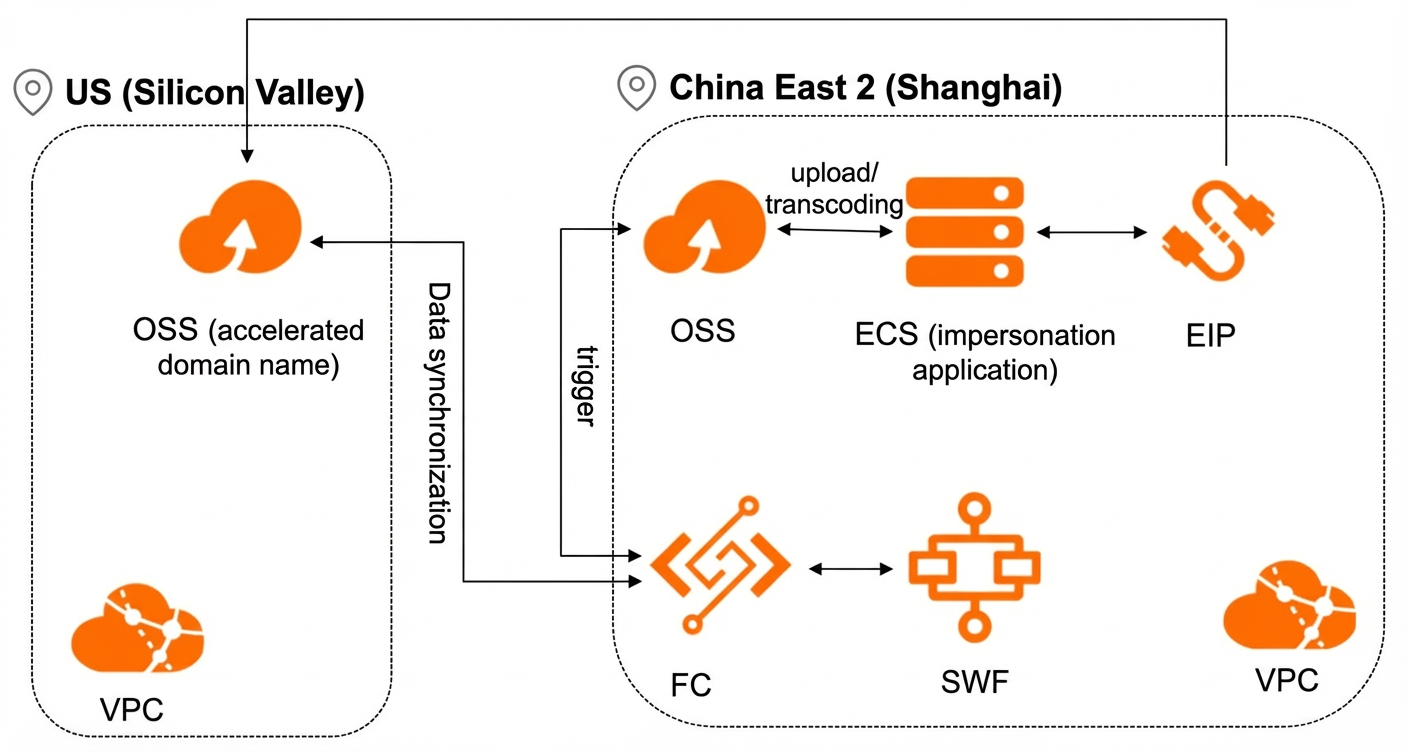
- An Elastic Compute Service (ECS) instance simulates an application that accesses Object Storage Service (OSS) in the China (Shanghai) and US (Silicon Valley) regions. This instance creates and uploads the content.
- The application uploads content to OSS in the China (Shanghai) region using an internal same-region endpoint.
- Uploading a file to Object Storage Service triggers Function Compute to invoke a Serverless Workflow. A step within the Serverless Workflow then uploads the file and quickly synchronizes it using the Object Storage Service accelerated domain name in US (Silicon Valley).
- An ECS instance simulates a local user in the US (Silicon Valley) region. The simulated user reads the file from OSS and verifies that the data is correct.
Advantages
- Low operations and maintenance (O&M) costs: Developers only need to focus on application logic.
- Low network costs: This solution reduces network costs compared to using Express Connect.
- Low deployment cost: Server provisioning is not required for the synchronization service because Function Compute triggers tasks on demand.
- Elastic and efficient: Each file synchronization triggers a Serverless workflow task to ensure efficient synchronization and optimal resource utilization.
Details
For more information, see Low-cost cross-border file transfer.
Is this page helpful?