Architecture
The Service Mesh architecture is logically partitioned into a control plane and a data plane.
Control plane: Manages proxies (Ant's self-developed MOSN) to handle traffic routing and runtime policy enforcement.
Data plane: Consists of multiple proxies (Ant's self-developed MOSN) that manage and control inter-service network communication.
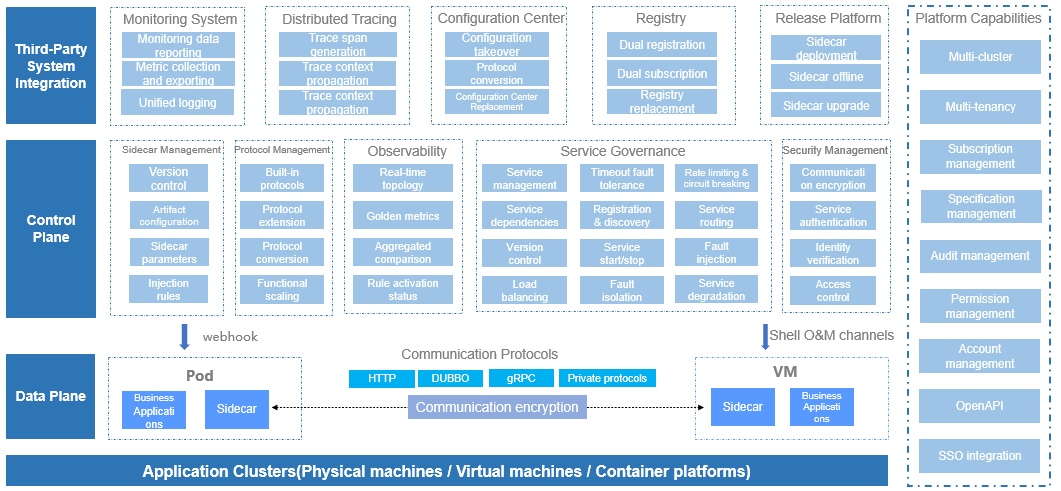
System architecture
Service Mesh combines the strengths of microservices, integrating both SDK-based traditional microservices and Sidecar-powered Service Mesh systems to achieve:
Interoperability: Seamless mutual access between applications across both architectures.
Smooth migration: Applications can migrate between the two systems without callers being aware of the change.
Flexible evolution: Following the achievement of interoperability and smooth migration, we can progressively refactor applications and evolve the architecture based on contextual demands.
On the control plane, DRM is introduced to deliver configurations (e.g., service routing rules), while independent service registries are retained for service discovery.
On the data plane, the self-developed MOSN is deployed, supporting both Dubbo and Spring Cloud applications.
For deployment models, we support Kubernetes container platforms as well as VM-based environments.