Mainframe/AS400 bank core migration solution
Migrating next-generation core banking systems is a key challenge in migrating from mainframes and proprietary hardware. It is also crucial for the digital transformation of banks. This core development suite combines versatile and stable core business components with a technical platform. It was developed and refined by Ant Group, proven in scenarios such as the annual Double 11 sales promotions and Yu'e Bao product innovations. The suite provides standardized, reusable financial services and open programming interfaces for Software as a Service (SaaS). It helps financial institutions quickly build various business products for deposits, loans, remittances, and Internet finance. The suite also hides the technical complexity of the distributed architecture from upper-layer applications. This shortens the learning curve and accelerates the transition to a distributed model.
Solution architecture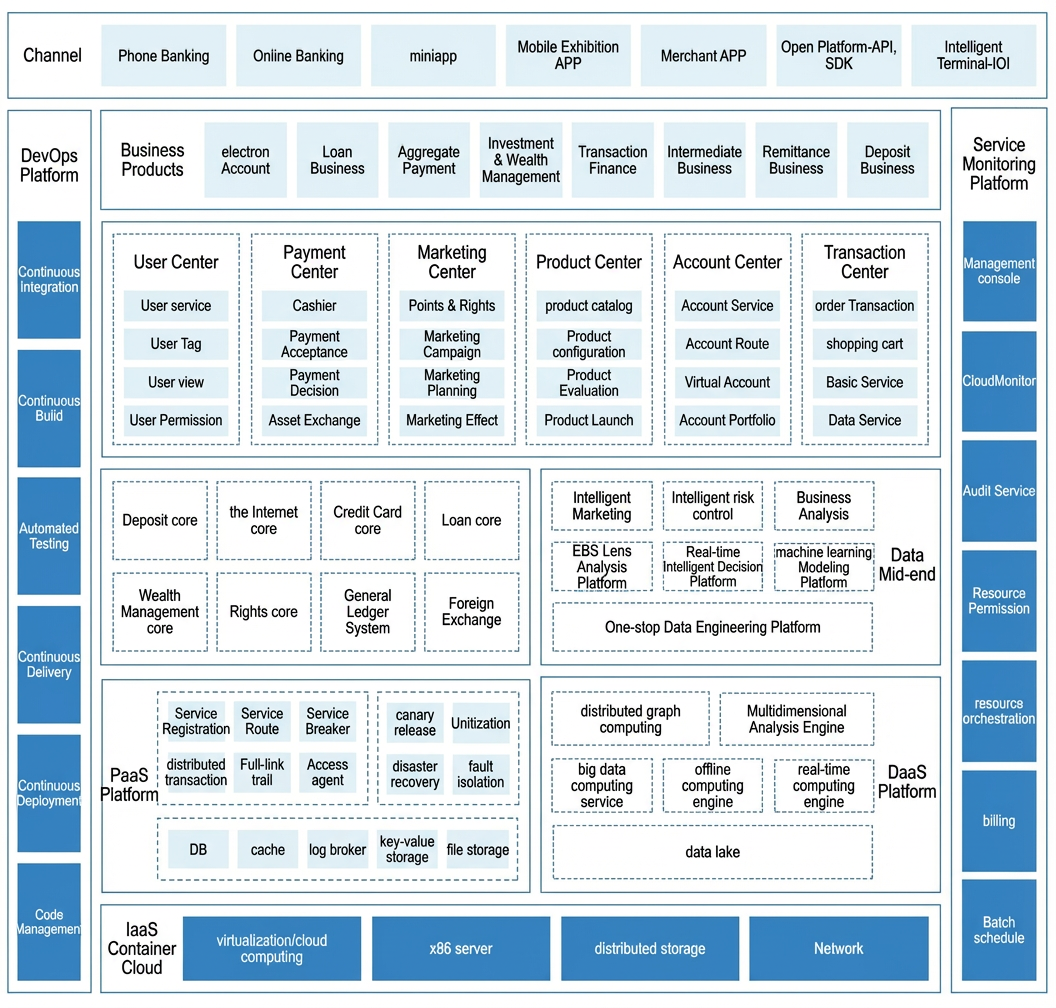
The architecture is customer-centric and product-driven. It is supported by asset and pricing management and built on an accounting system. New modules can be added as the business grows, which ensures scalability.
Agile product innovation
This solution fully implements the Business Mid-end concept. It groups and abstracts the atomic capabilities of the Business Mid-end into components that align with business language. This streamlines the entire product creation process, from product design and system architecture to the developer workflow. Business capabilities can be quickly assembled to meet specific demands. This reduces trial-and-error costs and provides personalized services.
Multi-dimensional pricing system
Based on a rich set of pricing models, this solution establishes an efficient, flexible, and unified pricing platform. The platform supports various pricing needs for fees, interest rates, exchange rates, and tax rates across different business lines. It can also create pricing plans based on factors such as customer category, product, service, channel, balance, transaction amount, and number of transactions to provide differentiated pricing services.
Decoupling of transactions and accounting
This solution provides an accounting engine that decouples transaction process control from accounting. Through flexible accounting rule settings, it generates accounting information for multiple legal entities, institutions, and account books. This meets accounting standard and information disclosure requirements.
Flexible asset core
This solution enables the rapid assembly of different payment tools, such as credit and debit cards, and marketing tools, such as red envelopes, vouchers, and points, in complex financial consumption scenarios. It also integrates seamlessly with cashier systems to meet diverse market needs and promote business growth.
Unified asset exchange
This solution hides the business and technical complexity of underlying asset tool processing logic from upper-layer business systems. It also allows asset tools to be connected once and used in multiple scenarios. Business operations can control the availability, visibility, sorting, and credit limits of asset tools for different scenarios. User behavior data is fed back into the asset exchange process. This creates a personalized user experience.
Integrated offline interest calculation and settlement
The system can flexibly switch to an offline computing mode based on the scale of customer data. For accounts with many transactions, it uses the big data processing capabilities of the offline computing platform to efficiently perform interest calculations and settlements.
Hierarchical and relational account system
This account system combines hierarchical and relational structures that can be flexibly configured. It supports various scenarios, such as Internet consumption, E-commerce, platform financing, group account management, and regulatory accounts.
Solution advantages
Applications are decoupled based on a distributed, service-oriented concept. Flexible transactions ensure data consistency, creating a large platform with micro-applications. A key feature is 24/7 online availability. The solution is especially suited for elastic service scenarios with frequent small-value orders and burst traffic from events such as flash sales.
Financial-grade high reliability
The solution is deeply integrated with the OceanBase distributed database and the SOFA financial-grade cloud-native distributed framework. This ensures the scalability of applications and data. It also provides high availability (HA) with a Recovery Time Objective (RTO) of 0 and a Recovery Point Objective (RPO) of less than 30 s, along with data consistency. Technical risk control components, such as the fund reconciliation system and end-to-end stress testing based on Ant Group's business practices, ensure fund security and effective risk management in a distributed architecture.
Hot spot account immunity
This solution includes built-in hot spot account solutions, such as summary accounting and buffered accounting. By analyzing system operations, it automatically detects hot spot accounts and intelligently selects the most suitable solution for the current scenario. This quickly resolves hot spot account issues and makes the system resilient to sudden hot spot problems in various scenarios.
Lower total cost of ownership
This solution helps customers quickly build solutions such as core business systems and Business Mid-end, which reduces development time. The open x86 architecture, flexible and elastic scheduling, unified information standards, and accompanying distributed administration tools help customers perform precise and efficient operations and maintenance (O&M). This lowers the total cost of ownership.
Customer use cases
None at this time.
Recommended products