Building a financial-grade transaction system from distributed to cloud-native
Building a financial-grade online transaction system begins with implementing a financial-grade distributed architecture. Ant's key technologies for this are SOFAStack and OceanBase. Both are commercially available with proven track records of successful implementations. SOFAStack provides a scalable and extensible architecture for the application layer and stateless services. OceanBase provides a distributed architecture for storage and stateful services, such as databases. Together, they offer the following four features:
High availability: Ensures over 99.99% availability for continuous system operation.
Consistency: Ensures eventual data consistency in any abnormal scenario to safeguard funds.
Scalability: Supports rapid scaling at the application, database, data center, and region levels.
High performance: Storage uses a read/write splitting architecture. The compute engine is optimized for end-to-end performance, delivering performance comparable to an in-memory database.
These four key features are critical for financial services and must be implemented end-to-end across the application and storage layers.
For example, consider scalability. Some systems claim to have a distributed architecture. In reality, they may only use a microservice framework to refactor the application layer into services. If the data layer does not use horizontal scaling or a distributed database, the data layer becomes a bottleneck that limits the scalability of the entire system.
Therefore, a truly distributed system must be distributed end-to-end to achieve unlimited scalability and high performance. A true financial-grade distributed system must also provide end-to-end high availability and consistency.
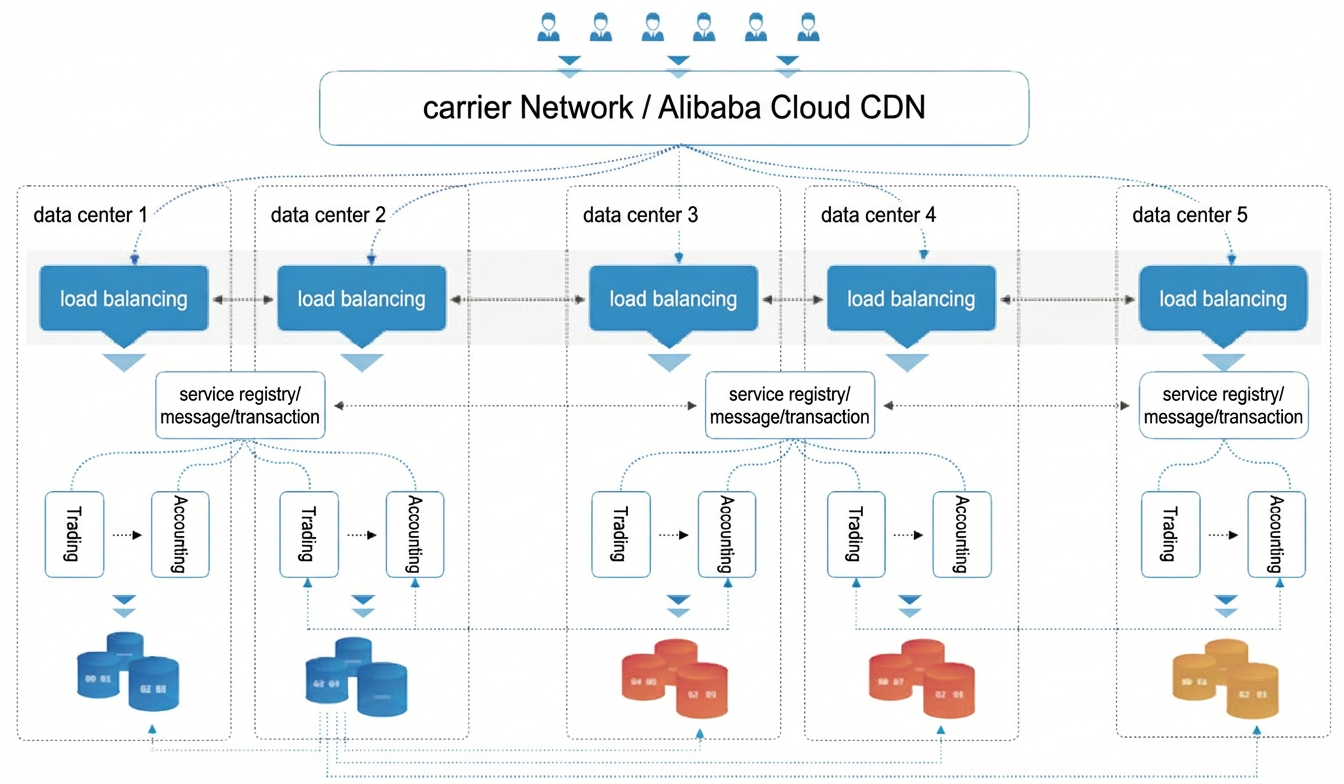
The primary goal of a high availability (HA) architecture is to prevent data loss and ensure continuous service. To achieve this goal, we designed and implemented an active geo-redundancy architecture that spans three regions and five data centers. Its core advantages include city-level disaster recovery, low-cost transactions, unlimited scalability, a Recovery Point Objective (RPO) of 0, and a Recovery Time Objective (RTO) of less than 30 s.
At the 2018 Apsara Conference, we performed a "cable cutting" demo. This demo demonstrated the architecture's cross-city active-active capabilities and its rapid recovery from disasters. In addition to high availability, the architecture also mitigates financial risks by ensuring fund security, resilience to changes, and fast failure recovery.