FAQ
PPU compatibility with NVIDIA Compute Capability
Develop and compile your applications in an environment equivalent to an NVIDIA A100.
Currently, the PPU compiler defaults to compute capability sm_80 regardless of the nvcc --arch flag and does not report an error.Compatibility of CUDA C++ core libraries
The algorithmic libraries in the
sdk/includedirectory, such as CUB, Thrust, pipelines, sync, and libcudacxx, are supported as follows:Features that are part of the fundamental CUDA C/C++ programming model, such as
pipeline,sync,bar, andmbarrier, are fully supported. These function as synchronization primitives for asynchronous data transfers.CUB,Thrust, andlibcudacxxare header-only compute libraries native to the CUDA SDK. These libraries are functionally unmodified and can be used as-is in most cases, with the following exceptions:Execution paths related to CUDA Dynamic Parallelism (CDP) within the
CUBandThrustcode have been disabled. You cannot use the features ofCUB,Thrust, orlibcudacxxwith CDP.The
CUBandThrustcode included in the SDK contains modifications to its CDP-related logic. If you directly integrate newer, open-source versions of these libraries into your project, you may encounter compilation failures that require code adjustments.
PPU does not currently support
cuCollectionsbecause it depends on the CUPTI Perfworks API. For details, see CUDA C++ core library compatibility issues.
PPU support for Apex, Megatron, DeepSpeed, and MMLab
SDK 1.3 supports mixed precision in Apex 24.04.01.
SDK 1.4 supports Megatron-core v0.8.0 and DeepSpeed v1.14.4.
PPU supports mmdetection3d v1.4.0, which is a dependency for autonomous driving models in OpenMMLab, along with its dependencies mmengine, mmdet, and mmcv.
Support for Triton Inference Server and backends
Yes, Triton Inference Server is supported as it is a CPU-based library.
The support status for Triton Inference Server backends is as follows:
vLLM is supported as a backend.
TensorRT-LLM is not currently supported. However, we provide a software stack with similar functionality, Holems-LLM, which can be used as a backend for Triton Inference Server.
The official Triton documentation at https://github.com/triton-inference-server does not mention support for SGLang as a backend. PPU compatibility cannot be verified until the steps to enable SGLang support on a GPU are provided.
PTG equivalent toolchain for NVIDIA tools
NVIDIA toolchain | PTG equivalent toolchain | Description |
nvidia-smi | ppu-smi | |
nvcc | nvcc | |
Nsight Systems (nsys) | Asight Systems (asys) | |
Nsight Compute (ncu) | Asight Compute (acu) | |
DCGM | PPU DCGM (dcgmi) | |
cuobjdump | hgobjdump | |
cuda-gdb | ppu-gdb | |
cuxxfilt | hgfilt | |
cuda-memcheck | hggc-memcheck | |
nvprof | <not applicable> | Legacy tool deprecated by NVIDIA. Use Asight Tools for equivalent functionality. |
cupti | hgpti | |
visual profiler | <not applicable> | Legacy tool deprecated by NVIDIA. Use Asight Tools for equivalent functionality. |
VampirTrace | <not applicable> | Legacy tool that is no longer maintained. Use Asight Tools for equivalent functionality. |
NVTAGS | <not applicable> | Support is not planned. This tool is for specific High-Performance Computing (HPC) workloads. These are not typical AI workloads. PPU does not currently plan to support these HPC-specific features. |
Support for graphics, image, and video processing
Support for common ecosystem software
Direct support:
Software
Description
FFmpeg
Requires enabling hardware acceleration for cuvid, nvenc, and npp during compilation.
OpenCV
Requires enabling CUDA support during compilation. However, compilation currently fails because PPU does not support Texture and Surface. This issue is scheduled to be resolved in the next release.
DALI
Supports image and video acceleration. PTG provides a DALI installation package directly.
nvImageCodec
Provides image codec capabilities, with hardware acceleration for JPEG.
Open3D
Supported in SDK 1.4. An image is scheduled for public release by the end of December.
Pillow
(CPU-based codec. No additional support from the PPU SDK is required.)
Pillow-SIMD
(CPU-based codec. No additional support from the PPU SDK is required. Compilation failures are likely due to missing environment dependencies and are not related to the accelerator.)
Scikit-Image
(CPU-based codec. No additional support from the PPU SDK is required.)
Image-IO
(CPU-based codec. No additional support from the PPU SDK is required.)
Indirect support:
Software
Description
PyAV
PyAV implements video codec functionality on top of FFmpeg.
PyTorch (TorchVision and TorchAudio)
The PyTorch submodules TorchVision and TorchAudio can call PyAV directly. However, hardware acceleration is not enabled by default and requires minor code changes.
PyTorch(TorchVision)
TorchVision supports the
cuda_video_decoderbackend, enabling hardware-accelerated video codec.Are there dedicated compute kernels or APIs?
The previously mentioned ecosystem software uses the following hardware acceleration capabilities:
Video Codec: Calls the NVIDIA Video Codec SDK interfaces and is compatible up to v12.3.
Image Processing: Calls the nvJPEG interfaces and is compatible up to v12.2.
Image Pre/Post-processing: Calls the NPP interfaces (implemented with CUDA kernels) and is beta-compatible up to v11.6.
The performance for video and image processing is comparable to the NVIDIA A100. The following lists the features that are not supported:
Video decode does not support the raw
nvdecmode, as frameworks like FFmpeg typically use thecuviddecode mode.Video decode does not support legacy formats such as MPEG-1, MPEG-2, MPEG-4, VC-1, and VP8. It primarily supports H.264, H.265, AV1, VP9, and AVS2.
JPEG-LS (Lossless) and JPEG 2000 are not supported.
NPP currently supports only the 2D Image Process interfaces, not the Signal Process interfaces. Frameworks like FFmpeg, OpenCV, and DALI only use the 2D Image Process interfaces.
CUDA C++ core library compatibility issues

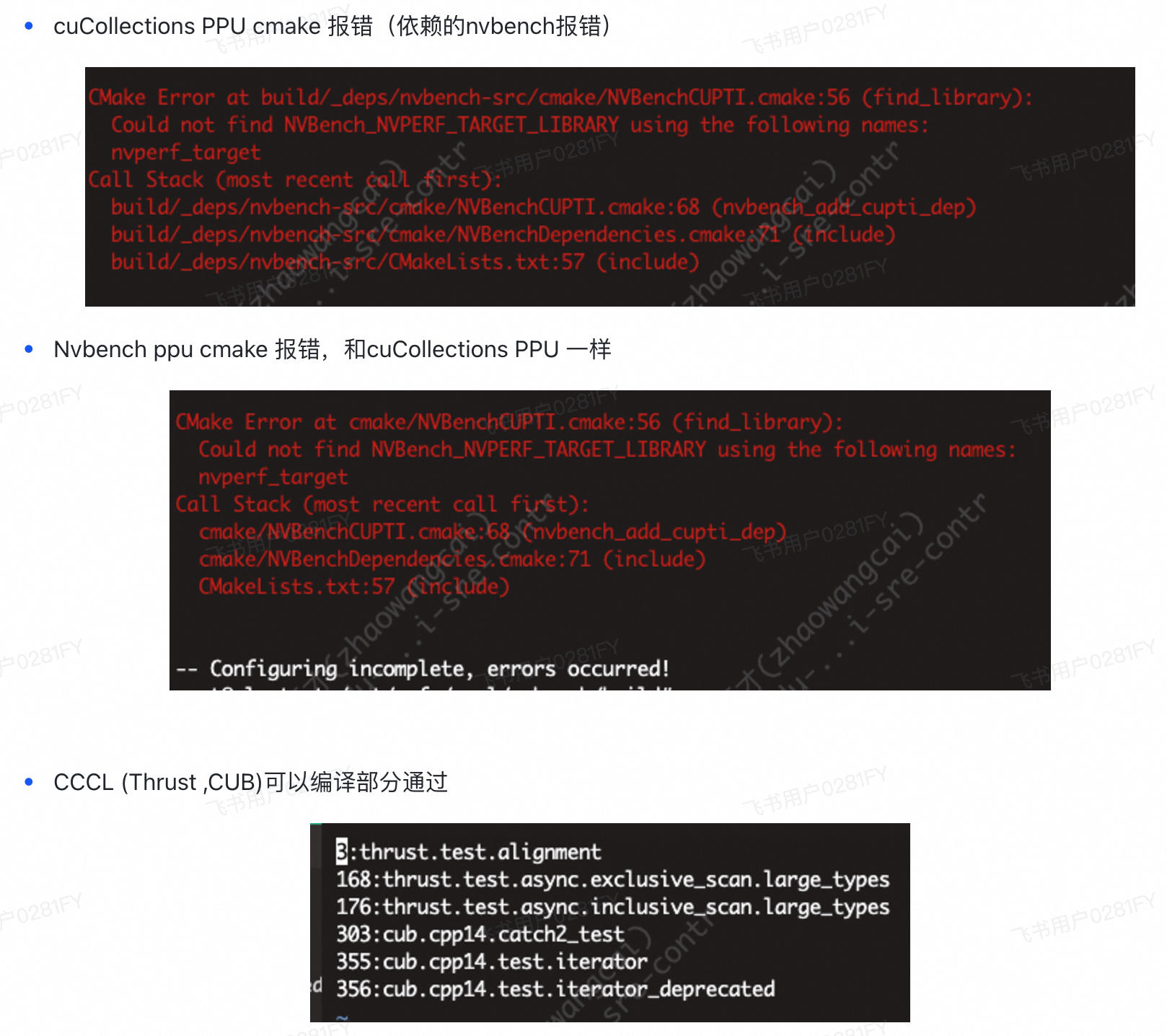
The linking errors shown in tools like
nvbenchoccur because they use the CUPTI Perfworks API, which PPU does not currently support.CUPTI is a performance analysis library provided in CUDA for developing profiling tools. NVIDIA's own Nsight tools are also developed using CUPTI APIs.
The most commonly used parts of the CUPTI library are the CUPTI Activity API and the CUPTI Callback API. Both are used in TensorFlow and PyTorch, and the PPU SDK supports them.
The Perfworks API is primarily used by NVIDIA's own Nsight Compute tool and is rarely used by third-party applications. As a result, support for it is progressing more slowly.
In PPU SDK 1.5, we will first resolve the linking issues with the Perfworks library. In subsequent PPU SDK versions, we will incrementally support a PPU-compatible version of nvbench by implementing the APIs it requires.