Repurchase prediction overview
Repurchase prediction uses past purchase records to train an algorithm model. The model predicts the likelihood that a user will make another purchase within a specified period. This process helps you identify large groups of people outside your core audience who are highly likely to repurchase. You can then run targeted campaigns for these groups to increase your brand's repurchase rate.
The following figure shows the data and feature flow.
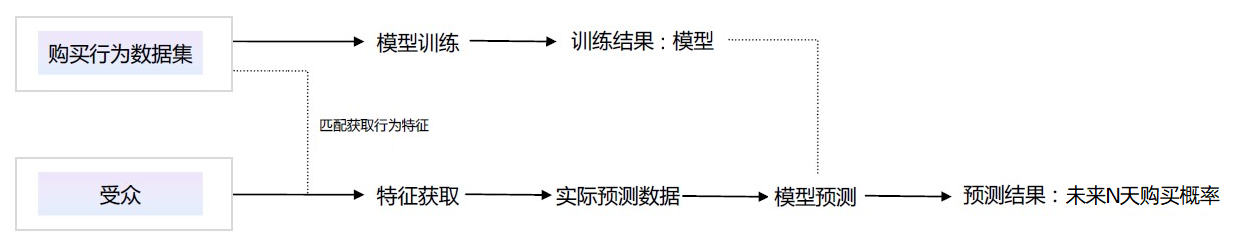
Data requirements
You must provide a behavioral dataset to train the algorithm model. For more information about the requirements for the behavioral dataset, see Behavioral Dataset Example.
The users and time periods that you can predict depend on the behavioral dataset:
Range of predictable users: Predictions are limited to users in the behavioral dataset who have made a purchase within the last year. The term "last year" refers to the one-year period before the most recent behavior time recorded in the dataset. Predictions cannot be made for users who have not made a purchase within this period.
Range of predictable periods: The prediction period is the N days following the most recent behavior recorded in the dataset. You can set N to a value from 15 to 90. For an example, see the following figure.
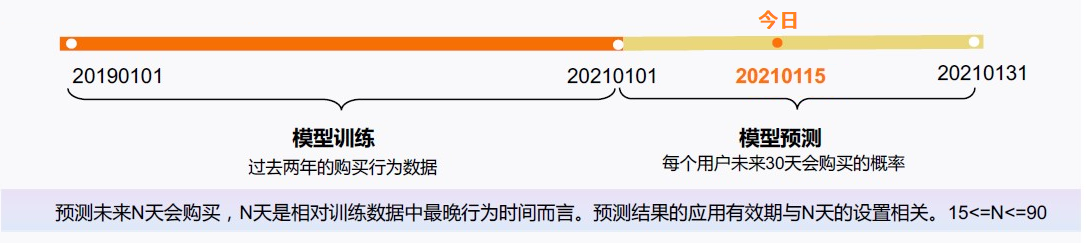
Workflow
Purchase the Repurchase Prediction feature package. For more information, see Pricing List and Billing Guide.
Connect to a data source. This feature analyzes data only from workspace data sources or organization data sources of the ADB 3.0 type. For more information, see Create a workspace data source and Grant permissions on tables in an organization data source.
Prepare a behavioral data table that meets the requirements in Behavioral Dataset Example, and then create a behavioral dataset.
Create an algorithm model. After the model is trained, you can view its training details to check the top 10 training features and validation results. For more information, see Model Configuration.
Update the model when your data changes significantly to maintain the accuracy of audience predictions. For more information, see Manual Update.
Create an audience prediction task from an existing algorithm model. You can then view and use the prediction results. For more information, see Audience Prediction.