SAIL software stack
Documentation for the T-Head SAIL® software stack, covering the SDK, drivers, high-performance interconnect, profiling tools, and other software modules. It describes how the stack's modules are organized and helps you quickly find the documentation you need for your scenario.
T-Head SAIL overview
T-Head SAIL is the software stack that T-Head built for its Zhenwu series AI chips. T-Head owns the full intellectual property, and the stack is fully compatible with mainstream AI ecosystems. The stack spans the OS layer, the SDK layer, and the interface layer: it exposes Zhenwu hardware compute to the layers above and supports the requirements of upper-layer applications.
You can use the stack through official Lingjun instance images, such as the base system image and the inference and training container images. The base system image includes the device drivers that the OS layer requires, high-performance network components, a cloud service access client, and system optimizations for business scenarios. The training and inference container images include the SDK in the SAIL software stack, along with some AI frameworks and toolchains.
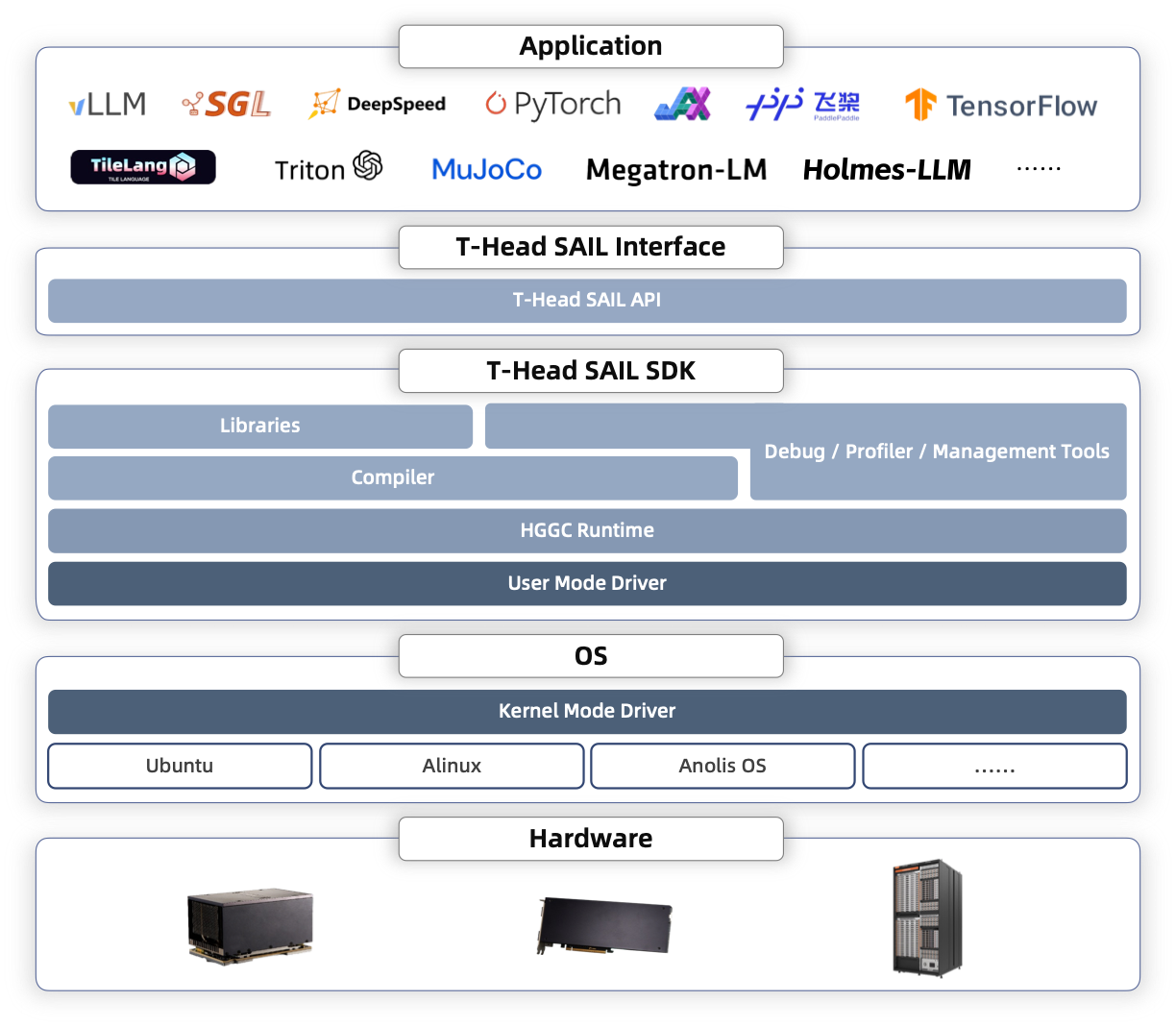
Application layer
The T-Head SAIL software stack supports mainstream open-source AI frameworks and toolchains across deep learning, high-performance computing, and other application scenarios. All frameworks use the T-Head SAIL API to access the underlying Zhenwu PPU hardware compute, so you can migrate application code without changes.
vLLM, SGLang, PyTorch, TensorFlow, and MXNet
Triton, Megatron-LM, DeepSpeed, PaddlePaddle, and Holmes-LLM, among others
SDK layer
T-Head SAIL SDK is a complete AI software development kit developed by T-Head. It provides a unified programming interface, the T-Head SAIL API, and native programming interfaces such as the HGGC Runtime API and the HGGC Driver API. The current version is T-Head SAIL v2.2.x, which supports the full Zhenwu hardware lineup, including Zhenwu M890 and Zhenwu 810E.
The SDK layer contains seven core modules:
Module | Description | Documentation |
T-Head SAIL user driver | T-Head SAIL HGGC Driver API | |
T-Head SAIL runtime | T-Head SAIL HGGC Runtime API | |
Compiler | T-Head SAIL HGCC, HGRTC, hgJitLink, libHGVM, libPPUDevice, Binary Utilities, hgFatbinary, PPU-GDB, HGGC Memcheck, Sanitizer API, and other compiler drivers, libraries, and tools | |
Device operations and maintenance | T-Head SAIL PPU-SMI | |
Acceleration libraries | The T-Head SAIL acceleration libraries acDNN, acBLAS, acFFT, acSOLVER, acRAND, and acSPARSE (closed source) | |
High-performance interconnect | PCCL collective communication, DeepEP expert parallelism, and the sailbandwidth bandwidth diagnostic tool, supporting ICN, PCIe, and RDMA interconnects | |
Profiling tools | The Asight Systems and Asight Compute profiling tools |
For complete documentation and usage guides for each module, see SDK layer.
OS layer: kernel-mode driver (KMD)
The OS layer includes the kernel-mode driver (KMD) and operating system adaptation. This section covers the KMD, which handles hardware abstraction and resource scheduling, and provides performance isolation and stability in multi-tenant environments:
Module | Description | Documentation |
Kernel-mode driver | The Zhenwu PPU kernel driver, ECC error handling, and power and performance management | |
Virtualization | MIG multi-instance isolation, vGPU virtualization, and SR-IOV and container support |