EventHouse overview
Overview
EventHouse is the cloud-native event lakehouse for EventBridge. It stores, governs, and intelligently analyzes event data.
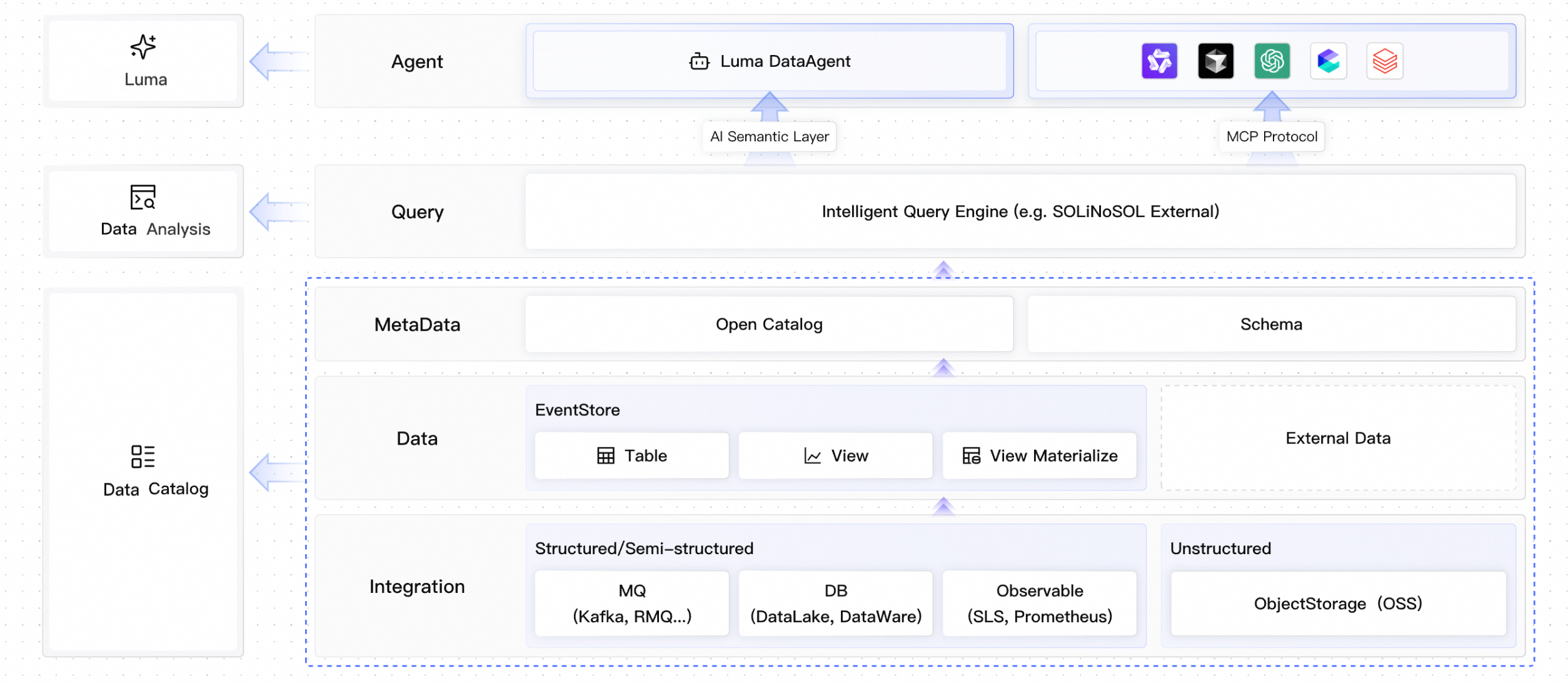
While the EventBridge event bus routes and distributes events, EventHouse addresses what happens after events are stored. It unifies structured, semi-structured, and unstructured data from sources such as message queues (Kafka, RocketMQ), relational databases (MySQL), and Object Storage Service (OSS) into a standard event model. The built-in Open Catalog and AI semantic layer provide Zero-ETL management of heterogeneous data sources and enable real-time analysis through SQL queries or AI Agents.
Core Components
EventHouse consists of three core components that work both independently and collaboratively:
|
Component |
Purpose |
Core Capabilities |
|
Metadata management center |
Multi-source metadata registration, schema evolution, data lineage tracking, fine-grained access control |
|
|
Compute engine layer |
Stream-batch SQL, federated query, materialized view, real-time anomaly detection |
|
|
AI analysis layer |
AI semantic layer, MCP protocol integration, DataAgent autonomous analysis, natural language query |
Core Value
Zero-ETL (Seamless Data Integration)
Directly map external data sources such as RDS and OSS and run federated queries without moving data into EventHouse. This reduces data latency and storage costs.
Unified Governance
The Open Catalog brings standardized metadata management and data lineage tracking to schema-less data in message queues, often called "dark data", helping break down data silos.
Agentic Analytics
EventHouse natively integrates the Model Context Protocol (MCP), allowing AI Agents to understand event data structures and perform analysis using natural language queries.
Data Catalog
The Data Catalog is the metadata management center for EventHouse. It manages metadata, schema definitions, access permissions, and data lineage for all connected data sources.
Unified Metadata Management
-
Multi-source Mapping: Automatically discovers and registers metadata from data sources such as Kafka, RocketMQ, and RDS.
-
Schema Evolution: Automatically infers and manages schema versions for event data. When upstream fields change, compatibility version control ensures downstream analysis tasks continue without interruption.
-
Data Lineage Tracking: Tracks the full lifecycle of events from production (Producer) and storage (EventStore) to analysis (Analysis), supporting troubleshooting and impact assessment.
Open Ecosystem Compatibility
The Open Catalog supports open table formats such as Iceberg, Hudi, and Delta Lake. Your data is not vendor-locked, so you can freely choose your preferred compute engines.
Permissions and Security
Fine-grained access control (ACL) is available at three levels: database, table, and column.
Application Scenario: Unified Data View
In an e-commerce scenario, order data might be scattered across RocketMQ for real-time streams and MySQL for persistence. You can create a unified View in the Catalog to logically associate real-time order streams in MQ with user information tables in the database. You can then query this View directly without knowing the physical storage location of the underlying data.
Data Analysis
Data Analysis is the compute engine layer of EventHouse, providing high-performance SQL queries, stream processing, and federated query capabilities.
Intelligent Query Engine
-
Multimodal Query: Supports three query modes: SQL for structured queries, NoSQL for document queries, and External for external data source queries.
-
Stream-Batch Integration: The same SQL syntax can query both historical archived data (Batch) and real-time incoming event streams (Streaming).
-
Materialized View: Pre-computed materialized views cache high-frequency query results for millisecond-level response times.
Federated Query
-
Cross-Source Federated Analysis: Directly associate EventHouse internal tables with external data sources such as OSS log files and RDS dimension tables by using SQL
JOIN, without data migration. -
Predicate Pushdown: Filter conditions are pushed down to the source for execution, so only necessary data is pulled, improving query efficiency.
Real-time Anomaly Detection
-
Built-in time window functions (Tumble, Hop, and Session) calculate metrics such as transaction success rates and latency distributions in real time.
-
Combine this with a rules engine to automatically trigger an alert event when analysis results exceed a threshold, for example, "more than 100 failed orders in 1 minute".
Technical Advantages
|
Feature |
Description |
|
Storage-Compute Separation |
Storage uses low-cost Object Storage Service. Compute resources auto-scale to handle traffic peaks. |
|
High Compression Ratio |
Columnar compression for event data (JSON/CloudEvents) reduces storage costs by over 50% compared to traditional databases. |
Intelligent Analysis Luma
Luma is the AI analysis layer of EventHouse. Its AI semantic layer and MCP protocol enable large language models (LLMs) to understand and analyze event data directly.
DataAgent
Luma includes a built-in DataAgent that autonomously runs a perceive-plan-act loop:
-
Perception: An abnormal drop in transaction volume was detected.
-
Plan: Decides to query associated payment gateway logs and database connection pool status.
-
Act: Automatically generates SQL for association analysis and outputs a root cause report.
AI Semantic Layer
Traditional database fields such as col_1 and status_code often lack business meaning that AI models can interpret. Luma lets you add business descriptions, synonyms, and computation logic to fields in the Catalog, improving the accuracy of Text-to-SQL conversion.
Example : If you ask "Query yesterday's failed orders in Beijing" in natural language, Luma automatically generates the corresponding SQL and returns the results.
Application Scenario: E-commerce Risk Control
-
An operations team member asks, "Have there been any abnormal brushing behaviors in the last half hour?"
-
The Luma Agent retrieves Catalog information using MCP and identifies the
Transaction_TableandUser_Behavior_Log. -
The Agent automatically generates association SQL (including time window, IP aggregation, and device fingerprint analysis) and executes it in the EventHouse analysis engine.
-
It returns a list of suspected brushing UserIDs and generates a risk report using the knowledge base.
MCP Protocol Integration
EventHouse natively supports MCP. Any AI Agent that supports MCP, such as LangChain, Dify, or custom Agents, can connect to EventHouse:
-
Tool-based Query: Query capabilities are encapsulated as MCP Tools that the Agent autonomously invokes based on user intent.
-
Context-Awareness: The Agent retrieves the data schema as context to produce more accurate analysis results.
MCP protocol integration is not yet generally available. For the specific release date, follow our product updates.