HCI integrates leading technologies such as compute virtualization, network virtualization, and storage virtualization. It helps you build a simple, stable, secure, and efficient IT infrastructure.
Benefits
HCI combines the 4S benefits of Apsara Stack (Simple, Strong, Scalable, and Smart) with the elasticity and multi-data center disaster recovery and backup capabilities of the Alibaba Cloud public cloud.
Apsara Stack benefits
HCI is a next-generation Infrastructure as a Service (IaaS) cloud platform designed based on the 4S (Simple, Strong, Scalable, and Smart) standards of the Apsara Stack platform.
Simple
Simple installation and deployment: You can download the installation file and deploy the cloud platform on a bare machine in 30 minutes.
Simple cloud platform setup: You can perform batch operations, such as creating and deleting cloud hosts. The platform provides list views and slide-out detail panels.
Simple and practical operations: HCI provides detailed user manuals, comprehensive help information, community support, and standard Application Programming Interfaces (APIs).
User-friendly UI: A well-designed, professional interface with simple operations to access powerful features.
Strong
Stable and efficient system architecture: The system architecture is stable and efficient. It features a fully asynchronous backend, an in-process microservices model, a lock-free architecture, a stateless service architecture, and a consistent hashing ring. A single management node can manage tens of thousands of physical hosts and hundreds of thousands of cloud hosts. A cluster of multiple management nodes that uses one database and one message bus can manage hundreds of thousands of physical hosts, millions of cloud hosts, and concurrently process tens of thousands of API requests.
Support for high-concurrency API requests: A single HCI management node can handle tens of thousands of concurrent API calls per second.
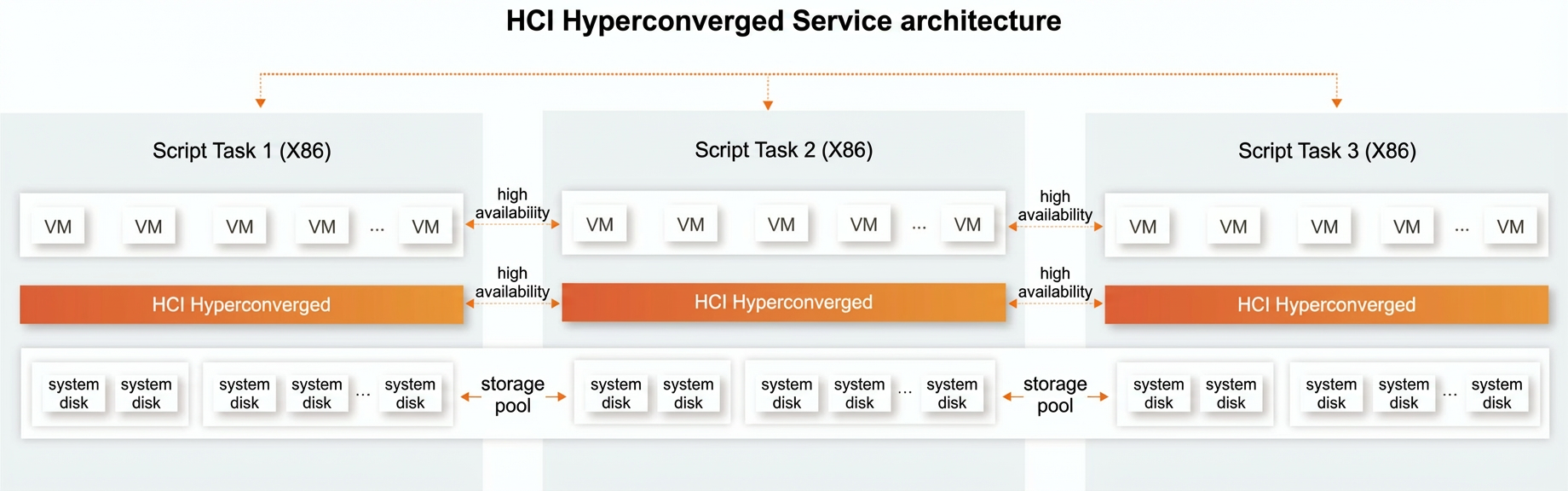
Meets strict high availability (HA) requirements: If a network or node fails, cloud hosts can automatically fail over to healthy nodes. The virtualization of management nodes provides HA for a single management node. This also supports dynamic migration of the management node in the event of a failure.
Scalable
Large-scale management: A single management node can manage from one to tens of thousands of physical hosts and hundreds of thousands of cloud hosts.
Comprehensive API support: HCI provides a complete set of IaaS APIs. You can use these APIs to build new cross-region available areas, change network configurations, and upgrade physical servers.
On-demand resource allocation: You can scale important resources, such as cloud hosts and cloud storage, as needed. HCI supports online changes to cloud host resources such as CPU and memory. You can also dynamically adjust resources such as network bandwidth and disk bandwidth for cloud hosts.
Smart
Automated Operations and Maintenance (O&M) and management: In an HCI environment, all operations are managed by APIs. HCI uses the Ansible library for fully automated deployment and upgrades. It provides automatic detection and reconnection for each node after network jitter or a physical host restart. Scheduled tasks support operations such as powering cloud hosts on or off at specific times and creating cloud host snapshots through polling.
Seamless online upgrades: You can perform a one-click, seamless upgrade in five minutes by upgrading only the management node. The compute, storage, and network nodes automatically upgrade after the management software starts.
Real-time global monitoring: You can obtain a real-time view of system resource consumption across the entire cloud platform. Real-time monitoring and intelligent allocation help you save on IT hardware and software resources.
Product introduction
For more information, see HCI Product Introduction.pdf.
Technical whitepapers
For more information, see HCI Technical Whitepaper.pdf.