Integration process
The mobile SDK and server integration allows you to perform online user verification in your existing mobile app. This topic describes how to integrate the Financial-grade Multi-factor Intent Verification SDK into your mobile app.
Integration
Alibaba Cloud provides SDKs for multiple programming languages, including Java, C#, Go, Python, Node.js/TypeScript, PHP, and C++. You can integrate an SDK to call the service's API operations. The SDKs simplify development by encapsulating the signature mechanism, timeout mechanism, and retry mechanism, and returning structured Response objects.
If the SDK-based approach does not meet your business needs, you can call the service APIs natively over HTTP or HTTPS. This requires you to build custom requests and handle the signature mechanism. The Alibaba Cloud SDKs already implement the signature algorithm. For more details, see V3 RPC-style request body & signature mechanism.
Background
The following sequence diagram shows the overall integration flow for a mobile app.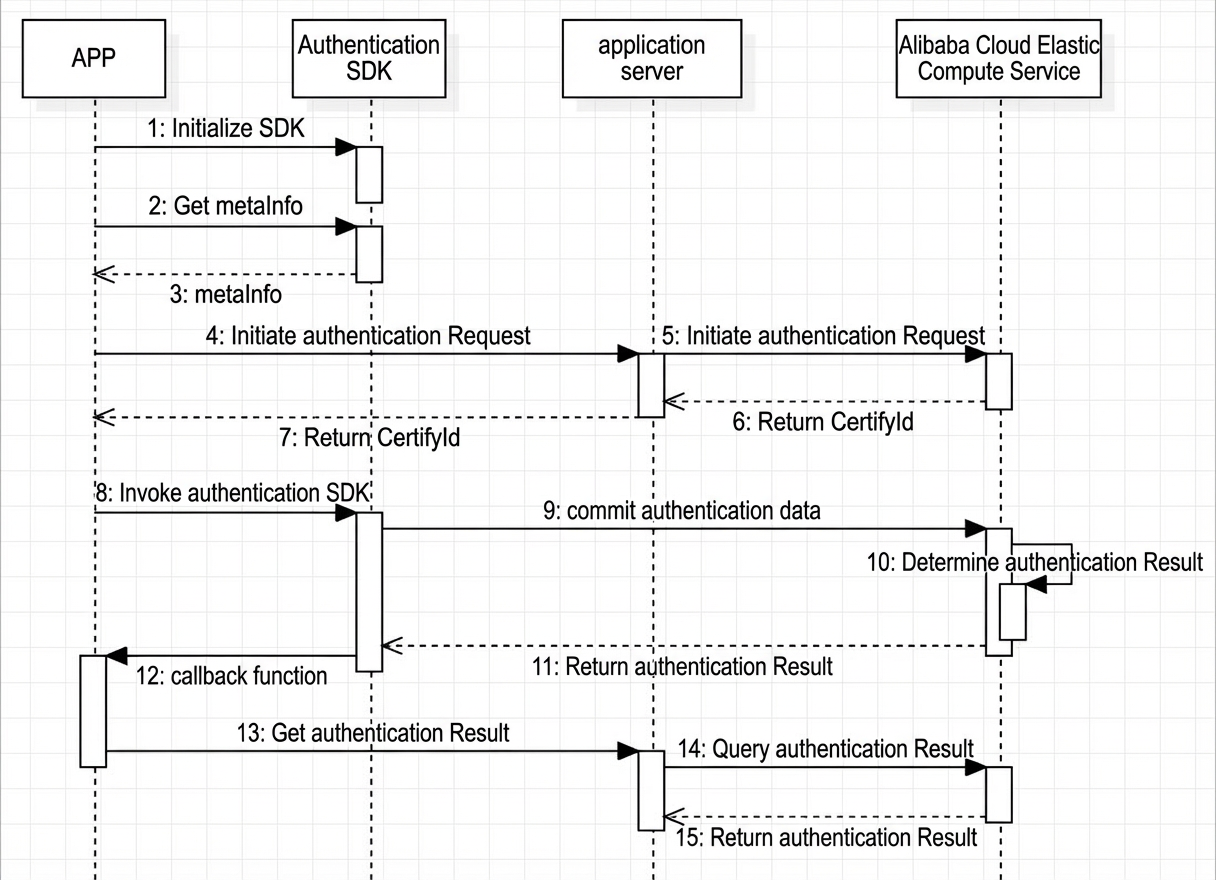
Table 1. System call sequence
Step | Description |
1 | Initialize the authentication SDK. |
2 | The app calls the authentication SDK to obtain the MetaInfo. |
3 | The authentication SDK returns MetaInfo. |
4 | The app sends an authentication request with the MetaInfo to the application server. |
5 | The application server calls the authentication request API on the Alibaba Cloud backend. |
6 | The Alibaba Cloud backend returns a CertifyId to the application server. |
7 | The application server passes the CertifyId to the app. |
8 | The app calls the authentication SDK with the CertifyId. |
9 | The authentication SDK sends the user-submitted authentication materials to the Alibaba Cloud backend. |
10 | The Alibaba Cloud backend determines the authentication result based on the submitted materials. |
11 | The Alibaba Cloud backend returns a completion status to the authentication SDK. |
12 | The authentication SDK triggers a callback function to signal the app to retrieve the authentication result. |
13 | The app queries the application server for the authentication result. |
14 | The application server queries the Alibaba Cloud backend for the authentication result. |
15 | The Alibaba Cloud backend returns the authentication result to the application server. |
Procedure
- Note
When adding a verification scenario, you can authorize Alibaba Cloud to access a specified OSS bucket to store images from the verification process. For more information, see Activate and authorize OSS storage.
- Set up multi-factor intent verification. For more information, see Set up intent verification.
- Integrate the Financial-grade Multi-factor Intent Verification solution.
- Call the server-side initialization API InitFaceVerify.
Call this API to obtain the CertifyId, which is the unique identifier for a real-person verification process. It is required to start the SDK and correlates all API calls within a single verification request. For more information, see InitFaceVerify - Initiate a verification request.
- Integrate the client-side SDK.
For platform-specific steps, see the following topics:
- Call the server-side query API DescribeFaceVerify.
After verification is complete, call this API from your application server to get the verification status and materials. For more information, see DescribeFaceVerify - Obtain a verification result.
- Call the server-side initialization API InitFaceVerify.