Device development guide for IoT Platform
This topic describes the recommended methods for connecting different types of devices to Alibaba Cloud IoT Platform.
Device manufacturers
Device manufacturers are vendors that develop and sell finished products.
Wi-Fi devices: Wi-Fi devices use Wi-Fi to connect to a network and communicate with Alibaba Cloud IoT Platform.
Ethernet devices: Ethernet devices use the Ethernet protocol to connect to a network and communicate with Alibaba Cloud IoT Platform.
WAN devices: Wide area network (WAN) devices use mobile cellular protocols to connect to a network and communicate with Alibaba Cloud IoT Platform. Two connection patterns are available:
MCU + module pattern: In this pattern, the product contains a microcontroller unit (MCU) and a communication module. The MCU integrates the Link software development kit (SDK) and runs the product logic. The module initiates the connection to Alibaba Cloud IoT Platform. The following figure shows this pattern.
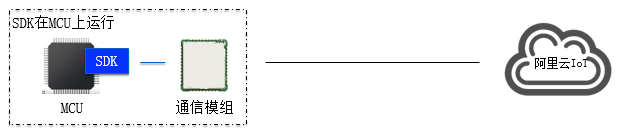
For more information, see Connect to IoT Platform using an MCU and a WAN module.
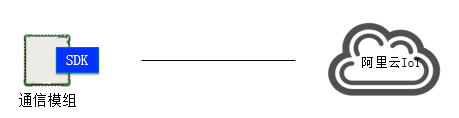
OpenCPU pattern: In this pattern, the device manufacturer runs the product's business logic directly on the WAN chip.
Gateways and sub-devices: A gateway device must integrate the Link SDK to connect to Alibaba Cloud IoT Platform. The gateway also acts as an agent to connect its sub-devices to the platform. The following figure shows this process:
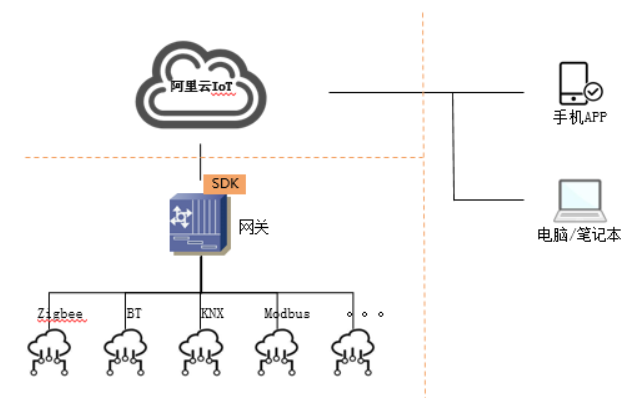
For more information, see Connect a gateway to IoT Platform.
DTUs: A data transfer unit (DTU) is a device that connects to various sensors through interfaces such as RS232 and RS485. After the Link SDK is integrated with the DTU, the DTU can connect the sensors to Alibaba Cloud IoT Platform.

Integrating the Link SDK on a DTU is similar to the OpenCPU pattern.
Module manufacturers
This section is for manufacturers of Wi-Fi, 2G, 3G, 4G mobile communication, and NB-IoT modules. It does not cover LoRa module manufacturers.
When module manufacturers integrate the Link SDK into their modules, device manufacturers can use these modules to develop their products. This reduces hardware adaptation time and product development costs. Device manufacturers can then focus on developing business features.
The following sections describe each type of module:
Wi-Fi modules: Alibaba Cloud recommends that Wi-Fi module manufacturers integrate AliOS Things. AliOS Things already includes the Link SDK and a complete hardware abstraction layer (HAL) implementation for the Link SDK. AliOS Things also provides features such as over-the-air (OTA) updates. This can shorten development time for module manufacturers.
To learn about the AliOS Things module porting guide, contact us before you begin the integration. We will assign resources to provide technical support. For more information about Wi-Fi modules, see the Wi-Fi Module Porting Guide.
2G, 3G, and 4G mobile communication modules: Use Message Queuing Telemetry Transport (MQTT) to connect to Alibaba Cloud IoT Platform.
This module supports the TCP protocol.
For modules that do not support MQTT but support TCP, see Integrate the SDK on a WAN module that supports TCP.
Modules that support MQTT
For modules that support MQTT, see Integrate the SDK on a module that supports MQTT.
NB-IoT modules: Use MQTT to connect to Alibaba Cloud IoT Platform.
Modules that support TCP
For modules that do not support MQTT but support TCP, see Integrate the SDK on a WAN module that supports TCP.
This module supports the MQTT protocol.
For modules that support MQTT, see Integrate the SDK on a module that supports MQTT.