Low-cost archive database for RDS
When you use Lindorm with a relational database, you can benefit from low storage costs, simplified O&M, and elastic scaling. This topic describes the solution architecture and its benefits.
The low-cost archive database for RDS scenario is not supported for Lindorm instances purchased after March 10, 2023. However, this scenario is still supported for instances purchased on or before this date.
Background information
The rapid growth of the mobile internet generates vast amounts of business data. As businesses expand, this data volume increases significantly, but historical data is accessed less frequently over time. Storing all of this data in a relational database can lead to several problems.
Challenges:
Increased storage costs: As the data volume grows, storage costs increase proportionally.
Decreased query performance: Query performance can drop sharply when the data in a single instance grows beyond several terabytes.
High O&M complexity: Using sharding to address performance degradation from a large data volume significantly increases O&M and development costs.
Requirements:
Controllable storage costs: The storage cost for historical data should be one-tenth of the cost for online data.
Elastic scaling: Compute and storage capabilities must scale out automatically, eliminating the O&M pain points of sharding.
Low-cost schema modification: The solution must support fast or dynamic schema modifications to avoid the long processing times typically associated with schema changes in archive databases.
Low migration costs: The database must support access through SQL.
Real-time query capability: For scenarios such as querying consumer bills or chat records, the response time (RT) for historical data queries must be close to that of online data queries.
Data analytics capability: Although historical data is accessed infrequently, some business scenarios, such as generating Alipay's annual bill summary, require analysis of the full dataset.
Lindorm (ApsaraDB for HBase Performance-enhanced Edition) provides low storage costs, simplified O&M, elastic scaling, and stable performance. It pairs perfectly with relational databases, making it an ideal choice for a real-time, low-cost archive database.
Solution architecture
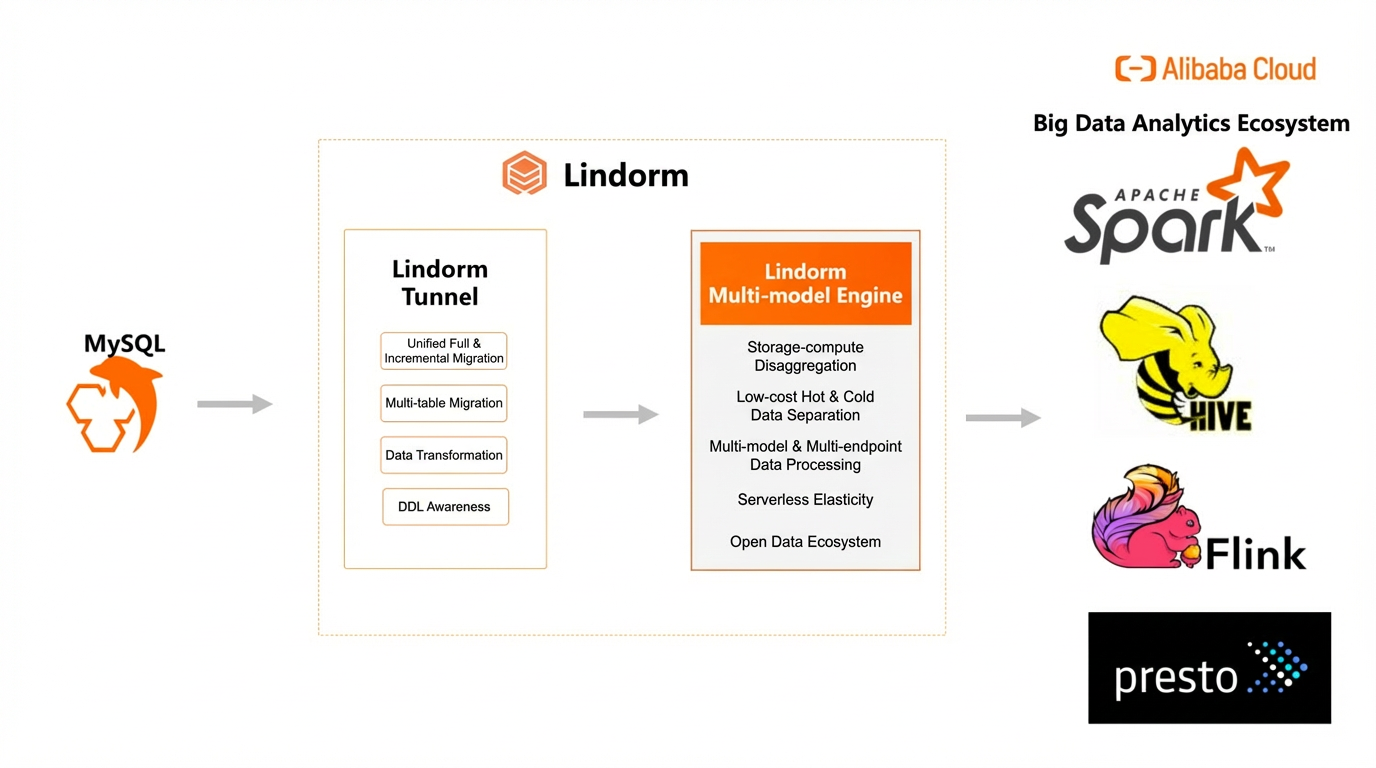
The Lindorm data synchronization service connects to relational databases, such as MySQL, to support both full and incremental data synchronization. It also provides enterprise-level synchronization capabilities, such as multi-table migration, data change detection, and Data Definition Language (DDL) awareness, to help you migrate data easily and efficiently.
Lindorm provides low-cost storage for massive data volumes(CNY 0.12/GB/month), elastic scaling with pay-as-you-go billing, and multi-model processing capabilities to meet data storage needs in various scenarios. Lindorm also seamlessly integrates with open source analytics ecosystems, such as Spark, Hive, Flink, and Presto. This integration meets complex data analysis requirements and maximizes data value.
Benefits
Simple and easy to use
You can configure data migration visually in minutes.
Support for both full and incremental synchronization minimizes usage costs.
Features such as multi-table migration and data transformation help you easily merge multiple tables and combine fields.
Comprehensive monitoring and alerting ensure the stability of data synchronization.
Cost-effective
Storage-optimized instances reduce storage costs to as low as CNY 0.12/GB/month. While storage costs are optimized, the built-in buffer acceleration layer ensures real-time query performance, making these instances an ideal storage choice for real-time archive databases.
In terms of performance, LindormTable has made significant breakthroughs in throughput and latency. Its baseline performance is seven times that of open source HBase. For more information, see Test results. LindormTSDB incorporates many innovative, high-performance schema designs. Its baseline performance ranks first on the current China Academy of Information and Communications Technology (CAICT) list, outperforming other dedicated time series databases.
Lindorm supports intelligent hot and cold data separation. For scenarios where data cools over time, such as monitoring, social media chats, and transaction bills, Lindorm automatically identifies hot and cold data. It then stores the data on separate high-performance or low-cost media. The unit price difference between these media can be as high as 10:1. Read and write access remains completely transparent to users, and the access performance for hot data is accelerated.
Lindorm supports adaptive compression. The system automatically selects the optimal combination of compression algorithms, such as dictionary, prefix, delta, and entropy encoding, based on the data type and its characteristics. This improves the overall compression ratio by 10% to 30% compared to common industry algorithms.
Cloud-native elasticity
Lindorm uses a decoupled storage and compute architecture. This architecture supports independent elastic scaling of compute and storage resources to minimize resource waste.
Lindorm also provides a Serverless service that offers on-demand elasticity and pay-as-you-go billing. Lindorm Serverless is built on multi-tenant data isolation, intelligent scheduling, and an elastic Infrastructure as a Service (IaaS) foundation. It provides an enterprise-grade Service-Level Agreement (SLA) and meets the availability requirements for most internal services. This significantly reduces the O&M burden of capacity management and eliminates stability risks caused by traffic fluctuations.
Multimodal and Retrieval
Lindorm is compatible with major open standard interfaces such as HBase, Phoenix (SQL), and Cassandra (CQL). This compatibility minimizes migration costs. Lindorm also provides features such as global secondary indexes, multi-dimensional retrieval, dynamic columns, and TTL to meet the needs of various scenarios, such as metadata, orders, bills, user profiles, social feeds, and logs.
You can enable the search engine with one click. The search engine is compatible with the open source Solr standard interface and provides full-text search, aggregate computing, and complex multi-dimensional query capabilities. This helps accelerate data retrieval and meet real-time complex analysis needs.
Big data ecosystem
Lindorm seamlessly integrates with open source big data products such as Spark, Hive, Flink, and Presto. It supports multiple connection methods, such as API access and file reads, to easily and efficiently meet your massive data analysis needs.
Typical applications
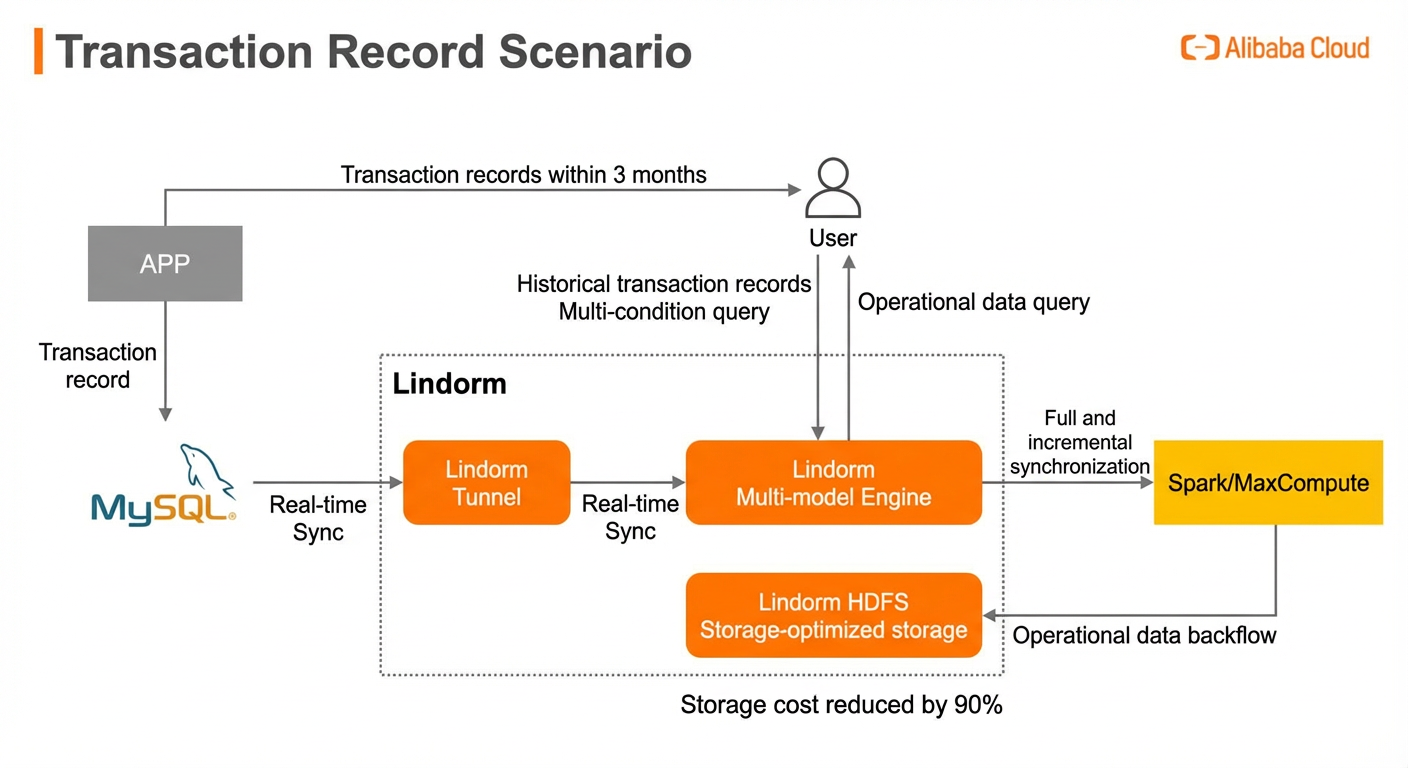
User transaction records are written to MySQL from an application. Lindorm synchronizes the data from MySQL to Lindorm in real time. Records from the last three months, whose status may frequently change, are queried from MySQL. Transaction records older than three months are queried from Lindorm. Historical transaction records are stored in storage-optimized instances, which reduces storage costs by more than 90%.
For real-time retrieval with complex conditions, such as queries that combine time, location, amount, and transaction notes, you can use the full-text search, aggregate computing, and complex multi-dimensional query capabilities of the Lindorm search engine. This easily meets user needs without requiring business logic changes.
You can use Lindorm to synchronize bill data to offline computing platforms such as Spark or MaxCompute. The data is then analyzed to generate operations reports based on business requirements. These reports are then written back to Lindorm for real-time queries.