Cloud-native migration solution for HDFS
The Lindorm file engine is a distributed file storage service for large amounts of unstructured data. It is fully compatible with Hadoop Distributed File System (HDFS) protocols, so you can migrate data from a self-managed HDFS cluster to Alibaba Cloud without modifying your application code.
When to migrate
Migrate your self-managed HDFS cluster to Lindorm if you want to:
-
Cut infrastructure costs — The total cost of ownership (TCO) for Lindorm can be less than 50% of a self-managed HDFS cluster.
-
Separate storage from compute — Scale storage and compute resources independently to build a cloud-native architecture.
-
Eliminate cluster maintenance — Hand off cluster operations to a team with ten years of expertise.
Solution overview
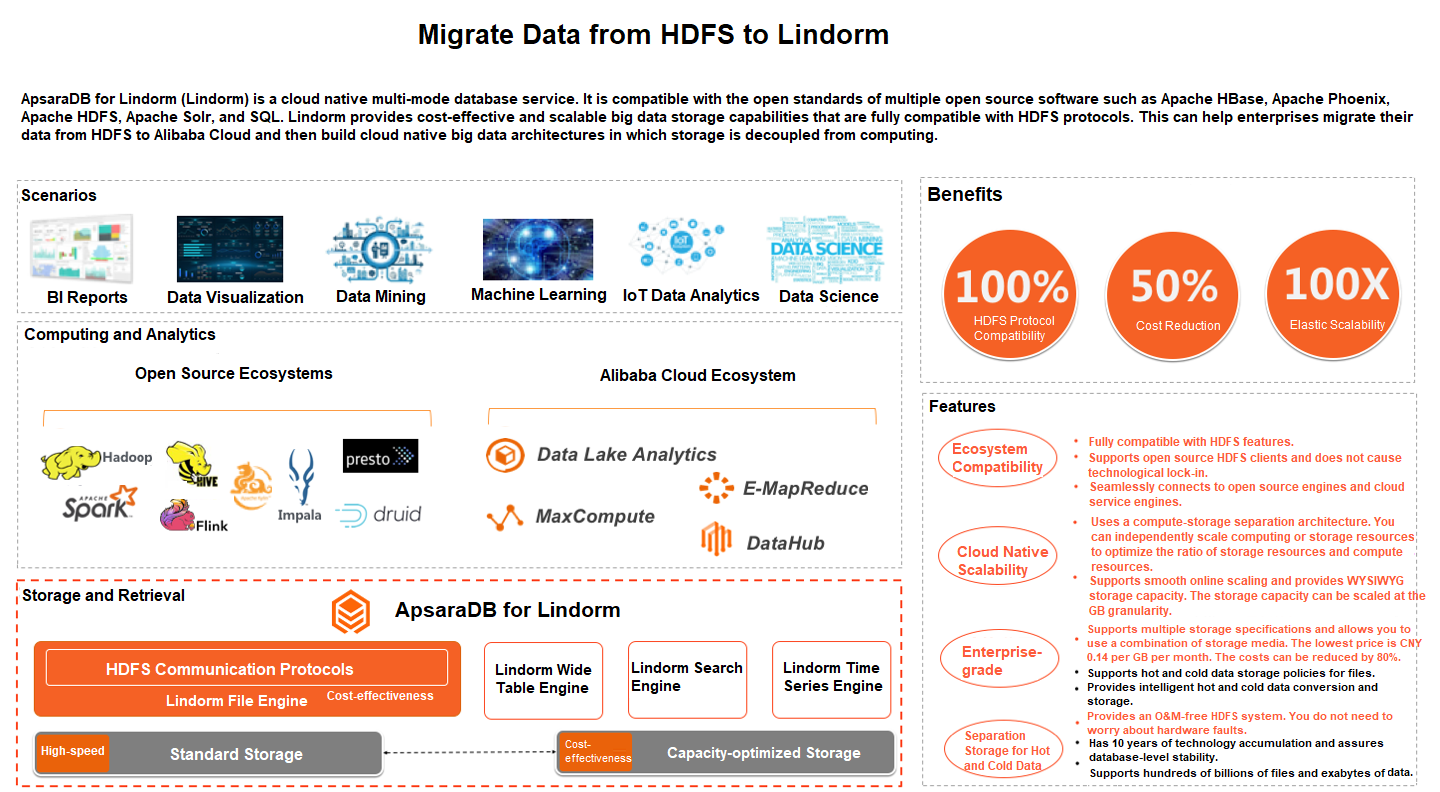
Migrate data from HDFS to Lindorm
-
Activate the file engine for your Lindorm instance.
-
Migrate the data in your self-managed HDFS cluster to your Lindorm instance.
-
Change the service address of your upper-layer computing application — for example, Hadoop, Hive, or Spark — from the HDFS server address to the file engine endpoint of your Lindorm instance.
-
Deactivate or scale down your self-managed HDFS cluster. For example, use the cluster scaling feature to change local disk nodes to compute-optimized ECS instances. This upgrades your architecture to a compute-storage separation architecture.
What's next
If you have questions, contact an expert. For more information, see Expert support.