Data asset classification
Data asset levels are determined by the business impact of poor data quality, which includes issues with completeness, accuracy, consistency, and timeliness.
The data asset levels are defined as follows:
- Destructive: Errors in data can lead to substantial asset loss and significant revenue decline. This is designated as A1.
- Global: Data that is used directly or indirectly for enterprise-level business activities, performance assessments, and critical decision-making. This is designated as A2.
- Local: Data that influences the operation and reporting of specific lines-of-business. Issues here can impact the business unit concerned or decrease operational efficiency. This is designated as A3.
- General: Data primarily utilized for routine data analysis, where the repercussions of issues are relatively minor. This is designated as A4.
- Unknown: Data with application scenarios that cannot be clearly identified. This is designated as Ax.
The asset level labels are A1 for Critical, A2 for High, A3 for Medium, A4 for Low, and Ax for Unknown. The levels are ranked by importance as follows: A1 > A2 > A3 > A4 > Ax.
In a data link, you can identify the applications that use each table and assign a data asset level to these applications. Based on these levels and the downstream dependencies, you can then assign an asset level to the entire data link. For example, consider an online operations analysis platform with a single application named PV_UV_Region. This application tracks website page views (PV) and unique visitors (UV), and groups statistics by user terminal type and region. If this application directly affects key business decisions, you can classify it as A2. As a result, all tables in its data link can be labeled A2-PV_UV_Region.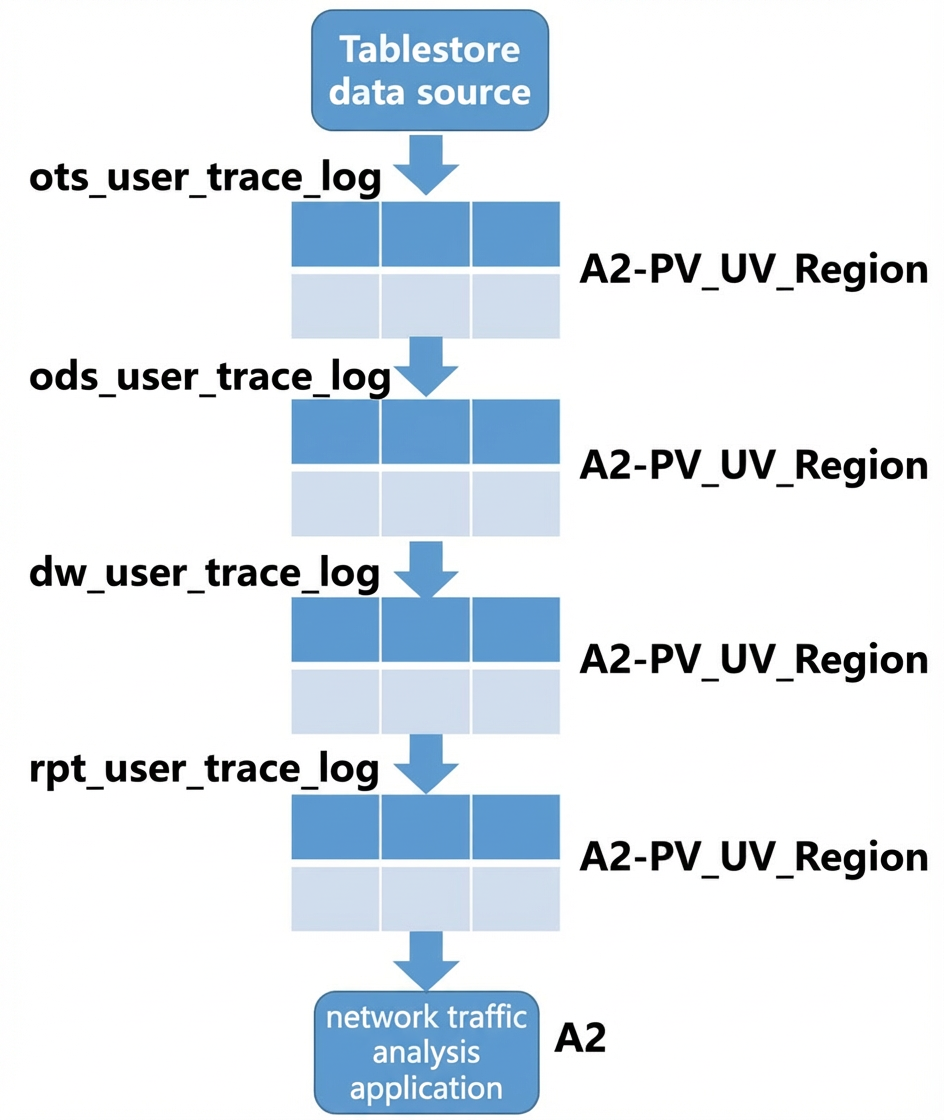
MaxCompute does not currently provide a tool for labeling data asset levels. You must use a third-party tool to perform this task.