Concept hierarchy
MaxCompute organizes its resources using a layered concept hierarchy. Understanding this hierarchy helps you plan projects and manage access control before you start building.
The figure below shows the full hierarchy.
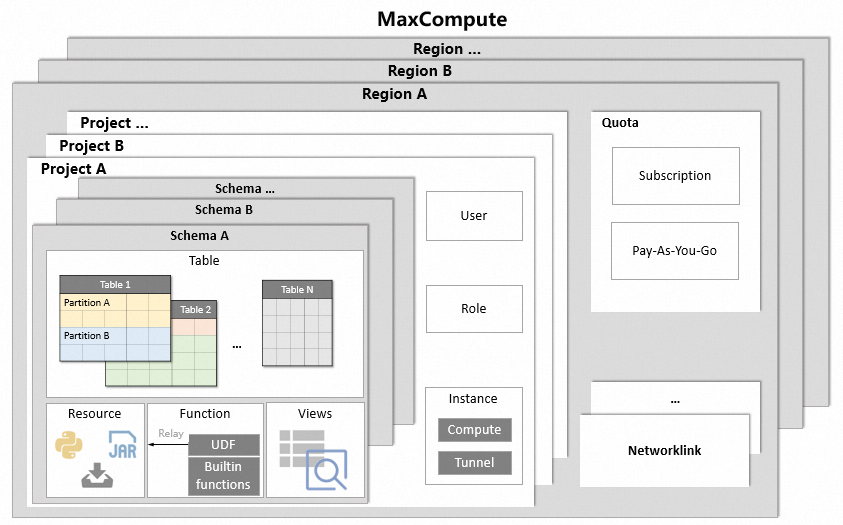
Data organization
| Concept | Description |
|---|---|
| Project | The basic organizational unit in MaxCompute, similar to a database or schema in a traditional database system. A project isolates users and controls access. Storage fees are charged at the project level. For details, see Project. |
| Schema | A namespace within a project for grouping tables, resources, and functions. Use schemas when a single project contains multiple logical datasets or teams. For details, see Schema-related operations. |
| Table | The primary data storage object in MaxCompute, equivalent to a relational table. For details, see Table. |
| Partition | A logical division of a table along one or more partition key columns. Each partition maps to a separate subdirectory. For details, see Partition. |
| View | A virtual table defined by a saved query against one or more existing tables. Use views when you want to retain query results without the need to create additional tables. For details, see View-related operations. |
Compute and runtime
| Concept | Description |
|---|---|
| Quota | A computing resource pool that provides the computing resources required for running jobs. A project is associated with either a pay-as-you-go quota or a subscription quota. For details, see Quota. |
| Instance | A single running job, similar to a job in Hadoop. For details, see Task instance. |
| Resource | A special concept in MaxCompute. Resources are required to implement user-defined functions (UDFs) and MapReduce operations. For details, see Resource. |
| Function | A callable unit of logic. MaxCompute provides built-in functions and supports user-defined functions (UDFs). For details, see Function. |
Access control
| Concept | Description |
|---|---|
| User | An identity that can access MaxCompute — either an Alibaba Cloud account, a RAM user, or a principal assigned a RAM role. All users except the project owner must be explicitly added to a project and granted permissions to manage data, jobs, resources, and functions. For details, see User planning and management. |
| Role | A named permission set assigned to one or more users. Granting permissions to a role automatically extends those permissions to every user assigned that role. One user can hold multiple roles, and multiple users can hold the same role. For details, see Role planning. |
Networking
| Concept | Description |
|---|---|
| Network connection | A configured pathway between MaxCompute and external services — such as HBase, RDS, or Hadoop — over a virtual private cloud (VPC) or the Internet. Required before using external tables, UDFs, or the lakehouse solution. For details, see Network connection process. |
How concepts map to an organization
The figure below shows how these concepts apply to a typical enterprise setup.
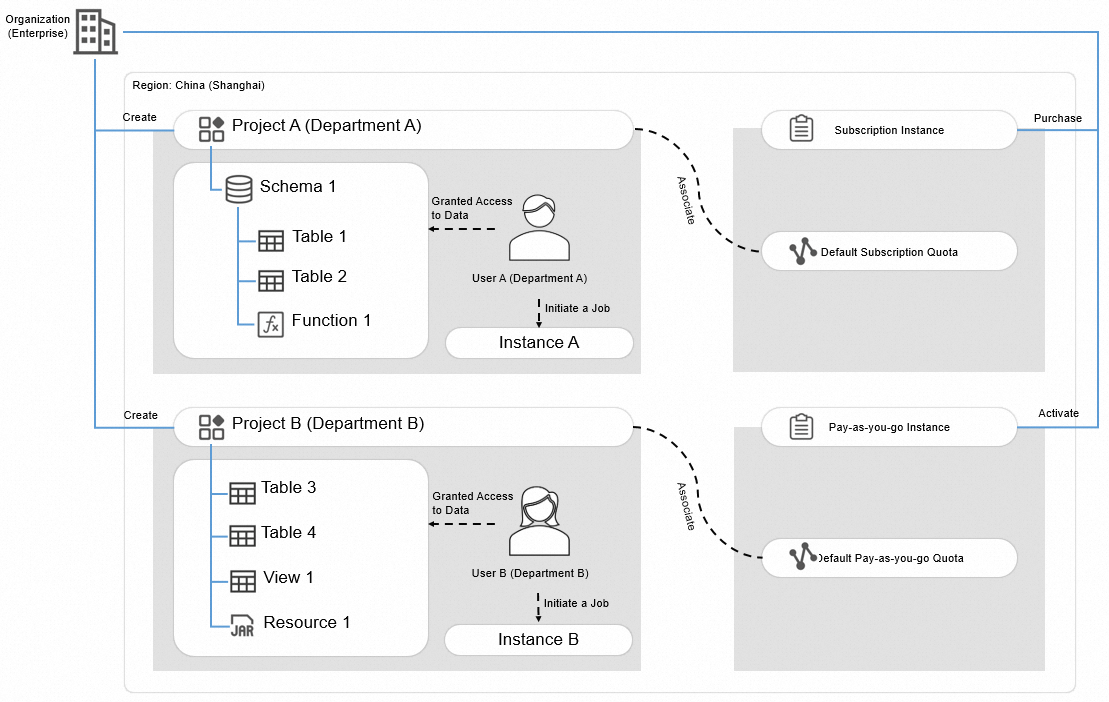
In this example, an enterprise activates pay-as-you-go MaxCompute in the China (Shanghai) region and purchases subscription computing resources. For the pay-as-you-go MaxCompute service, the default pay-as-you-go quota is used. For subscription computing resources, the default subscription quota is used.
-
Department A creates Project A and enables schemas. Schema 1 inside Project A holds Table 1, Table 2, and Function 1. Project A is associated with the default subscription quota, so all jobs in that project draw from the subscription resource pool. User A has access to Project A's data and can submit jobs.
-
Department B creates Project B without enabling schemas. Table 3, Table 4, View 1, and Resource 1 are stored directly in the project. Project B is associated with the default pay-as-you-go quota. User B has access to Project B's data and can submit jobs.
Billing summary
-
Storage: charged per project, regardless of quota type.
-
Pay-as-you-go queries: query costs are charged against the project that submits the job.
-
Subscription queries: no additional per-query charges; costs are covered by the subscription.