Mobi Python SDK
The Mobi Python software development kit (SDK) lets you use Mobi services in integration streams. To use the Mobi Python SDK, you must create an API key. For more information, see Manage API Keys.
Configure an API key
In the integration stream, click Global Settings in the navigation pane on the left and select the API key for the space that you want to configure.
Use the Mobi Python SDK
List files in a folder using the Mobi Python SDK
# Import MobiClient to call the service
from mobi_baas.client import MobiClient
# Import the request data model
from mobi_baas.models import PageFilesByFolderRequest
folder_id = "your_folder_id"
client = MobiClient()
# Call the page_files_by_folder service through MobiClient to list files in the specified folder
resp = client.page_files_by_folder(PageFilesByFolderRequest(folder_id=folder_id, page_size=500, page_number=1))
# Use get_data() to get data from the response class and use items to get the list of all files
if resp.success:
    files = resp.get_data()["items"]
    return files
else:
    return "Page files by folder failed, reason: " + resp.get_data()['message']
Result:
Delete a file by file ID using the Mobi Python SDK
# Import MobiClient to call the service
from mobi_baas.client import MobiClient
# Import the request data model
from mobi_baas.models import DeleteFileRequest
# The ID of the file to delete
file_id = "your_file_id"
client = MobiClient()
# Call the delete_file interface to delete the file
resp = client.delete_file(DeleteFileRequest(file_id=file_id))
if resp.success:
    return "File deleted"
else:
    return "File delete failed, reason: " + resp.get_data()['message']
Result:
Upload a file to the Mobi file system using the Mobi Python SDK
# Import MobiClient to call the service
import asyncio

from mobi_baas.client import MobiClient
# Import the request data model
from mobi_baas.models import FileUploadRequest

# Generate a sample demo.txt file
with open("demo.txt", 'w', encoding='utf-8') as file:
    file.write('This is a demo file.\n')
    file.write('Welcome to the Python file operation feature!\n')
client = MobiClient()
# Construct the file upload request
file_request = FileUploadRequest(
        name="file_name_demo",           # File name: The name of the file after it is uploaded
        data=open("demo.txt", "rb"),     # File data: The file object opened in binary read-only mode
        folder_name="folder_name_demo",  # Optional folder name: The name of the destination folder. If the folder does not exist, it is created.
)
# Call the upload_file_to_mobi method to upload the file asynchronously
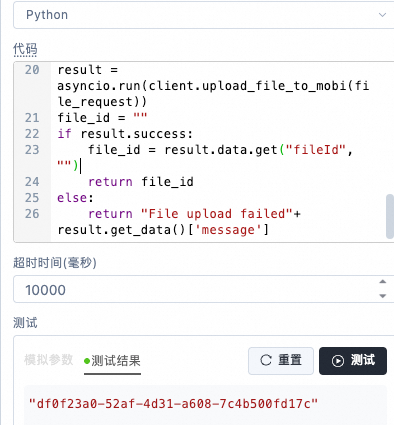
result = asyncio.run(client.upload_file_to_mobi(file_request))
file_id = ""
if result.success:
    file_id = result.get_data().get("fileId", "")
    return file_id
else:
    return "File upload failed"+ result.get_data()['message']
Result:
Call a built-in database integration operation using the Mobi Python SDK
# Import MobiClient to call the service
from mobi_baas.client import MobiClient
# Import the request data model
from mobi_baas.models import SystemPgConnector

client = MobiClient()
# Sample SQL
sql = "SELECT now();"
# Construct the integration operation request
connector_request = SystemPgConnector(
    sql=sql
)
resp = client.invoke_connector(connector_request)
if resp.success:
    return resp.get_data()
else:
    return "invoke failed"+resp.get_data()['message']
Result:
Call an HTTP integration operation using the Mobi Python SDK
Mobi HTTP resource configuration:
Resource ID:
# Import MobiClient to call the service
from mobi_baas.client import MobiClient
# Import the request data model
from mobi_baas.models import HttpConnector

client = MobiClient()

# Construct the integration operation request
connector_request = HttpConnector(
        resource_id='175376942956017',
        url='/index/create',
        method='POST',
        header= {
                'x-acs-version': '2023-12-29',
                'x-acs-action': 'CreateIndex',
        },
        body={
            "Name": "new_knowledge_base_demo",
            "StructureType": "unstructured",
            "SinkType": "BUILT_IN"
        }
)
resp = client.invoke_connector(connector_request)
if resp.success:
    return resp.get_data()
else:
    return "invoke failed"+resp.get_data()['message']
Result:
Call an OpenAPI integration operation using the Mobi Python SDK
Mobi OpenAPI resource configuration:
Resource ID:

The OpenAPIConnector contains the following fields:
resource_id: The ID of the Mobi integration resource.
action: The action name of the OpenAPI request.
method: The HTTP method in uppercase.
path: The request URI. It can contain parameters in the
{var1}format.path_params: A dictionary of key-value pairs for the parameters in the path.
query_params: A dictionary of key-value pairs for the query parameters in the URL.
body_params: A dictionary of key-value pairs for the body parameters.
header_params: A dictionary of key-value pairs for the parameters in the HTTP request header.
The following example uses the Model Studio ListCategory operation:
action: ListCategory
path: /{WorkspaceId}/datacenter/categories
method: POST
path_params: {"WorkspaceId": "bailianWorkspaceId"}
body_params: {"CategoryType": "UNSTRUCTURED"}
For request parameters, you must determine whether they are query parameters or body parameters. If you are unsure, contact the support team for the relevant cloud product to find the parameter's location in the HTTP request.
# Import MobiClient to call the service
from mobi_baas.client import MobiClient
# Import the request data model
from mobi_baas.models import OpenAPIConnector

client = MobiClient()

# Construct the integration operation request. Refer to the official documentation to fill in the action, path, and parameters for the corresponding locations.
# The following code constructs a Model Studio request as an example. For more information, see https://help.aliyun.com/zh/model-studio/api-bailian-2023-12-29-listcategory
connector_request = OpenAPIConnector(
    resource_id='174305288320562',
    action= "ListCategory",
    method="POST",
    path = "/{WorkspaceId}/datacenter/categories",
    path_params= {"WorkspaceId": "bailianWorkspaceId"},  # Path parameters, which replace parameters in the {var1} format in the path
    query_params= None, # Query parameters
    body_params= {"CategoryType": "UNSTRUCTURED"}, # Body parameters
    header_params= None # Header parameters
)
resp = client.invoke_connector(connector_request)
if resp.success:
    return resp.get_data()
else:
    return "invoke failed"+resp.get_data()['message']
Result: