OpenClaw personal task butler
Assign a task in one sentence, and OpenClaw automatically orchestrates text, image generation, and web search to get one thing done end to end.
Note
Disclaimer: The content shown on this page is all generated by AI models and is for reference only; it does not constitute any guarantee of results. Actual output and Credits consumption are subject to "Usage Details" in the console.This playbook walks through it with "hosting a 6-person Japanese hotpot party": after you assign the task in one sentence, OpenClaw uses web search to look up seasonal ingredients and list a shopping list, lays out a prep timeline, and generates an invitation card image, finally consolidating everything into a one-page list.
Tools: OpenClaw and similar adapted agent tools · orchestrates qwen3.7-max (list + timeline) + wan2.7-image (invitation card image) · web_search is automatically triggered by the model within the tool.
Actual output
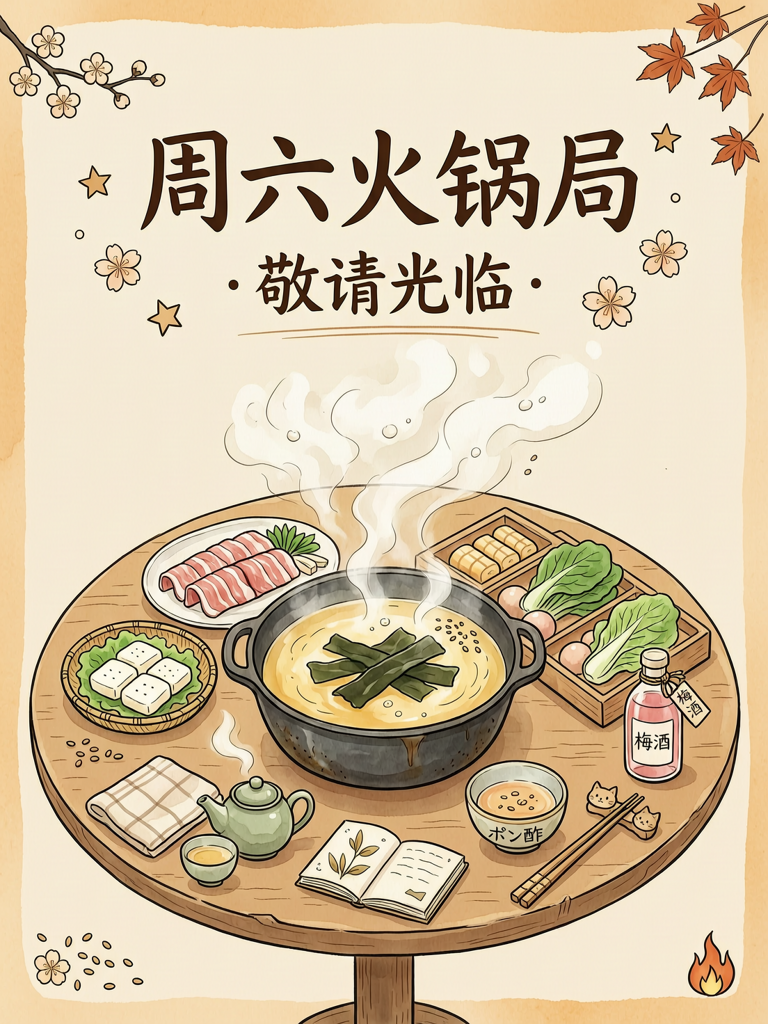
Walked through with "hosting a 6-person Japanese hotpot party", the invitation card image generated by wan2.7-image:
Steps: assign a task in one sentence
In OpenClaw, send the following instruction to the orchestration model:
Next Saturday I'm hosting a 6-person Japanese family hotpot party at home.
Help me: (1) use web search to look up seasonal ingredients and market prices, and list a shopping list (with estimated prices);
(2) schedule a prep timeline starting at 3 PM and eating at 6 PM;
(3) generate a warm invitation card image (Japanese warm-color illustration style);
Finally consolidate everything into a one-page list and send it to me.
1. Text orchestration (qwen3.7-max) + 2. Invitation card image (wan2.7-image) 1 time. Produces a complete shopping list + 3-hour prep timeline + invitation card illustration. web search (web_search) is automatically triggered by the supported model within the adapted tool and is billed separately per successful call; for real-time information such as prices and seasonal availability, refer to the actual web search results and verify carefully.
View actual output · Shopping list + prep timeline (qwen3.7-plus original output · sample output, real-time information subject to actual web search results)
Great! Hosting a Japanese hotpot party (Sukiyaki) at home is a very ritual and warm thing. It is now late spring and early summer (May), and traditional winter vegetables (such as garland chrysanthemum) are out of season, so I have selected seasonal refreshing vegetables (such as mizuna, water bamboo shoots, fresh shiitake mushrooms) to pair with the classic sukiyaki — both refreshing and in season.
Here is a tailored plan for you:
1. Shopping list for 6 people (with estimated market prices)
Note: The price data below is based on average web search prices across mainstream fresh-food e-commerce (Hema, Dingdong Maicai, JD Fresh) and offline supermarkets. Actual prices may fluctuate ±10% depending on city and channel.
Core meat and seafood (~480 yuan)
- High-quality wagyu / marbled beef slices: 1.5kg - 1.8kg (recommend M5-M7 grade or high-quality grain-fed chuck/short rib, about 3-4 boxes needed for 6 people).
[web search: Hema/JD average 120-150 yuan/500g, total 420 yuan] - Fresh shrimp / black tiger shrimp: 500g (about 12-15 pieces, adds seafood flavor).
[web search: Dingdong Maicai average 60 yuan/500g]
Seasonal vegetables and mushrooms (~85 yuan)
- Mizuna or tender spinach: 2 large bunches (mizuna is the soul of Japanese hotpot, crispest in late spring).
[web search: fresh-food e-commerce average 15 yuan/bunch, total 30 yuan] - Water bamboo shoots or fresh spring bamboo shoots: 3-4 pieces (seasonal ingredient, extremely savory after soaking up broth).
[web search: wet market/supermarket average 20 yuan] - Fresh shiitake mushrooms: 1 box (score crosswise).
[web search: average 15 yuan] - Enoki mushrooms / seafood mushrooms: 1 pack each.
[web search: average 10 yuan] - Large scallions: 2 roots (use white part only, slice diagonally).
[web search: average 5 yuan] - Baby cabbage: 2 packs.
[web search: average 5 yuan]
Soy products and staples (~45 yuan)
- Japanese grilled tofu or firm tofu: 2 blocks (pan-fry until golden on both sides).
[web search: average 15 yuan] - Konjac noodles / konjac knots: 2 boxes.
[web search: average 15 yuan] - Japanese udon noodles: 3-4 packs (as the finishing staple).
[web search: average 15 yuan]
Broth base, dipping sauce and extras (~115 yuan)
- Pasteurized eggs: 1-2 boxes (10-15 pieces, the soul dipping sauce of sukiyaki, must be edible-raw grade such as Huangtian'e / Chao Yi).
[web search: average 30 yuan/box, total 30 yuan] - Sukiyaki sauce: 1 large bottle (500ml, Ajinomoto or Kikkoman).
[web search: average 35 yuan] - Kombu (kelp knots) and bonito flakes: 1 small pack (for making basic stock; if that's too much hassle, just use purified water + sukiyaki sauce).
[web search: average 20 yuan] - Beef tallow / butter: 1 small piece (for greasing the pot at the start).
[web search: average 15 yuan] - Butane stove gas canisters: 2-3 bottles (backup).
[web search: average 15 yuan]
Total budget estimate: about 725 yuan (about 120 yuan per person, far below the 300+ yuan per person at a Japanese restaurant, with double the meat!)
2. Prep timeline (15:00 - 18:00)
- 15:00 - 15:30 [Inventory and rough wash]
- Unpack all ingredients, sort into the sink by category.
- Wash all vegetables and mushrooms; soak kombu in cold water in advance (if making stock).
- Check that the butane stove gas canister is full, test ignition.
- 15:30 - 16:30 [Fine cutting and prep]
- Cut vegetables: slice scallions diagonally; cut water bamboo shoots into thin slices; halve baby cabbage; score crosswise on shiitake caps.
- Prep tofu: cut firm tofu into thick slices, pan-fry with a little oil until lightly golden on both sides (won't fall apart and absorbs broth better).
- Prep seafood: trim shrimp whiskers, devein the shrimp.
- 16:30 - 17:15 [Japanese plating (key to great photos)]
- Get 2-3 large flat plates. Arrange the beef slices like petals across the plate (don't pile them up).
- Place vegetables on a large bamboo tray or long platter in alternating colors (red and white, e.g. baby cabbage with scallions).
- Crack a pasteurized egg into each of 6 individual dipping bowls and refrigerate (better texture).
- 17:15 - 17:45 [Table setup and broth base prep]
- Set the table: lay out heat-resistant mats, set up the butane stove, place bowls, chopsticks, napkins, and bone dishes.
- Make the broth: put kombu and water in the pot and bring to a boil, then remove the kombu. Pour in sukiyaki sauce at the bottle's ratio (usually sauce:water = 1:1 or 1:2), taste for saltiness — slightly sweet is fine.
- 17:45 - 18:00 [Welcoming guests and starting the pot]
- Friends arrive one after another, offer tea / plum wine.
- Pot-opening ritual: heat the pot, add a small piece of beef tallow to melt, first sear the scallions and a few beef slices to release aroma, pour in the sukiyaki broth and bring to a boil — then announce dinner is served!
3. One-page action checklist (One-Pager)
(Suggested to screenshot this part on your phone and check off while shopping at the supermarket or market)
======================================================
       6-person Japanese sukiyaki hotpot party · Action checklist
======================================================
[Shopping check-off zone] (budget: ~725 yuan)
[ ] Meat: wagyu/marbled beef slices 1.5-1.8kg (M5 and above)
[ ] Seafood: fresh shrimp/black tiger shrimp 500g
[ ] Vegetables: mizuna/tender spinach 2 bunches, water bamboo shoots 3 roots, baby cabbage 2 packs, large scallions 2 roots
[ ] Mushrooms: fresh shiitake 1 box, enoki/seafood mushrooms 1 pack each
[ ] Tofu/Staples: firm tofu 2 blocks, konjac noodles 2 boxes, udon 3 packs
[ ] Soul: pasteurized eggs 10-15 (must buy edible-raw grade!)
[ ] Seasoning: sukiyaki sauce 1 large bottle, beef tallow/butter 1 small piece
[ ] Extras: kombu 1 small pack, butane stove gas canisters 2 bottles

[15:00 Wash & cut zone]
[ ] Wash: all vegetables and mushrooms washed and drained
[ ] Cut: scallions diagonally, water bamboo shoots sliced, shiitake scored crosswise, baby cabbage halved
[ ] Pan-fry: tofu cut into thick slices, pan-fry until golden on both sides, set aside
[ ] Shrimp: trim whiskers, devein

[16:30 Plating zone]
[ ] Meat plate: spread beef slices flat, don't stack
[ ] Veggie plate: arrange vegetables in alternating colors
[ ] Egg: crack a pasteurized egg into each of 6 small bowls, refrigerate
[ ] Table: lay heat-resistant mat, set bowls/chopsticks, napkins, bone dishes

[17:45 Pot-start zone]
[ ] Test fire: check butane stove gas canister and test ignition
[ ] Make broth: boil kombu water and remove -> add sukiyaki sauce and water (1:1) -> taste
[ ] Grease pot: melt beef tallow -> sear scallions and a few meat slices -> pour in broth and boil
[ ] Eat: drop in meat at 18:00 sharp, dip in pasteurized egg and enjoy!

Chef tips:
1. Kansai style: sear meat first, add sugar and soy sauce, then add vegetables; Kanto style: make broth first, then cook meat. This checklist uses a modified Kanto method, better suited for families to cook and eat together.
2. Take the pasteurized egg out of the fridge and beat it right before; coat the just-out-of-the-pot hot meat in egg and it instantly cools with a silky-smooth texture!
======================================================
Wishing your hotpot party next Saturday great success! If any friends don't eat raw egg, you can prepare a small dish of Japanese yuzu vinegar (Ponzu) or sesame sauce as a backup dip.
Notes
- Consumption: This playbook involves text orchestration (
qwen3.7-max) and an invitation card image (wan2.7-image) 1 time, producing a complete shopping list, prep timeline, and invitation card illustration. - Web search:
web_searchis automatically triggered by the supported model within the adapted tool and is billed separately per successful call. - Time-sensitive information: For real-time information such as prices and seasonal availability, refer to the actual web search results and verify carefully.