Data disaster recovery solutions
To ensure high reliability and data security, ApsaraDB for MongoDB provides two solutions: multi-zone disaster recovery and geo-disaster recovery. You can choose the solution that best suits your requirements.
Multi-zone Disaster Recovery
Standalone instances do not support multi-zone disaster recovery. You can migrate data to a replica set or sharded cluster instance running MongoDB 4.2 or earlier. For more information about the migration method, see Perform a full data migration from a standalone ApsaraDB for MongoDB instance to an ApsaraDB for MongoDB instance of any architecture.
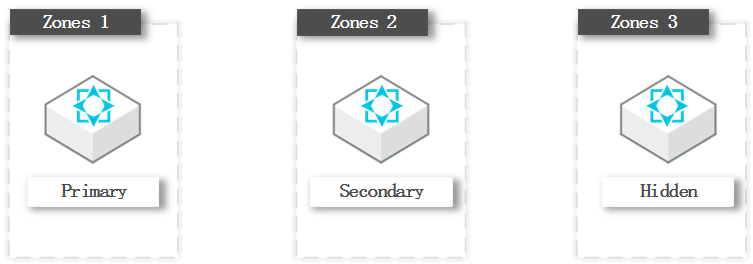
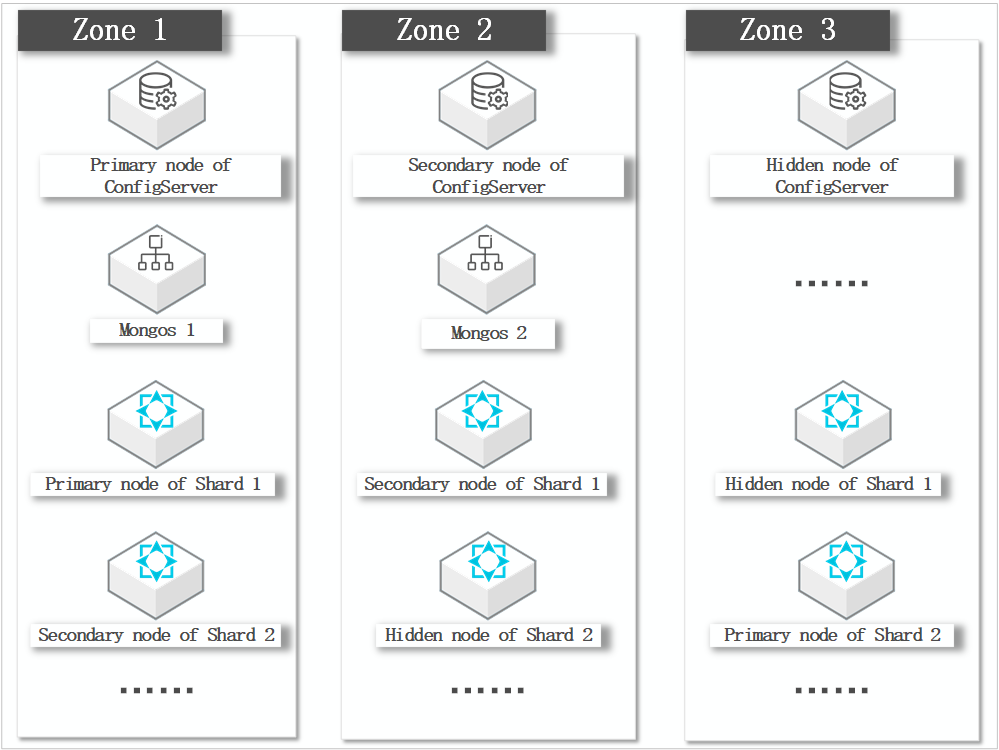
Multi-zone disaster recovery deploys the nodes of a replica set instance or the components of a sharded cluster instance across three different zones in the same region. If a zone becomes unavailable due to factors such as a power or network failure, the high availability (HA) system automatically triggers a switchover. This process ensures the availability and data security of the instance.
You can select multiple zones when you create an instance. For more information, see Create a multi-zone replica set instance or Create a multi-zone sharded cluster instance.
For a local disk instance running MongoDB 4.2 or earlier, you can migrate the instance from a single zone to multiple zones. For more information about the migration method, see Migrate an instance across zones.
Instance type | Node deployment policy |
Replica set instance |
|
Sharded cluster instance |
|
Geo-disaster recovery
You can create two identical ApsaraDB for MongoDB instances in different regions. Then, you can use Data Transmission Service (DTS) to implement geo-disaster recovery for the ApsaraDB for MongoDB instances and ensure data consistency. If the primary instance fails, you can switch your service traffic to the disaster recovery instance to quickly restore services. To create a MongoDB instance, see Create an instance.
For more information, see the following documents: