Electronic contracts: Shenzhen Fadada Network Technology Co., Ltd.
PolarDB uses a compute-storage decoupled architecture. It offers configuration scaling in minutes and fault recovery in seconds. It also provides global data consistency and free services for data backup and disaster recovery. PolarDB combines the stability, high performance, and scalability of a commercial database with the simplicity and rapid development of an open source database. This topic describes how Shenzhen Fadada Network Technology Co., Ltd. uses PolarDB to overcome its business challenges.

- Industry: Electronic contracts
- Website: Fadada Network Technology Co., Ltd.
About the company
Shenzhen Fadada Network Technology Co., Ltd. was founded in 2014. It is a leading third-party electronic contract platform in China. The company provides electronic contract, document signing, and evidence storage services to various industries. These industries include finance, insurance, third-party payment, tourism, real estate, and logistics. Fadada also serves online trading platforms, human resource management firms, and government agencies. The company offers value-added services, such as judicial authentication and legal support.
Business challenge: Archiving and querying historical contracts
Fadada stored data for different customers across four business clusters and faced the following challenges:
- The company added about 30 million new contracts each month. This required manual database sharding of its existing Relational Database Service (RDS) instance every three months on average.
- Searching through 600 million historical contracts required querying multiple databases in sequence. The average seek time was 7 seconds.
- The company considered extracting historical data to a unified big data platform. However, the migration cost was high and the process was time-consuming.
Solution
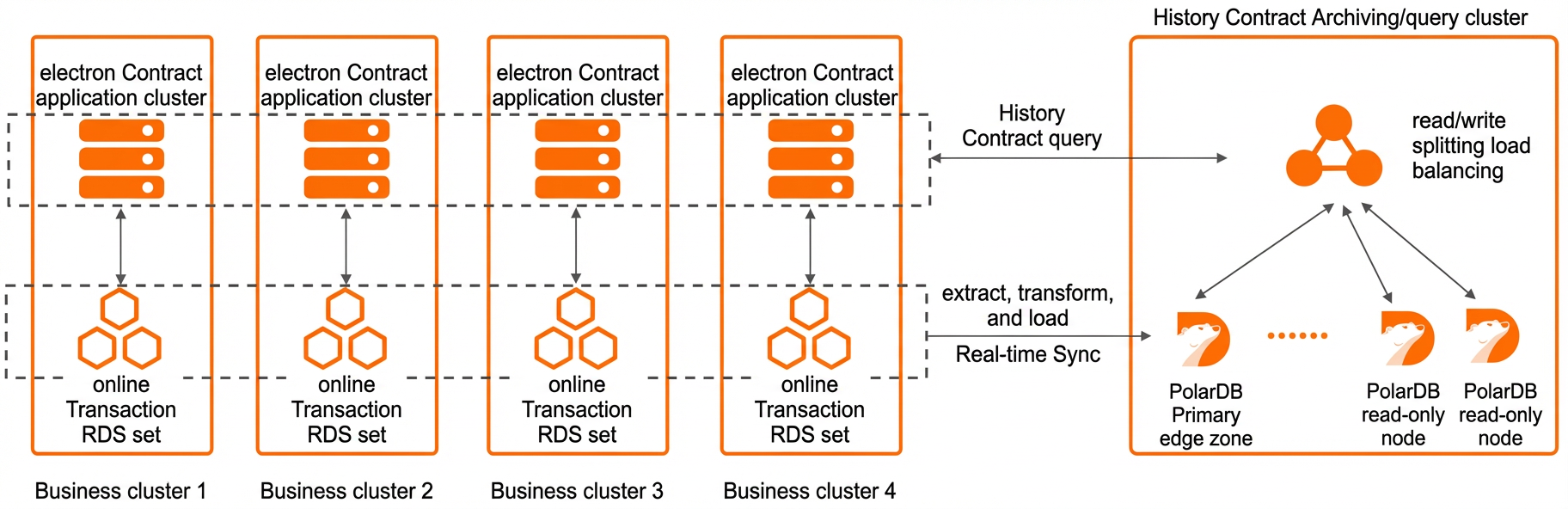
PolarDB uses a compute-storage decoupled architecture and a distributed storage architecture. This design supports mass storage and efficient queries on large data volumes.
- Fadada used Data Transmission Service (DTS) to migrate relevant data from its MySQL databases to PolarDB. The company also used extract, transform, and load (ETL) tools to periodically synchronize historical data to PolarDB.
- Fadada uses PolarDB to store over 600 million electronic contracts. Storing this data securely in PolarDB resolved the storage capacity bottleneck of the main business system.
- PolarDB, queries on the 600 million historical contracts took only 0.5 seconds. This resolved the slow query problem.
Customer value
- 100% compatible with MySQL for zero migration cost
PolarDB is fully compatible with MySQL 5.6, 5.7, and 8.0. After you migrate applications from MySQL databases to PolarDB, you can archive large volumes of historical data and perform real-time queries without application modifications. You can use the cloud migration tool DTS to smoothly migrate existing databases to PolarDB.
- Elastic and automatic scaling of data capacity
Fadada generates terabytes of new structured data every month. The elastic and mass storage capabilities of PolarDB resolved the storage capacity issues of traditional MySQL. The snapshot-based backup method of PolarDB also enables efficient backup and point-in-time restore for large data volumes.
- High-performance concurrent queries
PolarDB uses a read/write splitting architecture that supports concurrent access from multiple application servers. The average query time dropped from 7 seconds to 0.5 seconds. This significantly improved the query experience.
- Built-in high availability service with read/write splitting
The data service required 24/7 high availability (HA). The compute nodes of PolarDB use a cluster architecture with one primary node and multiple read-only nodes. This architecture provides high availability and reduces the cost of HA services. It also makes managing database endpoints simpler and more efficient.