PolarDB Agent LakeBase uses object storage as its persistent foundation, providing on-demand capacity scaling and pay-per-use pricing. However, object storage often falls short of the read latency and bandwidth required by data-analysis agents. To address this, PolarDB Agent LakeBase offers a configurable acceleration space that uses distributed shared caching to reduce read latency and increase read bandwidth, delivering the I/O performance that data-analysis agents need.
Background
PolarDB Agent LakeBase stores data on top of object storage, which offers the following benefits:
You pay only for the storage that you actually use.
Capacity scales on demand, so you no longer have to plan for storage growth.
However, object storage has the following limitations:
Read latency is relatively high.
Read bandwidth is relatively low.
To meet the I/O performance requirements of data-analysis agents, PolarDB Agent LakeBase provides a configurable acceleration space that delivers lower read latency and higher read bandwidth.
Architecture
The acceleration space has the following key characteristics:
Distributed shared cache: All compute nodes that access the acceleration space share the same cached data. A single copy of each data block is kept globally.
Transparent access: The acceleration space is completely transparent to users. During mount access, the client first reads data from the acceleration space. If the read is a cache hit, the data is returned directly. If the read misses, the client automatically falls back to object storage and populates the acceleration space with the retrieved data.
Best-effort durability: Cached data in the acceleration space is not durable. If a cache node fails, the cached data is discarded. Subsequent reads fetch the data from object storage, which generates additional Object Storage Service (OSS) read traffic.
Fixed capacity with LRU eviction: You must pre-configure a fixed capacity for the acceleration space. When cached data reaches the configured capacity, entries are evicted automatically based on the least-recently-used (LRU) algorithm.
Observable cache metrics: Cache-related metrics such as hit ratio and request counts are available on the console monitoring page. For more information, see Cache performance metrics.
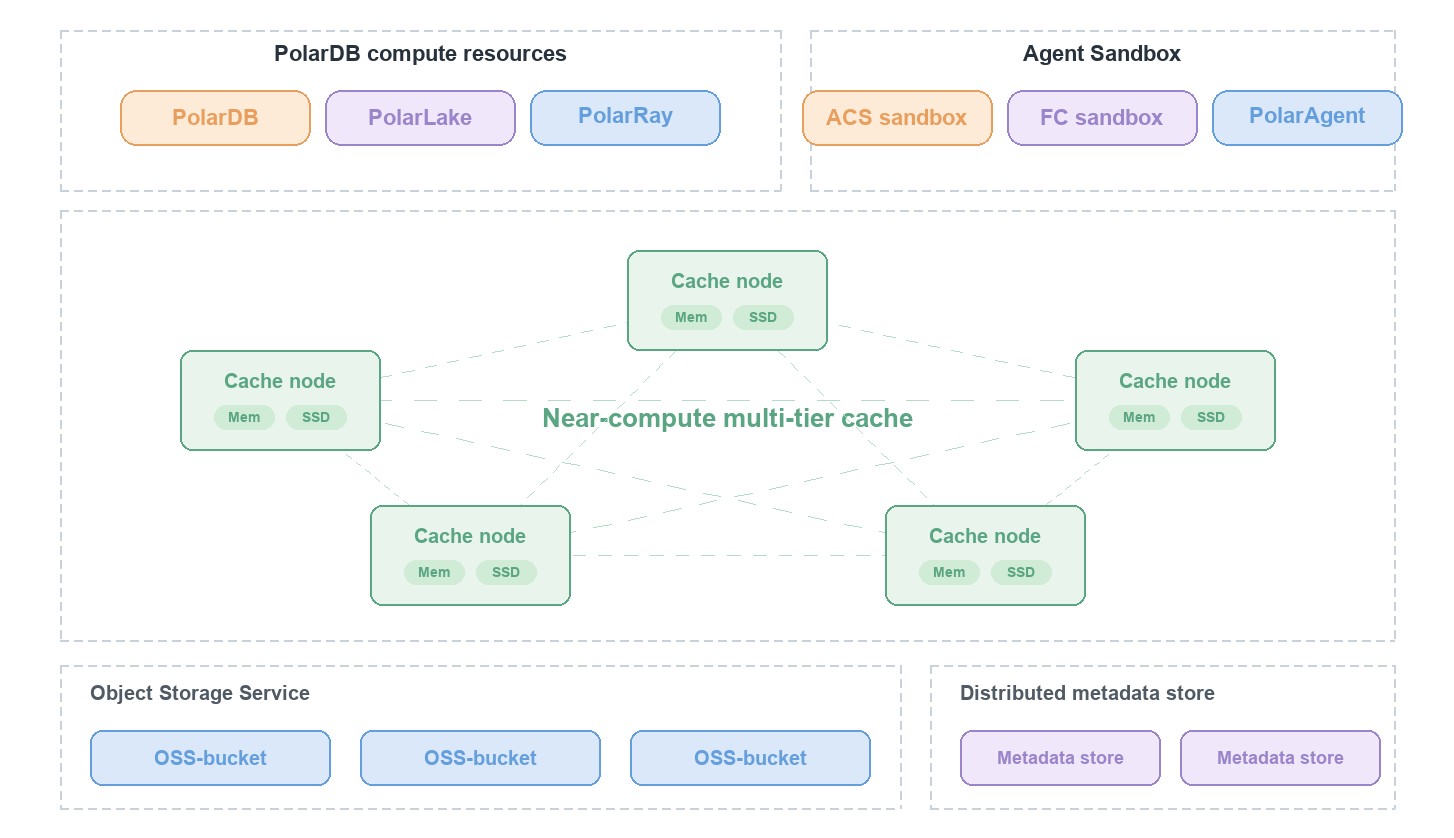
PolarDB Agent LakeBase also supports pluggable transparent acceleration for your existing object storage data through the OSS or S3 interface. To use this feature, submit a ticket.
Technical specifications
The following table lists the key performance specifications of the acceleration space:
Metric | Value | Description |
Cache-hit read latency | Longer than 200μs | Actual latency depends on the network path and other factors. |
Cache-hit read bandwidth |
| If you need higher bandwidth or higher bandwidth density, submit a ticket. |
Acceleration space capacity |
| If you need more capacity, submit a ticket. |