What is PolarDB PostgreSQL Agentic Database
PolarDB offers PolarDB PostgreSQL Agentic Database, a new form factor built for large-scale AI Agent workloads. It provides second-level provisioning, second-level Branch creation, Scale-to-Zero elasticity, low-cost OSS-based storage, and MCP-native access. Together, these capabilities deliver a highly elastic, low-cost, and cost-effective database service for AI Agent applications.
If you have any questions about PolarDB PostgreSQL Agentic Database features, search for the DingTalk group ID to join the consultation group. DingTalk group ID: 175205010586
Background
Cloud Native reshaped the foundational capabilities of databases, evolving them from single-machine systems into elastic, highly available, distributed data infrastructure with cloud-native operations. As AI Agents emerge as a new paradigm for building applications, databases are entering the Agentic Native era: instead of serving only developers, end users, and traditional applications, databases must now directly serve AI Agents that can understand goals, plan tasks, invoke tools, and collaborate on execution.
This shift redefines several core assumptions of database design:
Service subject: The database shifts from serving humans to serving Agents. It must supply context, memory, and action-support primitives for intelligent agents.
Workloads: Workloads extend from deterministic transactions and SQL queries to non-deterministic multi-step reasoning, multi-agent collaboration, and task execution.
Data forms: Data extends from structured tabular rows to vectors, long-term memory, short-term context, document semantics, and domain knowledge graphs.
Access patterns: Access moves beyond SQL to semantic interfaces, natural-language APIs, and task-oriented intelligent interactions.
Agentic Native Database is therefore not a superficial AI enhancement over traditional databases. It is data infrastructure redesigned for the era of intelligent agents. On top of Cloud Native's elasticity, reliability, and scalability, it further provides semantic understanding, memory management, knowledge organization, reasoning support, permission governance, and auditable execution, helping AI Agents use data safely, reliably, and continuously to complete complex tasks in real-world scenarios.
Key features
Agent Native access
The database is designed for Agent-first access. It exposes a standard MCP Server so that AI Agents can safely access database capabilities in the same way they call other tools. Agents no longer depend solely on pre-wrapped interfaces built by developers. Within permission boundaries, they can understand the schema, query data, invoke database tools, retrieve context, and cooperate with business systems to complete tasks.
The system also supports semantic access. It combines SQL, metadata, business knowledge, and natural-language interfaces so that Agents can use data in a way that is closer to task intent. The database no longer only returns results; it becomes a trusted context source for the Agent's reasoning, memory, and execution.
Rapid provisioning and instant Branch
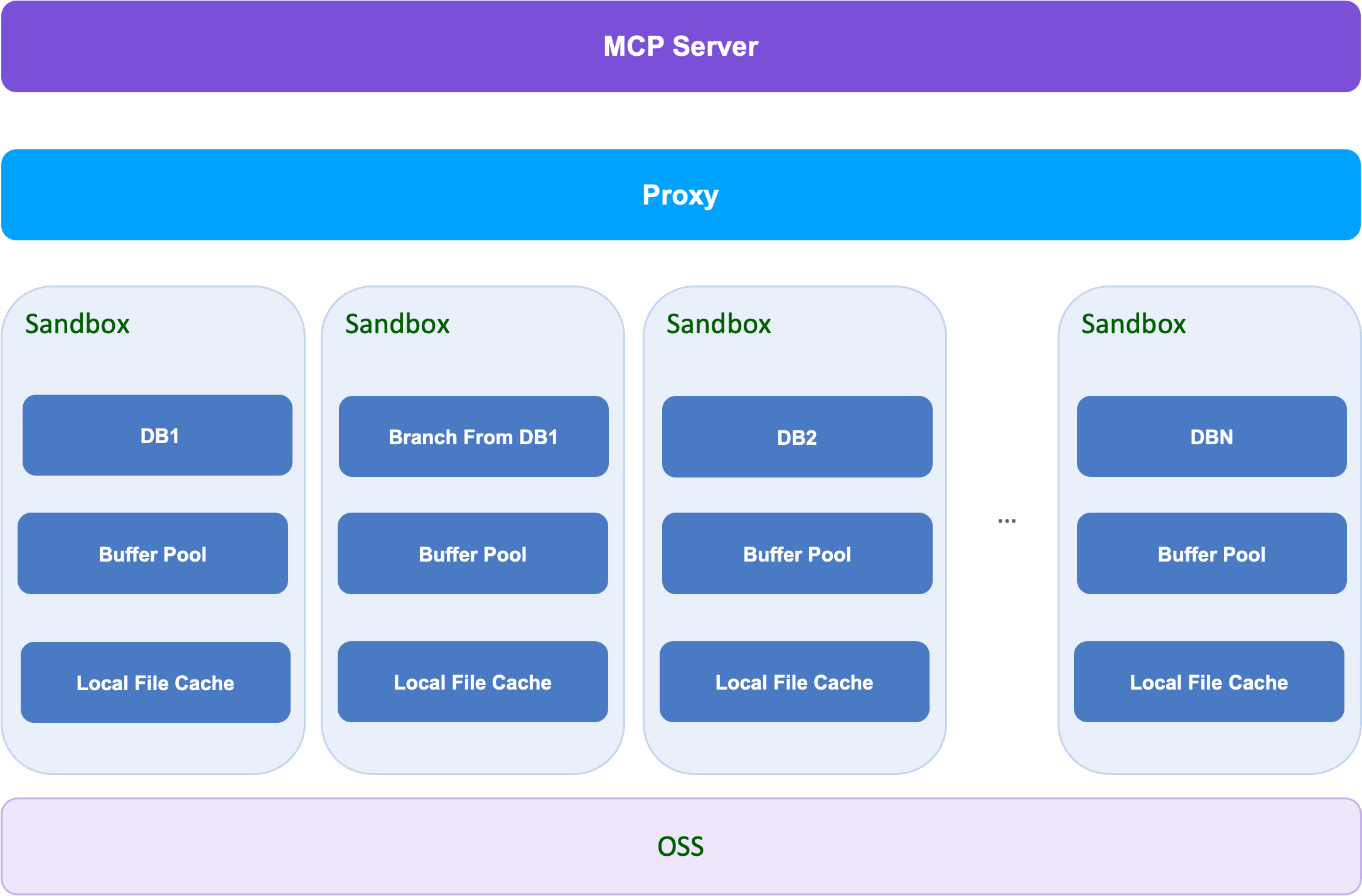
To match the fast-iterate, fast-ship rhythm of Agentic applications, the database provides a "sandbox + warm pool" capability that supports second-level cluster provisioning. Developers, application teams, and AI Agents can quickly create isolated environments for demos, testing, evaluation, ad-hoc tasks, or customer delivery. With prewarmed resource pools, templated configuration, and automated initialization, database clusters can be created, used, and released as easily as serverless functions, dramatically shortening the time from idea to delivery.
The database also supports second-level creation of new cluster branches (Branch) for cluster-level cloning and environment replication. Whether for development and testing, data replay, Agent task experiments, or multi-version business validation, you can quickly fork an isolated branch from an existing cluster without impacting the primary cluster. Branching gives the database the flexibility of a source-code repository: you can quickly create, roll back, discard, and compare different data environments. This is especially valuable when AI Agents need an isolated space to experiment, verify, and reason before promoting the results to production.
Fast elasticity and extreme cost efficiency
Compute and storage are decoupled. The compute layer scales up and down elastically. It automatically pauses when there is no traffic and resumes quickly on the next request (Scale to Zero and Scale from Zero), preventing idle resources from being wasted.
On the storage side, the full data set is stored on low-cost object storage such as OSS. Branches use Copy-on-Write to avoid duplicated storage, and compute nodes use local caches to accelerate hot access. This design balances performance and cost.
Multi-modal fusion retrieval
Building on the extension ecosystem of PolarDB for PostgreSQL, PolarDB PostgreSQL Agentic Database supports full-text, time-series, vector, and graph analytics. It fuses keyword, semantic, temporal, and relational retrieval to give Agents more complete context recall. On this foundation, you can build and use RAG, long-term memory, knowledge graphs, and semantic Q&A, turning the database into a unified substrate for the Agent's memory, retrieval, and reasoning.
Form-factor comparison
The following table compares the core differences among PolarDB Cluster Edition, Agile Serverless, Supabase, and PolarDB PostgreSQL Agentic Database, helping you choose the right form factor for your workload.
Dimension | Cluster Edition | Agile Serverless | Supabase | PolarDB PostgreSQL Agentic Database |
Billing model | Subscription or pay-as-you-go | PCU-based hourly billing | PCU-based hourly billing | PCU-based hourly billing |
PCU range | N/A (fixed specifications) | From 1 PCU | 0 PCU-8 PCU | 0 PCU-8 PCU |
Elasticity granularity | N/A (fixed specifications) | 0.5 PCU | 0.5 PCU | 0.5 PCU |
Data Branch | Not supported | Not supported | Schema-only Branch | Cluster-level Branch |
Provisioning speed | Minute-level | Minute-level | Minute-level | Second-level |
Load detection speed | N/A (manual scaling) | Second-level activity detection | Second-level activity detection | Second-level activity detection |
High availability | RPO=0 or RPO~=0 | Same as Cluster Edition | Same as Cluster Edition | Built-in standby node, HA by default |
Target workload | HTAP mixed workloads | Bursty OLTP | Bursty OLTP | AI Agents and Agentic applications |
Agent access | PostgreSQL protocol | PostgreSQL protocol | MCP + Data API | MCP + PostgreSQL protocol |
Billing
After the public preview ends at 00:00:00 on December 1, 2026 (UTC+8), PolarDB PostgreSQL Agentic Database clusters are billed based on actual resource usage. The billing unit is PCU (PolarDB Capacity Unit) and the unit price is CNY 0.35 per PCU per hour.