E-commerce industry: PolarDB-X partitioning policies help Yunbei manage merchant data
Highlight
Uses locality to physically isolate tenant data in a single instance.
Uses subpartitions to distribute data from hot spot tenants.
Overcomes sharding limitations with transparent distribution, making data distribution more flexible and transparent through partition migration and splitting.
Customer profile
Shanghai Yunbei Network Technology Co., Ltd., founded in September 2009, developed Wangjubao, a professional e-commerce customer relationship management (CRM) system designed for the Taobao platform. It offers member segmentation and precise, automated marketing services to online e-commerce merchants. Built for the Internet and based on a cloud computing platform, it provides a ready-to-use software subscription service. Since its version 1.0 release in 2011, the system has served thousands of customers. It also integrates data from business-to-consumer (B2C) platforms and offline outlets of traditional brands. Wangjubao is now a Taobao Gold Partner.
Business challenges
Severe hot spot skew.
As the number of merchants and the data volume grew, data skew became a critical problem. To manage storage, the company had to perform frequent manual data cleanups. They also had to allocate more CPU computing power to skewed nodes. These efforts increased labor and financial costs without significantly improving the merchant experience.
Higher requirements for data security and isolation.
Large merchants required strong data security. They wanted exclusive access to physical node resources. This forced the company to provide a separate database instance for each large merchant. As the number of these merchants grew, the workload for resource management and code deployment became substantial.
Inflexible merchant data adjustment due to sharding limitations.
When a new merchant was onboarded, their data was locked to a specific RDS node. The data location could not be adjusted online as their business needs evolved. Moving data to a new storage location with data synchronization was possible, but the process was not transparent to the application layer.
Solutions
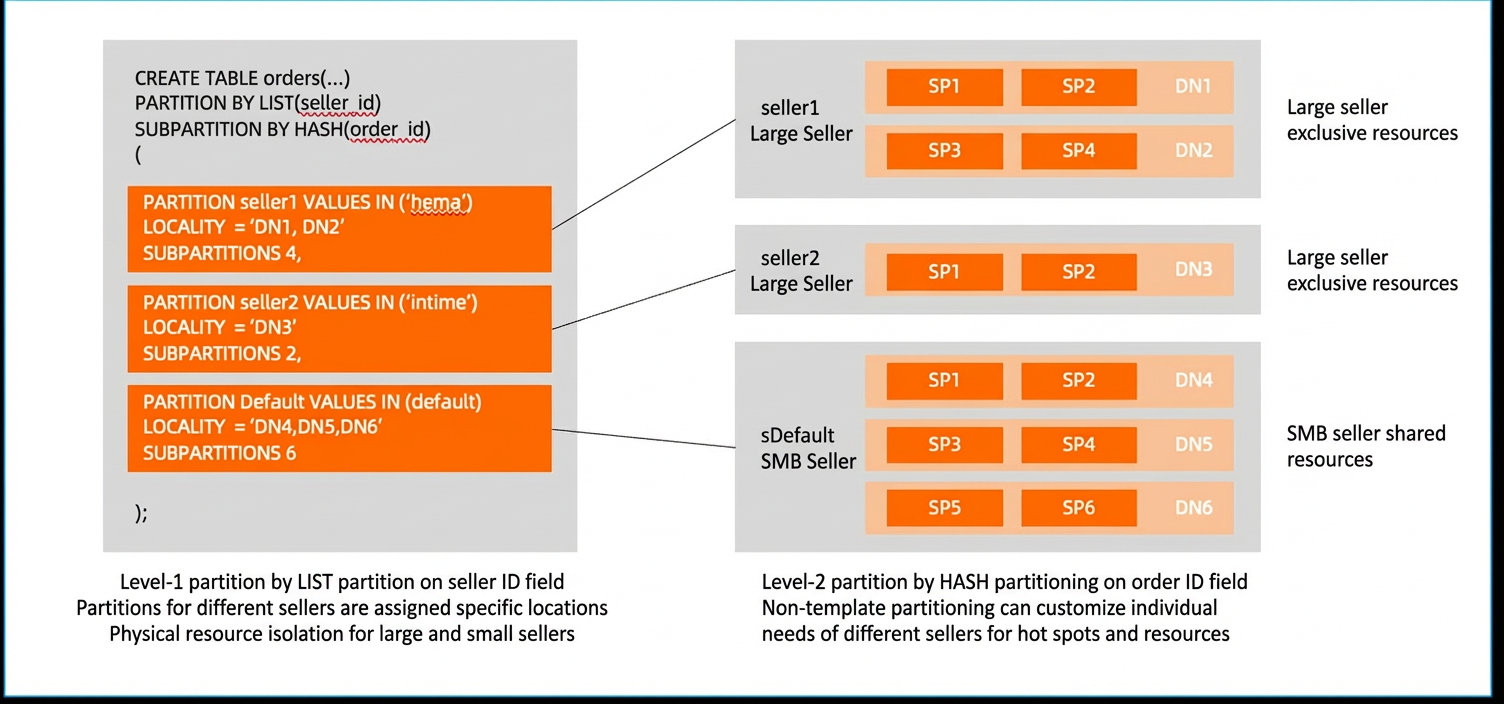
Subpartitions
Subpartitions are specified based on each merchant's data distribution. This balances the data load and resolves data and access hot spots caused by large merchants.
Locality
Locality is used to assign partitions to specific storage locations. The partitions of large merchants can be placed on one or more dedicated storage nodes. Smaller merchants can continue to share storage nodes. This model allows for both isolation and sharing. The entire process is transparent to the application layer.
Partition migration and splitting
A merchant's data volume changes as their business grows. When a small merchant becomes a large one, the partitioning policy can be adjusted online. Storage locations and the number of partitions can be changed online. These changes affect only the data of the specific merchant, leaving other merchants unaffected.
Customer benefits
A single database instance supports thousands of merchants and 50 TB of data.
Achieves physical and permission-based isolation for VIP customer data. This provides enhanced security and greatly improves the merchant experience.
Partitioning policies can adapt to business changes. This allows for greater business flexibility.