Multi-Tenant PXBaas Platform
PXBaas Multi-Tenant Edition leverages the distributed capabilities of PolarDB-X to deliver a middle-ground architecture that combines shared infrastructure with physical database isolation per tenant. Through a three-layer mechanism of Kong gateway tenant routing, application-layer RLS injection, and database-layer CCL rate limiting, it supports hundreds of tenants on a single deployment while maintaining strict security isolation and fair resource allocation.
Why multi-tenancy
When a SaaS platform provisions backend services for each tenant, it faces a fundamental cost-versus-security tradeoff:
-
Dedicated deployment is too expensive: 100 tenants = 100 independent systems, with monthly infrastructure costs exceeding CNY 5,000. Small tenants have less than 5% resource utilization, leaving the majority of compute capacity idle.
-
A middle ground is needed: Share infrastructure to reduce costs, yet isolate databases physically for security. This is exactly the design goal of PXBaas Multi-Tenant Edition.
Architecture
The multi-tenant edition uses a layered architecture with clearly defined responsibilities at each layer: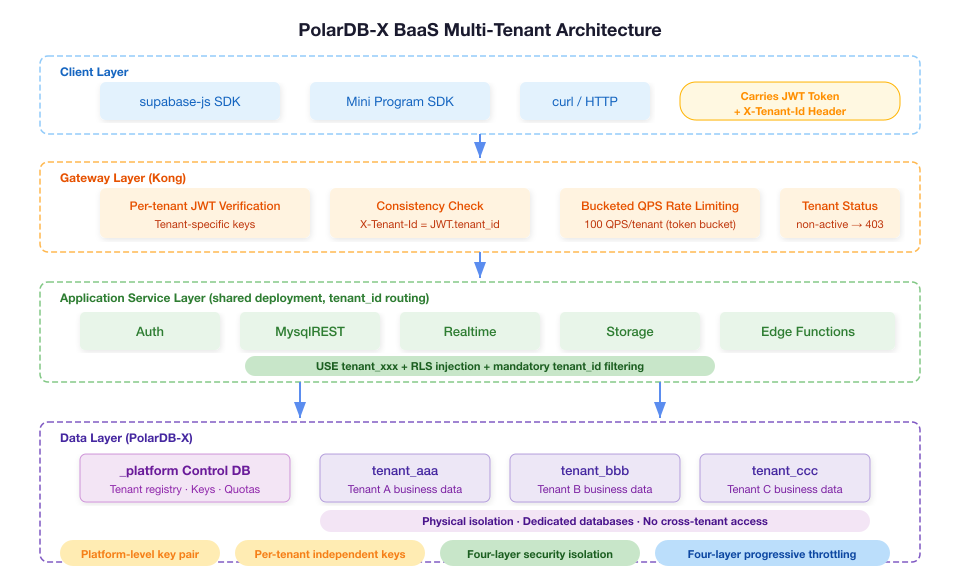
-
Client layer: supabase-js / mini-program SDK / curl, or any HTTP client. Requests carry a JWT token (Authorization header) and a tenant identifier (X-Tenant-Id header).
-
Gateway layer (Kong): The single entry point for all requests (port 8000). Handles JWT verification, tenant status checks, cross-tenant consistency validation, and per-tenant QPS token-bucket rate limiting before routing valid requests to backend services.
-
Application service layer: Auth, MysqlREST, Storage, Realtime, and Edge Functions are deployed as shared services. Each component routes to the correct tenant context using the
tenant_idclaim internally. -
Data layer (PolarDB-X): Platform management data resides in the
_platformdatabase. Each tenant's business data resides in an isolatedtenant_xxxdatabase, providing physical separation.
Key design decisions
-
Platform-level keys + per-tenant keys: The platform owns a global
anon_keyandservice_role_keyfor administrative operations. Each tenant receives a 32-byte randomjwt_secretat creation time, used exclusively for signing and verifying that tenant's JWTs. -
Physical database isolation: Every tenant has its own database
tenant_{tenant_id}. The application layer switches context withUSE tenant_{tenant_id}before executing operations.
Four-layer isolation for security
The multi-tenant edition enforces four progressive layers of isolation to guarantee that tenant data can never be accessed across boundaries: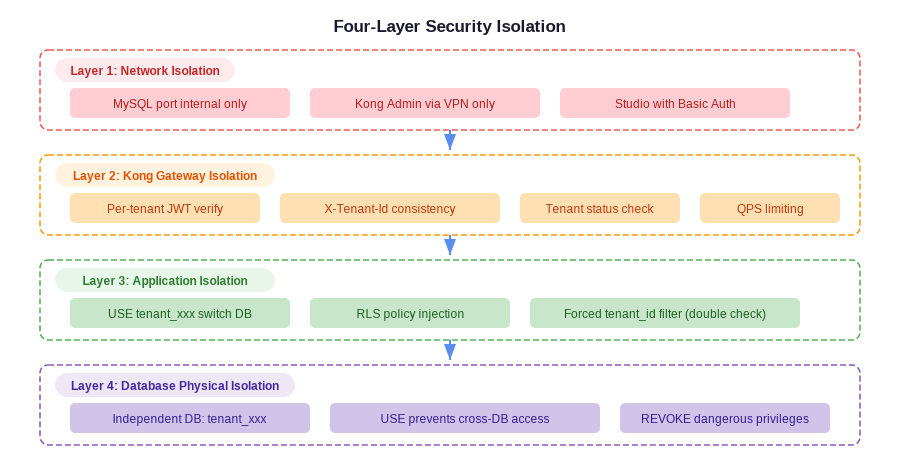
Layer 1: Network isolation
-
The MySQL port is accessible only from the internal network and is not exposed to the public internet.
-
The Kong Admin API is restricted to internal network or VPN access. Direct public access is prohibited.
-
The Studio management console requires Basic Auth to prevent unauthorized access.
Layer 2: Kong gateway isolation
-
Per-tenant secret verification: Each tenant uses an independent
jwt_secret. Kong extracts theX-Tenant-Idfrom the request header, then verifies the JWT signature with that tenant's secret. Requests with mismatched secrets are rejected immediately. -
X-Tenant-Id consistency check: Kong validates that the
X-Tenant-Idin the request header matches thetenant_idclaim in the JWT payload, preventing tenant identity spoofing. -
Tenant status check: Kong queries the tenant status (
active/suspended/deleted). Requests from non-activetenants receive an immediate403response.
Layer 3: Application isolation
-
Database switching: MysqlREST executes
USE tenant_{tenant_id}before processing each request, ensuring all SQL operations are scoped to the tenant's database. -
RLS injection: Even within a tenant's database, row-level security policies are injected to filter data rows based on the user identity in the JWT.
-
Forced tenant_id filter: All queries are appended with a mandatory
WHERE tenant_id = ?clause as a defense-in-depth measure. Even if theUSEstatement fails, no data from other tenants can be leaked.
Layer 4: Database physical isolation
-
Independent databases: Each tenant owns an isolated
tenant_{tenant_id}database that is physically separated from all other tenants. -
REVOKEof dangerous privileges: Tenant database users haveCREATE USER,GRANT, andDROP DATABASEprivileges revoked. Even in the event of SQL injection, privilege escalation is not possible.
Four-layer progressive throttling
To prevent any single tenant from exhausting shared resources, the multi-tenant edition implements four progressive layers of throttling: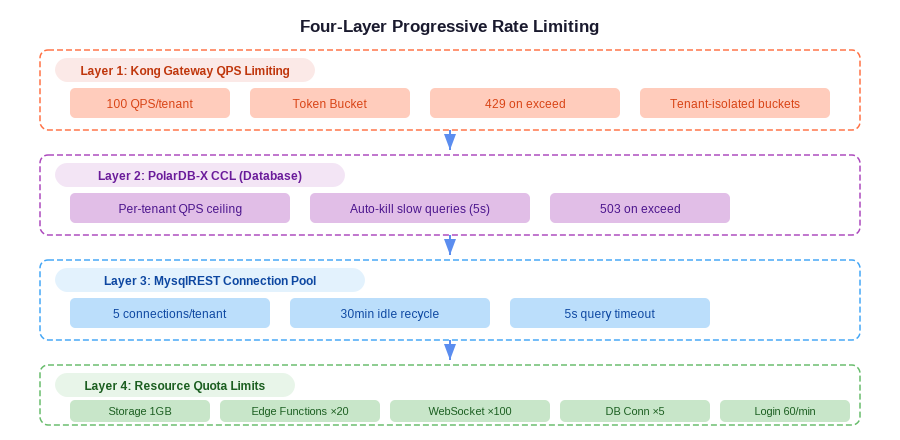
Layer 1: Kong gateway QPS limiting
-
Default limit of 100 QPS per tenant, based on the Token Bucket algorithm.
-
Requests exceeding the limit receive
HTTP 429 Too Many Requests. -
The threshold can be adjusted per tenant through the Admin API.
Layer 2: PolarDB-X CCL (database)
The native CCL (Concurrency Control Language) feature of PolarDB-X enforces per-tenant QPS limits and slow query protection at the database layer.
-- Set the QPS limit for tenant tenant_001 to 200
CREATE CCL_RULE tenant_001_qps
  ON `tenant_001`.*
  TO 'app_user'@'%'
  FOR SELECT, INSERT, UPDATE, DELETE
  WITH MAX_CONCURRENCY = 200;

-- Automatically kill slow queries that exceed 5 seconds
CREATE CCL_RULE tenant_001_slow
  ON `tenant_001`.*
  TO 'app_user'@'%'
  FOR SELECT
WITH MAX_CONCURRENCY = 10, WAIT_TIMEOUT = 5000;-
Per-tenant QPS limits prevent any single tenant from exhausting database connections.
-
Slow queries are automatically killed after a 5-second timeout, returning
503 Service Unavailable.
Layer 3: MysqlREST connection pool
-
Each tenant has an independent connection pool with a default of 5 database connections.
-
Idle connections are automatically reclaimed after 30 minutes to reduce resource consumption.
-
Queries are subject to a 5-second timeout. Queries exceeding this limit are terminated and an error is returned.
Layer 4: Resource quota limits
The platform maintains per-tenant resource quotas in the _platform database's tenant_quotas table:
|
Quota |
Default |
Description |
|
Storage |
1 GB |
Combined database and file storage |
|
Edge Functions |
20 |
Maximum number of deployable serverless functions |
|
WebSocket connections |
100 |
Concurrent Realtime WebSocket connections |
|
Database connections |
5 |
MysqlREST connection pool size |
|
Login rate |
60/min |
Auth service login/signup request limit |
All quotas can be adjusted in real time through the Admin API. Kong polls for quota changes every 60 seconds and applies updates automatically:
# Adjust the QPS quota for tenant_001 to 500
curl -X PUT http://<supabase_host>:<supabase_port>/api/admin/tenants/tenant_001/quotas \
  -H "Authorization: Bearer <service_role_key>" \
  -H "Content-Type: application/json" \
  -d '{
    "kong_qps_limit": 500,
    "storage_limit_gb": 5120
  }'
Cost advantages and elastic scaling
Cost comparison
|
Dimension |
Dedicated (100 tenants) |
Multi-tenant shared |
Savings |
|
Compute |
100 instances x 0.5C = 50C |
1 instance x 4C = 4C |
~90% |
|
Monthly cost (est.) |
CNY 5,000+ |
CNY 500+ |
~10x reduction |
|
Operations complexity |
100 systems managed independently |
1 unified system |
- |
Elastic scaling
-
Online scaling: PolarDB-X supports adding CN (compute nodes) and DN (data nodes) online. The scaling operation is fully transparent to clients and requires no downtime.
-
Locality resource groups: Dedicate specific DN nodes to VIP tenants using the Locality feature of PolarDB-X. Tenant data is pinned to designated node groups, providing physical-level resource guarantees.
-
Read-write splitting: Read-only replicas absorb read traffic while writes go to the primary node. Load is balanced automatically.
-
Online DDL: Schema changes execute online without locking tables or disrupting active requests.
Use cases
|
Scenario |
Description |
Multi-tenant benefits |
|
Vibe Coding platform |
AI-assisted programming platform where each user or project has an isolated backend environment |
Sub-second tenant provisioning, usage-based billing, and CCL rules to prevent AI-generated inefficient queries from impacting the platform |
|
Online Education SaaS |
Each training institution has isolated student, course, and order data |
Physical database isolation meets education industry compliance requirements; elastic scaling handles enrollment peaks |
|
E-commerce SaaS |
Multi-merchant platform where each merchant manages products, orders, and customers independently |
Complete data isolation between merchants, auto-scaling during promotions, and dedicated resources for VIP merchants |
|
Enterprise Collaboration |
Each enterprise or team has isolated document, messaging, and task spaces |
Realtime enables collaborative editing; WebSocket quotas guarantee real-time communication quality |
|
IoT Platform |
Device data from each enterprise customer is stored and analyzed independently |
Distributed architecture handles massive device data volumes; CCL prevents large analytical queries from interfering with each other |
|
Low-code/No-code Platform |
Each app creator has an independent database and API endpoint |
REST APIs auto-map to database tables; Edge Functions enable custom logic extensions |
Comparison with original Supabase
|
Dimension |
Original Supabase |
PXBaas Multi-Tenant Edition |
|
Database engine |
PostgreSQL (single-node) |
PolarDB-X (MySQL-compatible distributed) |
|
Multi-tenant support |
Separate instance per project; cost scales linearly with tenants |
Built-in multi-tenant management with shared deployment + physical DB isolation; cost scales sub-linearly |
|
Horizontal scaling |
Requires manual sharding or third-party solutions |
Native distributed architecture; online CN/DN node addition with transparent horizontal partitioning |
|
Resource guarantees |
Depends on PostgreSQL configuration; no per-tenant resource isolation |
Locality resource groups + CCL rate limiting; VIP tenants can be assigned dedicated DN nodes |
|
Database-level rate limiting |
No built-in mechanism; requires application-layer implementation |
Native CCL rate limiting + automatic slow query kill; database-layer fairness enforcement |
|
Cost model |
Per-instance billing; 100 tenants = 100x the cost |
Shared billing; 100 tenants share 1 infrastructure set at approximately 1/10 the cost of dedicated deployment |