What is Context0
Context0 is a full-lifecycle context management service for AI agents, covering context writing, distillation, retrieval, assembly, and evolution. Context0 is fully compatible with the Mem0 API and provides three built-in core capabilities: long-term memory, knowledge base, and context assembly. No additional vector databases, graph databases, or RAG pipelines are required.
Context0 is currently in public preview. If you have any requirements, submit a ticket to contact us.
Overview
Context0 provides three core capabilities:
Long-term memory: Fully compatible with the Mem0 API for zero-modification migration. A three-layer memory distillation pipeline (raw conversations → atomic facts → entity profiles) and a hybrid retrieval mechanism support cross-session memory persistence, improving retrieval accuracy and context relevance.
Knowledge base: Enterprise documents are indexed upon upload. RAG retrieval, Wiki knowledge distillation, and knowledge graphs enable multiple retrieval methods for the same knowledge.
Context assembly: Two core APIs (
ingestfor writing +assemblefor assembly) curate memory, knowledge, and conversation history within a specified token budget, returning structured content that can be directly appended to prompts.
Vector database selection, retrieval fusion, summary compression, multi-tenant isolation, offline evolution, and governance auditing are all built-in capabilities. No third-party middleware is required.
Capability overview
Covering the full context lifecycle of writing → distillation → retrieval → assembly → evolution, Context0 provides the following built-in capabilities, eliminating the need to build your own vector databases, graph databases, RAG pipelines, and memory frameworks.
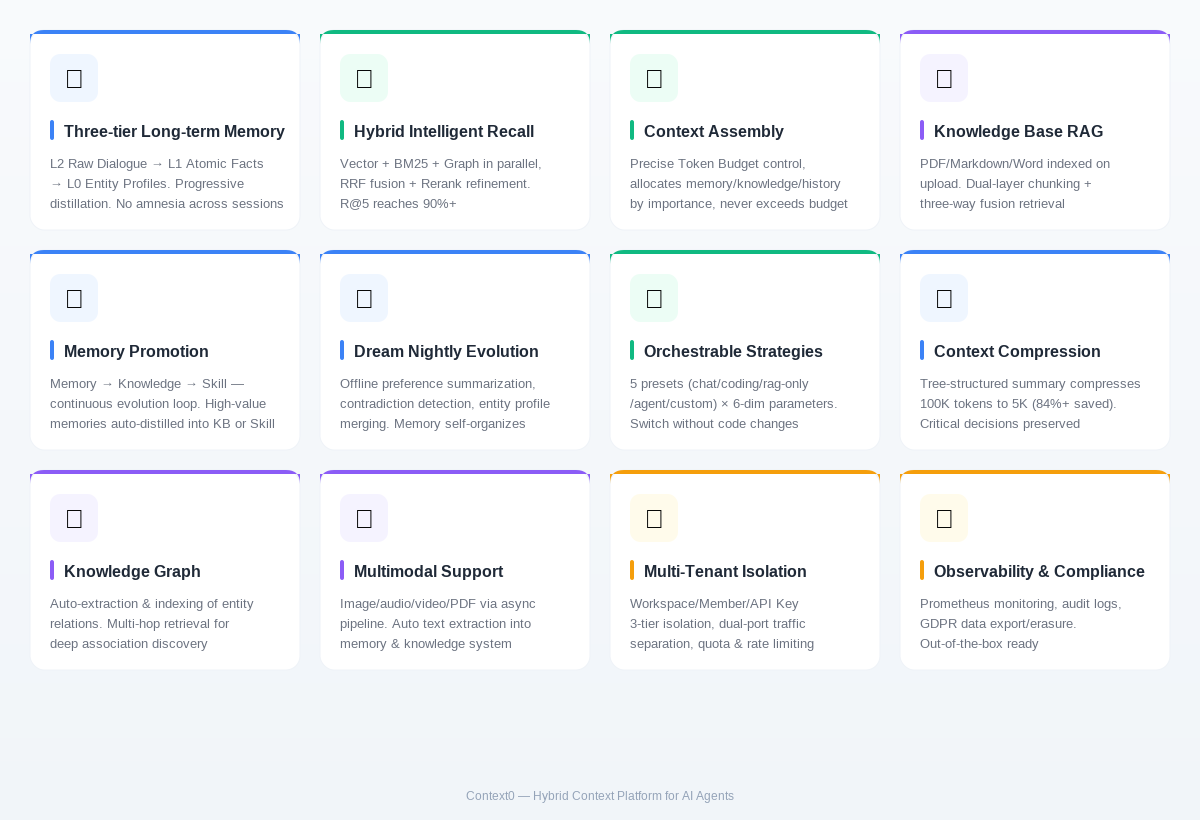
These capabilities fall into four categories:
Category | Capabilities | Problem solved |
Memory and distillation | Three-layer long-term memory, memory promotion, Dream nighttime evolution, and context compression | Enables agents to retain memory across sessions and better understand users over time |
Retrieval and assembly | Hybrid intelligent retrieval, context assembly, and configurable strategies | Curates the most relevant context within a token budget |
Knowledge and multimodal | Knowledge base RAG, knowledge graphs, and multimodal support | Ingest enterprise knowledge once and use it in multiple ways |
Enterprise governance | Multi-tenant isolation, observability, and compliance | Production-grade security, isolation, and governance out of the box |
For details on how to use and configure each capability, see User Guide.
Benefits
Benefit | Description |
Mem0 compatible, ready to use out of the box | Fully compatible with the Mem0 API, enabling zero-modification migration for existing agents. Three-layer memory distillation and hybrid retrieval deliver higher retrieval accuracy and context relevance. |
Two APIs cover the entire pipeline | The |
Precise and controllable token budget | A single |
Memory automatically distills into knowledge | High-value memories are automatically distilled into knowledge base documents or reusable skills, forming a continuous evolution loop of memory → knowledge → skill. Agents become smarter with use. |
Hybrid retrieval | Vector, BM25, and graph retrieval run in parallel, with RRF fusion and rerank refinement. Complex queries use the agentic deep mode to support multi-hop queries. |
Multiple agents share a single profile | Multiple agents within the same workspace share memory and user profiles, enabling seamless service handoff without requiring users to repeat their context. |
Switch strategies without code changes | Five preset strategies and six configurable parameters allow the same memory to produce different context for different scenarios. Configuration changes adapt the system to various business requirements without code modifications. |
Enterprise-grade security and isolation | Workspace-level physical isolation, three-tier API key permissions, audit logs, quota throttling, and GDPR-compliant data export are all built-in. No additional security components are required. |
Asynchronous writing without blocking conversations | The |
Architecture
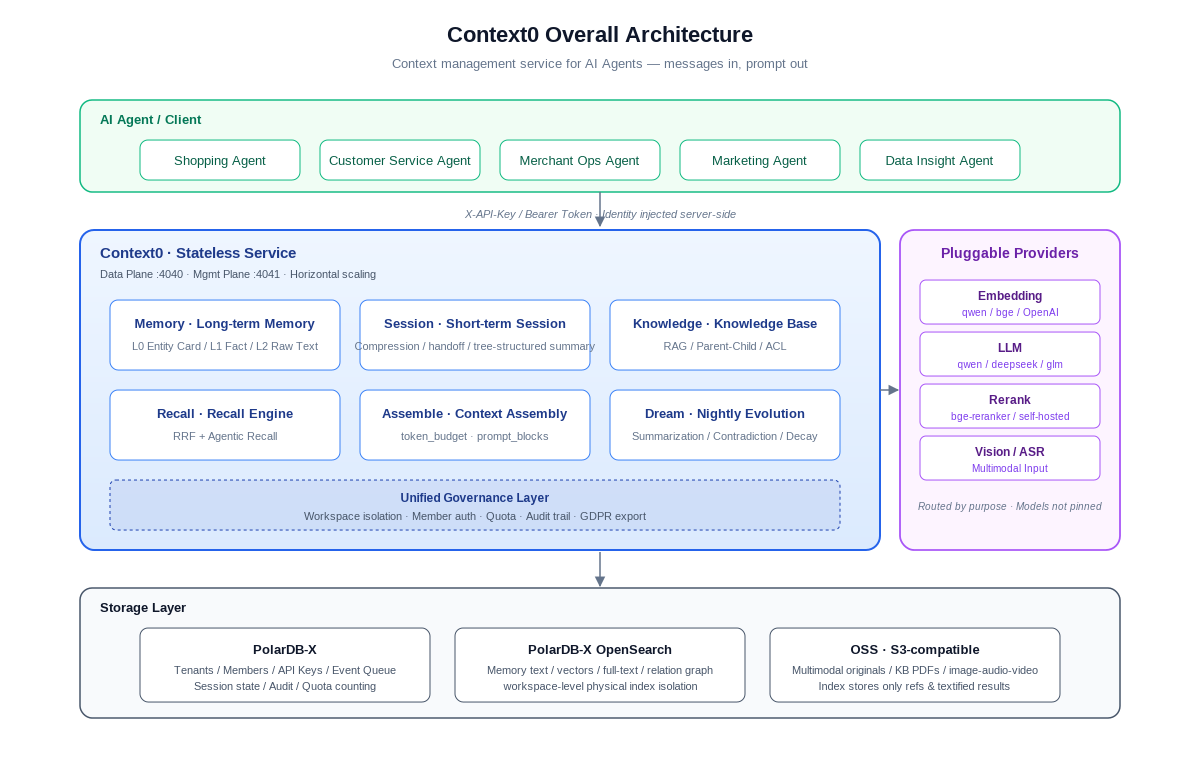
Context0 is a stateless backend service that can be horizontally scaled. Writing and distillation are decoupled through asynchronous event-driven architecture (event queue and background evolution processors), ensuring that writes return immediately while distillation runs in the background.
Storage layer
Storage | Content |
PolarDB-X | Metadata, authentication, event queues, quotas, and auditing |
Vector, full-text, and relational indexes for memory, knowledge, and graphs | |
OSS | Multimodal originals and large files |
Dual-port isolation
Context0 uses a dual-port architecture with physical isolation between the data plane and the management plane. This is a core security and separation design:
Plane | Default port | Purpose |
Data plane |
| Used by AI agents to call all business APIs ( |
Management plane |
| Operations, console, auditing, and other management tasks. Isolated from business traffic. |
Three-layer memory model
Long-term memory is not a flat table. Instead, it is organized as a three-layer progressive distillation structure.
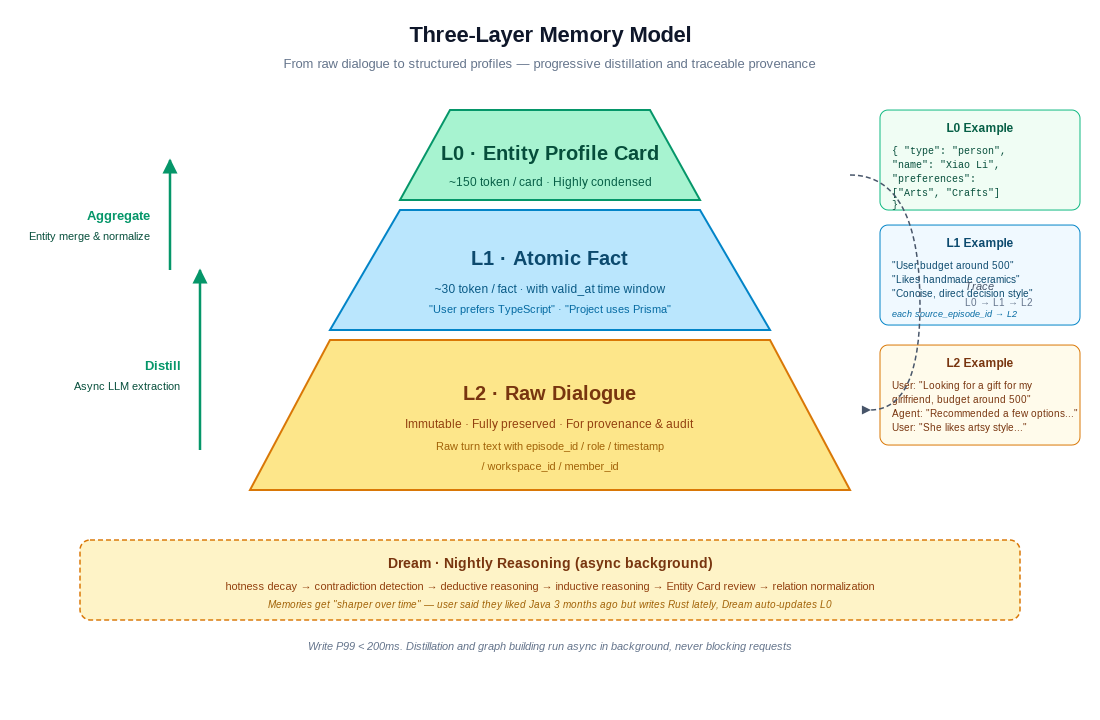
Layer | Description | Features | Example |
L2 raw conversations | Complete conversation records | Immutable and permanently retained for tracing and auditing | Verbatim messages between users and agents |
L1 atomic facts | Facts extracted from conversations by the LLM | Tagged with confidence scores and time windows ( | "User prefers TypeScript", "Target memory < 50MB" |
L0 entity profiles | Structured profile cards (approximately 150 tokens) | Aggregatable and evolvable, supporting relationship graphs |
|
Traceability
Each L1 fact carries a source_episode_id that points back to L2. Each L0 profile is aggregated from a set of L1 facts. The LLM can respond using the condensed L0 profiles without reading through thousands of conversations. When verification is needed, the system can trace back to the original messages.
Token economy example
A user has approximately 1,000 messages over 30 days (approximately 30K tokens). Context0 applies two rounds of distillation:
1,000 raw conversation messages (30K tokens).
After the first distillation, 50 L1 atomic facts are produced (approximately 30 tokens each, totaling 1.5K tokens).
After the second distillation, 5 L0 entity profile cards are produced (approximately 150 tokens each, totaling 0.75K tokens).
If only L0 profiles are fed to the LLM, 30K tokens can be compressed to 0.75K. Structured profiles have higher information density than scattered raw conversations, which helps improve LLM comprehension and reasoning.
Context asset types
Context0 manages three types of core context assets, assembled through a unified assemble API.
Long-term memory (Memory)
Facts, preferences, decisions, and user profiles accumulated across sessions, organized as the three-layer memory model. Features:
Asynchronous distillation. Writes return within P99 < 200ms without blocking conversations.
Retrieval supports three scopes:
session,user, andworkspace.Supports memory pinning (pin), invalidation marking (invalidate), and scope promotion (promote).
Dream nighttime evolution: automatically decays outdated preferences, detects contradictory memories, and consolidates entity profiles.
Knowledge base (Knowledge)
Unified management of enterprise documents, manuals, runbooks, and RAG corpora. Unlike a standard vector database, the Context0 knowledge base provides four capabilities:
Capability | Description |
RAG retrieval | Documents are automatically parsed upon upload with two-level chunking (small chunks for precise matching and large chunks for context backfill), vectorized, and indexed. Vector, BM25, and rerank retrieval are fused. |
Wiki knowledge distillation | Automatically discovers high-value memory clusters and enables agents to synthesize Markdown knowledge documents, forming an evolution loop where knowledge accumulates and the knowledge base grows organically. |
Knowledge graph | Optionally enables entity relationship graph indexes to support multi-hop relationship retrieval. |
Content review | Memory promotion to knowledge requires manual review before being ingested, ensuring knowledge quality. |
Supports multiple formats including PDF, Markdown, Word, Excel, PPT, RTF, EPUB, images, and audio. Updated documents are automatically re-chunked and re-embedded incrementally.
Skill
Hosts skill definitions and tool contexts that agents can invoke, assembled together with memory and knowledge into the context window.
Core concepts
Understanding the following concepts is fundamental to using Context0.
Concept | Definition |
Workspace | The top-level tenant isolation unit. Indexes are physically partitioned by workspace, and data across workspaces is completely invisible to each other. |
Member | A member identity within a workspace (typically corresponding to an agent). Multiple members within the same workspace can share memory. |
User ID | The end-user identifier within an application (such as a customer or a developer). Used only in the memory domain to isolate profiles by user. |
API Key | Three permission levels: ADMIN (management plane), OWNER (workspace owner), and USER (bound to an end user). Identity is injected on the server side and cannot be forged by clients. |
Session | A session that carries a continuous stream of conversation messages. The |
Strategy | Retrieval and assembly strategies. Five presets are provided: |
Tenant isolation anchor: (workspace_id, member_id) is the core anchor for isolation. user_id is used only within the memory domain to distinguish end users.
Use cases
Use case | Typical usage | Recommended strategy |
AI coding assistant | Remembers developer technical preferences and project decisions for instant session recovery. Code semantic retrieval uses the knowledge base. |
|
Intelligent customer service and sales assistant | Remembers user profiles and historical decisions. Multiple agents share |
|
Enterprise knowledge base RAG | Policy documents, manuals, and runbooks are available for Q&A upon upload. Pure retrieval without memory extraction. |
|
Multi-agent collaboration | Different members within the same workspace share the memory store, enabling seamless handoff from reception to technical support to escalation. |
|
For detailed integration and configuration for each use case, see Common scenarios.
Public preview notes
Context0 is currently in public preview. During the public preview period:
The full data plane (
ingest,assemble, memory, and knowledge) and management plane (console, auditing, and quotas) capabilities are available.We recommend that you verify strategy effectiveness and retrieval quality in a test workspace before production integration.
Memory and knowledge data can be exported. No vendor lock-in risk exists.
If you have any requirements, submit a ticket to contact us.