Product overview

更新时间:
复制 MD 格式

PolarDB is a cloud-native relational database by Alibaba Cloud with a compute-storage decoupled architecture. PolarDB is 100% compatible with MySQL and PostgreSQL, highly compatible with Oracle syntax, and supports centralized and distributed deployments. Compared with self-managed databases, PolarDB delivers up to 6x transactional and 400x analytical performance of open source databases at 50% of the total cost of ownership (TCO).

Choose the PolarDB database engine that best suits your application while maintaining full ecosystem compatibility.

PolarDB database

Ecosystem compatibility

Service architecture

Product form

PolarDB for MySQL

100% compatible with MySQL

Shared storage, compute-storage decoupled

Public cloud, Apsara Stack Enterprise, DBStack

PolarDB for PostgreSQL

100% compatible with PostgreSQL, highly compatible with Oracle syntax

PolarDB for Xscale

Shared-nothing, integrated centralized and distributed architecture

Benefits

Ecosystem compatibility

  • 100% compatible with MySQL and PostgreSQL ecosystems.

  • Highly compatible with Oracle syntax. End-to-end Oracle migration with zero downtime, controllable risk, and predictable progress — proven by 500+ customer cases.

  • In both centralized and distributed deployments, PolarDB integrates with existing systems for smooth enterprise database upgrades.

High performance

  • Up to 6x transactional processing (TP) performance over open source databases.

  • Up to 400x online analytical processing (OLAP) performance over open source databases, with parallel query and columnstore indexes for real-time analytics.

High availability

  • Single-zone, dual-zone, three-zone (RPO=0), and cross-region high availability configurations for failure prevention and data protection.

  • Up to 99.995% SLA availability.

Mass storage

  • PolarDB for MySQL and PolarDB for PostgreSQL: up to 500 TB.

  • PolarDB for Xscale: petabyte-scale.

Easy to scale

  • Intelligent proxy with multiple read consistency levels.

  • Serverless elastic scaling and linear scaling for distributed deployments.

  • Low-latency physical replication for efficient inter-node synchronization.

Security

  • Access control: Resource Access Management (RAM) users, IP whitelists, security groups, and Virtual Private Clouds (VPCs).

  • Data security: Transparent Data Encryption (TDE), backup and recovery, and flashback query.

  • Transmission security: SSL encryption.

Service architecture

PolarDB for MySQL

PolarDB for MySQL uses a cloud-native, compute-storage decoupled architecture that combines commercial-grade stability and performance with open source simplicity. It delivers second-level elasticity, high availability, and mass storage.
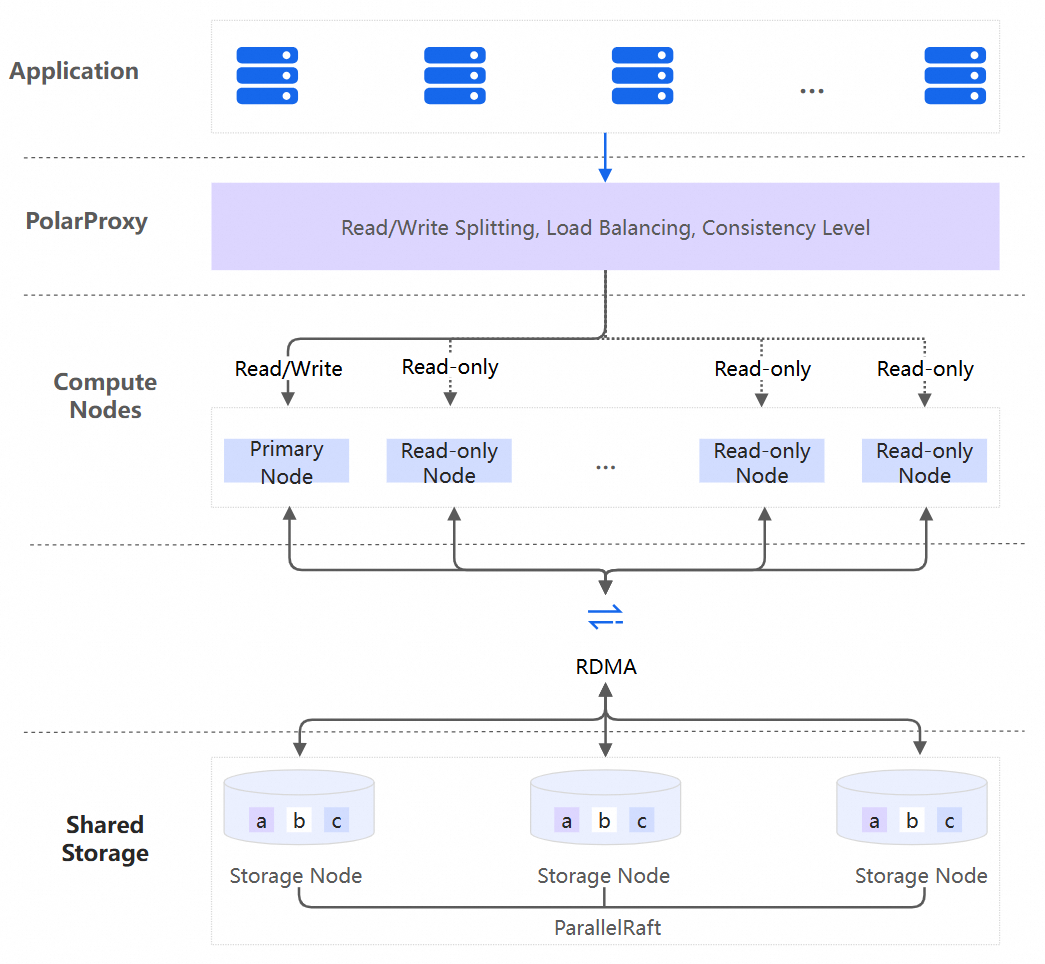
PolarDB for MySQL architecture

  • Database proxy (Proxy)

    A network proxy between the database and your application that forwards all requests. Provides security authentication, automatic read/write splitting, load balancing, consistency levels, connection pooling, persistent connections, and overload protection.

  • Database compute nodes

    • PolarDB uses a multi-node cluster architecture. Cluster Edition provides one read/write node and multiple read-only nodes. Multi-master Clusters have multiple read/write nodes and multiple read-only nodes.

    • Active-active failover between read/write and read-only nodes ensures high availability.

    • Compute nodes host the SQL engine and come in General-purpose and Dedicated specifications.

  • Shared distributed storage

    All compute nodes share a single data copy, reducing storage costs. Built on distributed block storage, capacity scales online up to hundreds of terabytes without single-server limits.

PolarDB for PostgreSQL

PolarDB for PostgreSQL clusters support both centralized and distributed forms:

  • Centralized

    Uses a cloud-native, compute-storage decoupled architecture that combines commercial-grade stability and performance with open source simplicity. Delivers second-level elasticity, high availability, and mass storage.

  • Distributed

    A distributed database built on centralized PolarDB for PostgreSQL. Uses a two-layer CN/DN architecture for distributed scalability with compute-storage decoupling. Retains all centralized cluster features for diverse enterprise workloads.

Centralized (Enterprise Edition and Standard Edition)

PolarDB for PostgreSQL centralized architecture

  • Database proxy (Proxy)

    A network proxy between the database and your application that forwards all requests. Provides security authentication, automatic read/write splitting, load balancing, consistency levels, connection pooling, persistent connections, and overload protection.

  • Database compute nodes

    • PolarDB uses a multi-node cluster architecture. Cluster Edition provides one read/write node and multiple read-only nodes.

    • Active-active failover between read/write and read-only nodes ensures high availability.

    • Compute nodes host the SQL engine and come in General-purpose and Dedicated specifications.

  • Shared distributed storage

    All compute nodes share a single data copy, reducing storage costs. Built on distributed block storage, capacity scales online up to hundreds of terabytes without single-server limits.

Distributed

PolarDB for PostgreSQL distributed architecture

  • Database nodes

    • CNs handle cluster metadata management and distributed plan generation. DNs store actual data shards.

    • Each CN and DN uses a centralized, compute-storage decoupled architecture with database proxy and one-primary-multiple-read-only mode. High-availability failover is built in. Add read-only nodes (ROs) to scale out read capability.

  • Distributed features

    • Manual sharding and horizontal scaling for data volumes under 1 PB.

    • Ensures consistency for distributed transactions.

    • Dual-zone deployment: primary zone for the working cluster, secondary zone for hot standby.

    • 24/7 zero-downtime configuration changes, upgrades, and maintenance. Supports heterogeneous CN and DN additions.

PolarDB for Xscale

PolarDB for Xscale starts with centralized DNs fully compatible with standalone MySQL 5.7 and 8.0. When growth demands it, the architecture upgrades in-place to distributed mode — distributed components connect to existing DNs without data migration or application changes.

Centralized (Standard Edition)

PolarDB for Xscale centralized architecture

  • Data Node (DN)

    DNs handle data persistence with high reliability and strong consistency via the Paxos majority-vote protocol. The self-developed Lizard distributed transaction engine system delivers ~35% better performance than the native MySQL distributed engine.

  • Multi-replica architecture

    The system uses Paxos majority-vote consensus to ensure strong consistency (RPO=0) among replicas. Each write must be confirmed by more than half the nodes, so the cluster tolerates single-node failures. Replica roles:

    • Leader

      Processes client requests and makes decisions. Maintains logs for data consistency and recoverability.

    • Follower

      Executes instructions from the Leader. Can be elected as the new Leader if the current Leader fails.

    • Logger

      Participates in majority protocol voting without providing data services. May serve as interim Leader after a failure until Followers catch up with protocol logs, then steps down.

    • Learner

      Passively receives system status without participating in voting or decisions.

Distributed (Enterprise Edition)

PolarDB for Xscale distributed architecture

  • Global Meta Service (GMS)

    Maintains globally consistent metadata (tables, schemas, statistics), manages security (accounts, permissions), and provides a global timestamp service (TSO).

  • Compute Node (CN)

    The stateless entry point of the system, with SQL parser, optimizer, and executor. Handles distributed data routing, 2PC transaction coordination, distributed DDL, and global index maintenance. Supports enterprise features like three-role mode.

  • Data Node (DN)

    Persists row-store data with high reliability and strong consistency via Paxos majority-vote. Uses MVCC for distributed transaction visibility. Supports computation pushdown (Project, Filter, Join, Aggregation) for distributed workloads.

  • Columnar node

    Provides persistent columnstore indexes built on OSS. Consumes distributed transaction binary logs in real time for live updates. Works with compute nodes to deliver snapshot-consistent columnstore queries.

  • Change Data Capture (CDC) node

    Provides incremental subscriptions fully compatible with MySQL binlog format and protocol. Supports MySQL-compatible primary/secondary replication.

Videos

How to use PolarDB

Manage PolarDB clusters — create clusters, databases, and accounts — through:

  • Console: Graphical web interface.

  • API: All console operations available programmatically.

  • SDK: Language-specific SDKs for programmatic access.

  • CLI: Command-line access for all console operations.

Quick guide

PolarDB database

Billing

User Guide

Whitepapers

PolarDB for MySQL

Product Billing

Performance Whitepapers

PolarDB for PostgreSQL

Product Billing

Performance Whitepapers

PolarDB for PostgreSQL (Compatible with Oracle)

Product Billing

PolarDB for Xscale

Billing overview

User Guide