HUAWEI CLOUD RDS for SQL Server data source
Create a HUAWEI CLOUD RDS for SQL Server data source to connect Quick BI to your HUAWEI CLOUD SQL Server database for data analysis.
Prerequisites
-
You have created a HUAWEI CLOUD SQL Server database instance.
-
You have the username and password for the HUAWEI CLOUD SQL Server database.
Limitations
This data source supports SQL Server versions from 2008 to 2022.
Procedure
-
Add IP addresses to the whitelist.
Before connecting to HUAWEI CLOUD SQL Server, add the IP addresses of Quick BI to the whitelist of your HUAWEI CLOUD SQL Server instance.
-
Verify the data source connection and create the data source.
-
Log on to the Quick BI console.
-
Add a data source:
-
Go to the data source creation page from the Create Data Source entry point.
-
On the HUAWEI CLOUD databases tab, select RDS for SQL Server.

-
-
-
In the connection configuration dialog box, configure the following parameters.
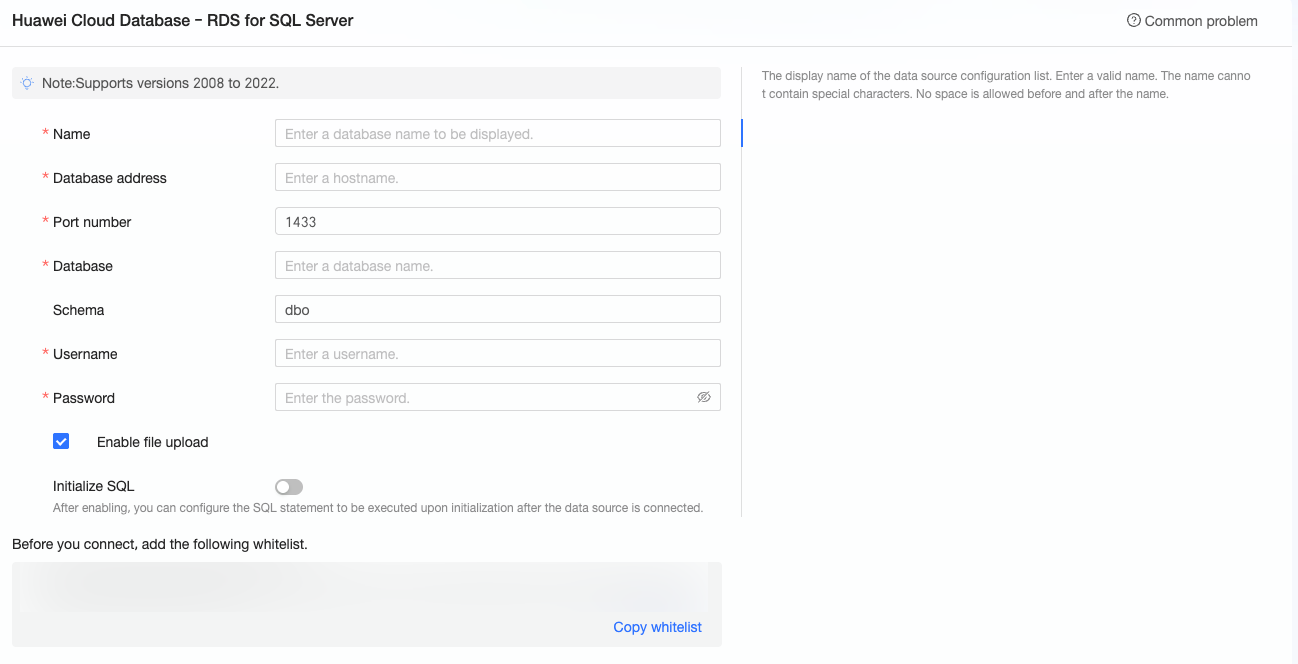
Parameter
Description
display name
The display name of the data source in the data source list.
The name cannot contain special characters or leading or trailing spaces.
database address
The public endpoint of the SQL Server database instance. To obtain this address, log on to the HUAWEI CLOUD console, go to the instance details page, bind an elastic public IP address, and then find the address on the connection management page.
port
The port number of the database. Default value: 1433.
database
The name of the database to connect to.
schema
The name of the schema. Default value: dbo.
username
The username for database authentication.
password
The password that corresponds to the username.
Enable upload entry
Select this option to allow file uploads.
initialization SQL
SQL statements that run immediately after a connection is established.
Only SET statements are allowed. Separate multiple statements with semicolons (;).
-
Click test connection to verify the data source connection.

-
After a successful connection test, click OK to create the data source.
Next steps
After the data source is created, you can create a dataset and start analyzing your data.
-
To add tables or custom SQL queries from the data source, see Create a dataset.
-
To add a visual chart and analyze data, see Create a dashboard and Visual chart overview.
-
To drill down into your data, see Step 3: Configure and display drill-down data.