Aurora PostgreSQL data source
Add an Aurora PostgreSQL data source to connect Quick BI to your Aurora PostgreSQL database for data analysis and visualization.
Limitations
Version 15.4 is supported.
Procedure
-
Add to the allowlist.
To connect to Aurora PostgreSQL, add the Quick BI IP addresses to its allowlist.
-
Go to the page for creating a data source. For more information, see Create a data source.
-
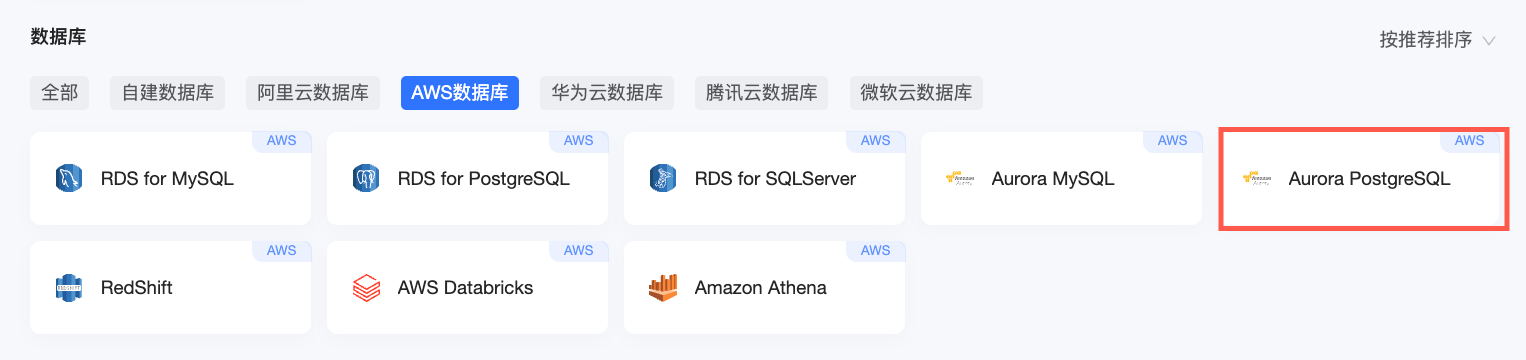
On the AWS databases tab, select the Aurora PostgreSQL data source.
-
In the Configure Connection dialog box, configure the following parameters based on your business needs.

Parameter
Description
Display name
The display name for the data source, shown in the data source list.
The name cannot contain special characters or leading or trailing spaces.
Database address
The public endpoint of the Aurora PostgreSQL database cluster.
To obtain the address, log in to the Amazon RDS console, select your database, and on the Connectivity & security tab, copy the endpoint, for example,
xxxxxxxx.rds.amazonaws.com.For more information, see Create and connect to an Aurora PostgreSQL DB cluster.
Port
The database port number. Default: 5432.
Database
The name of the target database.
Schema
The name of the target schema.
User name and password
The user name and password for the Aurora PostgreSQL database.
NoteThe user must have create, insert, update, and delete permissions on the tables in the database.
Initialization SQL
SQL statements to run after the connection is established.
Only
SETstatements are allowed. Use a semicolon (;) to separate multiple statements.SSL
Enable this option if your data source requires an SSL connection.
-
Click Test Connection to verify the connection.

-
After the connection test is successful, click OK to add the data source.
Next steps
After the data source is created, you can create a dataset and start analyzing your data.
-
To create a dataset from your Aurora PostgreSQL data source, see Create a dataset.
-
To add visualizations and analyze data, see Create a dashboard and Visualization overview.
-
To perform in-depth analysis using drill-downs, see Step 3: Configure and display drill-downs.