Overview of creating a database source
This topic describes the entry points for creating database sources, the supported data sources, and their connection methods.
Limitations
Only users with the Developer user type and a workspace role that includes the Create (Edit) Data Source permission can create database sources.
Entry points
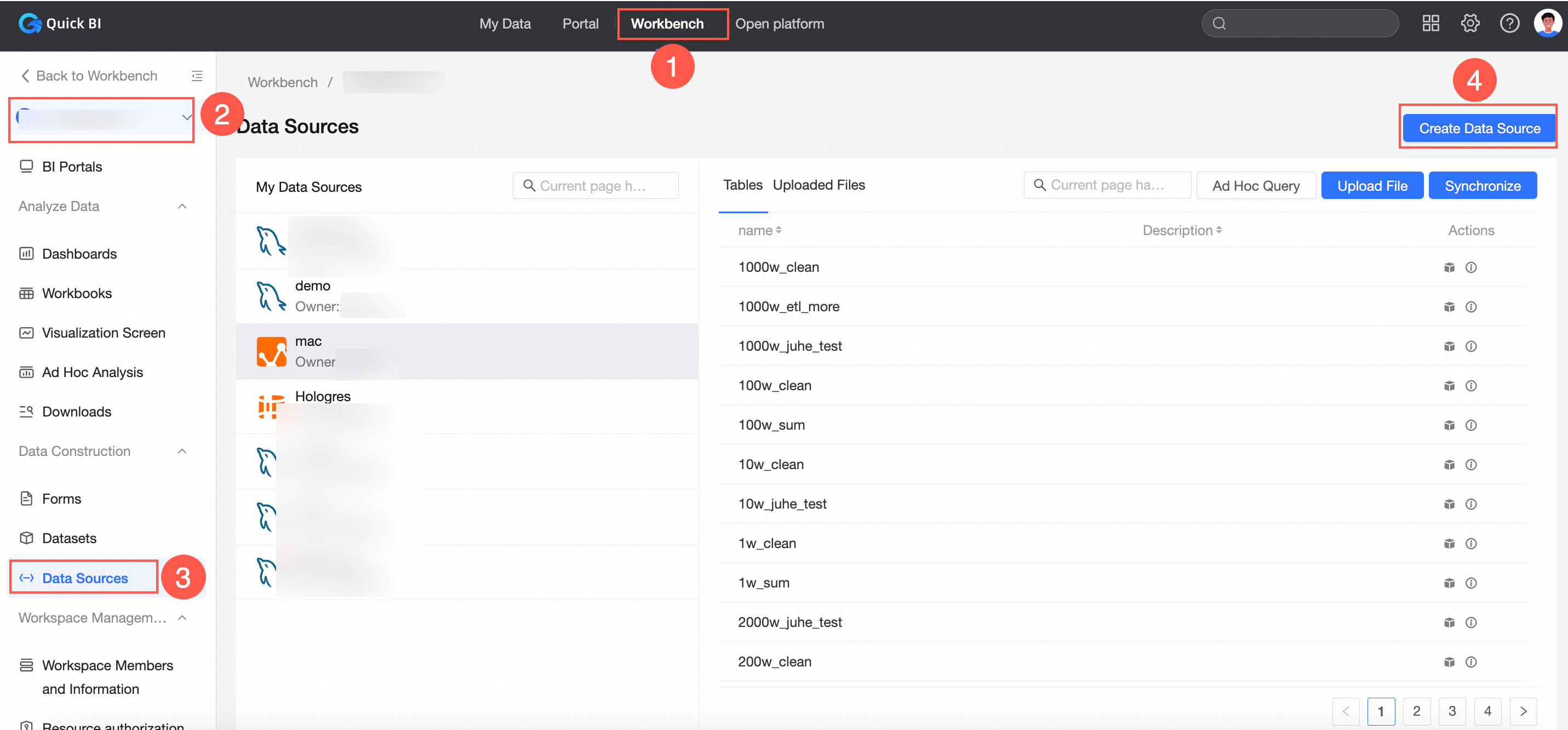
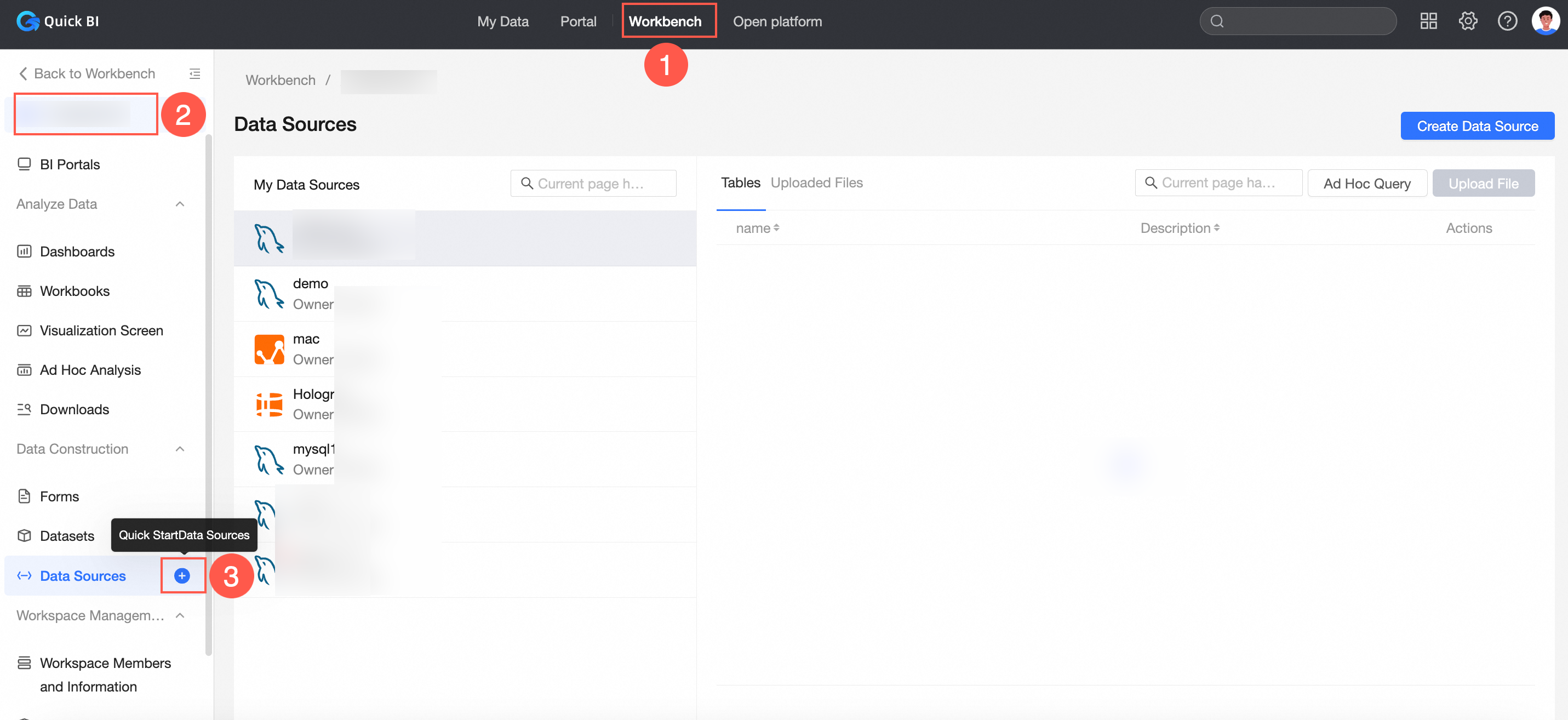
Log on to the Quick BI console. You can open the data source creation page in several ways.
Entry 1: From the global resource menu
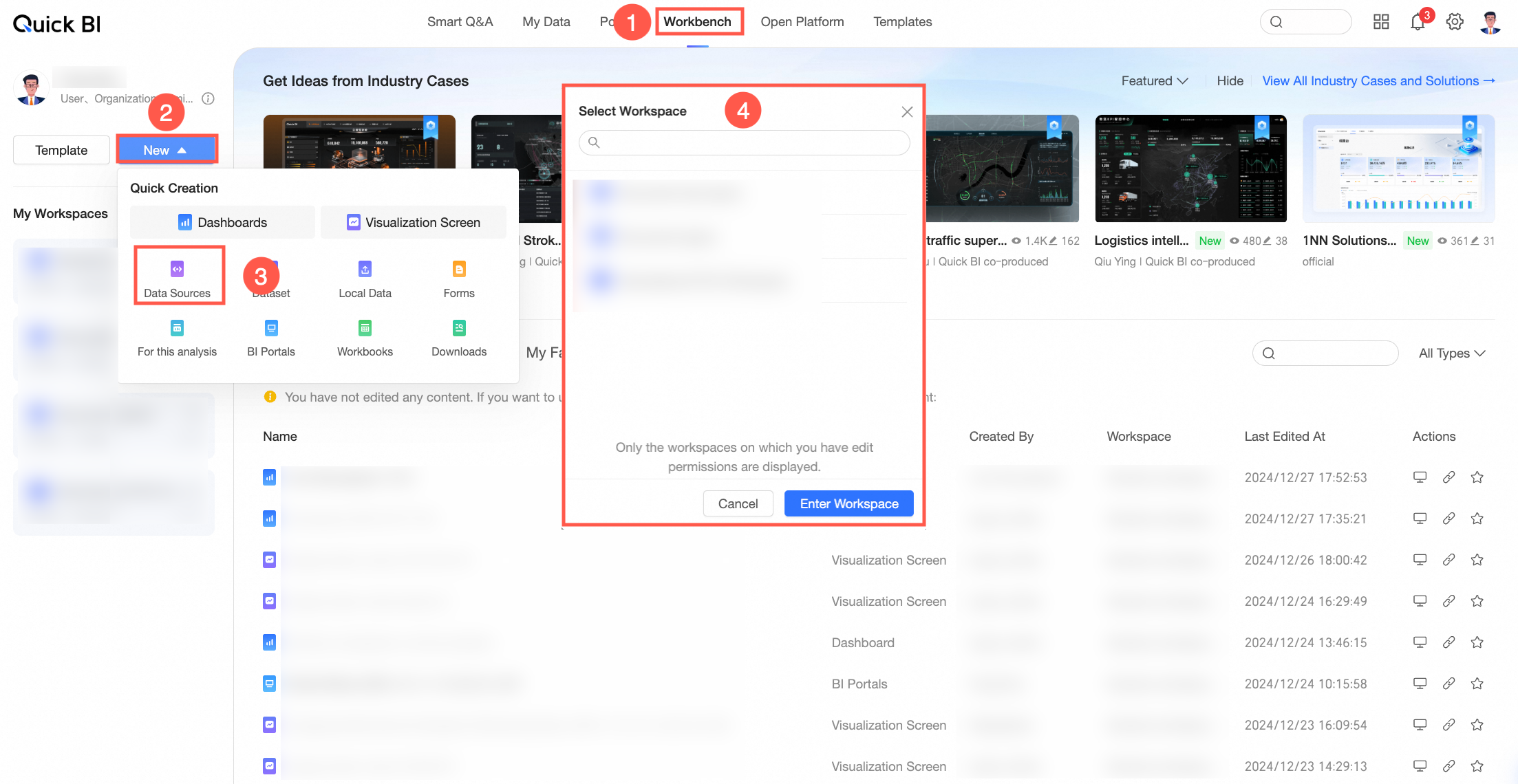
Entry 2: From the Data Sources page within a workspace
Entry 3: From the resource list within a workspace
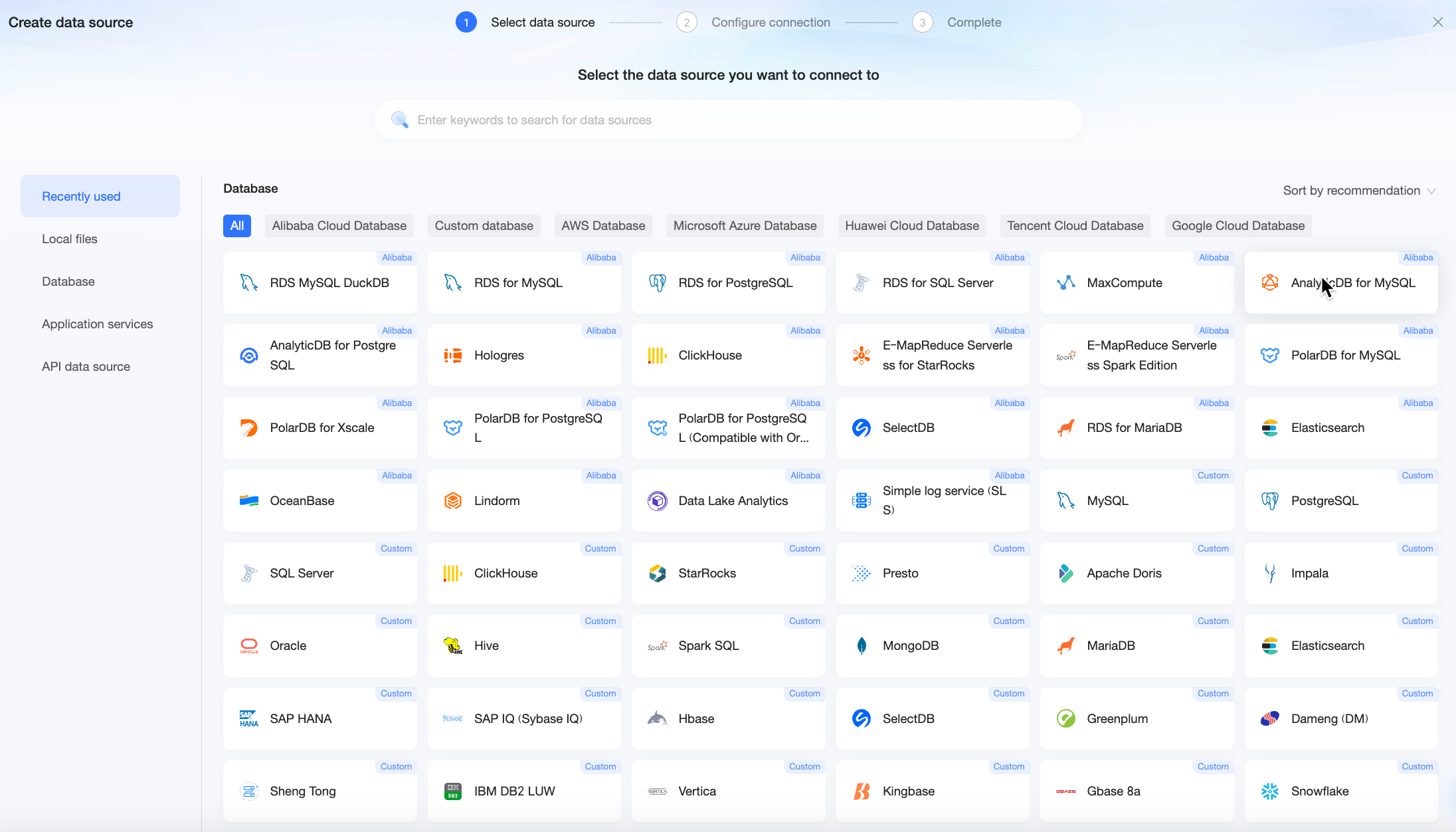
Each of these entry points takes you to the Connect to a Data Source page, where you can select a data source type and configure its connection.
IP allowlist
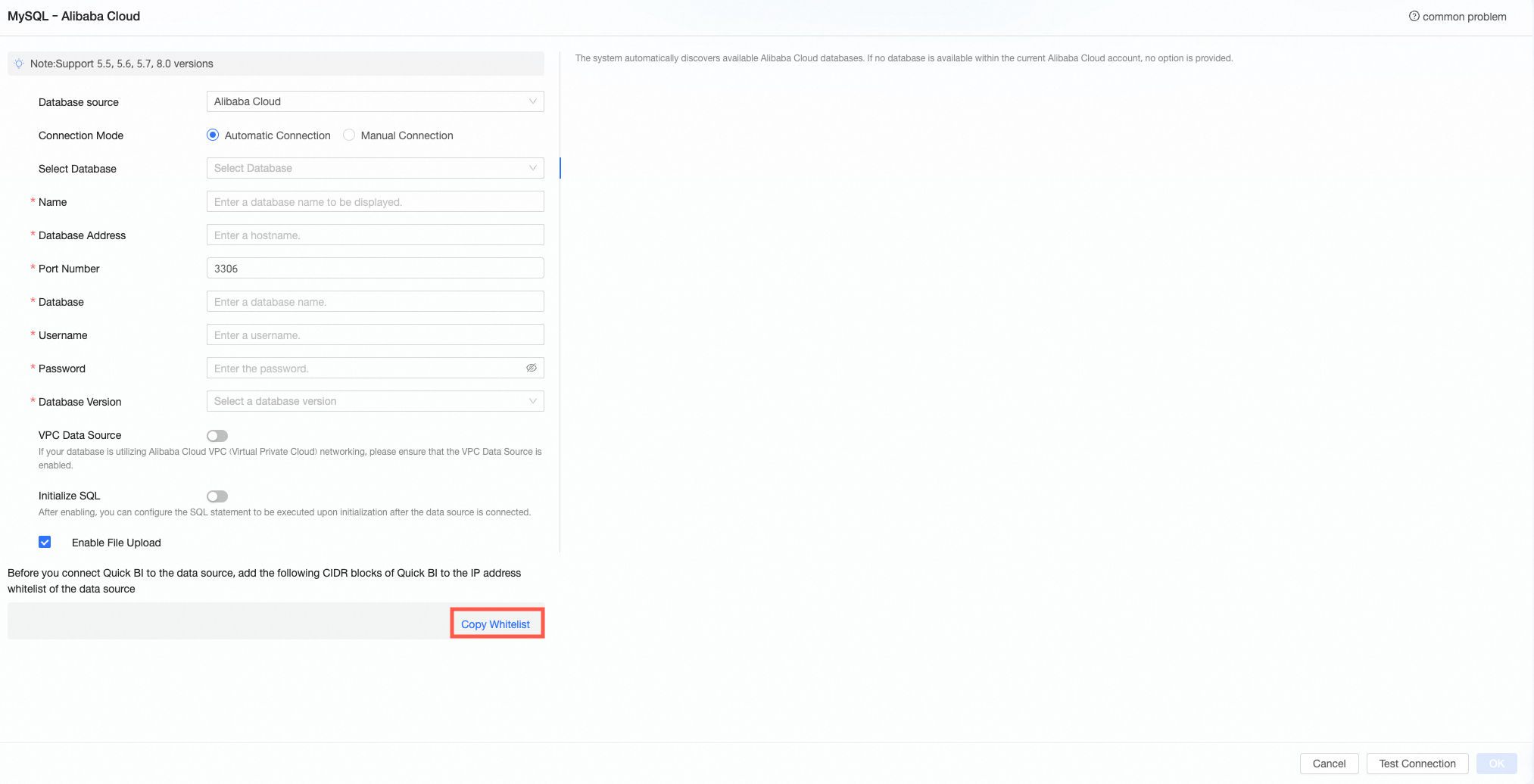
When you connect Quick BI to a database over the public network, you must add the Quick BI IP addresses to the database's allowlist.
On the data source configuration page, click Copy Allowlist to copy the Quick BI IP addresses. The following figure shows an example using Alibaba Cloud RDS for MySQL.
Supported data sources and types
Data source | Data source type |
MySQL | |
MaxCompute | |
AnalyticDB for MySQL | |
SQL Server | |
PostgreSQL | |
Hologres | |
ClickHouse | |
AnalyticDB for PostgreSQL | |
Presto | |
Data Lake Analytics | |
PolarDB for MySQL | |
Oracle | |
Hive | |
PolarDB for Xscale | |
PolarDB for PostgreSQL | |
SAP HANA | |
PolarDB for Oracle | |
IBM DB2 LUW | |
Vertica | |
Lindorm | |
OceanBase | |
SAP IQ (Sybase IQ) | |
Kingbase | |
Gbase 8a | |
Impala | |
Snowflake | |
Kylin | |
Spark SQL | |
MongoDB | |
Apache Doris | |
Dameng | |
TiDB | |
MariaDB | |
StarRocks | |
SelectDB | |
Simple Log Service (SLS) | |
Huawei GaussDB | |
Huawei GaussDB(DWS) | |
Elasticsearch | |
TDSQL-H LibraDB | |
Shentong | |
Greenplum | |
Aurora MySQL | |
Aurora PostgreSQL | |
Amazon Redshift | |
Databricks | |