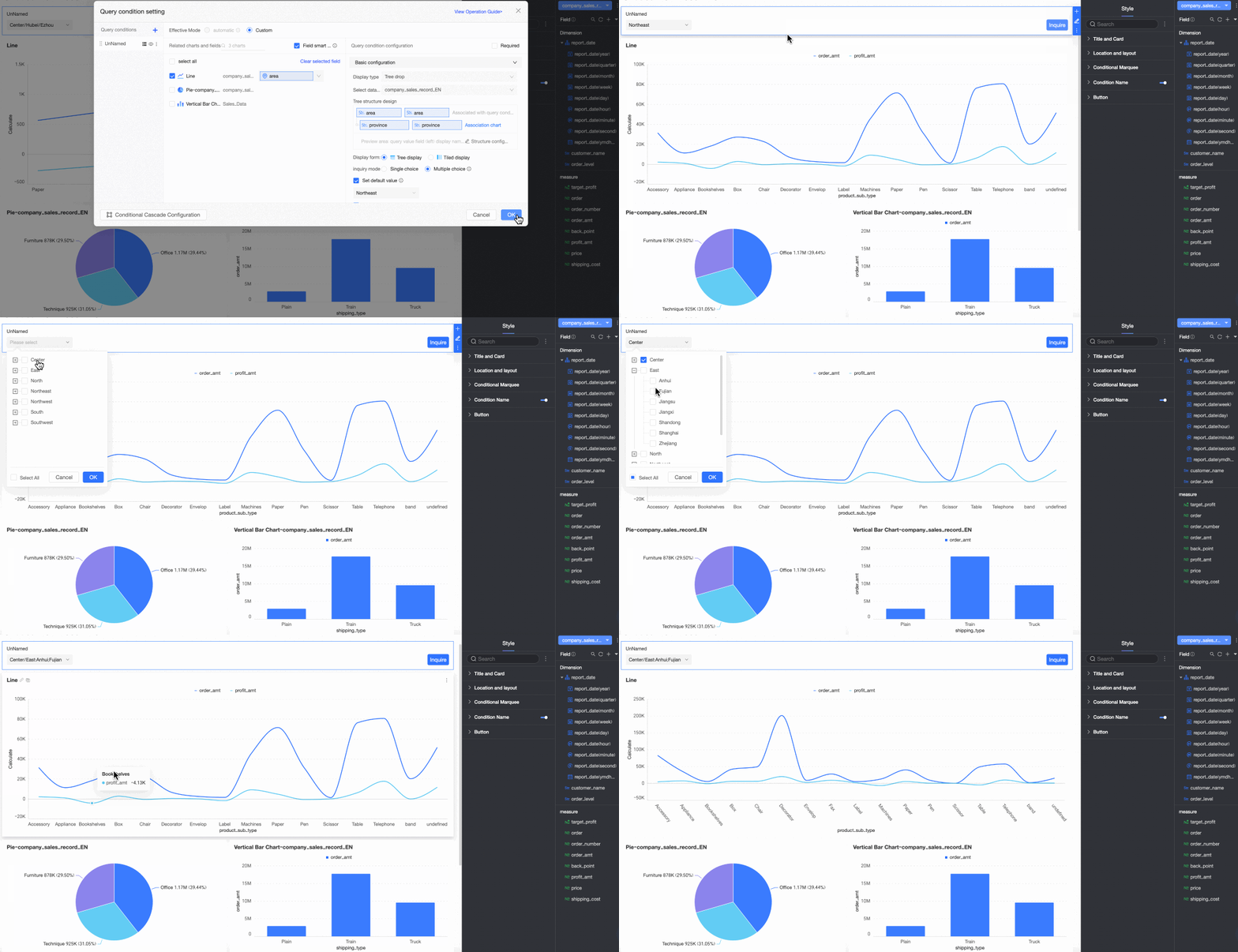
Text filters
Text filters allow report viewers to dynamically query and filter data by entering or selecting text field values. This helps them focus on relevant information by filtering chart data based on specific text conditions.
The main advantages of text filters are as follows:
High flexibility: Offers three display types (drop-down list, text input box, and tree drop) with extensive configuration options for various business scenarios.
High precision: The filter supports multiple matching conditions, such as
contains,does not contain,starts with, andends with, for precise data filtering.
Quick BI supports three display types for text filters: drop-down list, text input box, and tree drop. This topic describes the use cases and configuration for each type.
Prerequisites
You have created a dashboard that contains charts with text fields.
You have added an empty filter to the dashboard. For more information, see Create a filter.
Configure the filter
Go to the dashboard edit page. For instructions, see Create a dashboard.
In the dashboard list, find and click the target dashboard.
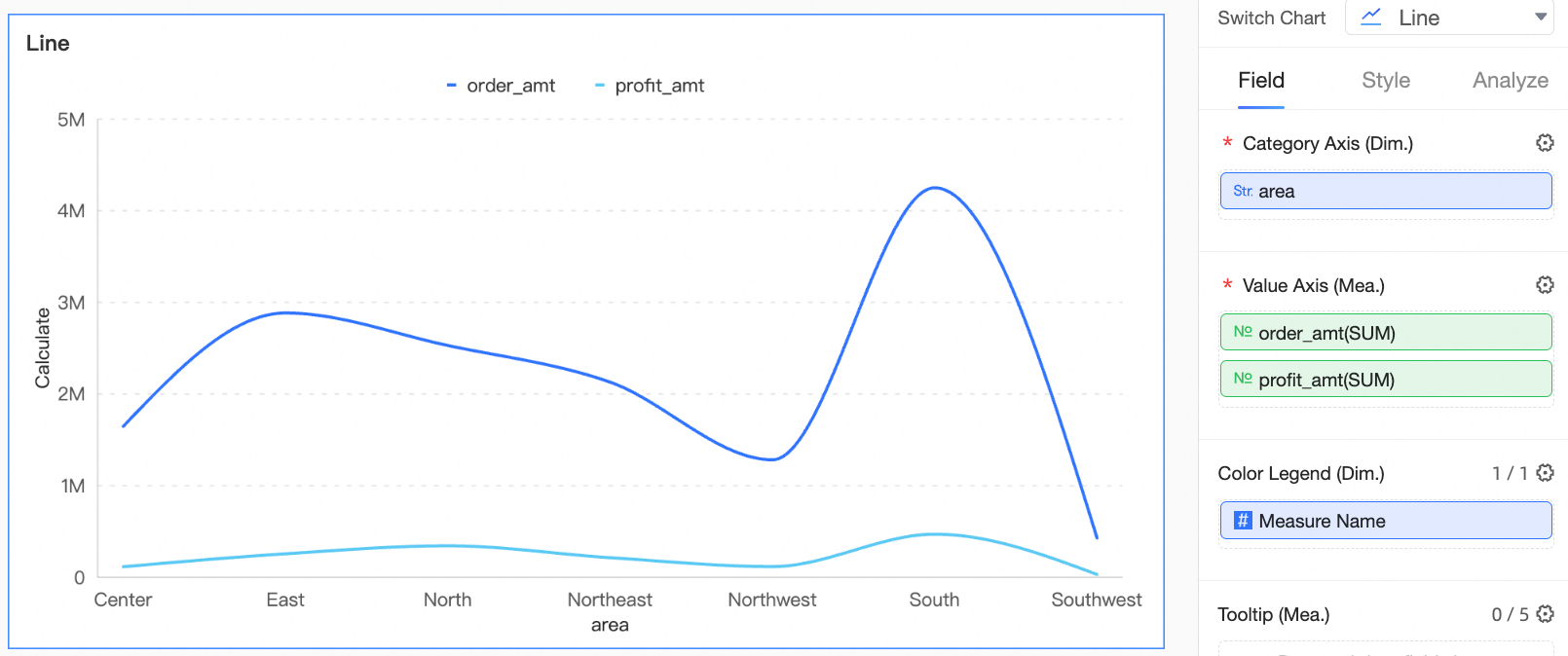
The charts on the dashboard must contain text fields to set up a text filter. This topic uses a line chart as an example. For more information, see Line chart.
Follow the steps in the figure to add a filter.
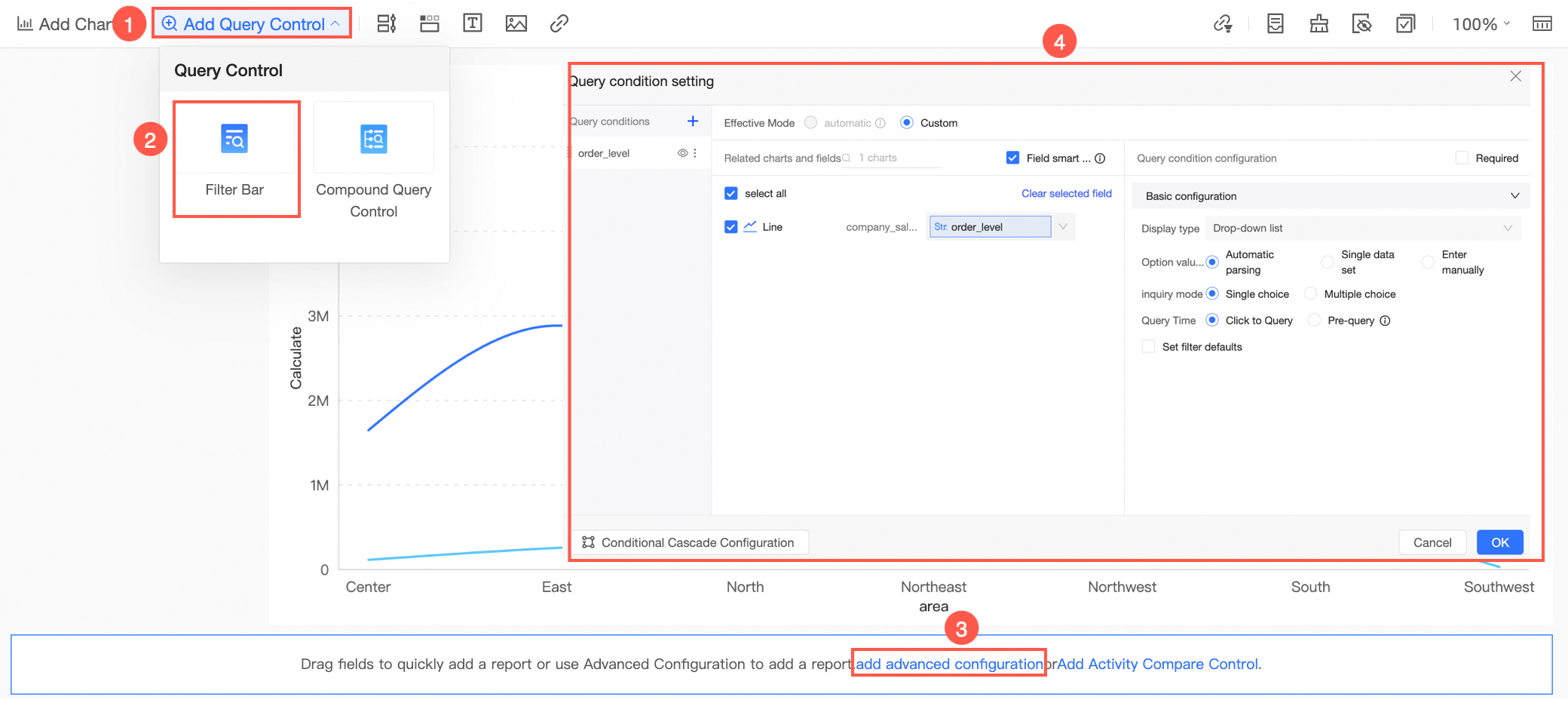
Configure the filter.
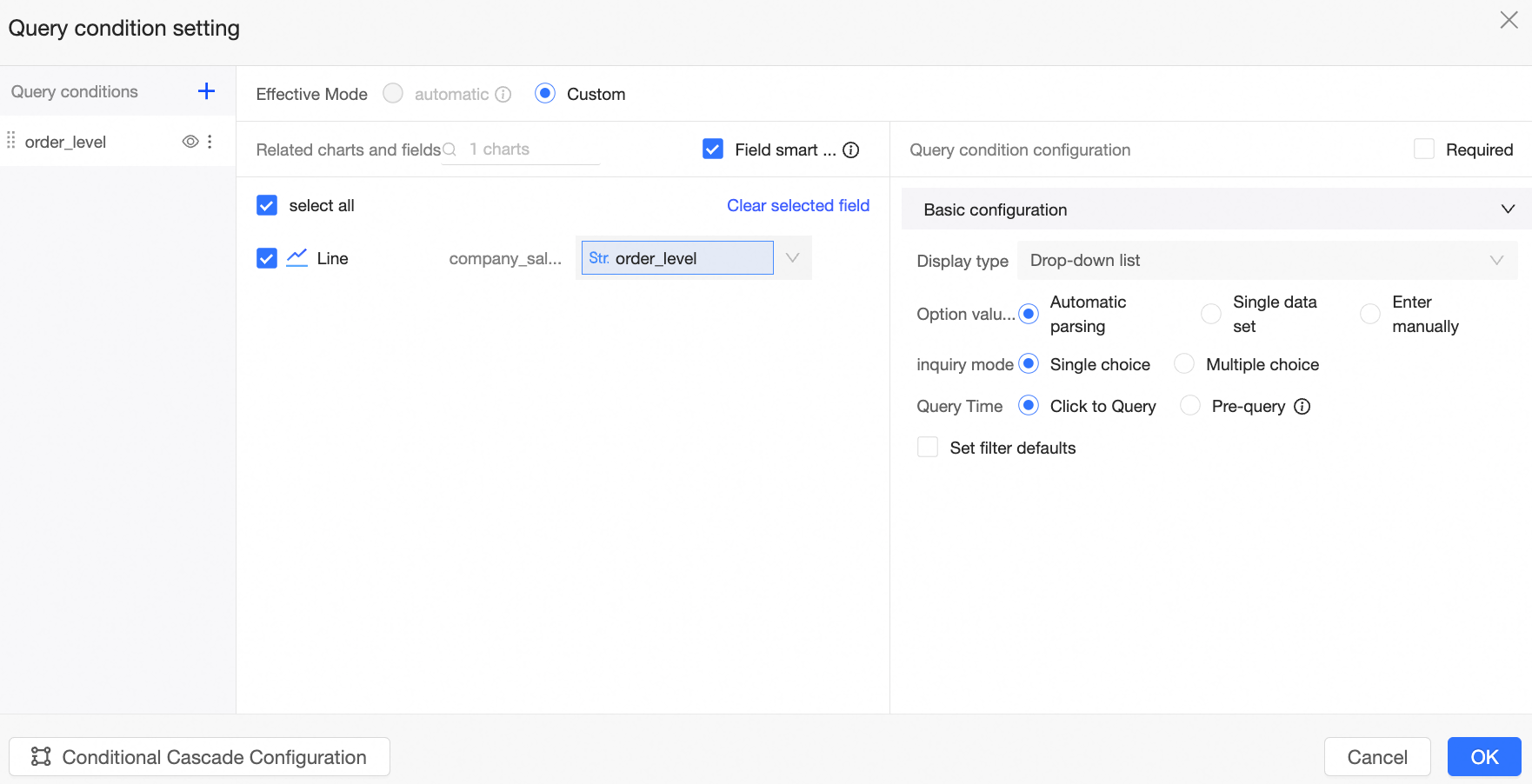
Set the filter name to Level Query.
Select the associated chart Line Chart and the associated field Order Level.
Set the display type and complete the filter configuration.
If you set Display type to Drop-down list, see the example in Drop-down list.
If you set Display type to Text input box, see the example in Text input box.
If you set Display type to Tree drop, see the example in Tree drop.
Click OK.
Drop-down list
The drop-down list display type presents predefined options for selection. When you set the Display type to drop-down list, you can set the option source to Automatic parsing, single dataset, or Manual input.
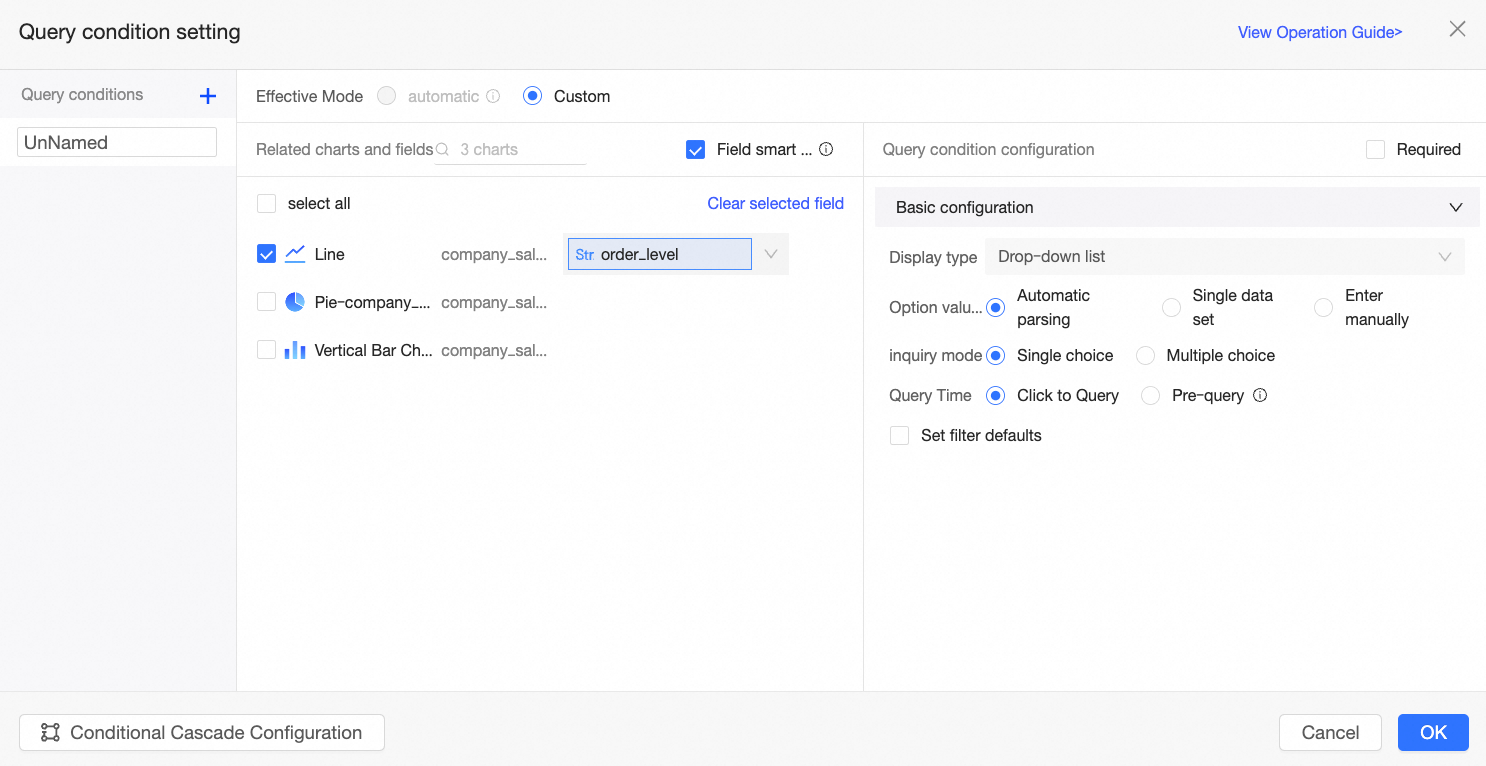
Automatic parsing
When you select automatic parsing as the option source, Quick BI automatically populates the filter with a union of all values from the associated fields.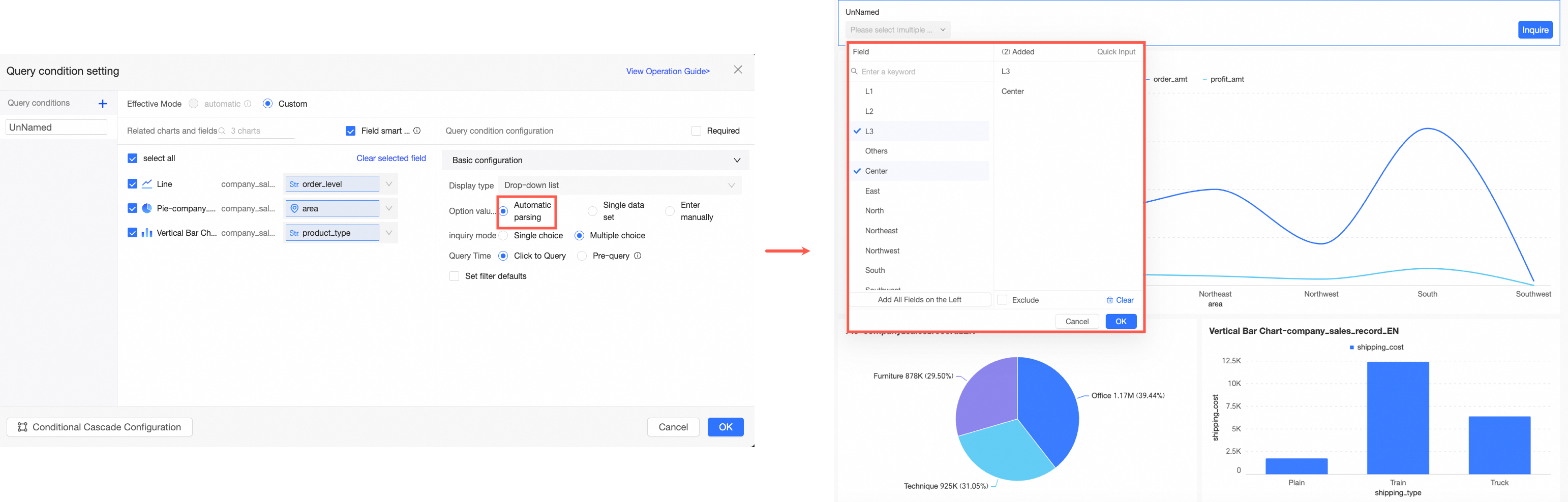
If the charts selected in the Associated charts and fields section are from the same dataset, automatic parsing obtains the values from that dataset.
If the chart selected in the Associated Charts and Fields area is based on multiple datasets, selecting Auto Parse means that the system automatically retrieves the values from these datasets. That is, the values in the drop-down list are a union of the values from the associated datasets.
Parameter | Description | Example |
Selection mode | Supports single choice and multiple choice. |
|
Query time | Supports click to query and pre-query.
| |
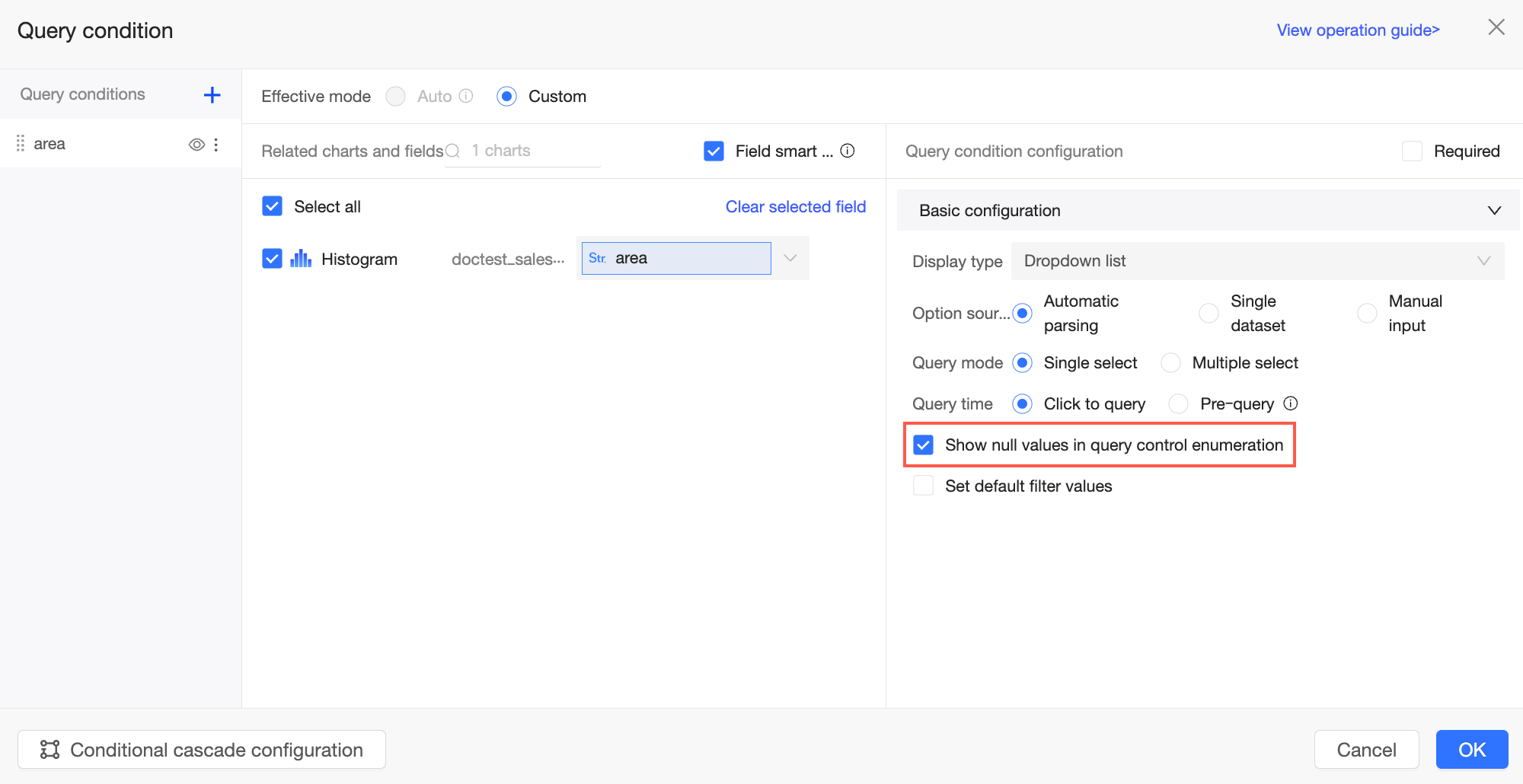
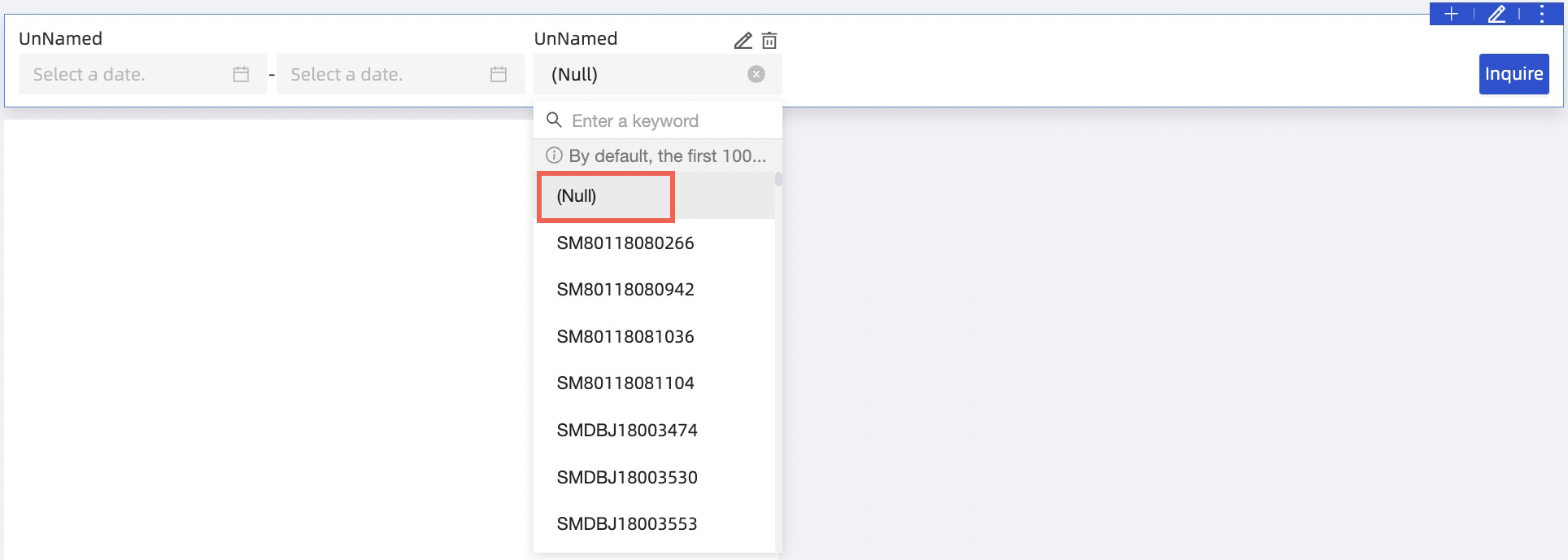
Show null enum values in filter |
When this option is selected, (Null) appears in the filter if the source field contains null values.
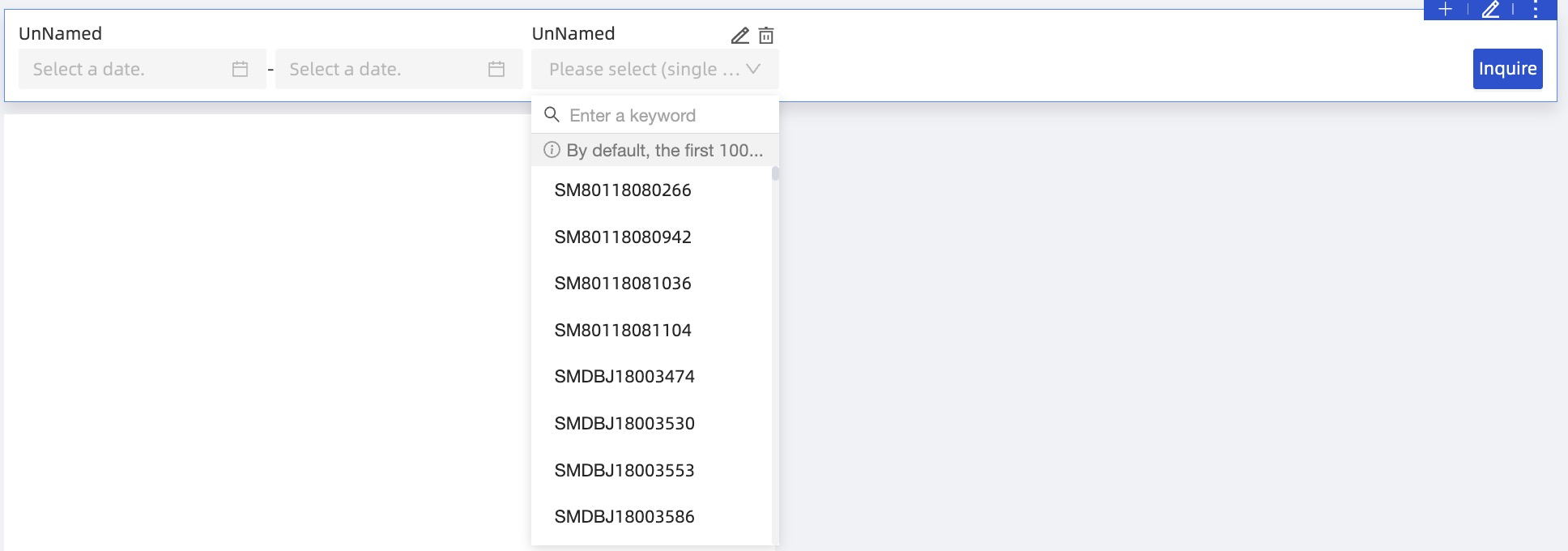
If this option is not selected, null values in the drop-down list are filtered out and not displayed.
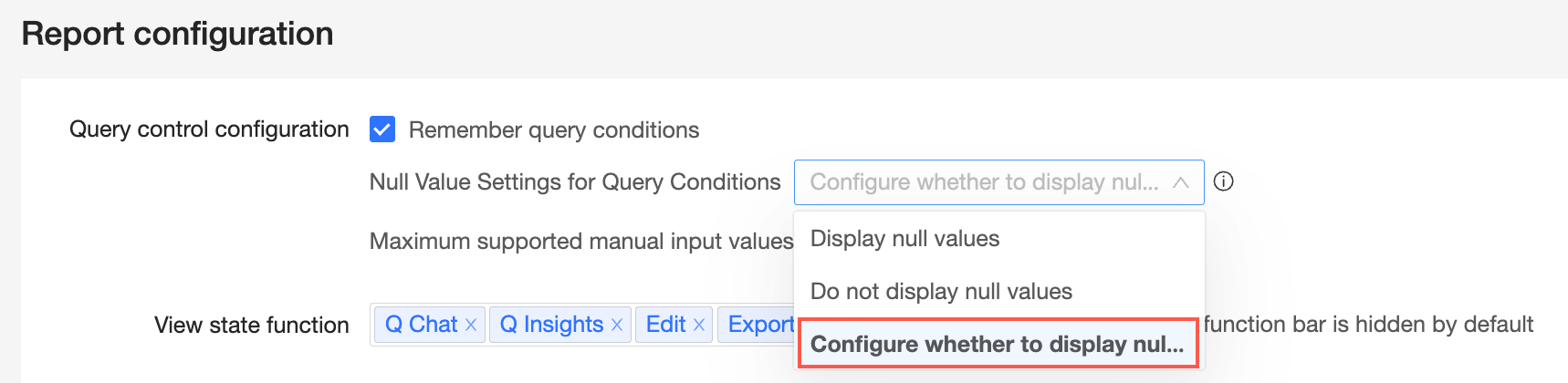
Note This parameter is available only when Configure in each query condition whether to show null values is selected in the Report configuration settings at the organization level.
| |
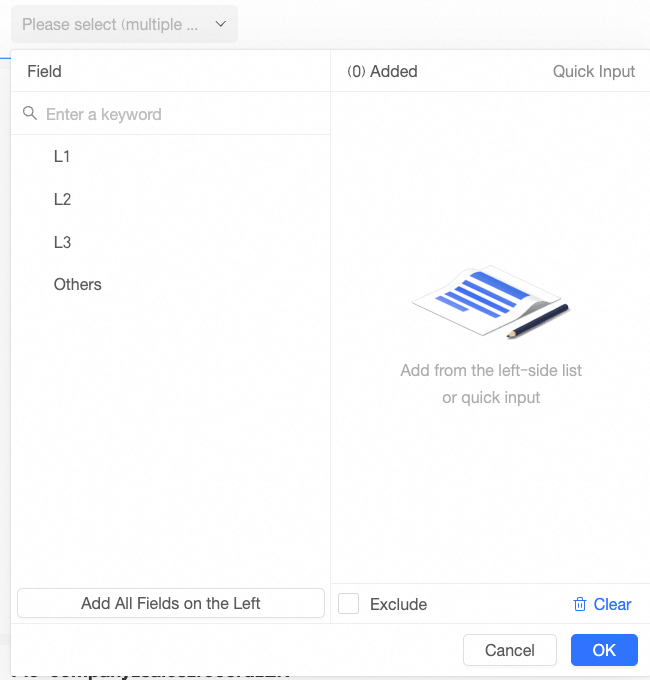
Set filter defaults | If you select this option, the filter box displays Please select. Click the filter box to configure default values in the Field dialog box. In this dialog box, you can perform the following operations:
Note If there are more than 1,000 filter options, the first 1,000 are displayed by default. You can search for options beyond this limit. |
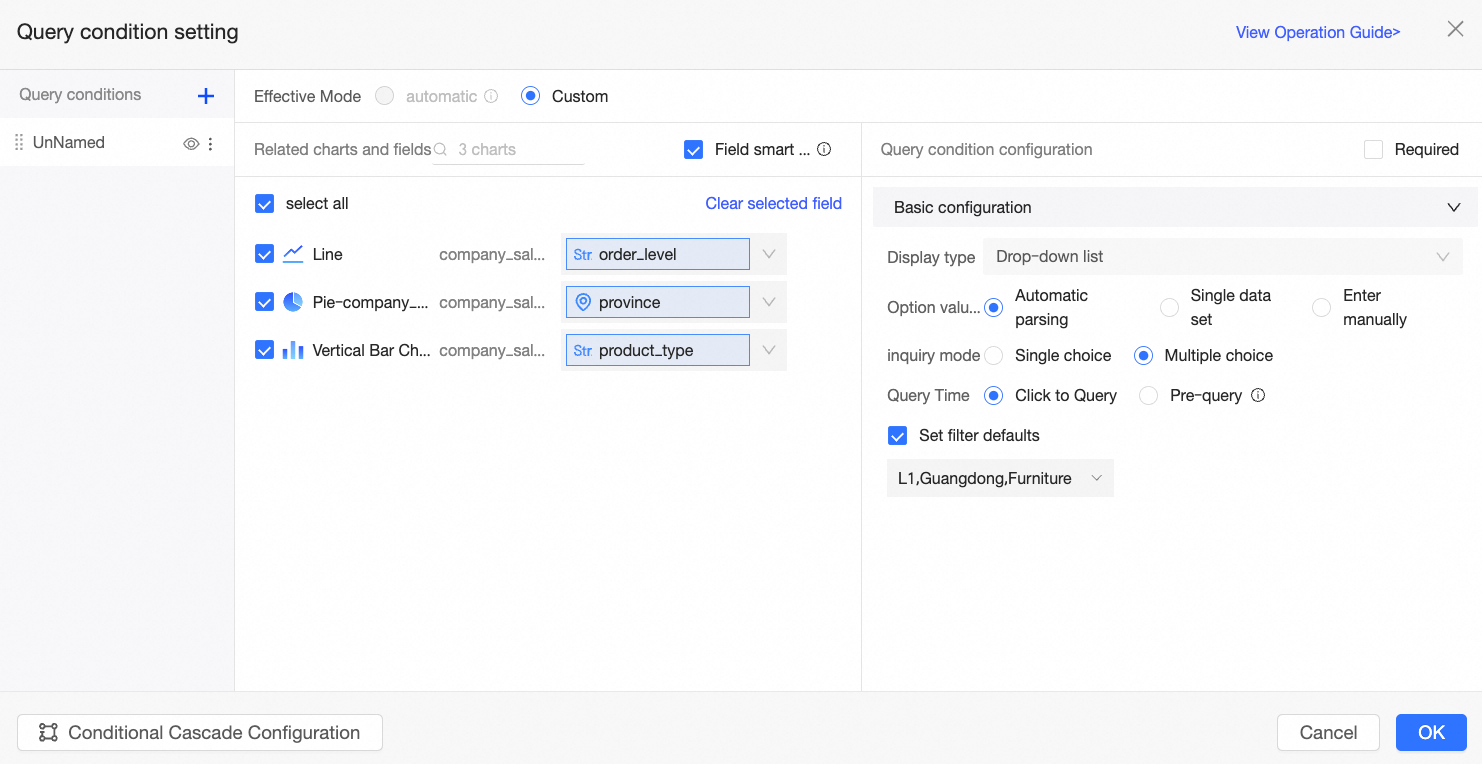
In this example, the following configuration is used:
Multiple associated fields from different datasets are selected in the Associated charts and fields section. As a result, the filter's drop-down list displays a union of all associated field values.
Selection mode is set to multiple choice, allowing multiple options to be selected in the filter.
Query time is set to click to query, which requires the report viewer to click the query button to trigger the conditional query.
The filter defaults are set to Advanced, Guangdong Province, and Furniture Products. When a user opens the report, it is pre-filtered by these values.
The result is as follows: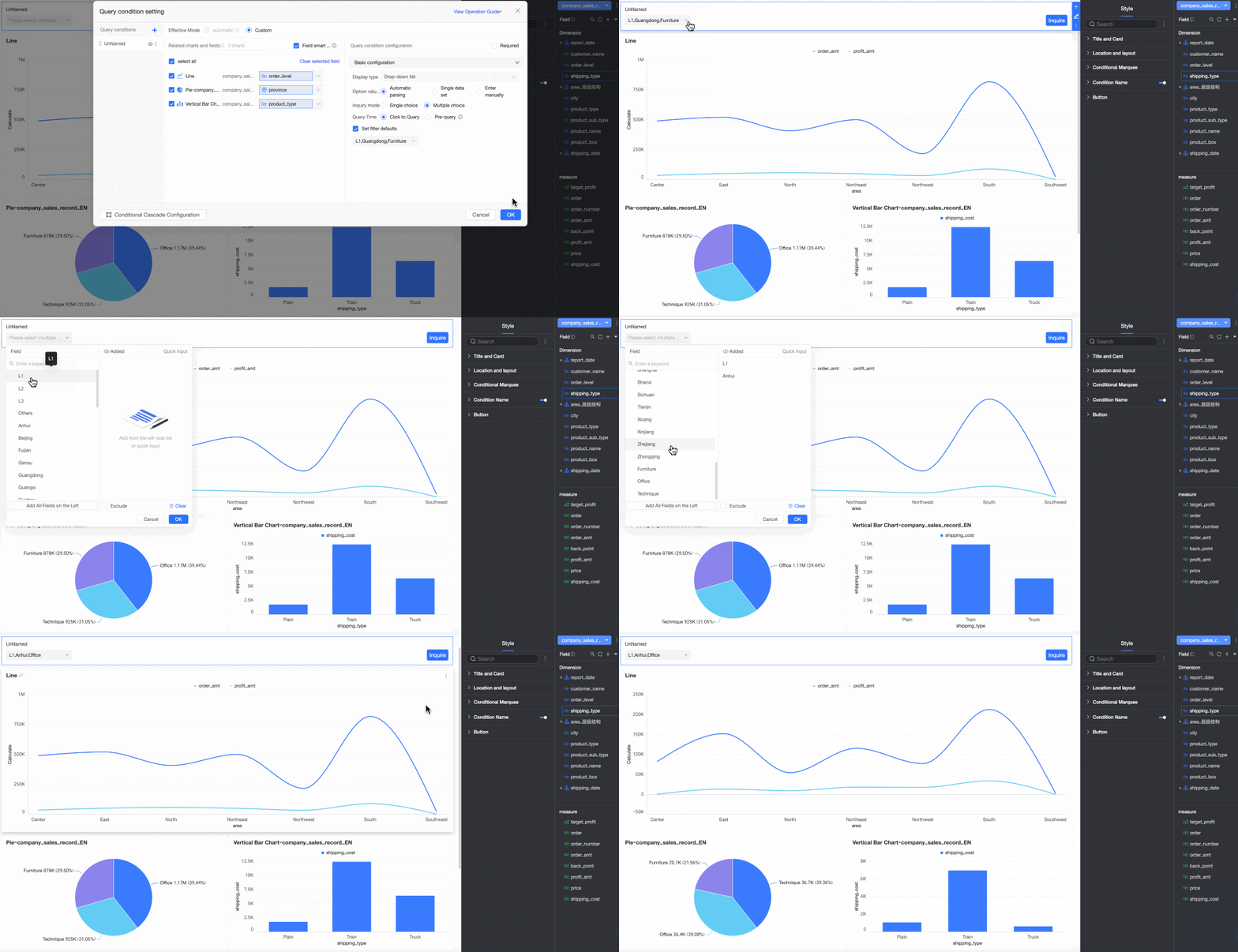
Single dataset
When sourcing options from a single dataset, the filter is populated with values from a specific field within that dataset.
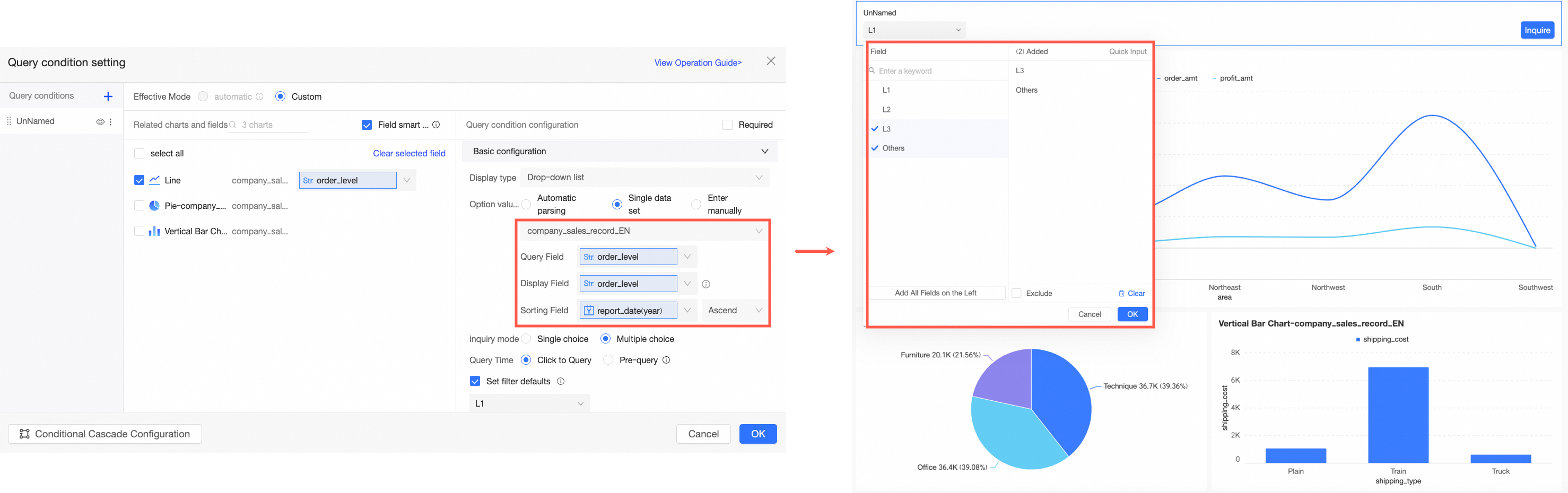
Parameter | Description | Example |
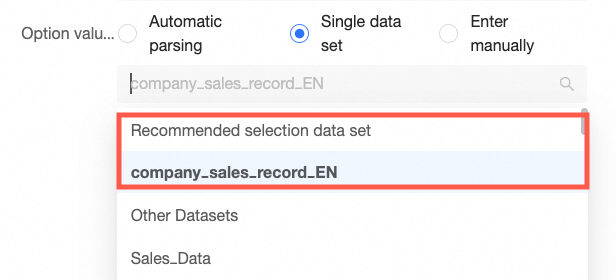
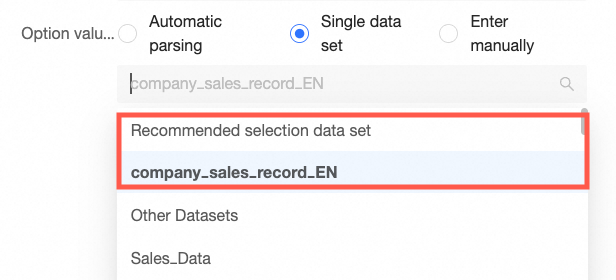
Select dataset | You can select any dataset within the current dashboard's workspace. We recommend using the chart's source dataset. |
|
Query value field | The field from the selected dataset whose values are used for the actual query. It must correspond to the associated field in the chart. | |
Display name field | The field whose values are displayed as options in the filter. This can be used to display user-friendly names instead of raw data values.
| |
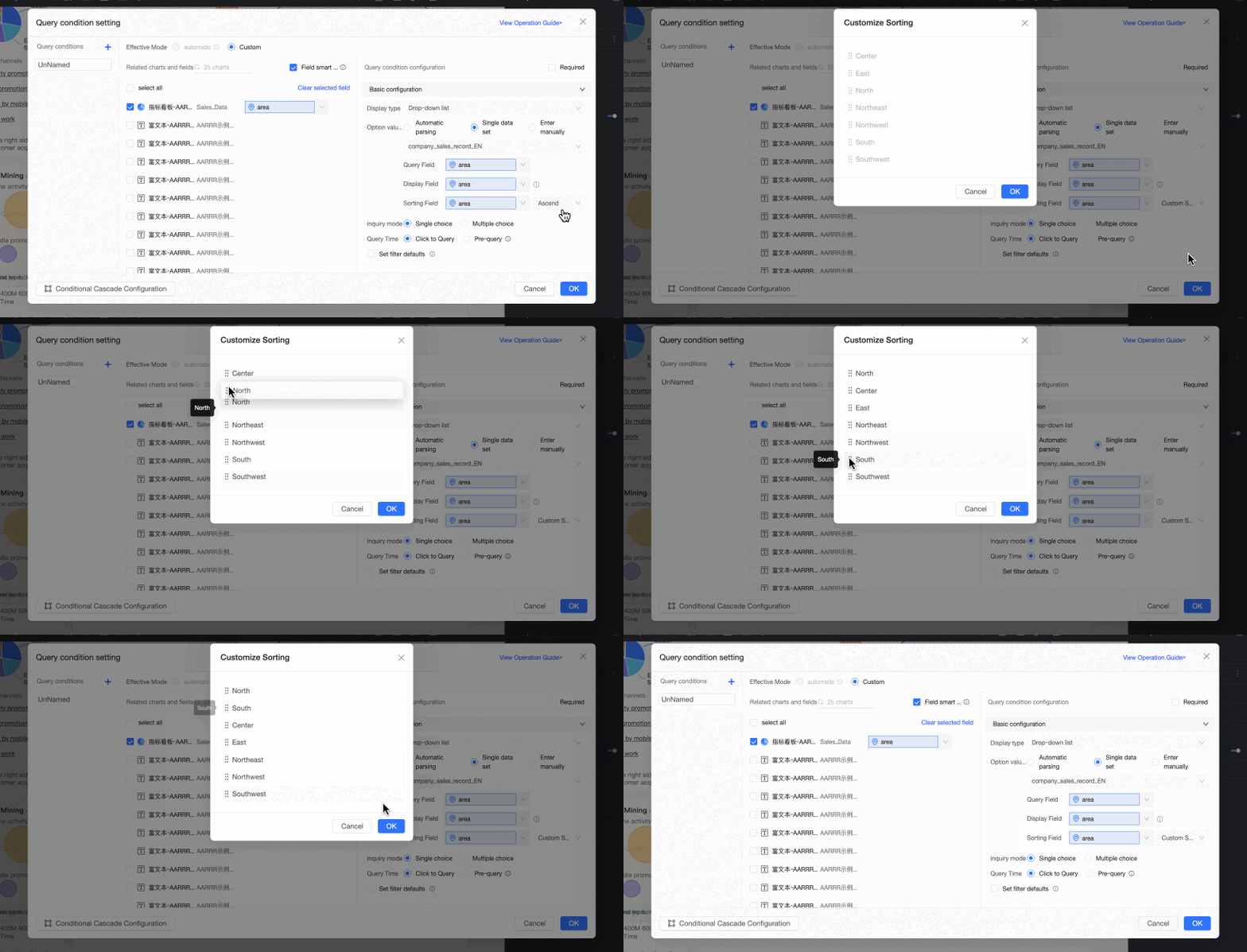
Sort field | Allows sorting by a selected field. This parameter is optional. If not specified, the data is sorted by the default order in the dataset. If you need to sort by a specific field, you can select a sort field from the drop-down list, such as a measure or a date field. The supported sorting methods are Ascending, Descending, and Custom sorting. When you select custom sorting, you can drag and drop field values to arrange their order in the Custom sorting dialog box. This setting affects the sorting of the filter's drop-down list but does not affect the sorting of dimension values within the chart. The sorting of dimension values within the chart is controlled by the dataset or the chart's data panel. | |
Selection mode | Supports single choice and multiple choice. | |
Query time | Supports click to query and pre-query.
| |
Show null enum values in filter |
If this option is not selected, null values in the drop-down list are filtered out and not displayed.
Note This parameter is available only when Configure in each query condition whether to show null values is selected in the Report configuration settings at the organization level.
| |
Set filter defaults | If you select this option, the filter displays preset values. Note If there are more than 1,000 filter options, the first 1,000 are displayed by default. You can search for options beyond this limit.
|
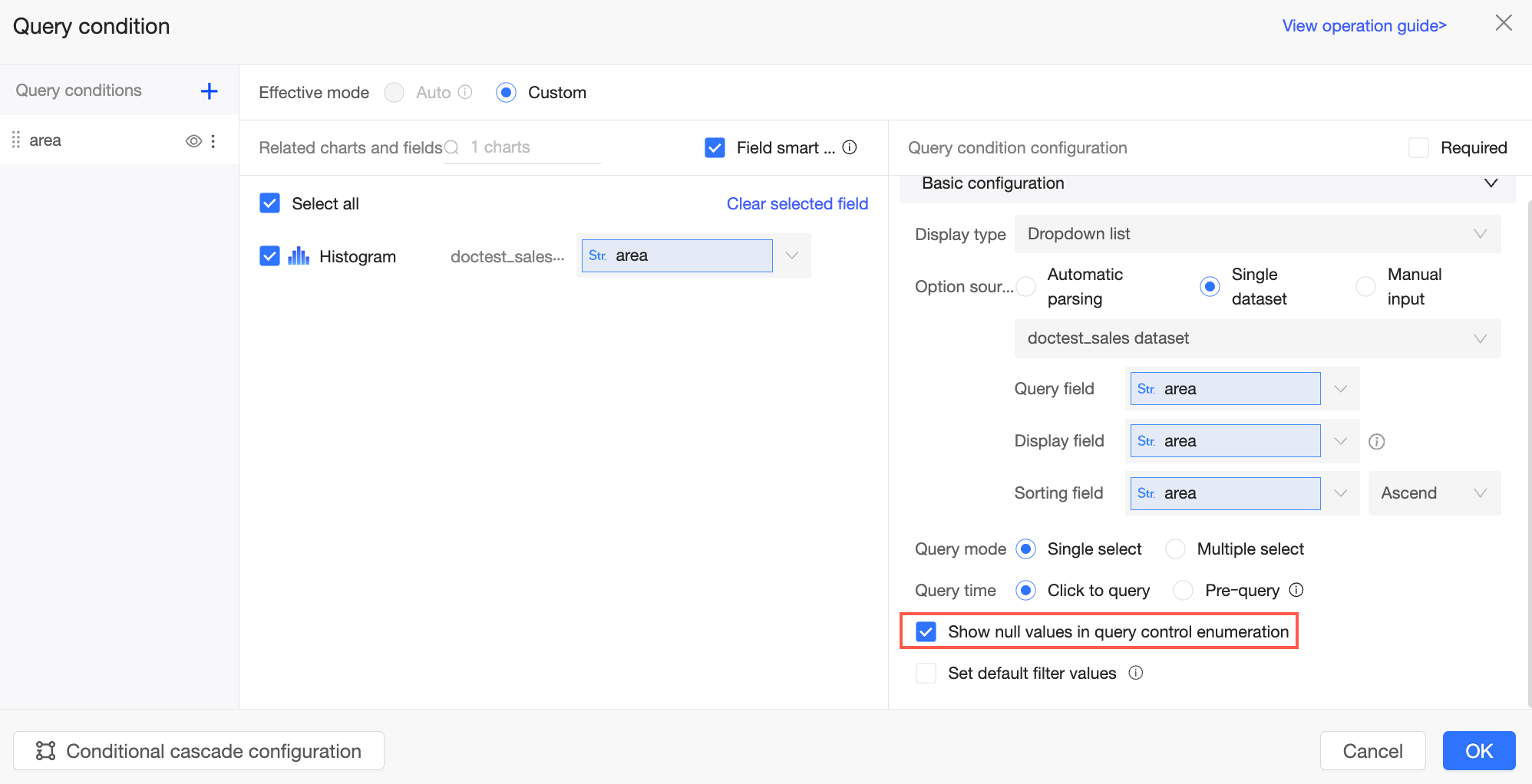 When you select Show null enum values for query conditions, if the drop-down list contains null values, they are displayed as (Null) when a user views the report.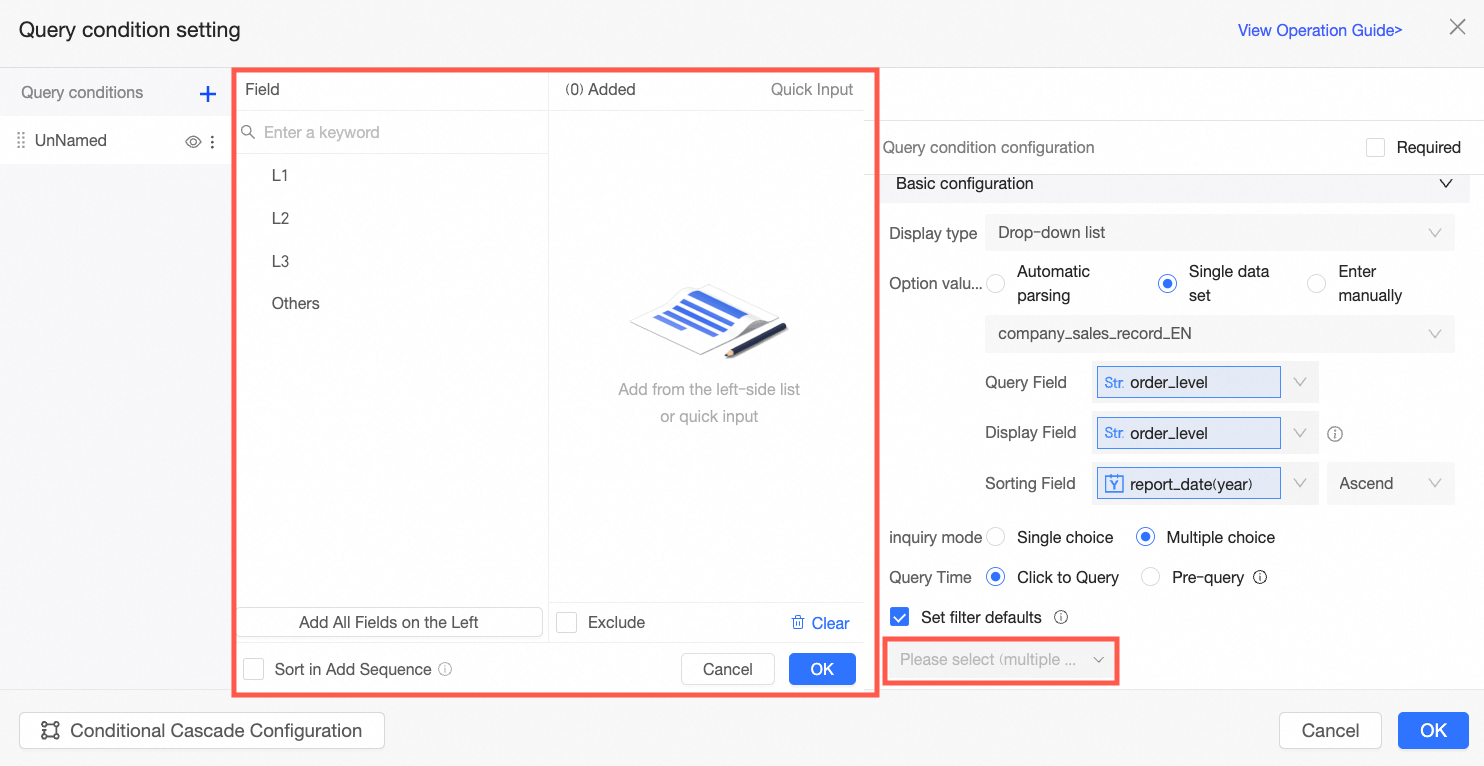
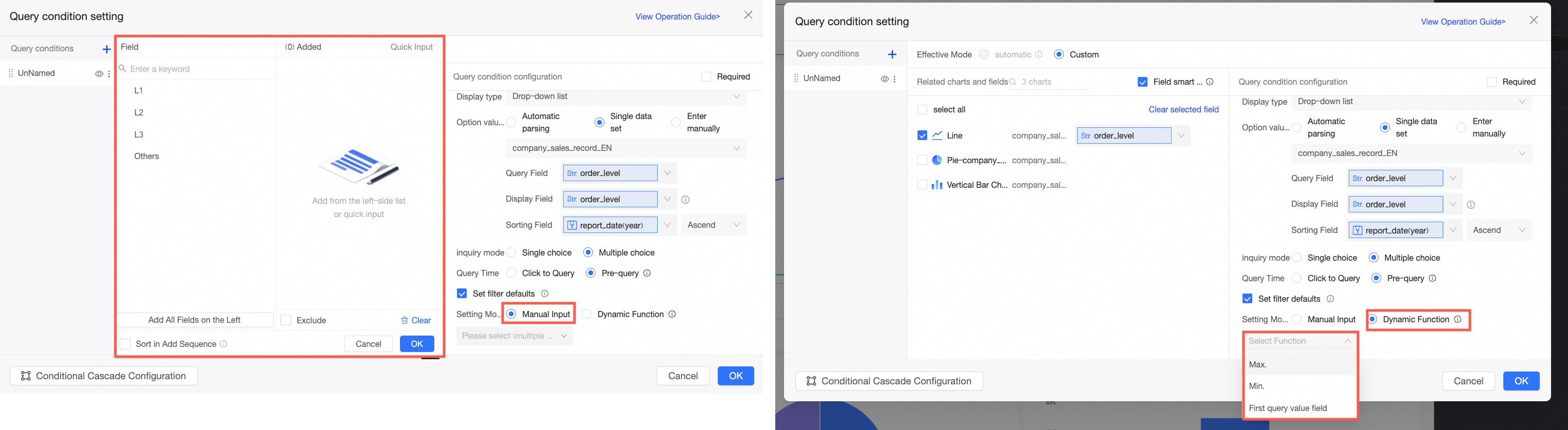

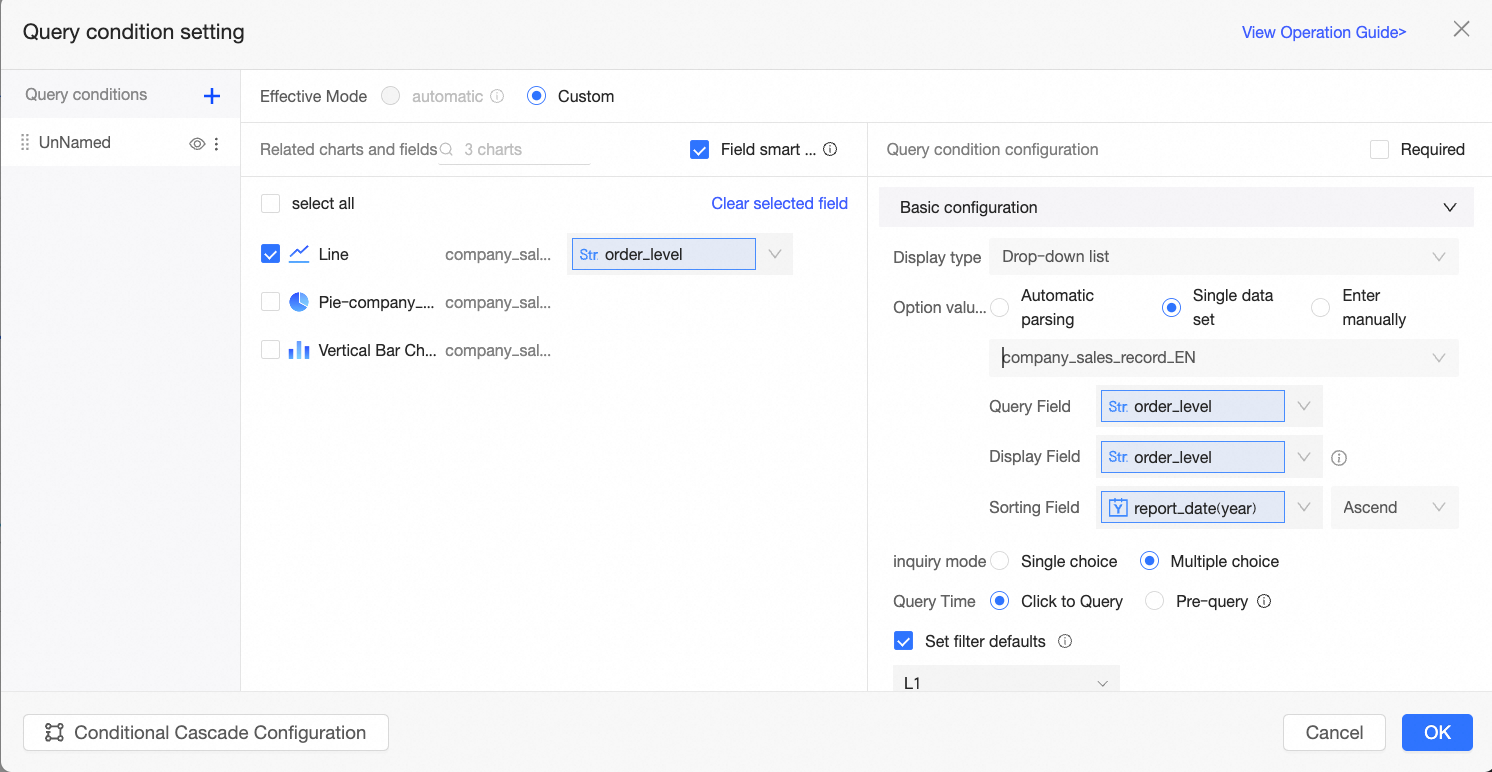
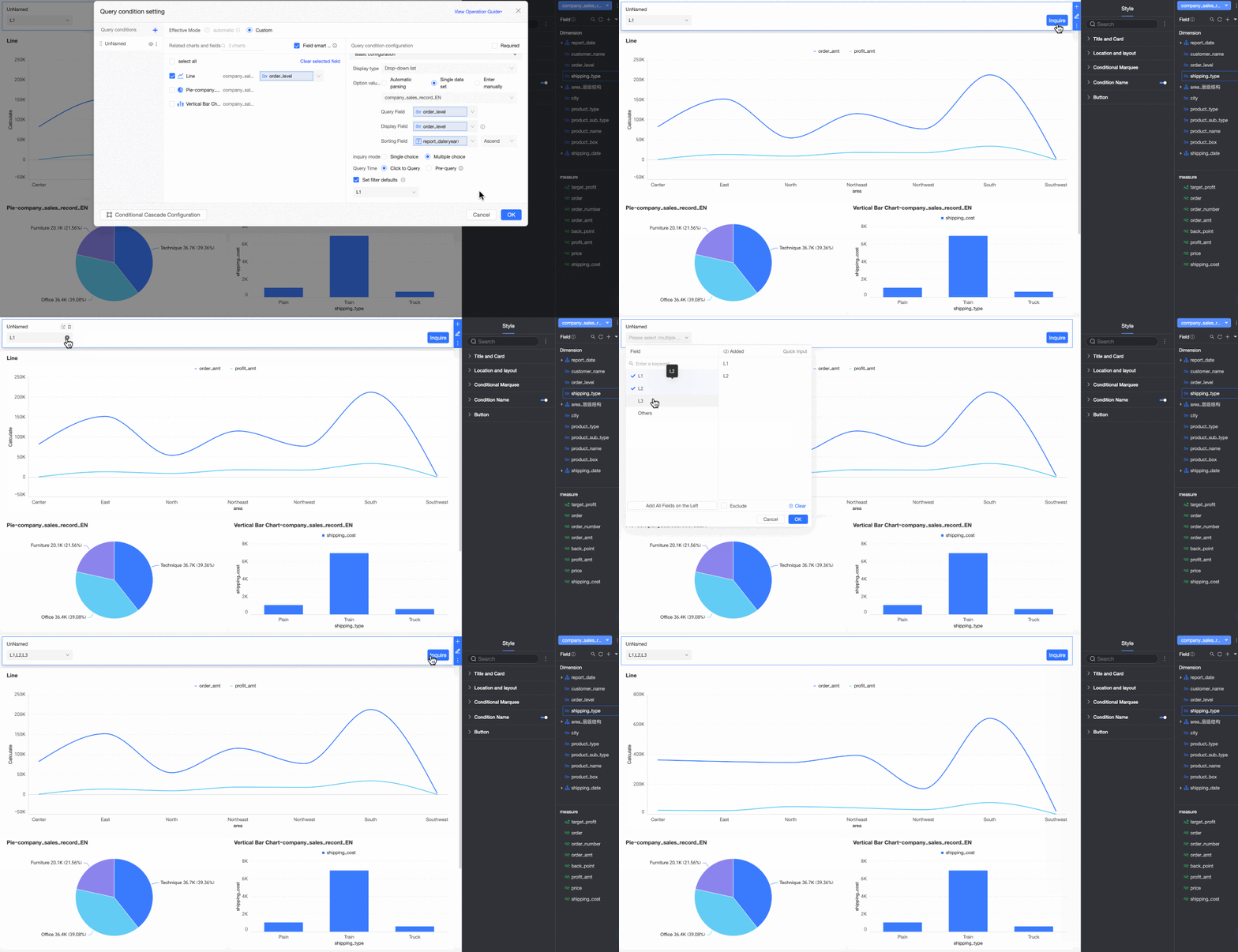
In this example, the following configuration is used:
The system-recommended dataset,
company_sales_record, is used, which is the source dataset for the current chart.The Query value field is set to Order Level, which is the same as the associated field and provides the option values for the query.
The display name field is also set to Order Level.
Order Date is selected as the Sort field to sort the filter options.
Selection mode is set to multiple choice, allowing the report viewer to select multiple option values in the filter.
Query time is set to click to query, which requires the report viewer to click the query button to trigger the conditional query.
The filter default is set to Advanced. When a report viewer opens the report, it defaults to showing results for the Advanced order level.
The result is as follows:
Manual input
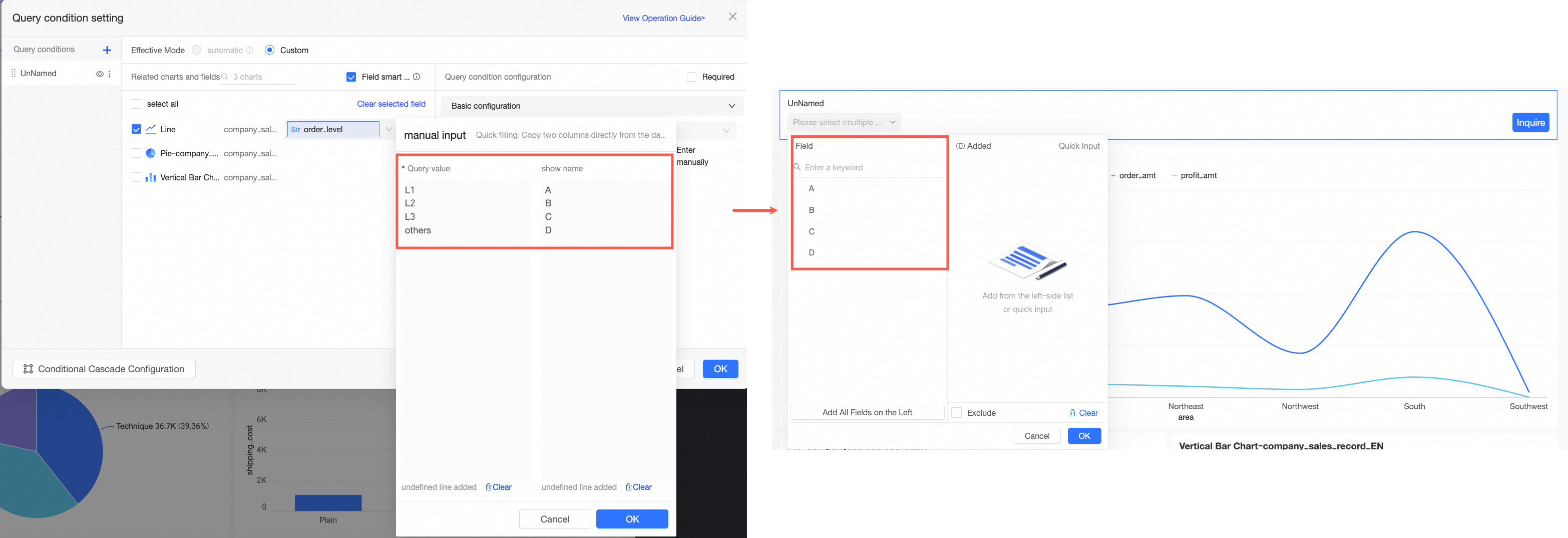
When you select manual input, the report creator manually enters the filter options, which should correspond to the values of the associated field.
Parameter | Description | Example |
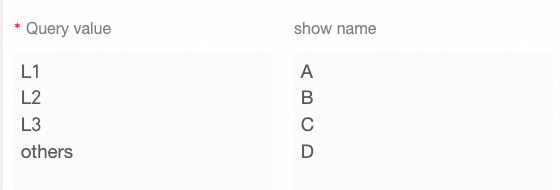
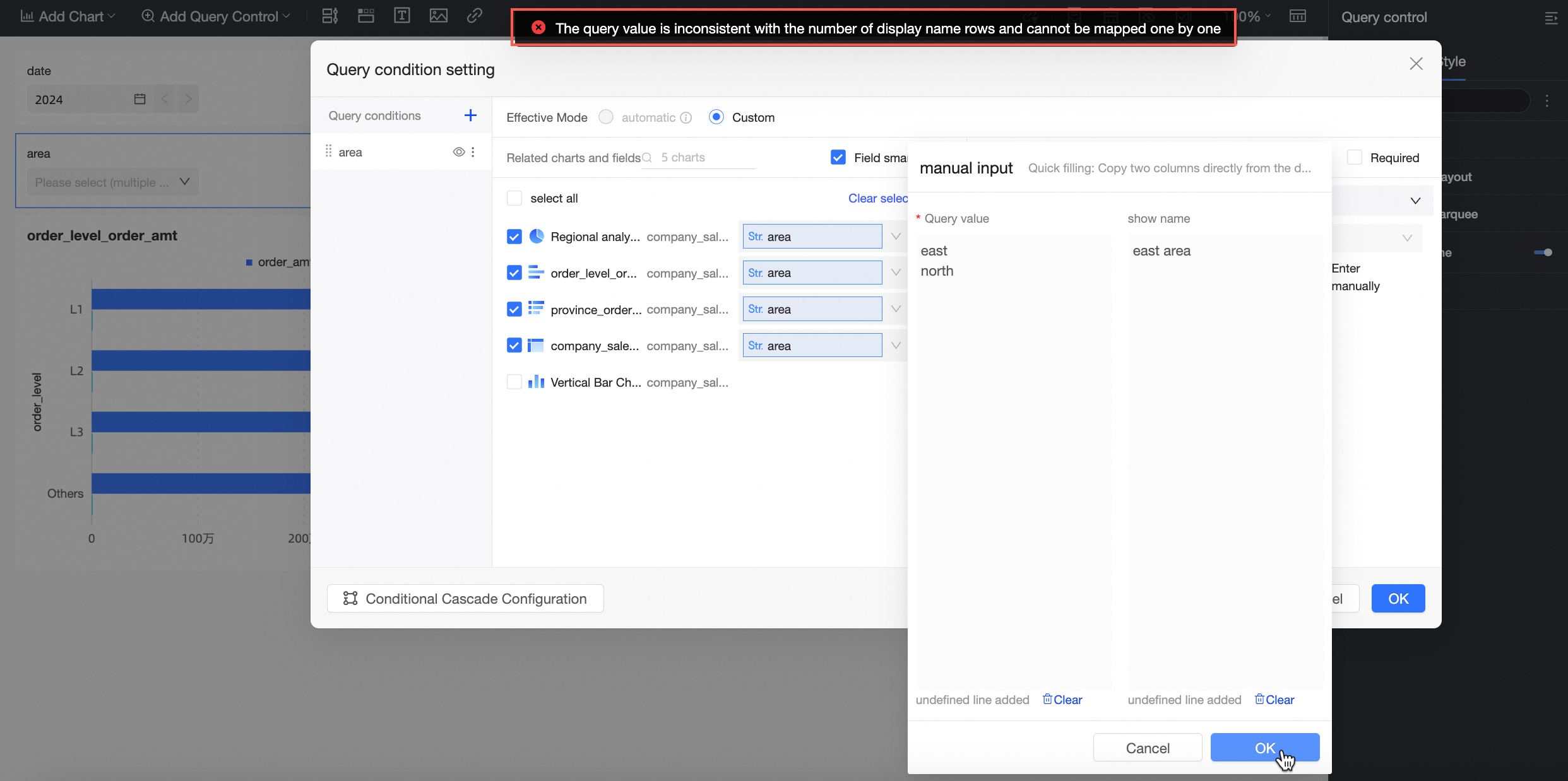
Manual input | Click Manual input. In the Manual input dialog box, enter the Query value and Display Name.
Note
|
|
Selection mode | Supports single choice and multiple choice. | |
Set filter defaults | If you select this option, the filter displays preset values. |
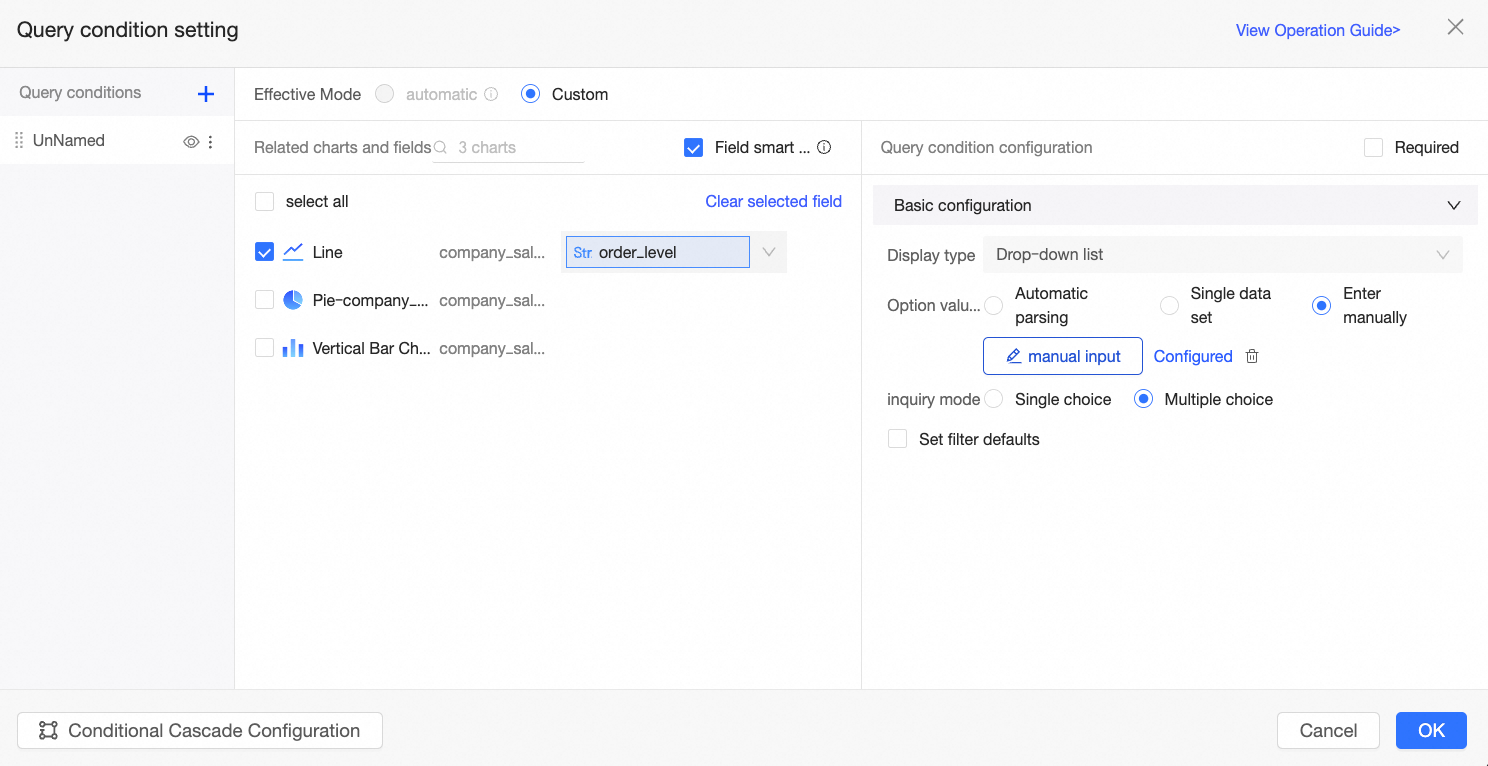
In this example, the following configuration is used:
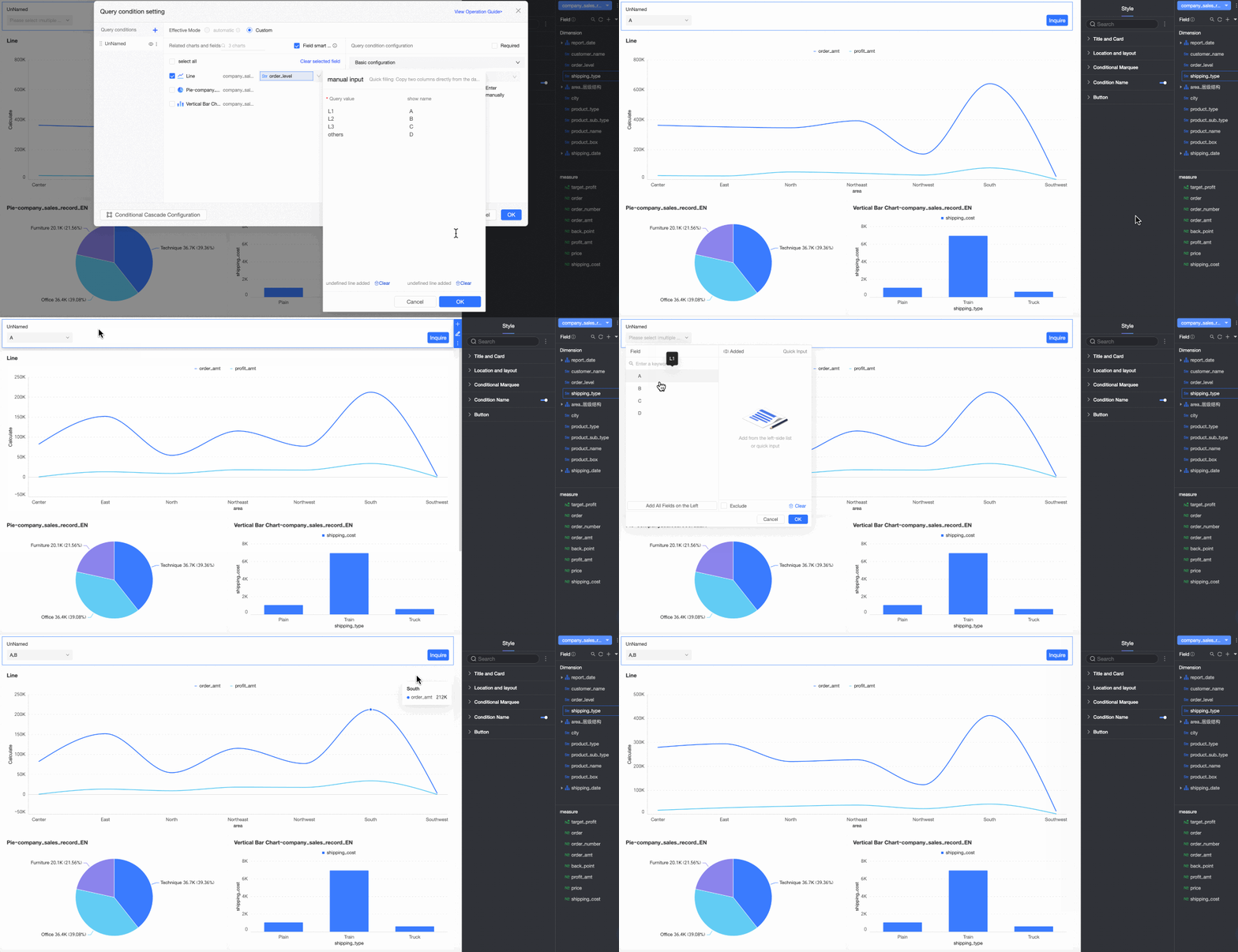
The Order Level field values are manually mapped to corresponding display names: Advanced maps to Grade A, Intermediate to Grade B, Basic to Grade C, and Other to Grade D.
Selection mode is set to multiple choice, allowing the report viewer to select multiple options.
The default filter value is set to Grade A. When a report viewer opens the report, it defaults to showing results for the Advanced order level.
The result is as follows:
Search
You can search within the filter to quickly find specific option values.
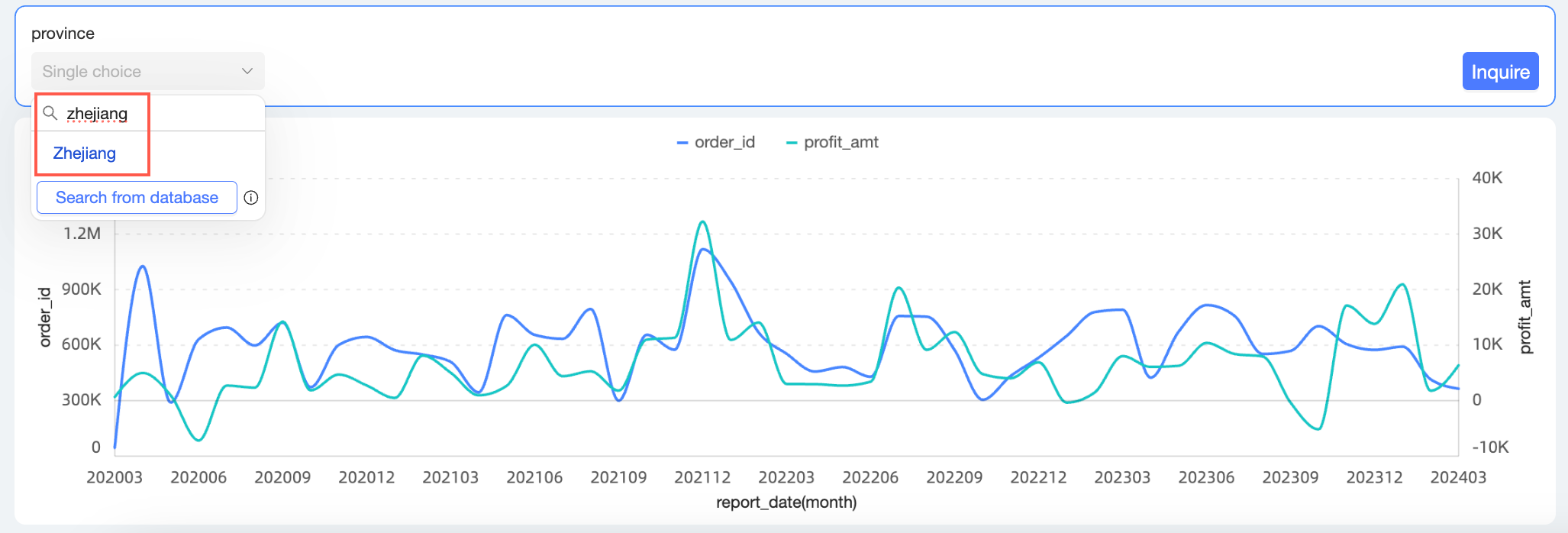
If you cannot find the desired option value, you can try Search from Database.

By default, the list displays up to 1,000 options. To find other values, use the search bar or click Search from Database.
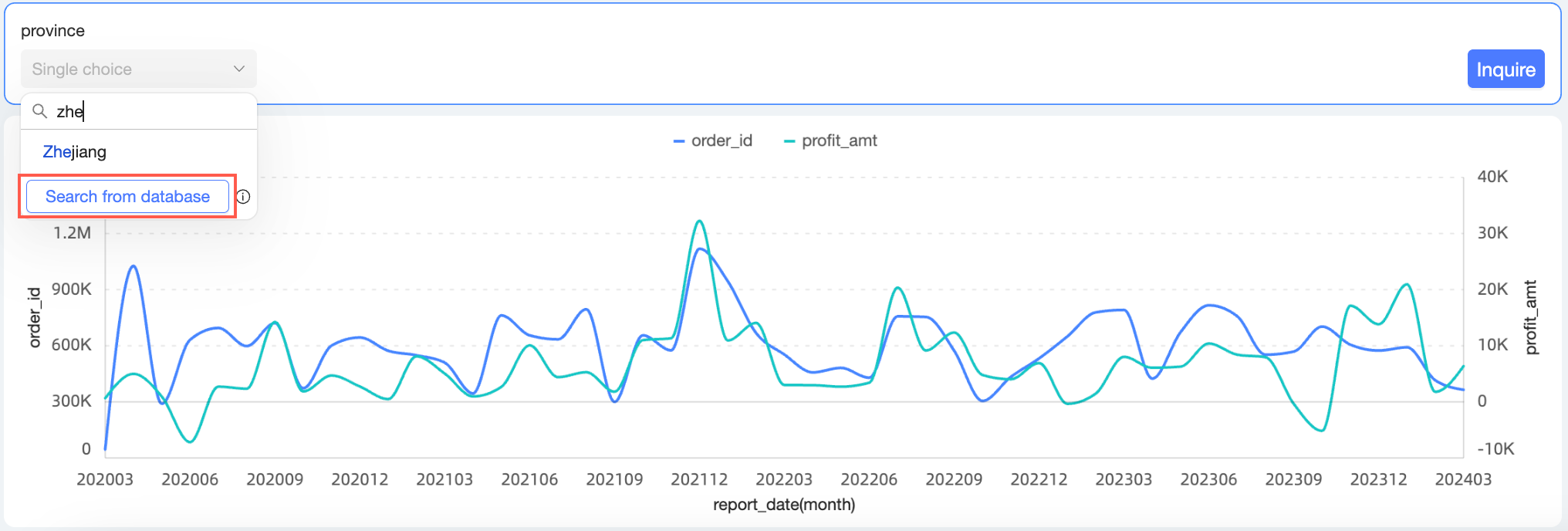
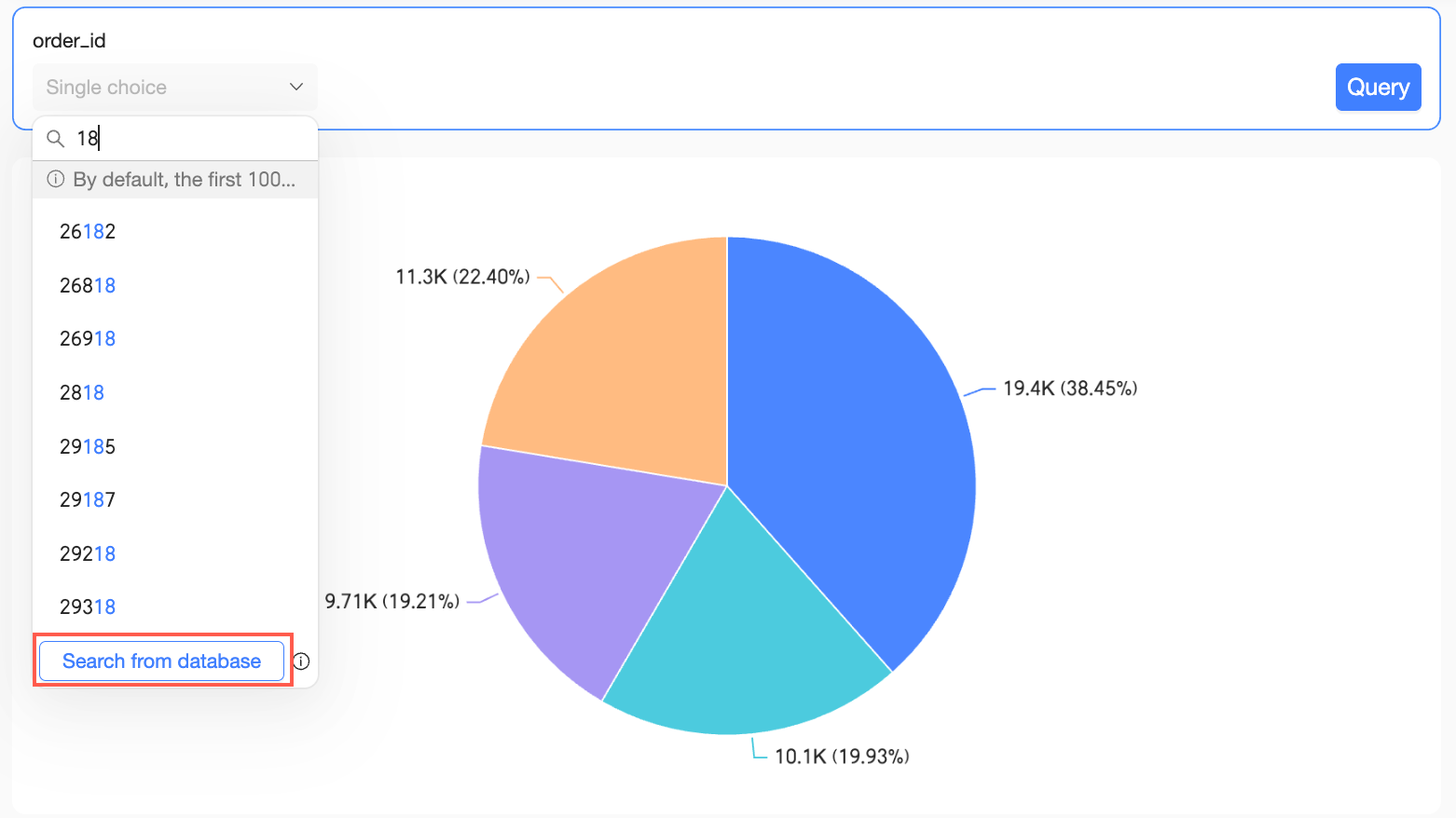
The Search from Database feature is available only when Display type is set to drop-down list and the option source is set to Automatic parsing or Single dataset.
Text input box
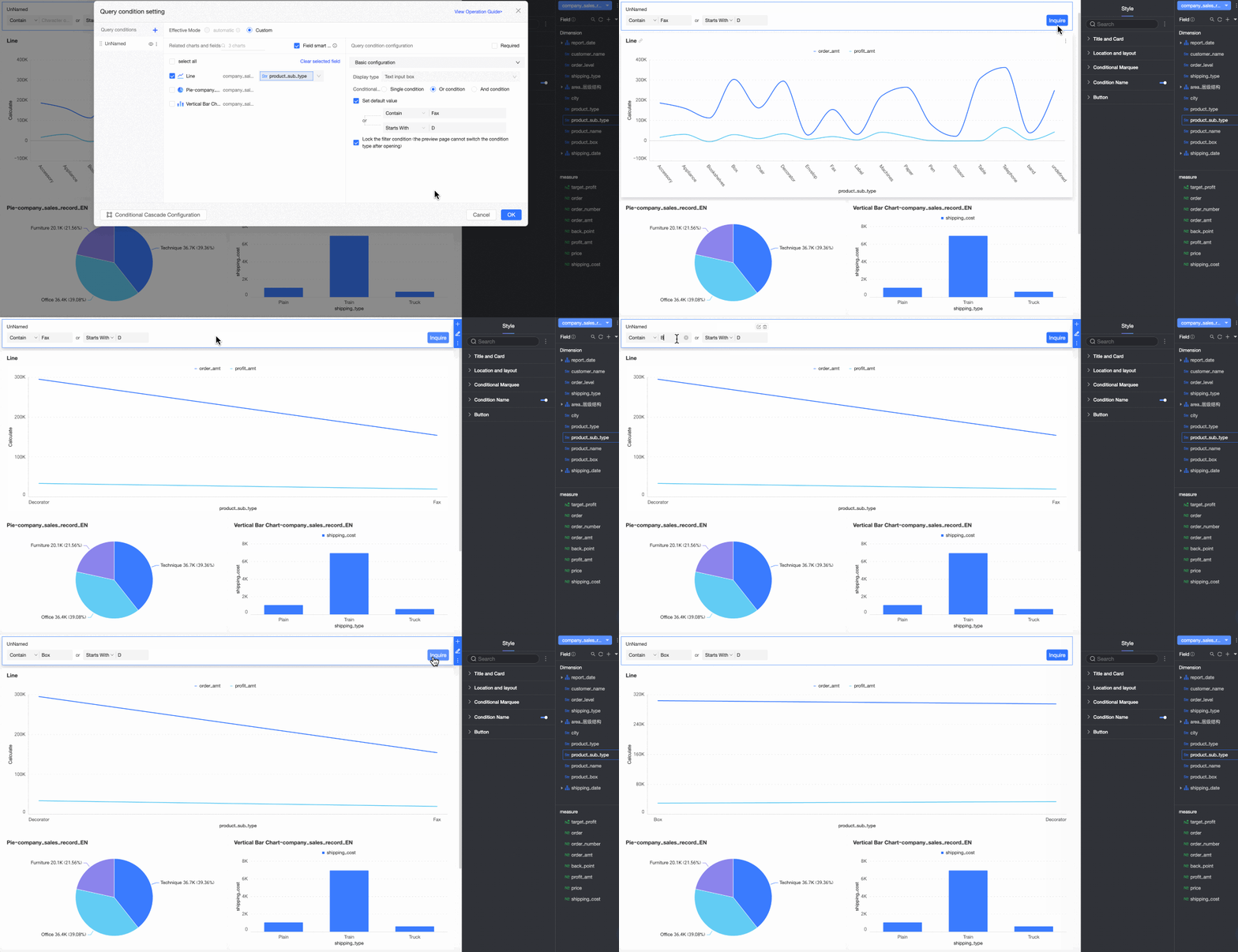
The text input box allows users to enter keywords for precise and flexible data queries. When you set the Display type to text input box, the Conditional form setting supports Single condition, OR condition, or AND condition. This topic uses the OR condition as an example.
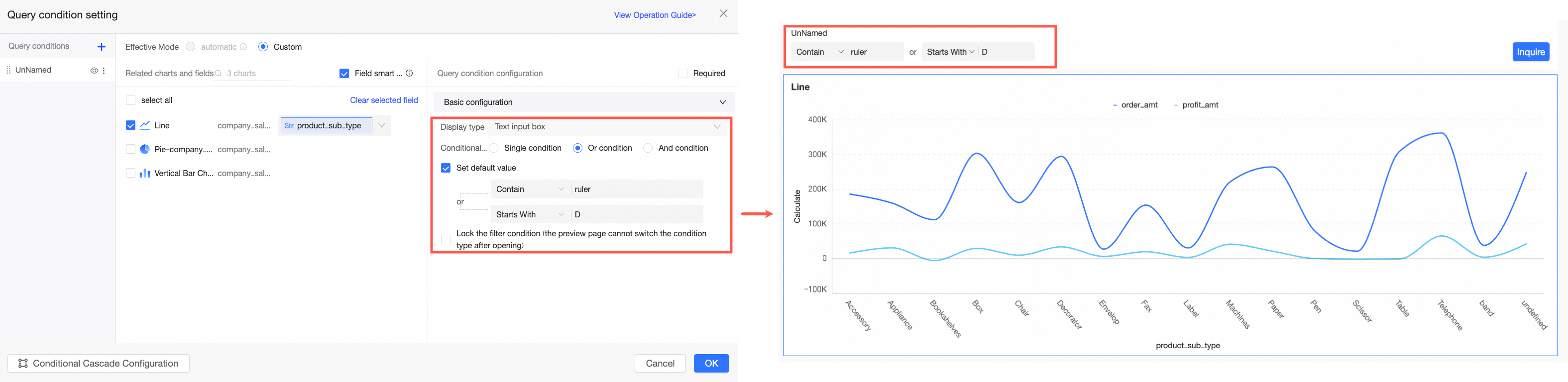
Parameter | Description | Example |
Conditional form | Supports Single condition, OR condition, and AND condition.
|
|
Set default value | The available options depend on the selected conditional form. The following list describes the available matching rules and their corresponding SQL syntax when setting a default value for the Product Type field.
| |
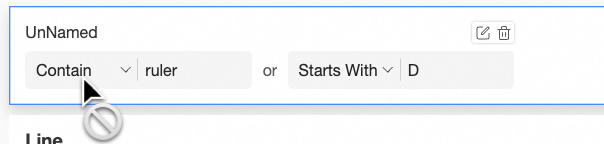
Lock filter condition | If selected, users cannot change the conditional form on the report page. Note This option is available only when Set default value is selected. |
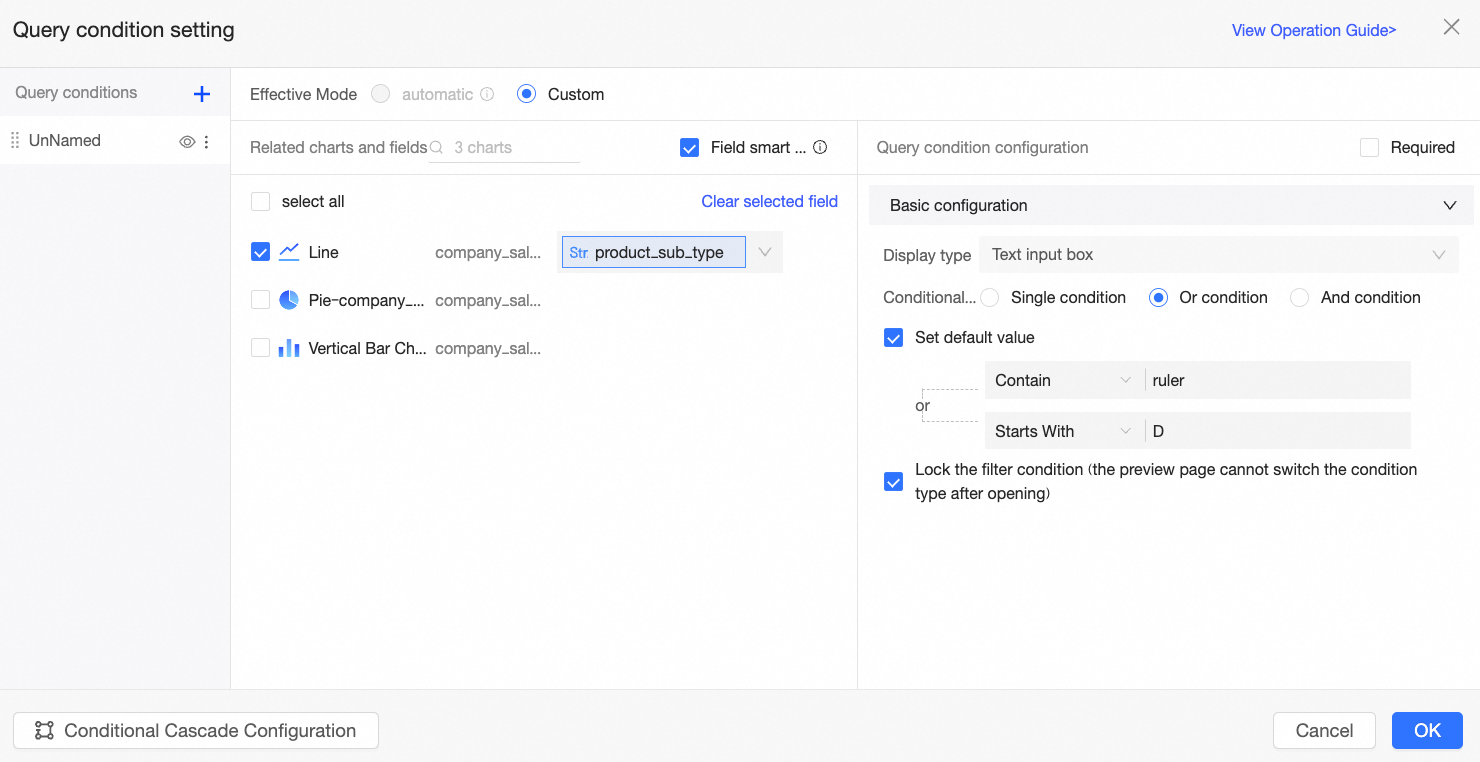
In this example, the following configuration is used:
Conditional form is set to OR condition, meaning data that meets any of the query conditions will be displayed.
The default value is set so that the field either contains the string Ruler, or starts with the string Table. When a report viewer opens the report, it defaults to showing results where the product type contains "Ruler" or starts with "Table".
Lock filter condition is selected, which prevents report viewers from changing the conditional form on the report page.
The result is as follows:
Tree drop
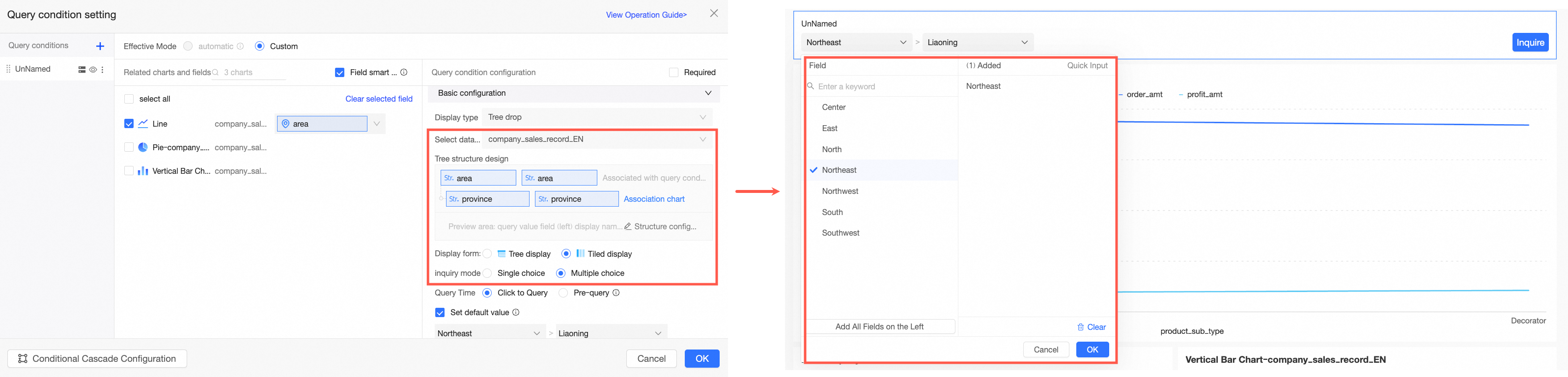
The tree drop display type allows report viewers to filter data with parent-child relationships, such as organizational structures, geographical regions (Country > Province > City), or product categories (Main Category > Subcategory). Users can navigate the hierarchy to locate and select items for filtering.
When the associated charts use a dataset combination and multiple associated fields are selected, the tree drop display type cannot be used.
Parameter | Description | Example | |
Select dataset | You can select any dataset within the current dashboard's workspace. We recommend using the chart's source dataset. |
| |
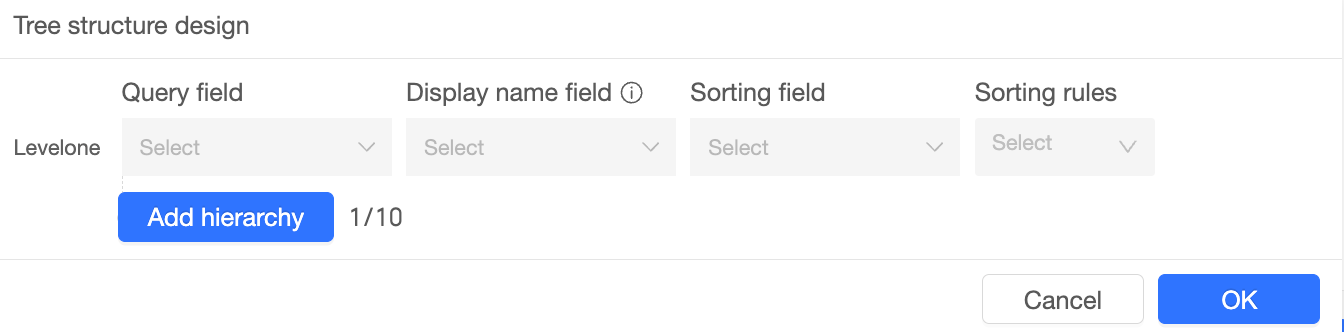
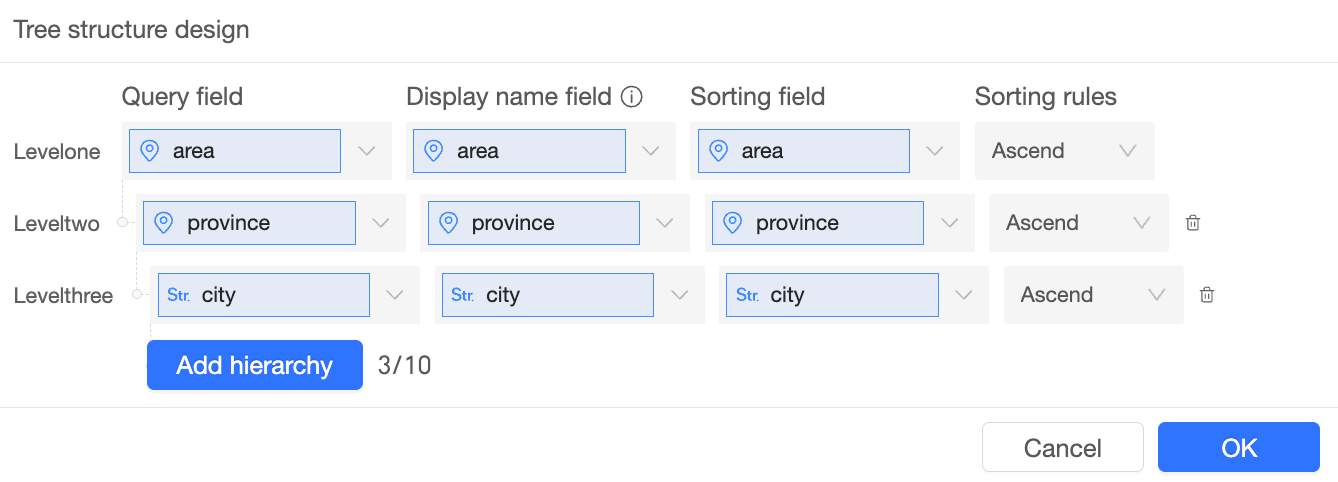
Tree structure design | Click Start Configuration. In the Tree structure design dialog box, configure the Query Field, Display name field, Sort field, and Sort rule for each level of the filter.
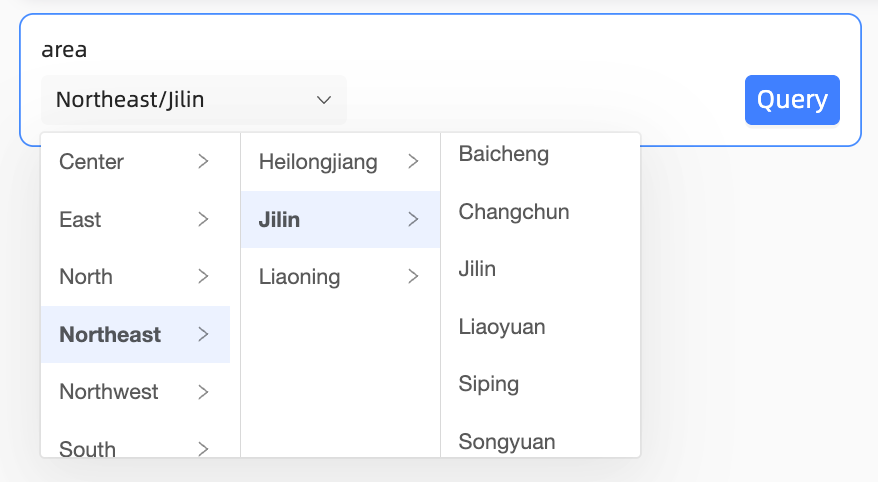
Example: For example, if you create a tree filter with a "Region-Province-City" hierarchy and set an ascending sort rule for each query field:
The filter options will be sorted in ascending order for each level (Region, Province, and City):
Note
| ||
Display form | Supports Tree display and Tiled display. Note If the filter will have more than 1,000 options, we recommend using Tiled display. |
| |
Selection mode | Supports single choice and multiple choice. | ||
Query time | Supports click to query and pre-query.
| ||
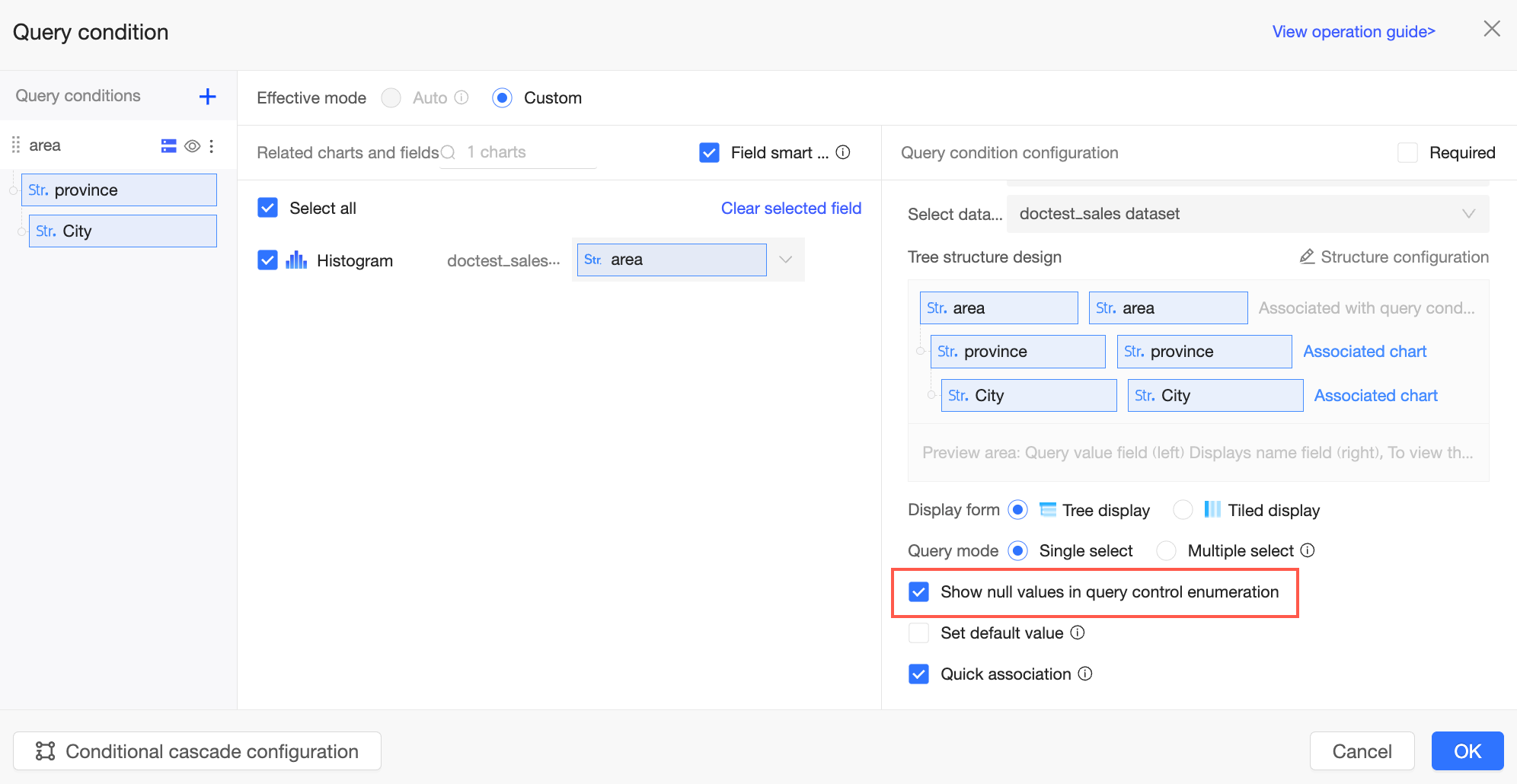
Show null enum values in filter |
When you select Show null enum values for query conditions, if the drop-down list contains null values, they are displayed as (Null) when a user views the report.
If this option is not selected, null values in the drop-down list are filtered out and not displayed. Note If an intermediate node's value is null, the entire branch, including the null node and all its children, will not be displayed, even if the child nodes have non-null values.
Note This parameter is available only when Configure in each query condition whether to show null values is selected in the Report configuration settings at the organization level.
| ||
Set default value | Select this option and set the relevant values. The filter will display these preset values when the report page loads. Note The default value here corresponds to the display name field in the tree structure design. | ||
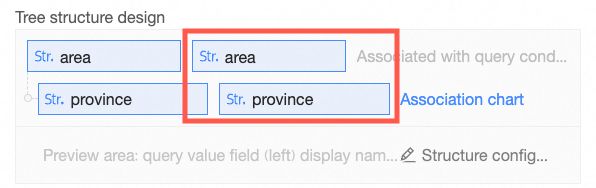
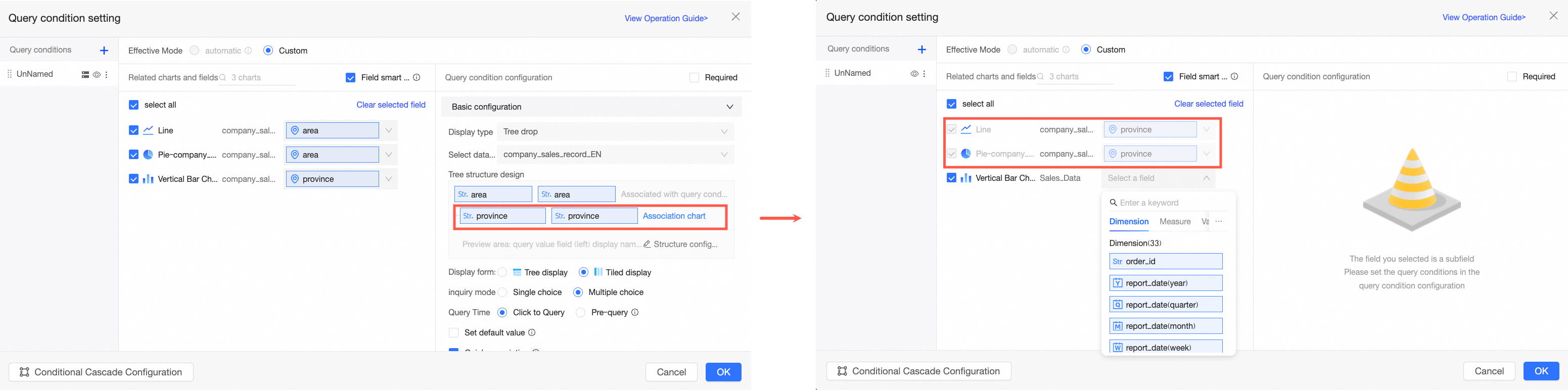
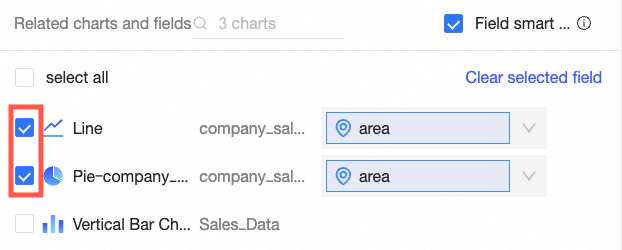
Quick association | After you select Quick association, the child-level fields in the tree structure are automatically added to the Associated charts and fields section for charts from the same dataset. This streamlines the configuration process. For example, in the following figure, when setting up the associated charts and fields for the second-level Province field, the system has automatically populated the Province field into the associated fields of the line chart and column chart, which are from the same dataset. The associated field for the pie chart, which is from a different dataset, needs to be entered manually.
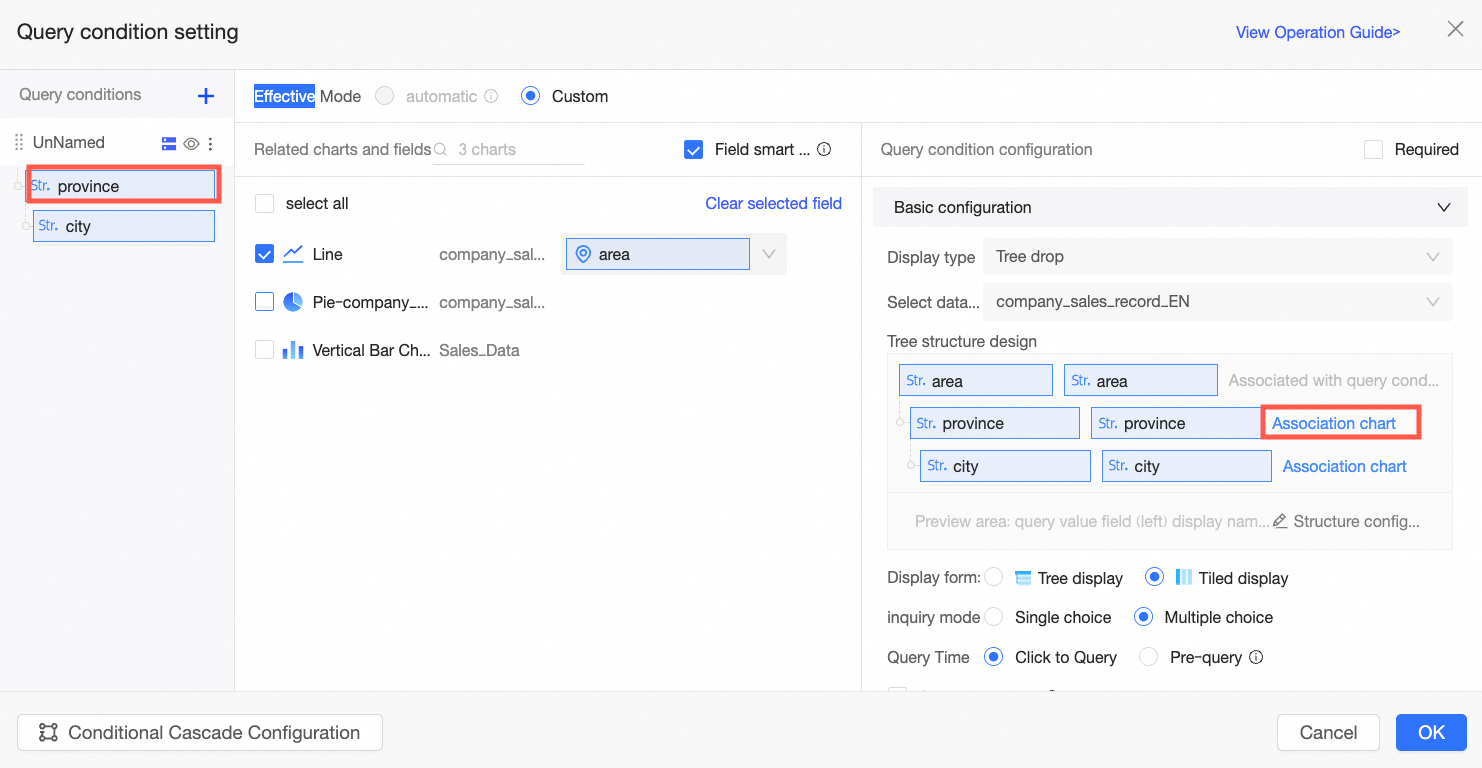
Note Automatic synchronization of child-level fields only applies to charts that were associated at the top level of the tree. You can click Associated charts in the tree structure or click the name of a child level in the left-side query items to associate the child levels with charts and fields from other datasets. | ||
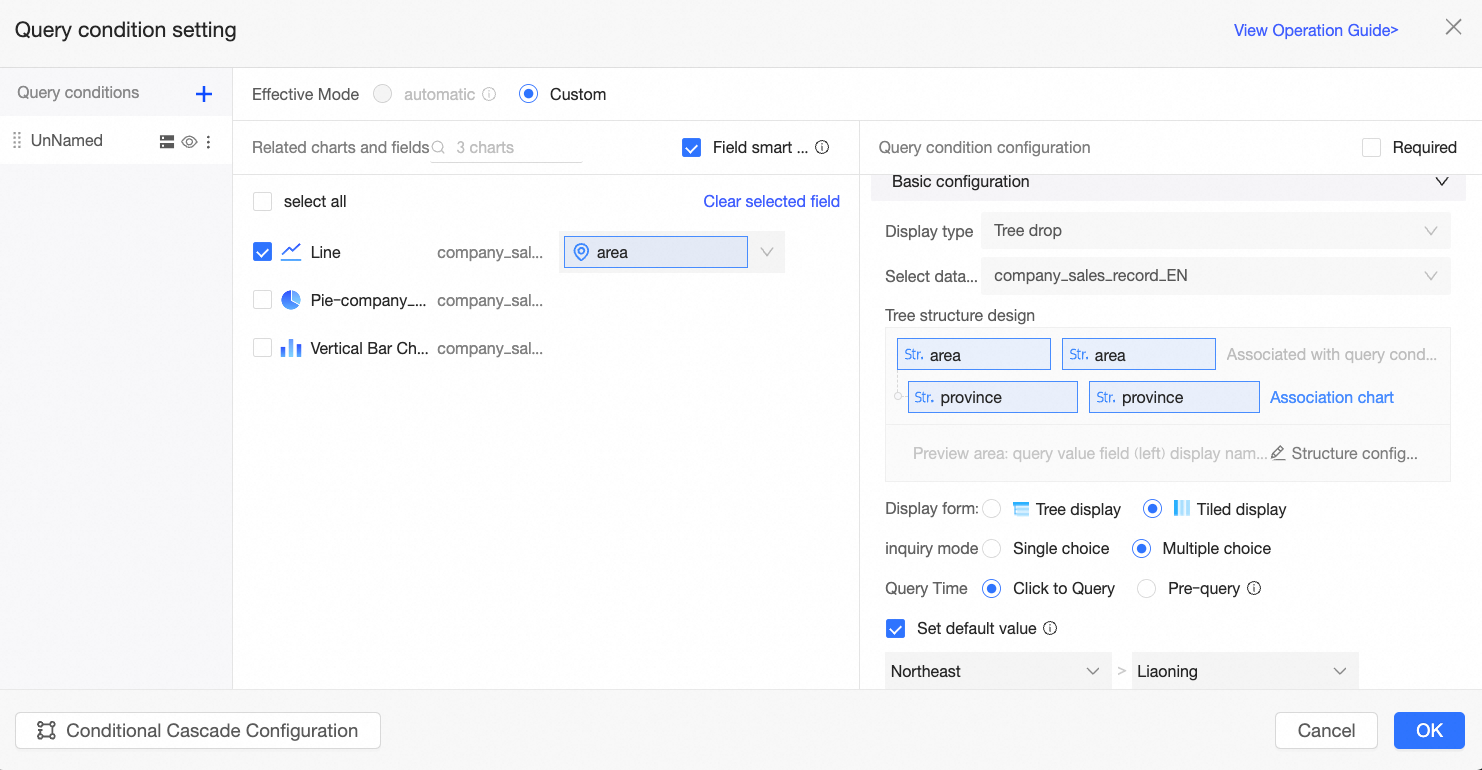
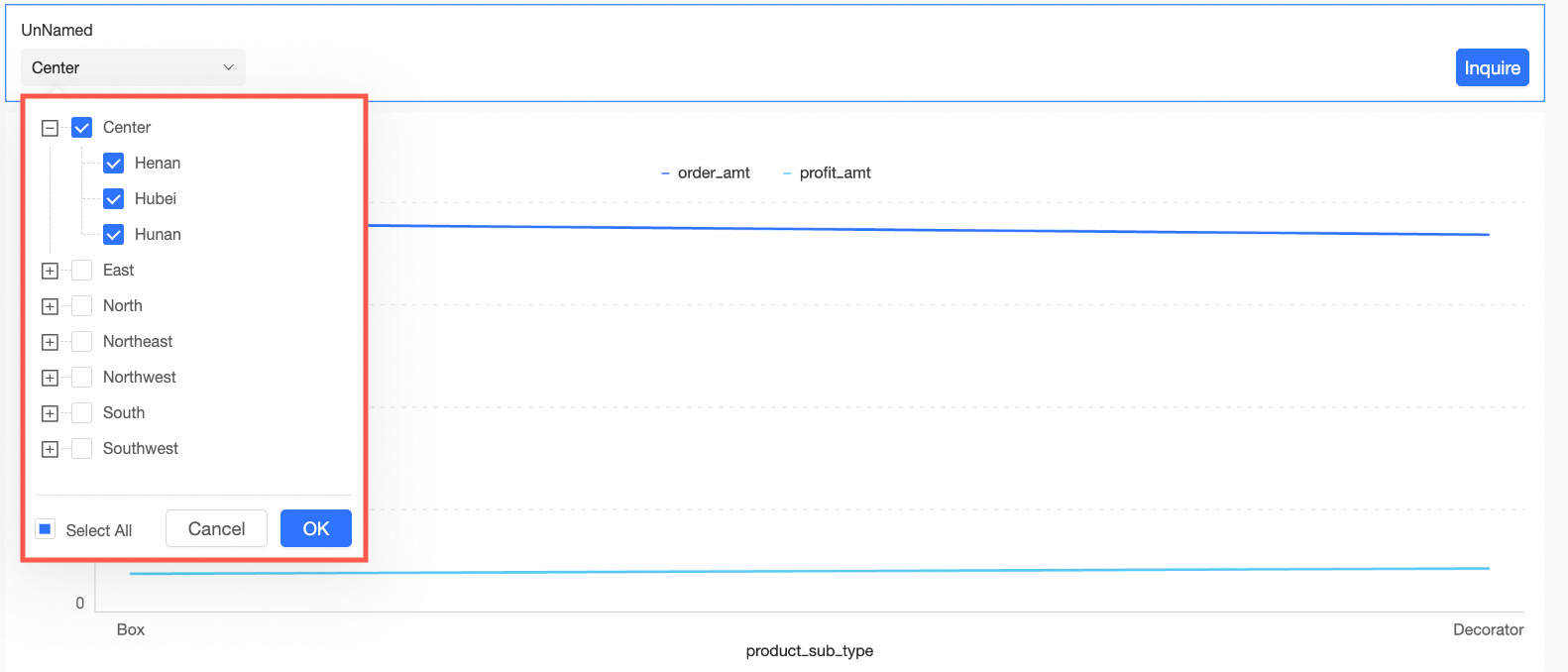
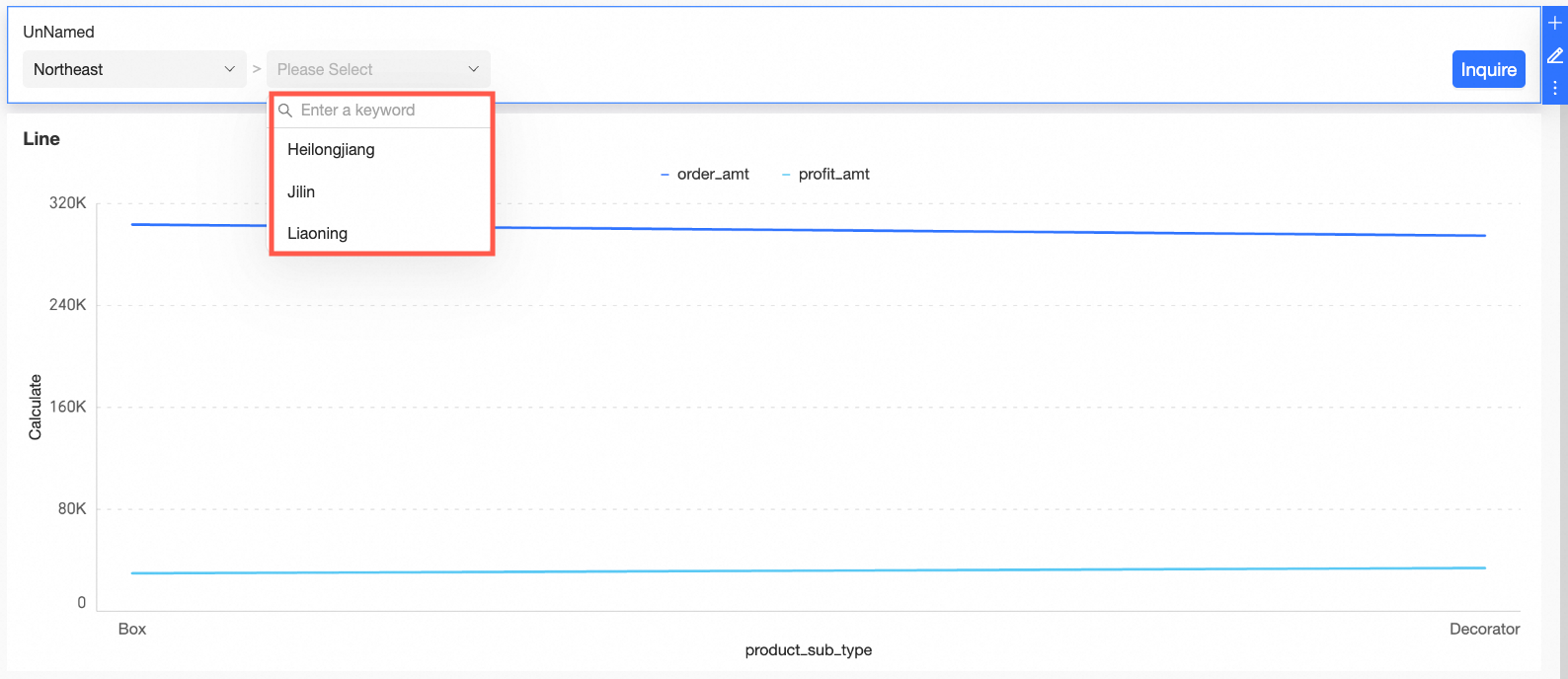
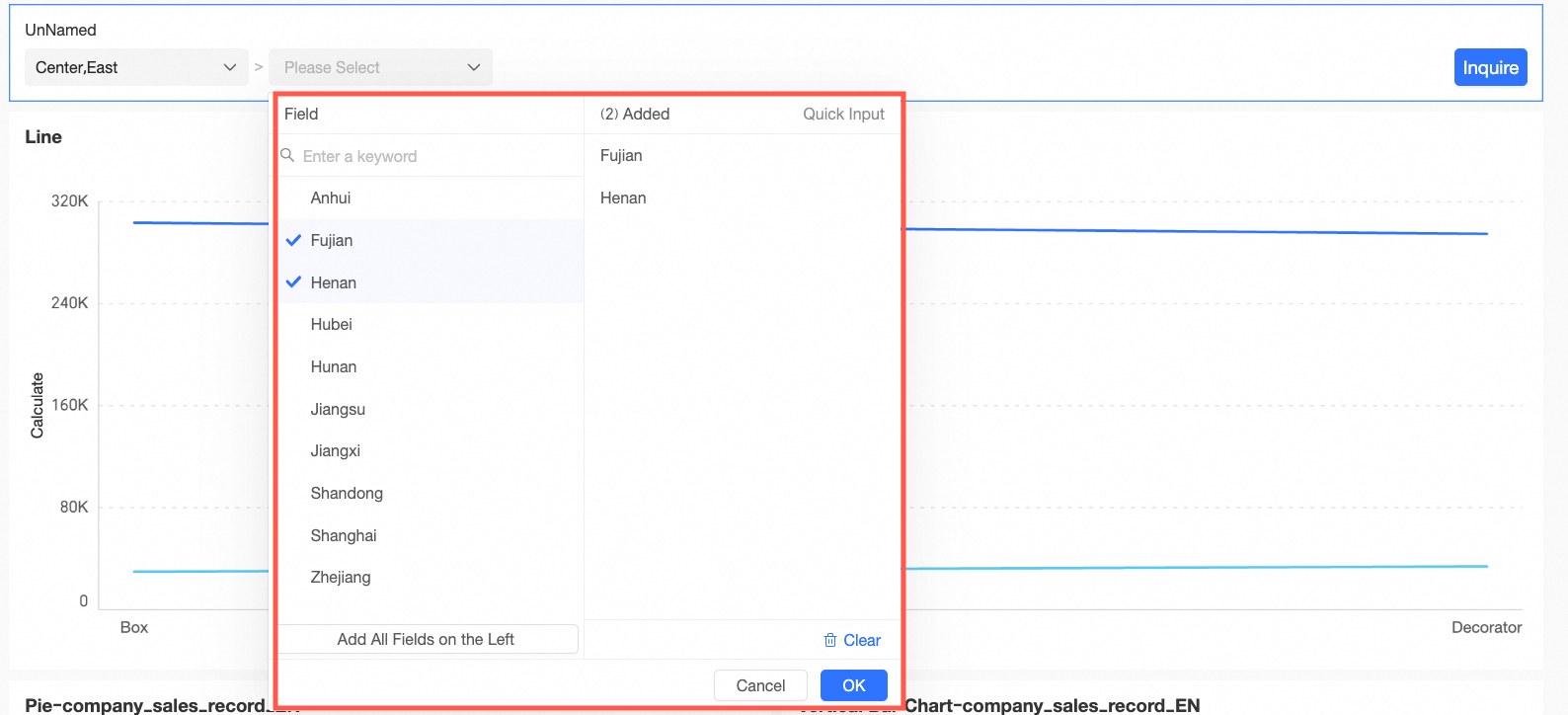
In this example, the following configuration is used:
The chart's source dataset,
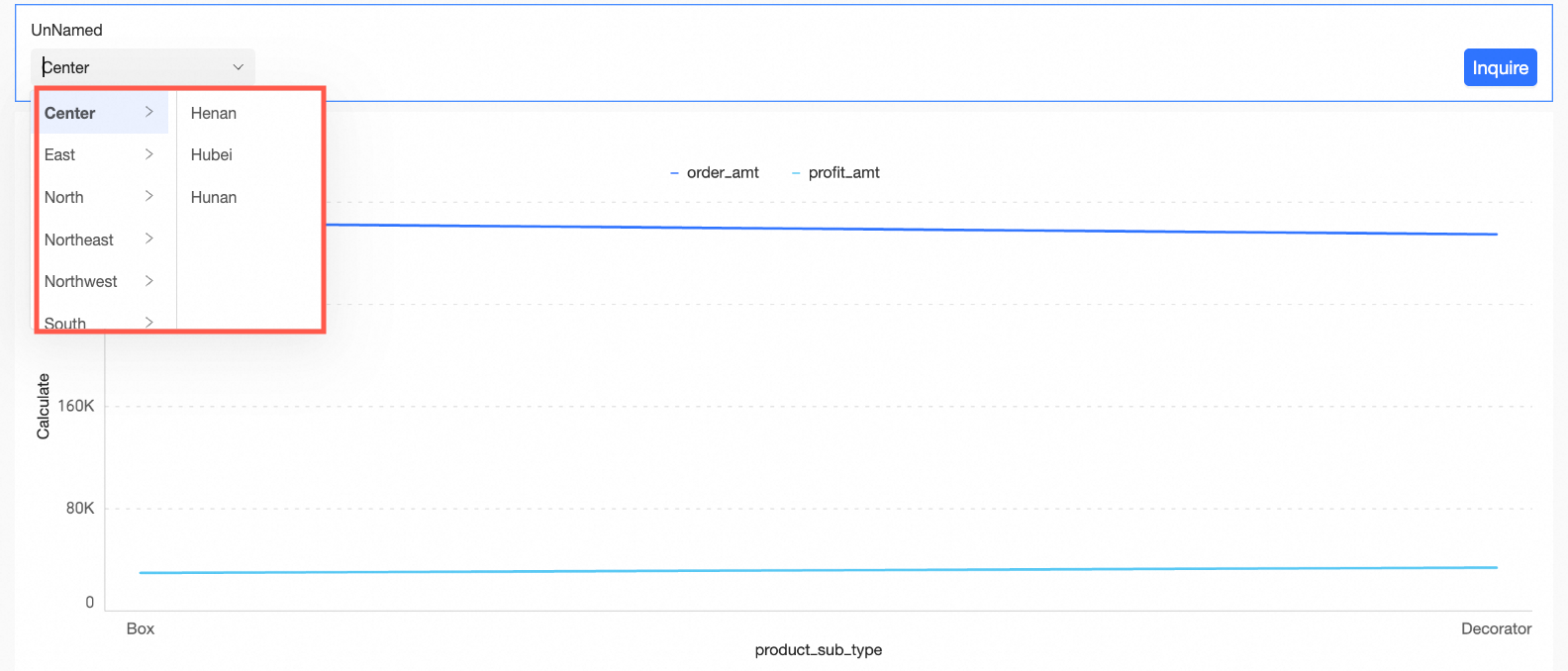
company_sales_record, is selected for the Select dataset parameter.The Tree structure design is configured with the Region field at Level 1 and the Province field at Level 2. Since the query field values are clear and easy to understand, the query field and display name field are kept the same.
Display form is set to Tiled display.
Selection mode is set to multiple choice, allowing the report viewer to select multiple option values in the filter.
Query time is set to click to query, which requires the report viewer to click the query button to trigger the conditional query.
The default value is set to Northeast > Liaoning. When a report viewer opens the report, it defaults to showing results for the Liaoning province in the Northeast region.
The Quick association option is selected.
The result is as follows: