RDS PostgreSQL supports serverless instances
RDS PostgreSQL serverless instances from Alibaba Cloud are designed for small and medium-sized enterprises (SMEs) and individual developers. They feature auto scaling for CPU and memory and automatic storage expansion, based on a cloud disk architecture. The beta test for RDS PostgreSQL serverless will run from March 6, 2023, to April 10, 2023.
Beta test period
March 6, 2023, to April 10, 2023
Beta test product
RDS PostgreSQL serverless instance
Serverless instances
A serverless instance automatically scales its compute resources during workload peaks and troughs, allowing it to respond quickly to business changes while optimizing costs and improving efficiency. For more information, see Introduction to RDS PostgreSQL serverless instances.
The following figure compares the resource usage and specification changes between a general-purpose instance and a serverless instance for a workload with significant fluctuations.
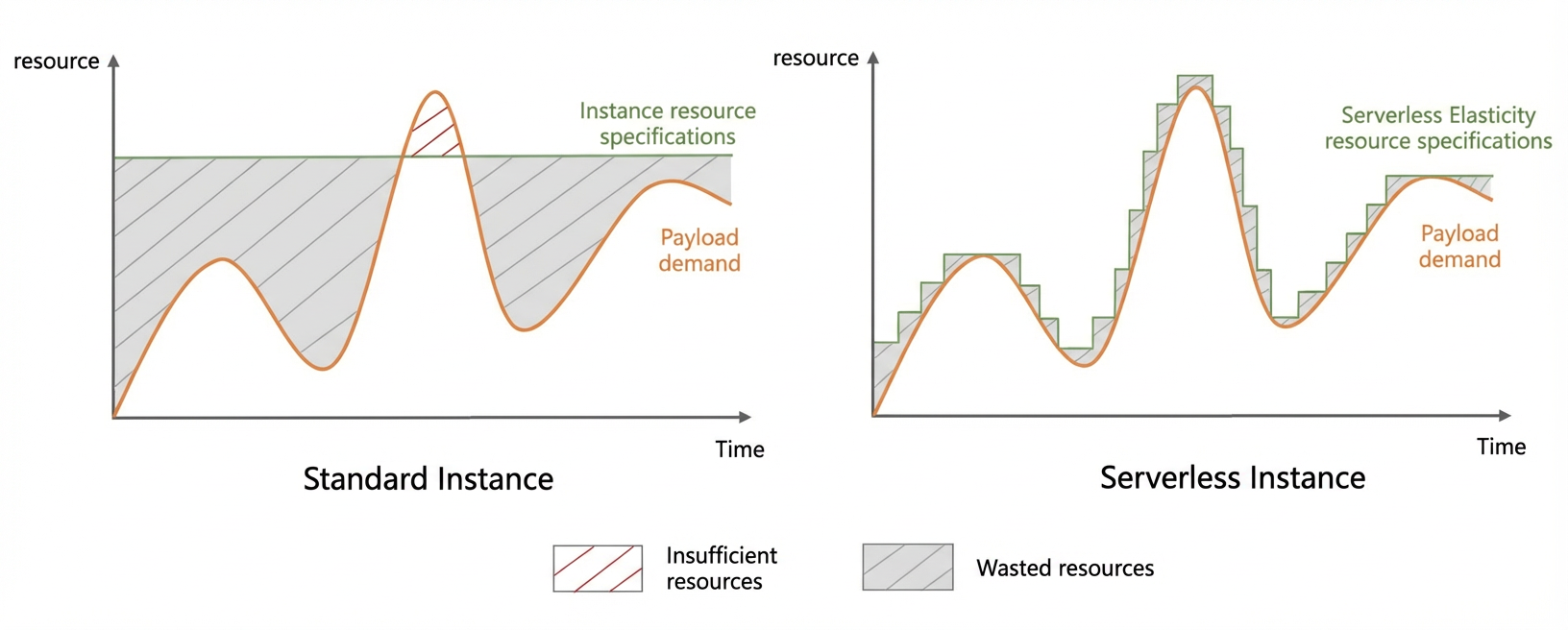
As shown in the figure, for workloads with significant fluctuations:
A general-purpose instance wastes resources during off-peak periods and lacks sufficient resources during peak periods, which can harm your business.
A serverless instance:
Because its compute resources adjust dynamically to workload demand, it minimizes waste, increases resource utilization, and reduces overall consumption.
It fully meets business demands during peak periods, ensuring service continuity and improving system stability.
It replaces the fixed-capacity billing model with a true pay-as-you-go model that dynamically matches resources to your workload, leading to significant cost savings.
It eliminates manual scaling, which improves O&M efficiency and reduces operational costs for both staff and developers.
It is optimized for high-throughput write scenarios and high-concurrency services. Its elastic scaling capabilities make it ideal for applications with large data volumes and fluctuating workloads.
Beta test
Submit a beta test application with your Alibaba Cloud account (primary account). After approval, go to the RDS console to create an RDS PostgreSQL serverless instance. More details about the beta test are as follows:
Each Alibaba Cloud account (UID) can create only one RDS PostgreSQL serverless instance.
Because serverless instances are in a free beta test period, the SLA is not guaranteed. Alibaba Cloud does not guarantee service availability or reliability during this period. You assume all related responsibilities.
The beta test is available only in the China (Hangzhou), China (Beijing), China (Shanghai), China (Shenzhen), and China (Chengdu) regions.
Currently, you can create serverless instances only with the major engine version PostgreSQL 14.
To create an RDS instance, a RAM user must have the AliyunRDSFullAccess permission. For instructions on how to grant this permission, see Authorize a RAM user.
Billing
During the beta test (before April 10, 2023), approved users receive a 100 GB free storage quota for each serverless instance. Within this quota, RCU (RDS Capacity Unit) usage is free. If storage usage exceeds 100 GB, standard billing applies according to the Billing standards, and you will be charged for all RCU usage and storage fees.
ImportantInstances created during the beta test period will automatically switch to commercial billing after 30 days. If you no longer require the instance, release it promptly to avoid incurring unexpected charges.
Starting April 10, 2023, you can no longer create beta test instances. You can create commercially available instances instead.
Billing standards
The total cost of an RDS PostgreSQL serverless instance consists of RCU fees and storage fees. RCUs are billed in increments of 0.5 RCU, up to a maximum of 12 RCUs per instance. The system generates separate hourly bills based on the instance's RCU consumption and storage usage.
The storage size you select when you purchase an instance is the minimum billable storage amount. For example, if you create a serverless instance with 100 GB of storage, you are billed for 100 GB even if your actual usage is less. If your usage exceeds 100 GB, the serverless instance automatically expands its storage, and you are billed for the actual amount used.
After a serverless instance's storage automatically expands, it cannot be automatically shrunk, which ensures data integrity. Monitor your bills carefully.
Unit prices
Billable item | Unit price |
RCU (RDS Capacity Unit) | CNY 0.333/hour/RCU |
Storage fee | CNY 0.0021/hour/GB Note Currently, only ESSD PL1 cloud disk storage is supported. |
Billing formula
Total serverless fee = RCU fee + Storage fee
Billing example
For example, you purchase an RDS PostgreSQL serverless instance in the China (Hangzhou) region. The compute specifications are set to a minimum of 1 RCU and a maximum of 8 RCUs, and the initial storage size is 100 GB. Over a 24-hour period, the instance experiences a 1-hour peak consuming 8 RCUs, and consumes 1 RCU for the remaining 23 hours. The storage usage is 150 GB. If the unit price for an RCU is CNY 0.333/hour/RCU and the unit price for storage is CNY 0.0021/hour/GB, the total cost for the day is calculated as follows:
RCU fee:
(0.333 × 8 × 1) + (0.333 × 1 × 23) = CNY 10.323Storage fee:
0.0021 × 150 × 24 = CNY 7.56
Total fee: 10.323 + 7.56 = CNY 17.883.
The prices in this example are for reference only. Your actual bill may vary.
Use cases
Development and testing environments with highly fluctuating workloads.
SaaS applications, such as website building services for small and medium-sized enterprises.
Educational scenarios, such as online courses and student labs.
Scenarios with unpredictable workloads, such as Internet of Things (IoT) and edge computing.
Users with fluctuating or unpredictable business workloads.
Applications that run intermittent or scheduled jobs.
Individual developers.