Develop a SKILL and use it in OpenClaw
This topic uses an example to show you how to develop an enterprise SKILL and use OpenClaw in business scenarios.
Background, challenges, and solution
Enterprise customers often face the following challenges when using a desktop Agent like OpenClaw:
Low accuracy that fails to meet enterprise requirements. When Agents operate enterprise software, they cannot guarantee the accuracy of the results. Inaccurate results can cause direct financial losses for the business, such as in supply chain processes for preparing customs declarations or in e-commerce operations for listing products.
Slow execution speed, making them unsuitable for production workflows. An Agent goes through numerous "perceive-plan-act" cycles. When operating enterprise software, it can get stuck in lengthy, ineffective attempts or take a long time to complete tasks.
High token consumption and low cost-effectiveness. The Agent constantly uses a large model, even for repetitive tasks.
This topic provides the following solution:
First, use RPA to build repeatable automation workflows from standard enterprise operating procedures. These workflows can then be integrated as SKILLs that the Agent can call.
When employees use the Agent, it can use these SKILLs to deliver real business value.
Use case
Case background
An Operations Agent is designed for e-commerce operations staff. It runs in the cloud, allowing operators to use it without interrupting their work on their office computers.
This topic describes the implementation of a daily SOP (standard operating procedure) provided by this Agent. The SOP workflow, as shown in the following figure, aims to analyze the previous day's sales and determine the next action plan.

Agent components:
OpenClaw: Employees interact with the Agent through DingTalk IM to assign tasks and receive results.
Enterprise SKILL: Based on the SOP, the SKILL must provide at least the following two functions:
Automatically retrieve product sales data from the company's stores on various platforms.
Automatically fill in the daily report in the company's reporting system.
Runtime architecture

The process of developing a SKILL and integrating it into OpenClaw is as follows:
Install OpenClaw and configure its integration with DingTalk.
Use RPA to develop an automation workflow and publish it as an MCP Tool.
Create the corresponding SKILL in the RPA console.
Prepare a service-based robot as the SKILL runtime.
Add the SKILL and MCP Server to OpenClaw.
The process for an operator is as follows:
Interact with OpenClaw through DingTalk to perform the SOP.
Procedure
Install OpenClaw
In this section, you use a Simple Application Server to install and configure OpenClaw and integrate it with DingTalk. For detailed steps, see:
Purchase and deploy the OpenClaw application image. This topic uses OpenClaw v2026.6.10 and the qwen3.7-plus large model.
After successful configuration, you can communicate with OpenClaw in a DingTalk chat window.
Develop a workflow and publish as an MCP Tool
For details about how to develop an automation workflow by using RPA, see Develop an automation workflow.
The following table describes the process input and process output for the automation workflows required in this example.
Automation workflow
Input parameter
Output
Automatically retrieve store product sales data
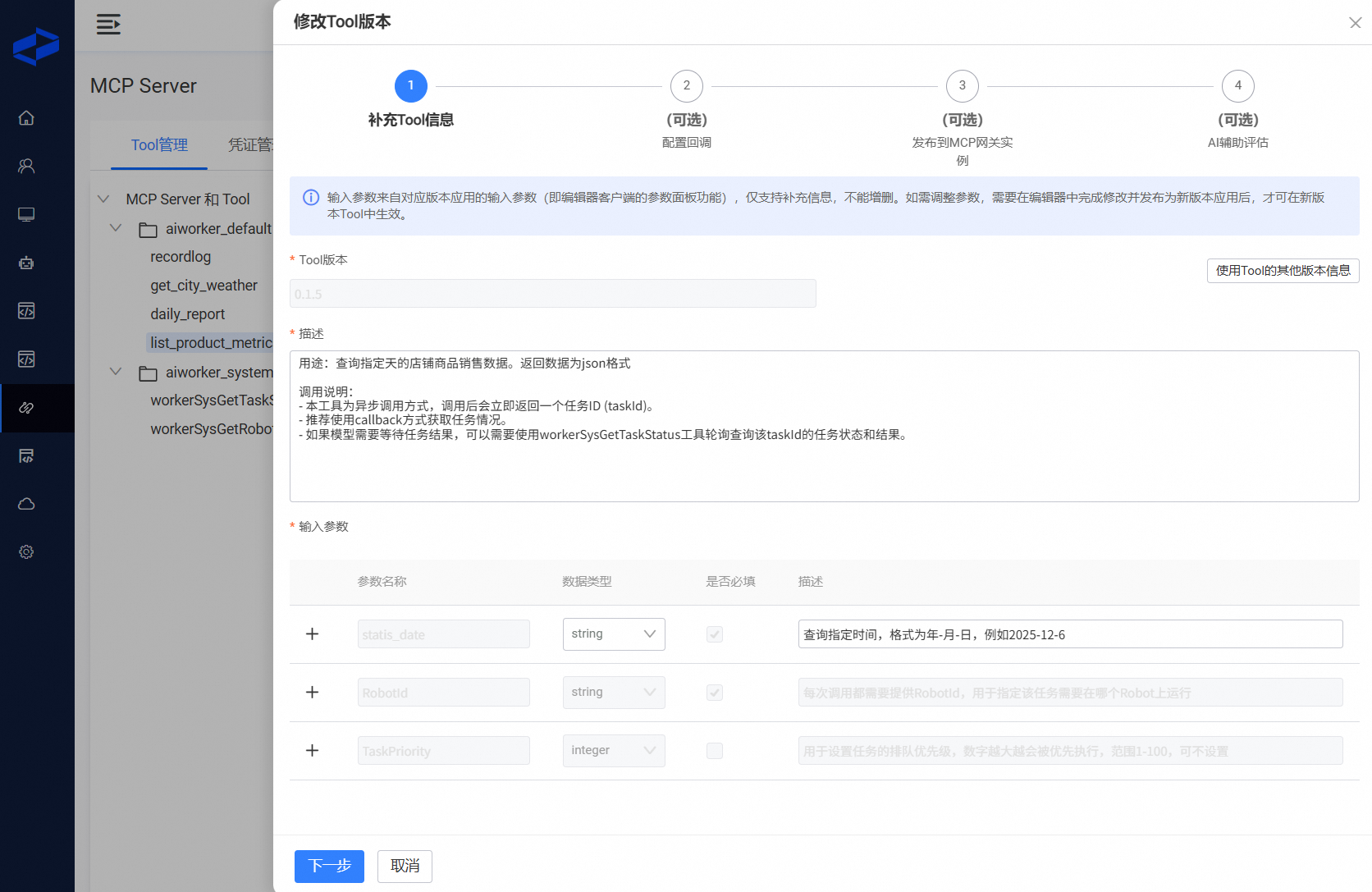
statis_date: Queries product sales data for a specified date.
The retrieved product data is in JSON format and includes details for each store, such as product ID, product name, style tags, sales quantity, unit price, and favorites count.
The automation workflow saves the retrieved data using task_result.
Submit a daily report
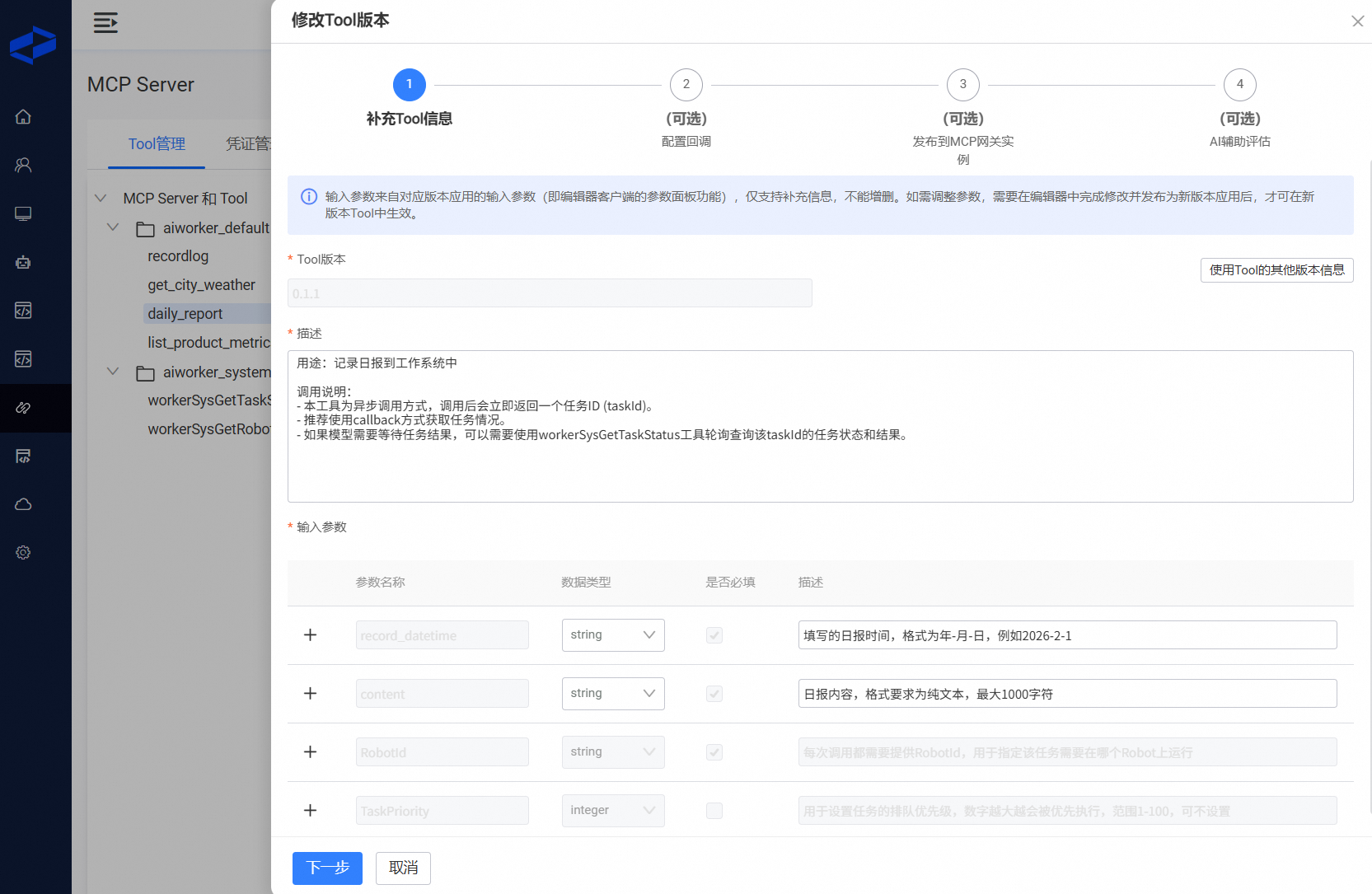
record_datetime: The date of the report.
content: The content of the daily report.
None
ImportantThe implementation details in this example are not universally applicable because enterprises use different platforms, data, and software. You can refer to Develop an automation workflow to create a workflow that fits your business processes.
Publish the automation workflow as an RPA application. For more information, see Publish and manage applications.
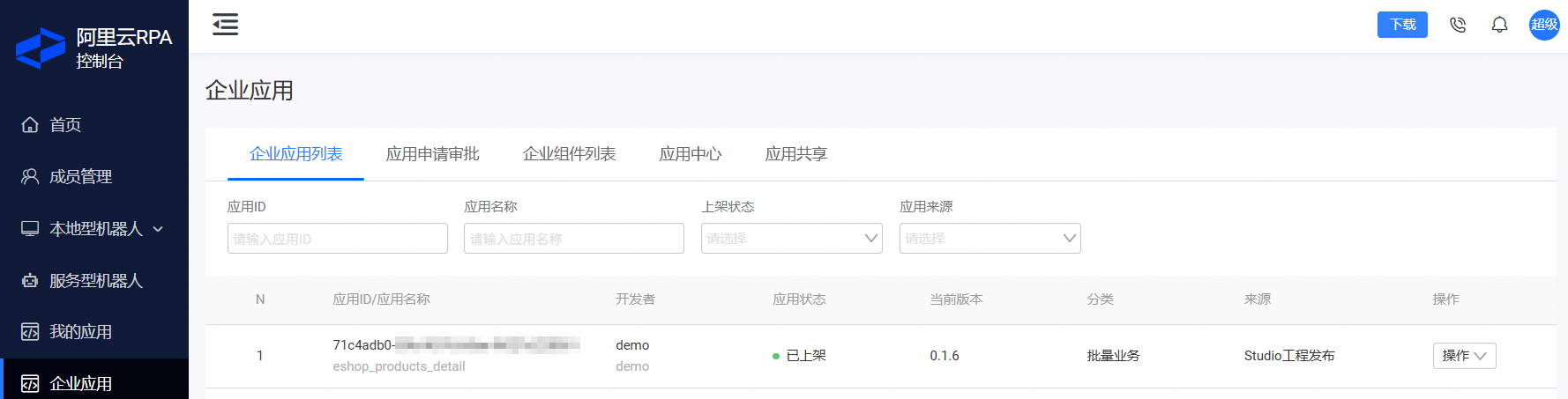
Publish the application as an MCP Tool. For more information, see Publish as an MCP Tool. The following figure shows the details of the published MCP Tool.
Retrieve store sales data
Submit a daily report
 Important
If the automation application takes a long time to run, we recommend that you add the estimated duration and the suggested polling interval for the Agent in the tool description.
Create a SKILL
In the Alibaba Cloud RPA console, use the SKILL Management page to automatically create and edit SKILLs online.
Generate a draft version of the SKILL.
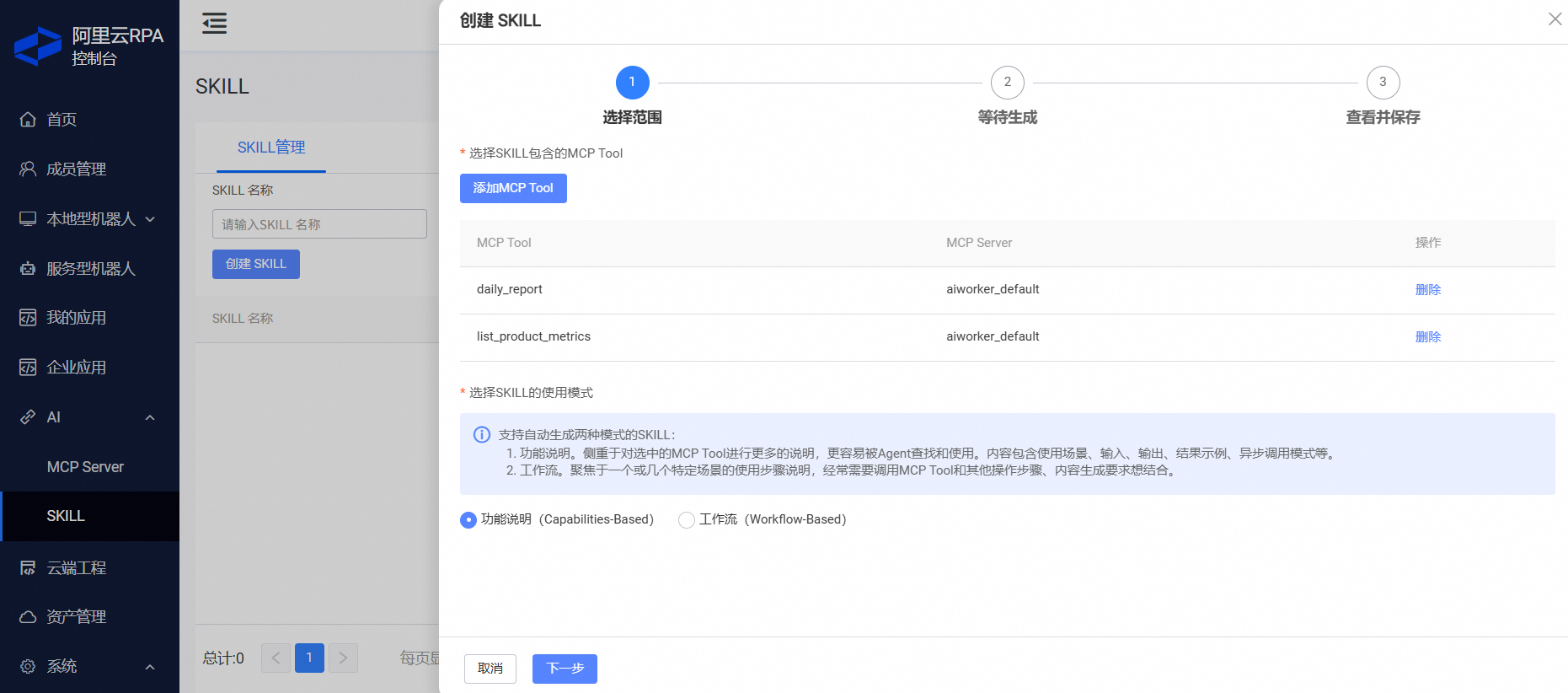
Click New SKILL. In the first step, select the two MCP Tools that you published in the previous step, as shown in the following figure.

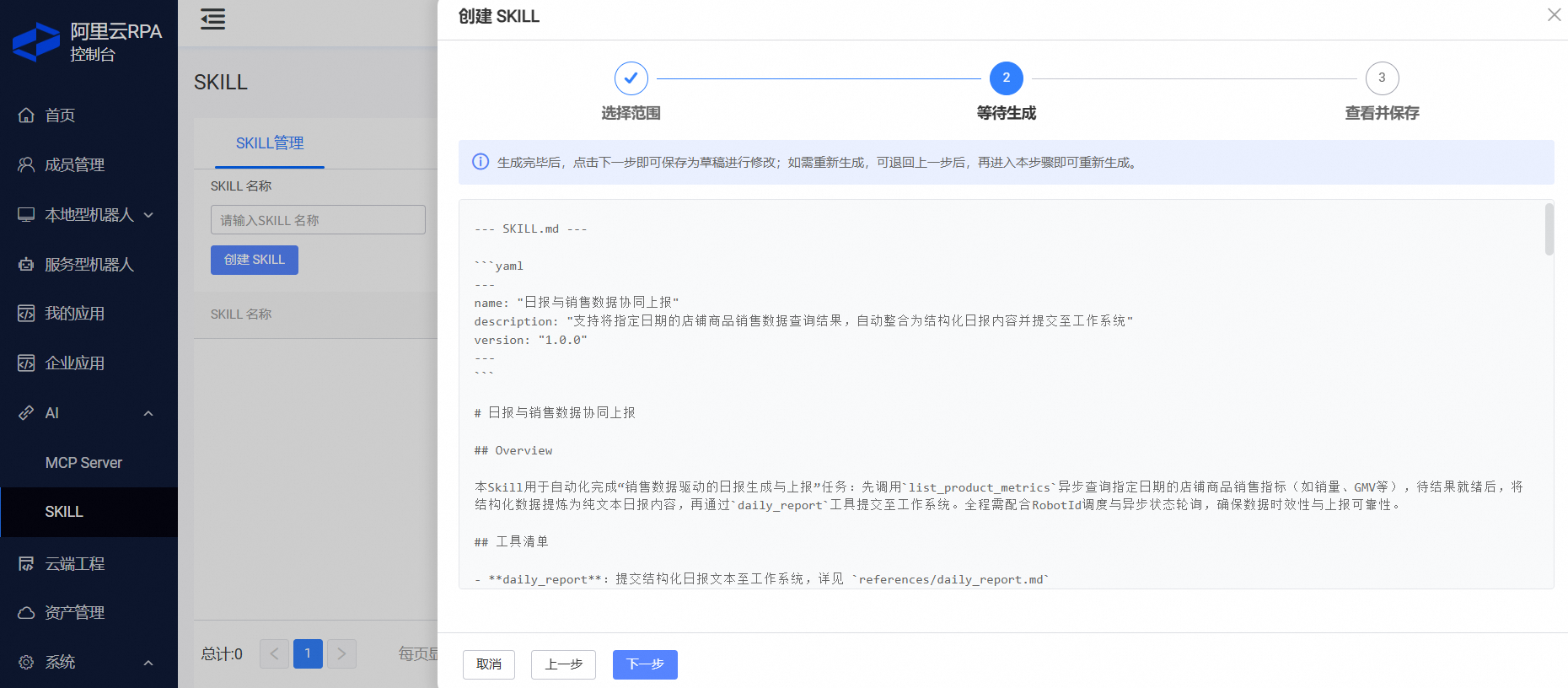
Click Next. In the second step, the large model automatically generates the SKILL based on the details of the selected MCP Tools and best practices.
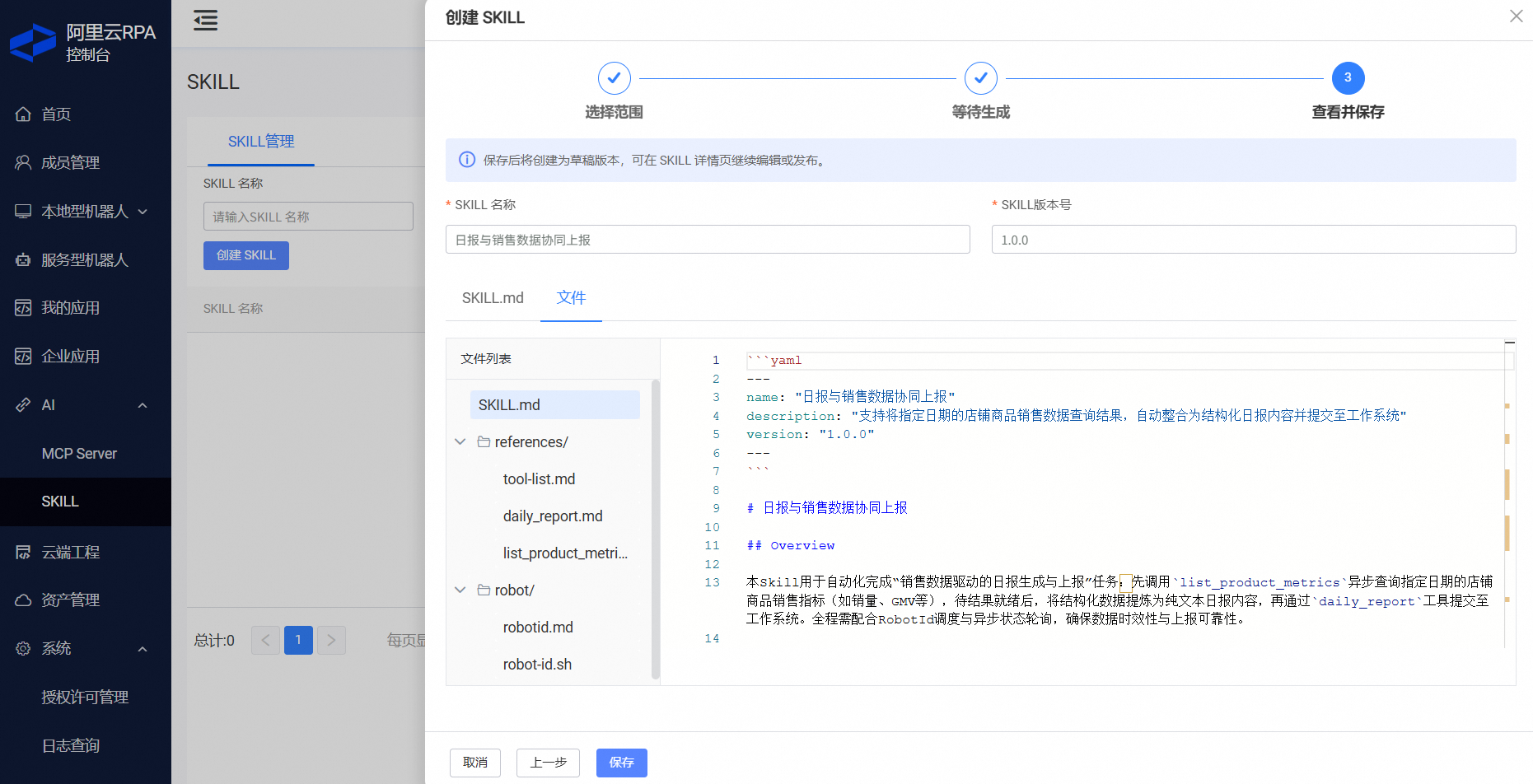
In the third step, you can review the generated SKILL. You must save the draft before making further edits.
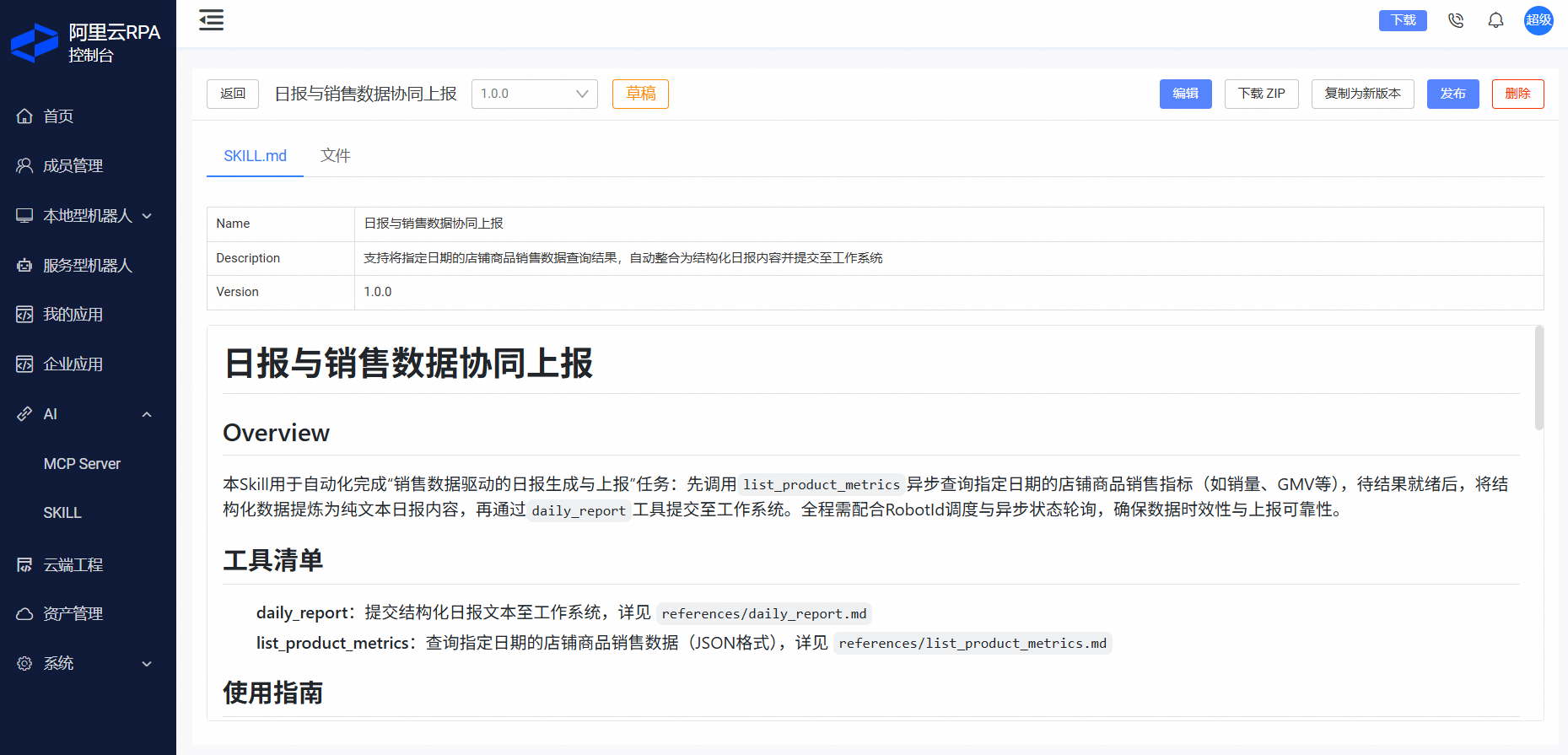
Confirm the draft is correct, then publish it. Before publication, the SKILL undergoes a security check, and only versions that pass can be published.
Prepare the SKILL runtime
In this example, a service-based robot is used as the SKILL runtime.
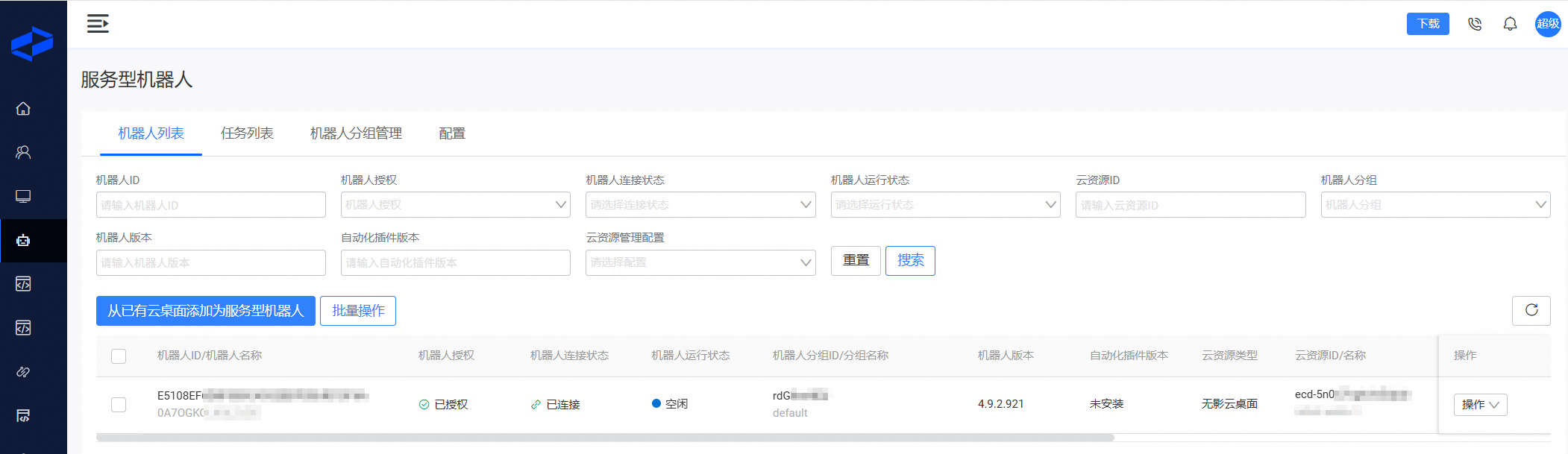
A service-based robot requires Elastic Desktop Service. For configuration details, see Run an automation workflow as a service. After the robot is created, it appears as shown in the following figure. You will use this robot to run the SKILL.
Add an MCP Server and SKILL
Add an MCP Server.
In this example, OpenClaw uses mcporter to manage and call MCP Tools.
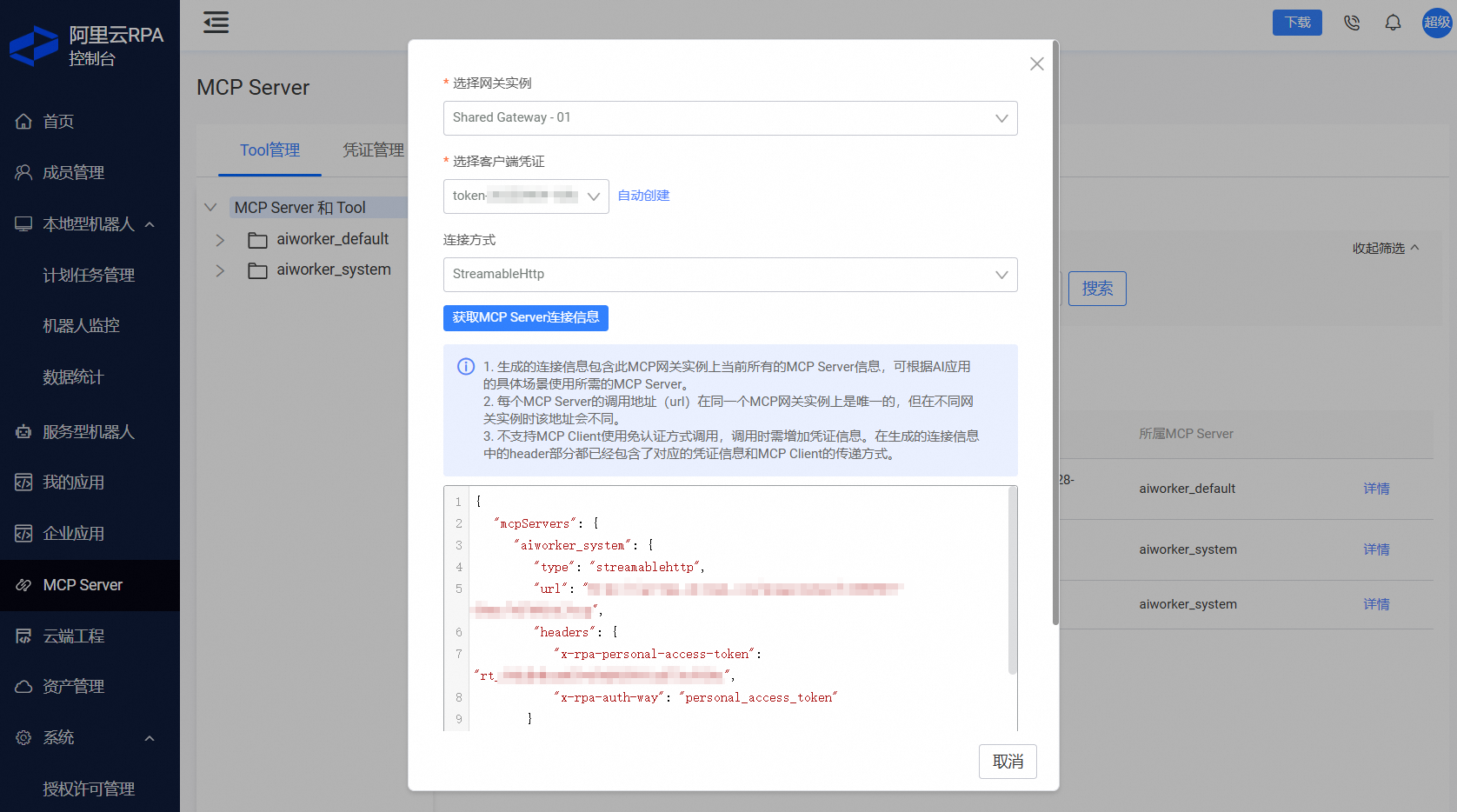
In the Alibaba Cloud RPA console, get the MCP Server configuration from the MCP Server menu. As shown in the following figure, this configuration can contain details for multiple MCP Servers.
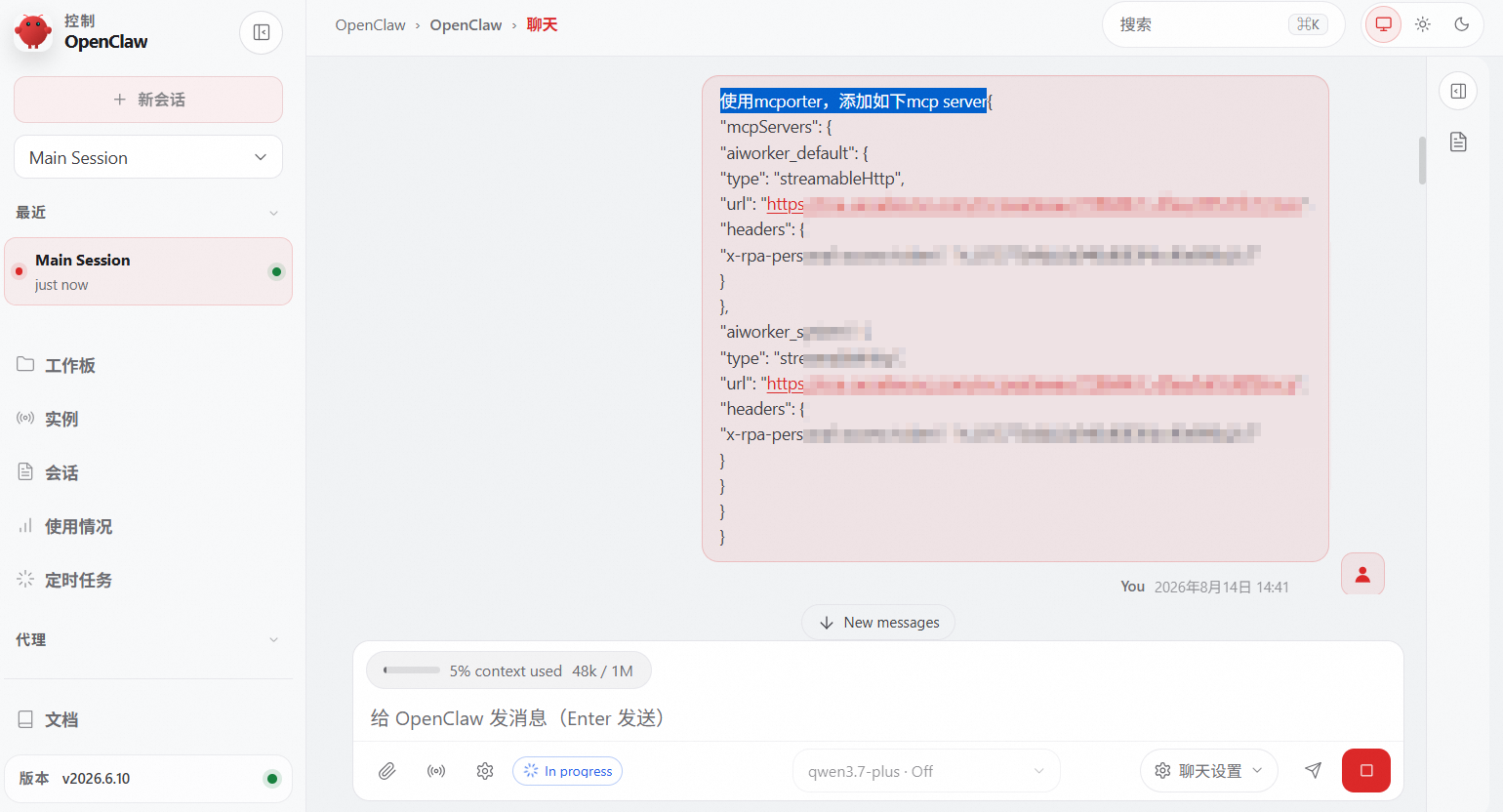
Add an MCP Server in the chat window of the OpenClaw Gateway Dashboard by entering the command
use mcporter, add the following mcp serverand attaching the JSON from the previous step, as shown below.
Add a SKILL.
This section describes how to install the SKILL by using an online URL. You can also download the SKILL.zip file and install it manually.
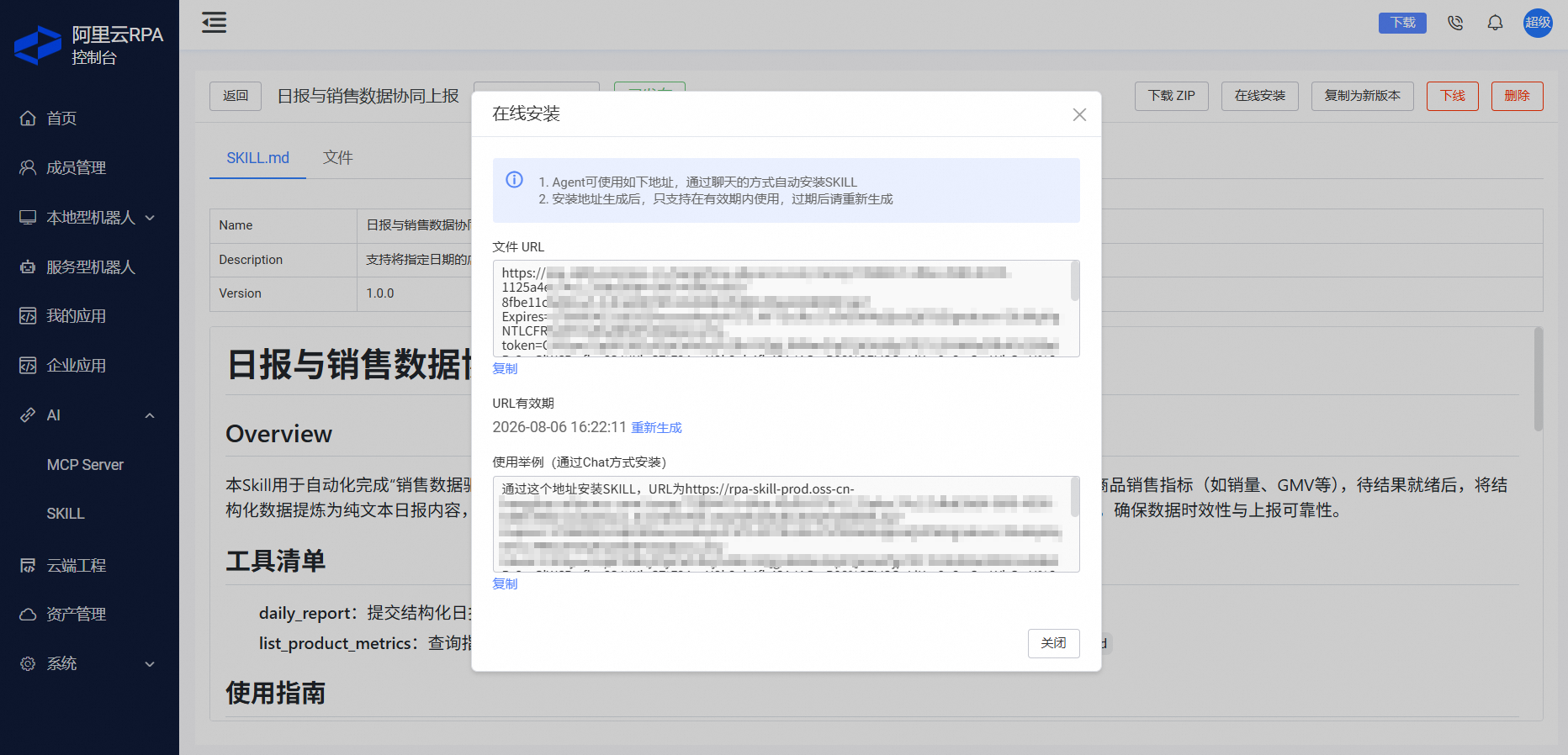
In the SKILL menu, click Online Install to get the download URL for this version of the SKILL. The link is valid for one hour. If it expires, you can click to regenerate it.
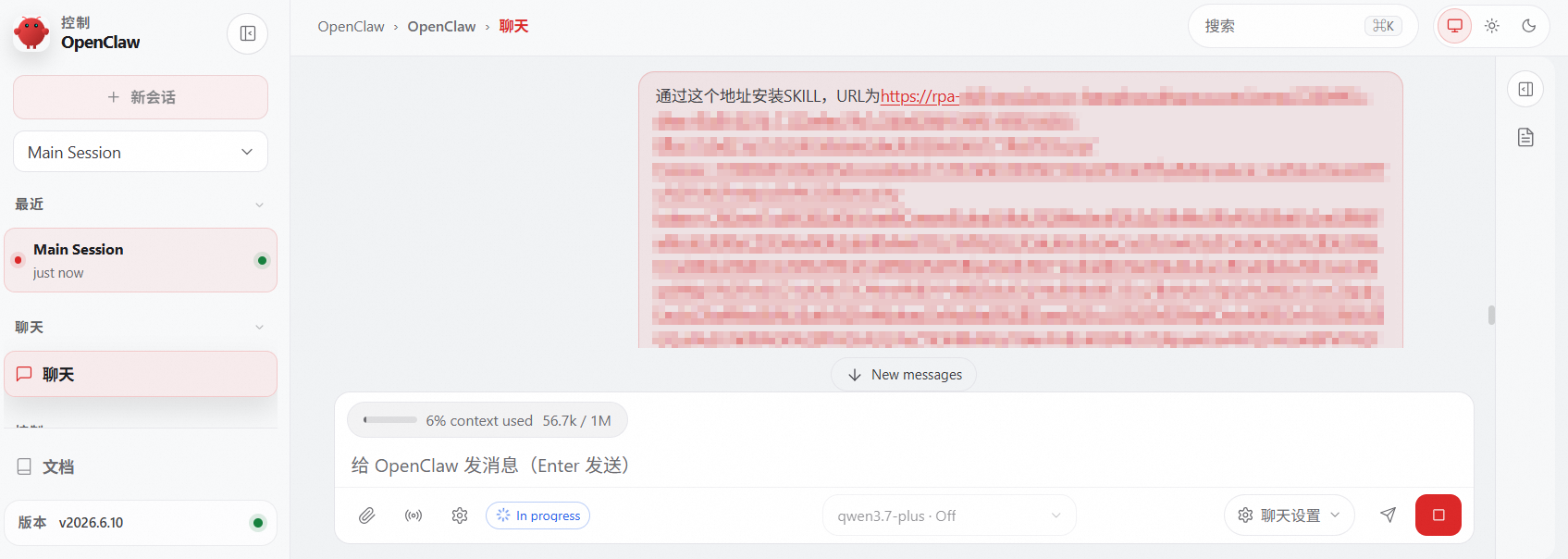
Install the SKILL from the chat window in the OpenClaw Gateway Dashboard.
(Optional) Set the RobotID.
WarningDuring the proof of concept (POC) testing phase, you can allow the SKILL to automatically get an available service-based robot from the server. The server randomly allocates a service-based robot.
For formal integration, development, and production use, we recommend that you manage the allocation of service-based robots through your upper-layer system instead of using automatic allocation.
Results
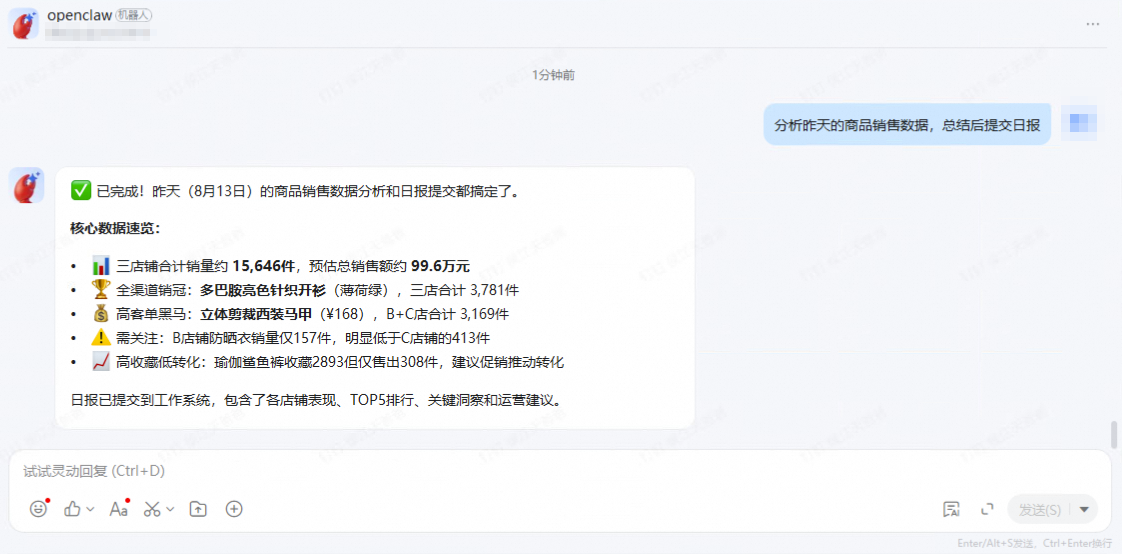
The following figure shows a conversation with OpenClaw in the DingTalk client.
In the OpenClaw Gateway Dashboard, you can view more information about this session.
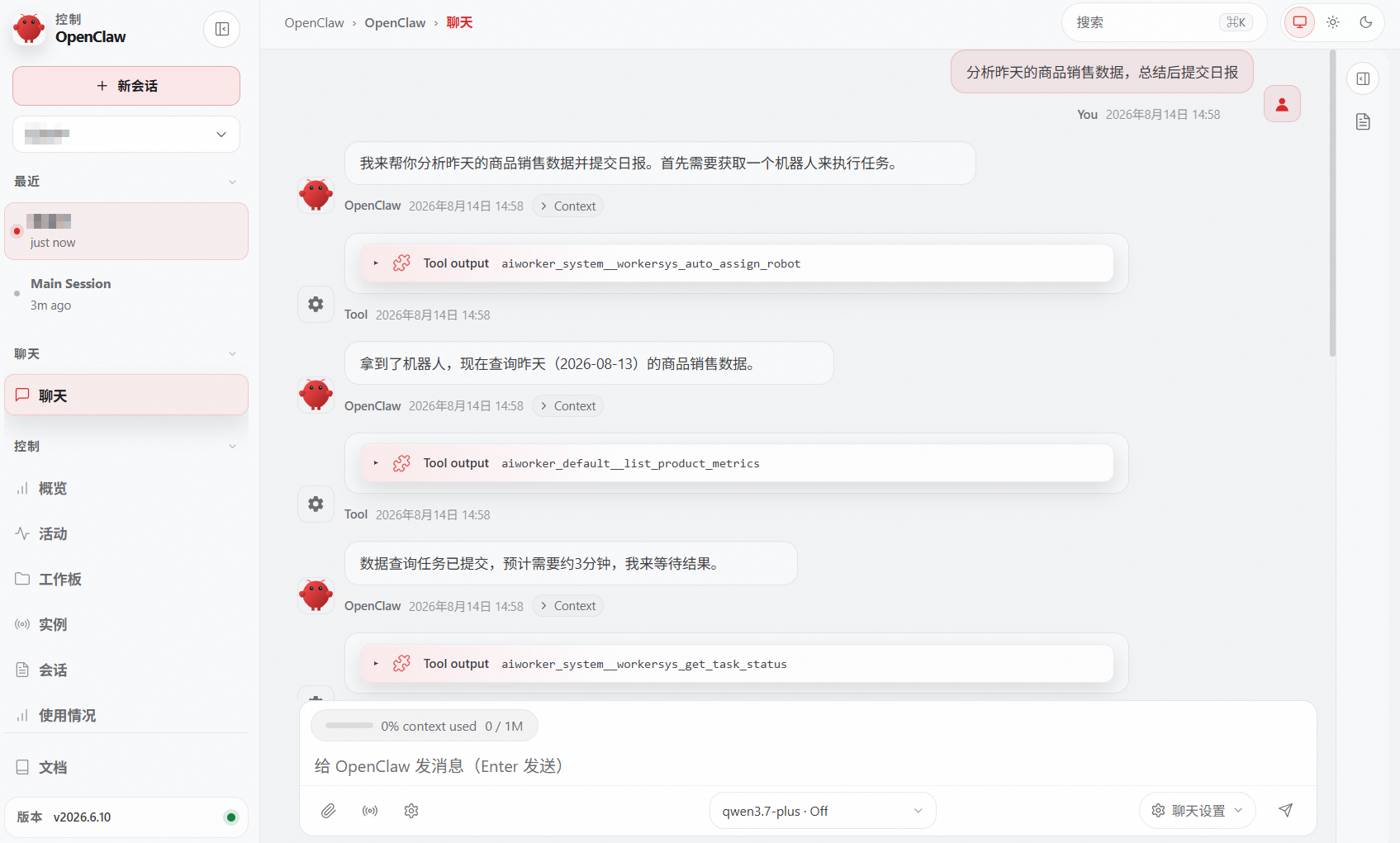
The product sales data in this topic is simulated.
Appendix: Run a SKILL on-premises
The previous sections describe how to run a SKILL in the public cloud by using a service-based robot and Elastic Desktop Service. This section describes how to run a SKILL in a customer's on-premises environment and call it from OpenClaw.
This scenario requires an on-premises robot. The runtime architecture is as follows:

Most of the steps are the same as in the previous sections. The key differences are as follows:
Prepare the SKILL runtime.
Use an on-premises robot and install it in the customer's Windows environment. For more information, see Install and log on to an on-premises robot.
ImportantThe on-premises robot client must be able to connect to the public cloud RPA server.
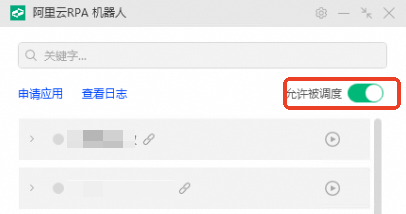
Turn on the Allow to be scheduled switch in the robot client.
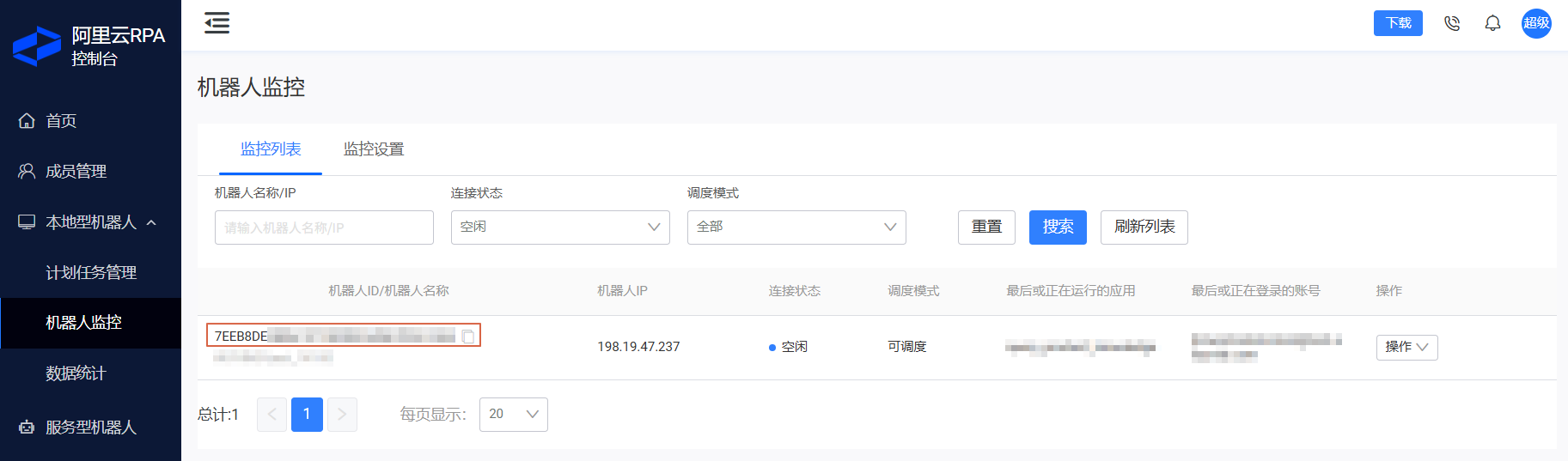
You can view information about this robot on the On-premises Robots - Robot Monitoring page. The value in the red box is the RobotID.
Obtain the MCP Server information. An administrator must grant the calling account permission to use the automation application. For example, if Account A makes MCP calls, the administrator must grant Account A permission to use the corresponding RPA application. For more information, see Application Management.
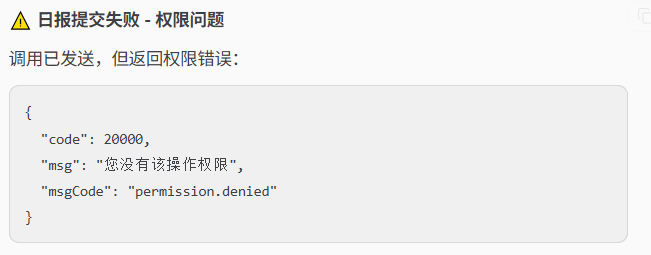
ImportantIf OpenClaw reports a permission error during execution, as shown in the following figure, the account lacks permission to use the corresponding RPA application.
After you add the SKILL, set the RobotID to be used, as shown in the following figure.
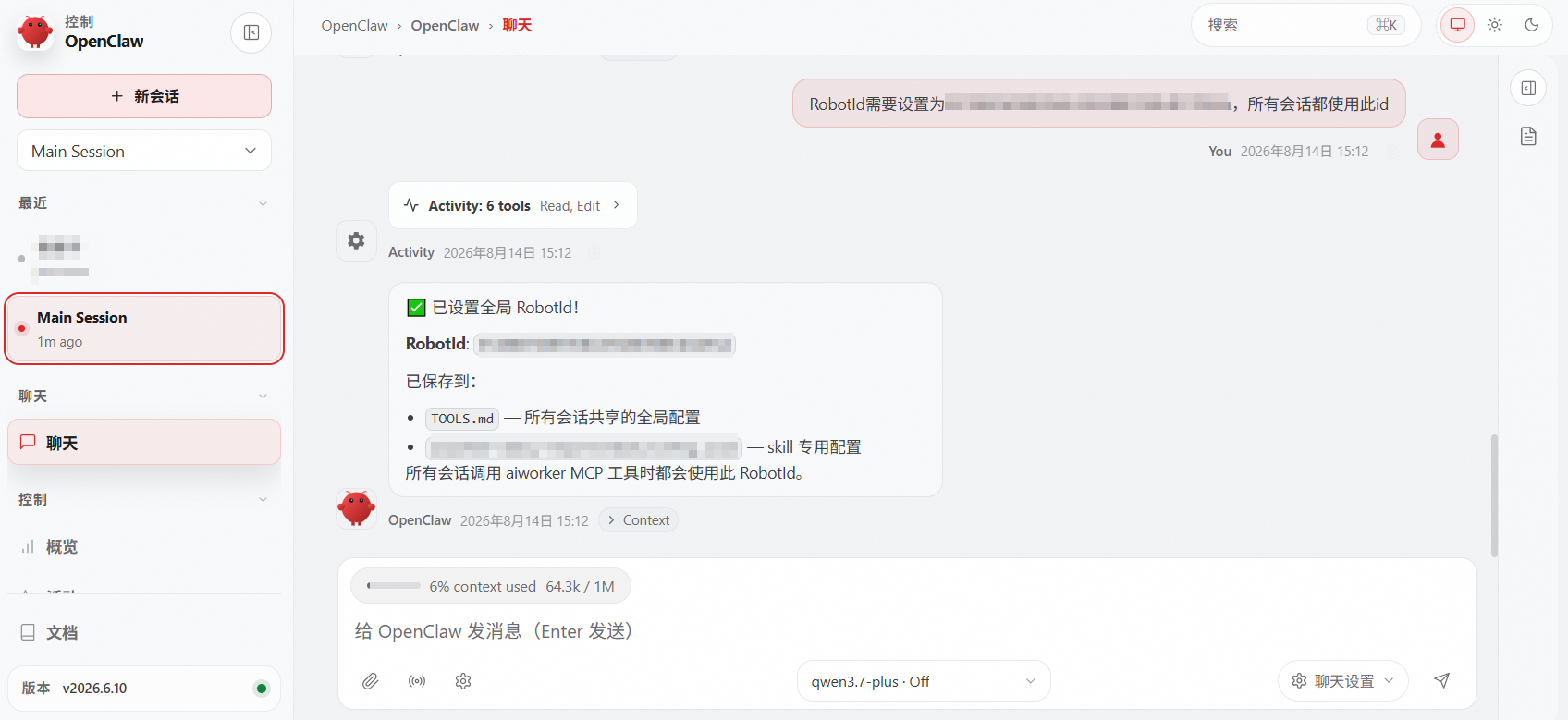
After the configuration is complete, OpenClaw automatically schedules the customer's on-premises robot to run the SKILL.