June 30,2026
This release of Agentic SOC focuses on the Security Operations Agent launch and adds and enhances ingestion capabilities for multiple log source types including Azure, network devices, SaaS/API, Cloud Firewall, AI Gateway, and IDaaS, bringing more security logs into the unified analysis pipeline. Additionally, the Security Operations Agent, Log Parsing Agent, Entity Investigation Agent, and Alert Correlation Agent receive continuous capability upgrades to help security teams improve alert triage, incident investigation, log standardization, entity remediation, and response report generation efficiency.
Release highlights
With this release, Agentic SOC further extends the end-to-end security operations loop from security Q&A, log ingestion, detection and alerting, incident investigation, to response and remediation, providing a more comprehensive data and capability foundation for continuous triage and efficient response. The release highlights are as follows:
-
Launches the Security Operations Agent for natural-language-driven, multi-agent collaborative security operations.
-
Expands multi-source log ingestion and standardization coverage.
-
Adds the Log Parsing Agent to assist log ingestion.
-
Enhances detection, alert, and incident pipeline capabilities.
-
Upgrades the Entity Investigation Agent and response report capabilities.
Security Operations Agent launch
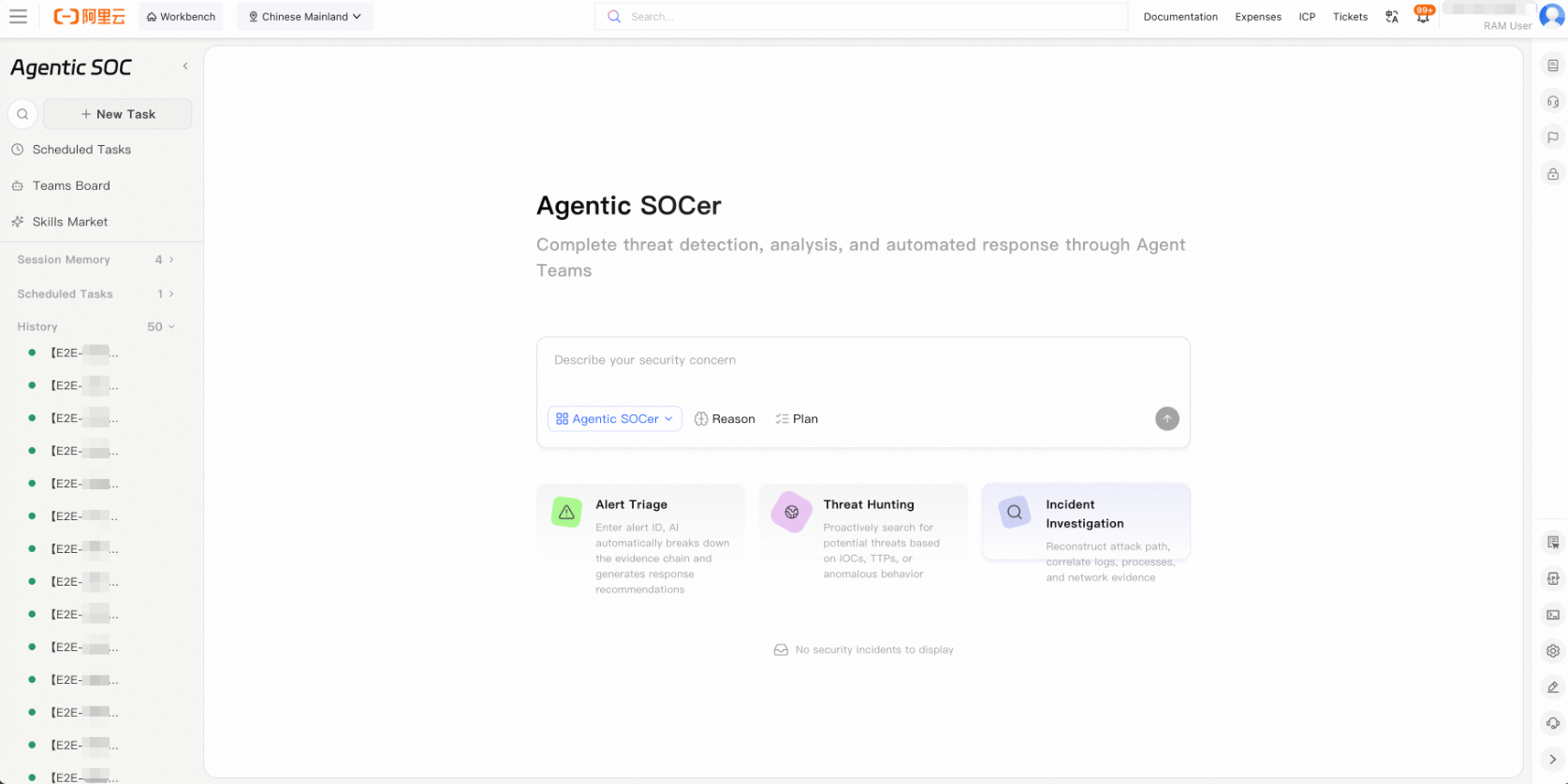
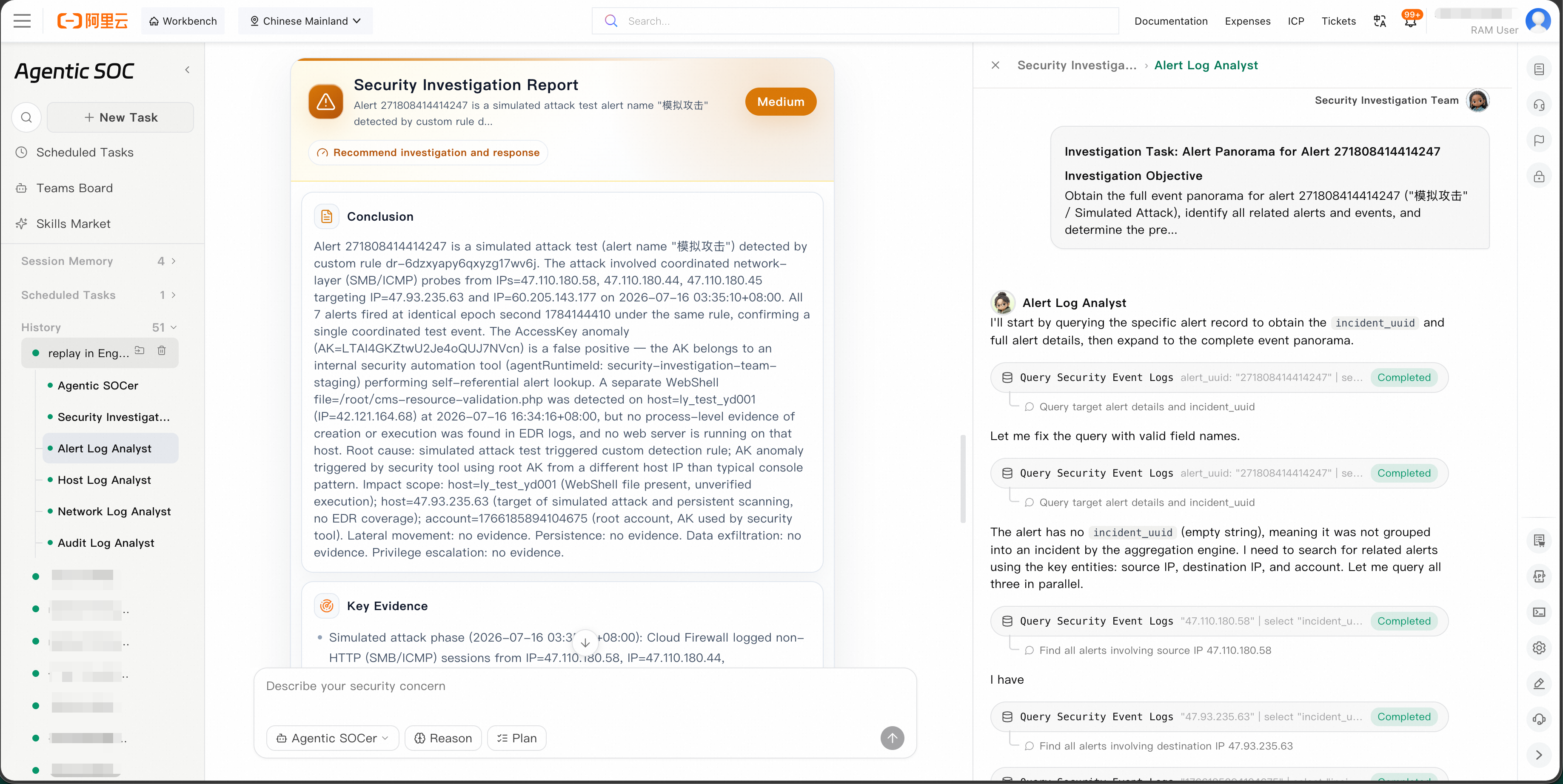
The Security Operations Agent is the unified interaction entry point for Agentic SOC. Built on the principle of "question-driven complete security investigation", it supports natural language security Q&A, multi-agent collaborative investigation, automated inspections, and conversation memory management. Key released capabilities include:
-
Multi-agent team collaboration:
-
Investigation and response teams cover the full detection, investigation, and response security pipeline. The investigation team runs agents in parallel, reducing hours of serial triage to minutes. The response team generates remediation plans such as network blocking, host isolation, and account containment for confirmed threats, shortening the window from discovery to containment.
-
Security research team assists with security research tasks by searching global threat intelligence online, producing TTP mapping and attack chain analysis, helping security operations personnel complete vulnerability research, attack technique analysis, and defense strategy development, reducing reliance on senior security expertise.
-
All teams are orchestrated by the Security Operations Agent, which automatically routes and delegates tasks for parallel execution based on question type. Streaming cards display each Agent's reasoning and progress in real time, keeping the entire security operations process observable and traceable.
-
-
Natural language Q&A: Supports asking questions about alert triage, incident investigation, risk summaries, and remediation recommendations through natural language conversations, reducing the barrier to security analysis and information retrieval.
-
Deep investigation and reasoning: For complex security incidents, the system automatically decomposes the investigation into multi-dimensional evidence collection tasks. Multiple security analysts query SLS logs in parallel, cross-validate evidence, and compile a structured investigation report covering the timeline, attack path, impact scope, and remediation recommendations. You do not need to write query statements manually or review logs one by one — you receive a complete evidence chain and conclusions, which significantly lowers the incident investigation barrier.
-
Security skills marketplace: Provides multiple preset security skills covering alert triage, threat intelligence, and other scenarios. You can invoke or combine skills on demand. Even operations personnel with limited security experience can use preset skills to complete professional-level security analysis and response.
-
Conversation memory and scheduled inspections: Supports saving and continuing historical conversations. You can follow up on the same security incident without re-entering background information. You can also configure scheduled inspection tasks that run security checks automatically on a defined schedule and record results, shifting security operations from manual monitoring to automated inspection with anomaly notifications.
Multi-source log ingestion enhancements
This release adds native log ingestion capabilities that support third-party security products, third-party cloud providers, and user-defined data source logs ingested in their original field format without the need to complete complex standardized field mapping beforehand, which significantly reduces the barrier to third-party log ingestion. The release also expands and optimizes native and standardized log ingestion capabilities for identity, WAF, network device, proxy access, SaaS/API, security intelligence, Cloud Firewall, AI Gateway, and IDaaS scenarios. New data sources include:
-
Azure WAF and Azure Entra ID: Adds Azure WAF native log ingestion, fixes Azure Entra ID native log field parsing and indexing issues, and adds Azure WAF and Entra ID detection capabilities. These changes improve the visibility, search quality, and detection coverage of Azure identity and web protection logs in Agentic SOC.
-
ThreatbookApiLogs and ThreatbookOneSec: Adds standardized SaaS/API data source ingestion to support account operation auditing, sensitive data access, sign-in behavior, and threat intelligence operation analysis.
-
Cisco Switch, Squid proxy, and Palo Alto Panorama: Adds native ingestion configurations for network device, proxy access, and perimeter security logs. Network device state changes, proxy access behavior, and perimeter security logs can now enter the unified security analysis pipeline.
-
Cloud Firewall VPC protection logs: Supports centralized standardized ingestion of Cloud Firewall VPC protection logs. VPC protection logs can now be used for unified search, detection analysis, and incident investigation.
-
Alibaba Cloud AI Gateway and IDaaS logs: Adds AI Gateway and IDaaS log ingestion rules. Identity access, application invocation, and AI Gateway access behavior can now enter unified security analysis.
With these ingestion and standardization capabilities, newly ingested logs not only enter the data ingestion pipeline but can also be used for unified search, detection rule configuration, alert generation, incident investigation, and response remediation, forming a closed loop from data collection to security analysis.
Log Parsing Agent-assisted ingestion
The Log Parsing Agent assists with log ingestion by generating log parsing rules, which reduces the configuration cost of standardized ingestion for new log sources.
Primary use cases include:
-
New log source ingestion
-
Non-standard log format parsing
-
Field mapping completion
-
Parsing rule validation
Agent-assisted parsing rule generation reduces manual configuration and debugging costs, which improves log ingestion efficiency and standardization quality.

Detection, alert, and incident pipeline enhancements
This release enhances custom detection, predefined detection, and alert-to-incident pipeline capabilities. Key enhancements include:
-
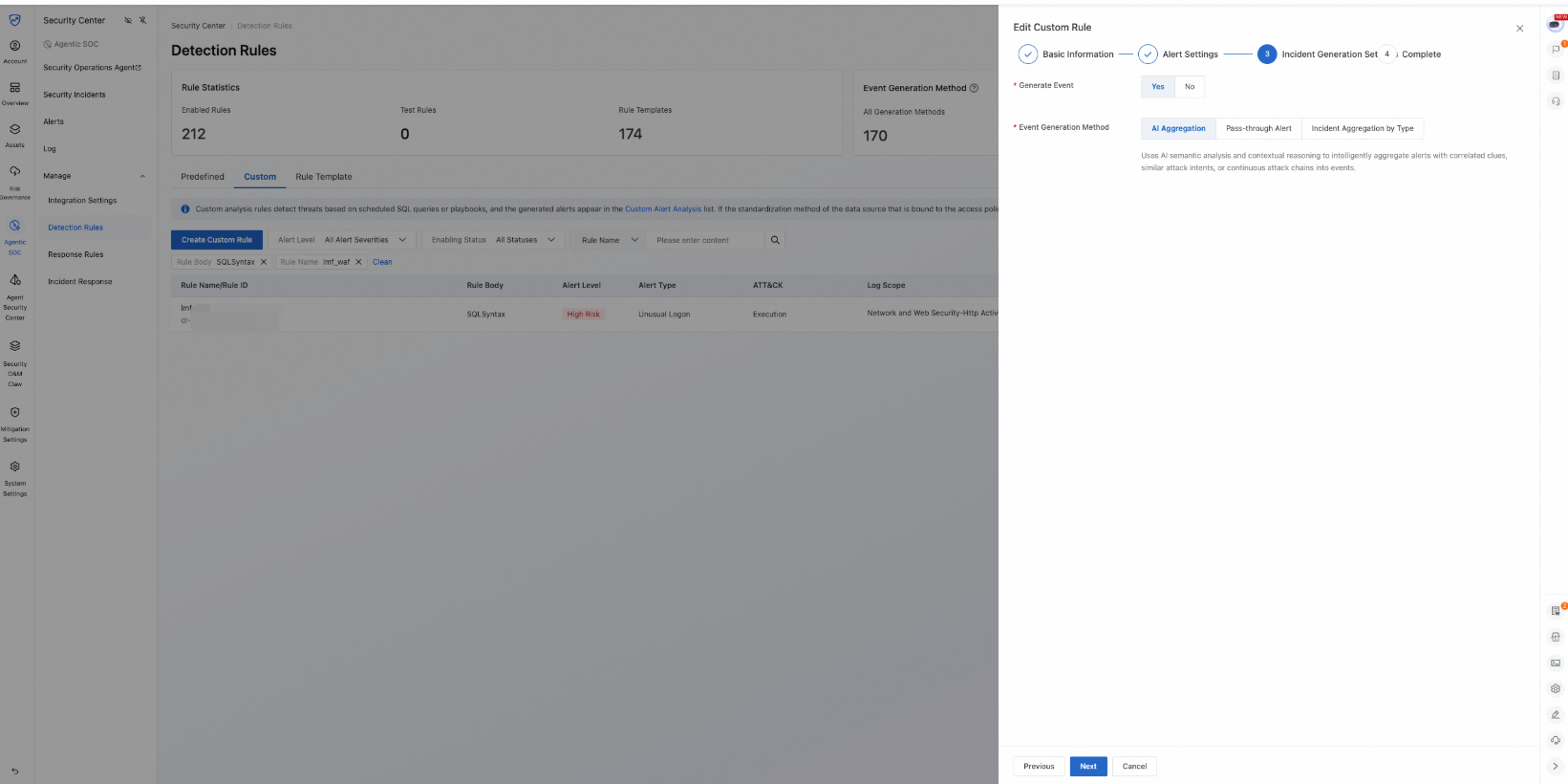
AI event aggregation supports custom alerts: The Alert Correlation Agent supports aggregating alerts based on custom rules and generating incidents. This allows alerts to enter the incident investigation workflow more reliably.
-
Extended predefined detection capabilities: Adds ESA-WAF predefined detection capabilities, improving detection coverage and alert output for WAF data sources.
-
Optimized incident display metrics: The incident list now includes the incident response time field and optimizes the incident update time display logic. The incident update time focuses on alert correlation and merge scenarios. The incident response time tracks response and remediation progress, distinguishing risk updates from remediation updates.
-
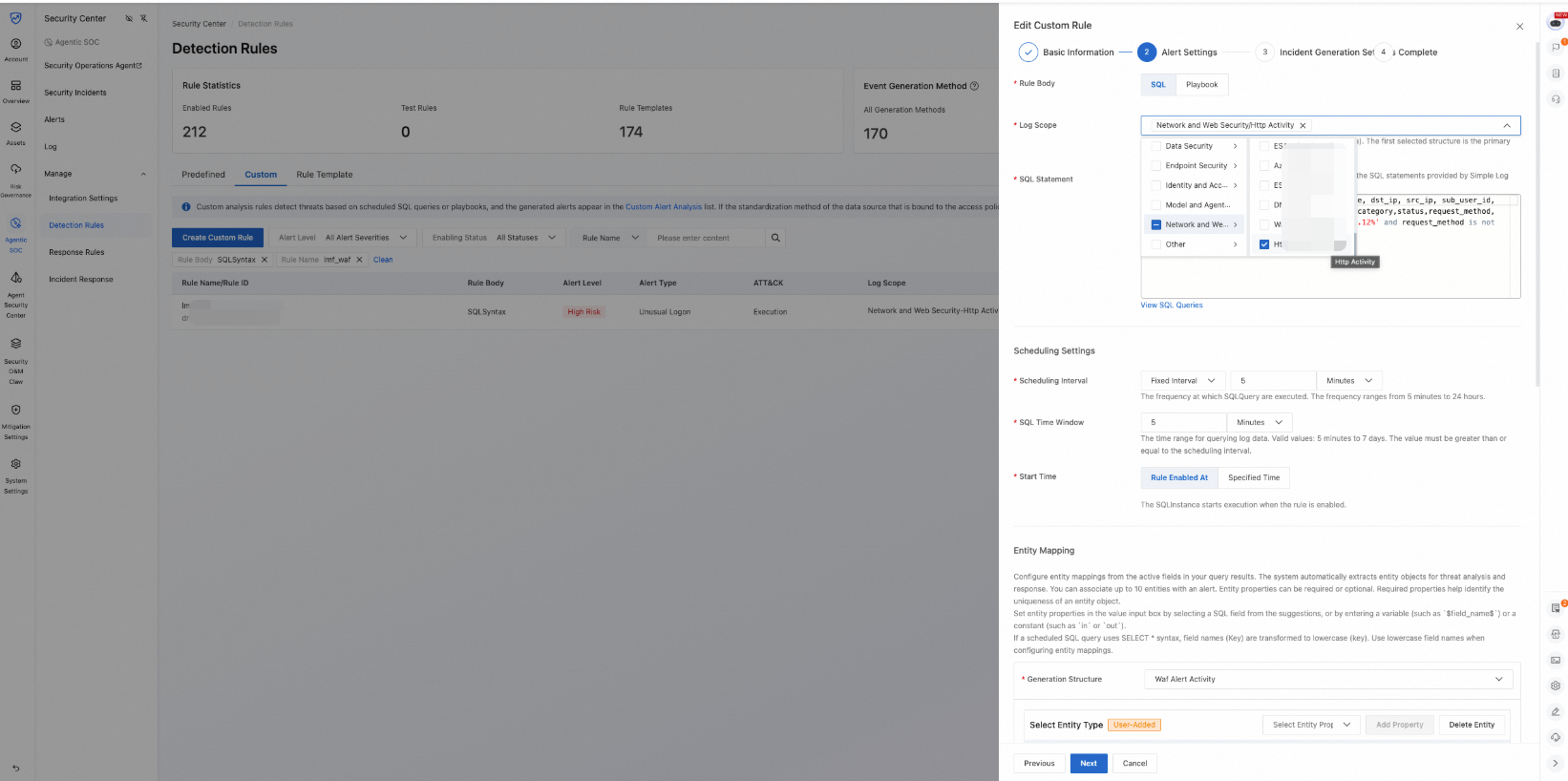
Enhanced custom rule configuration:
-
Log scope selection: Custom log sources can now be selected in custom detection rules, improving rule configuration capabilities after custom log ingestion.
-
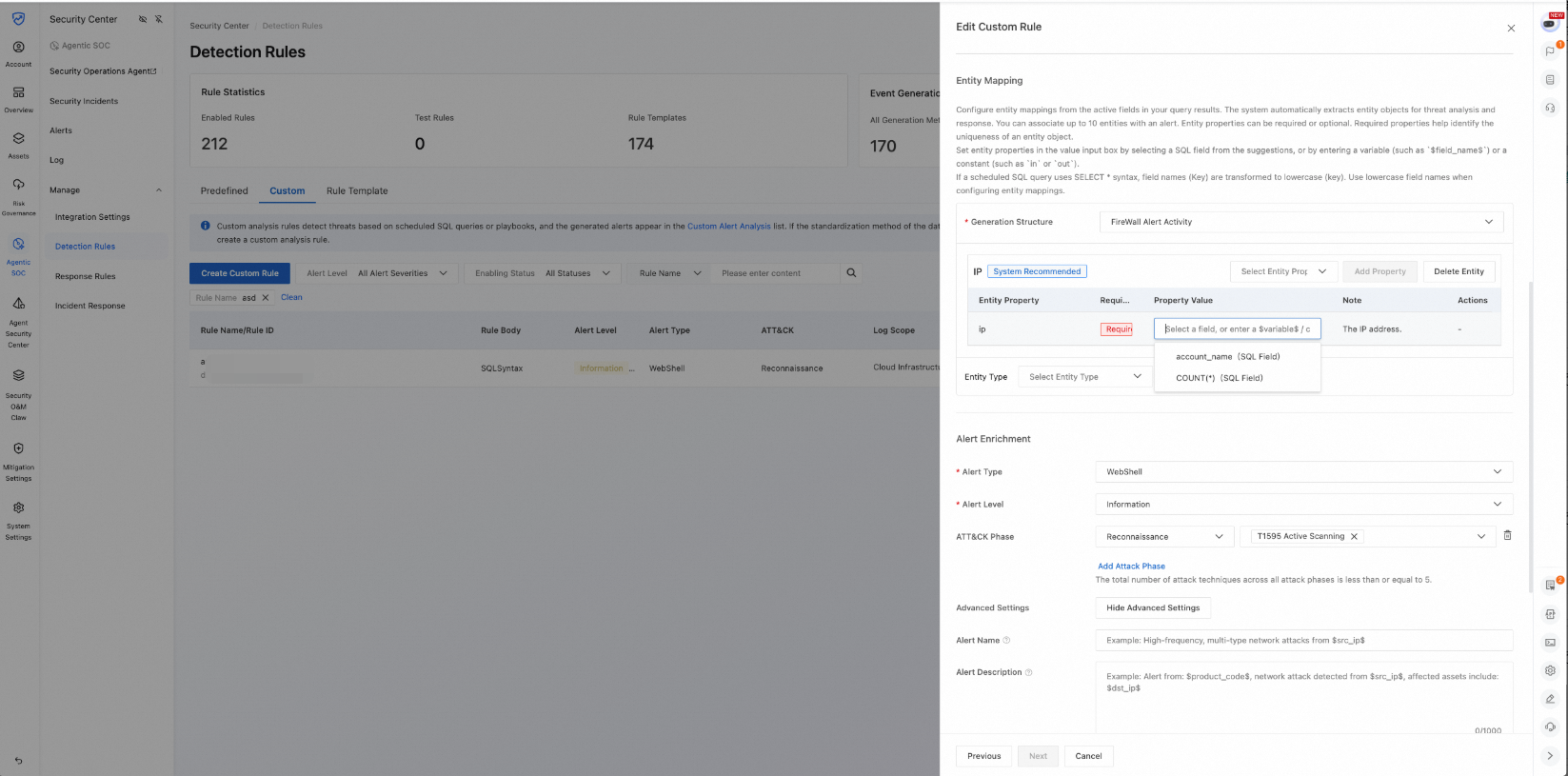
Entity extraction: Adds alert template, entity type mapping, and recommended entity configuration specifications to improve consistency in detection rule configuration, entity identification, and field display.
-
Entity Investigation Agent and response report upgrades
Upgrades the Entity Investigation Agent to support more risk entity types and enhance the explainability of investigation results and report generation capabilities. Key enhancements include:
-
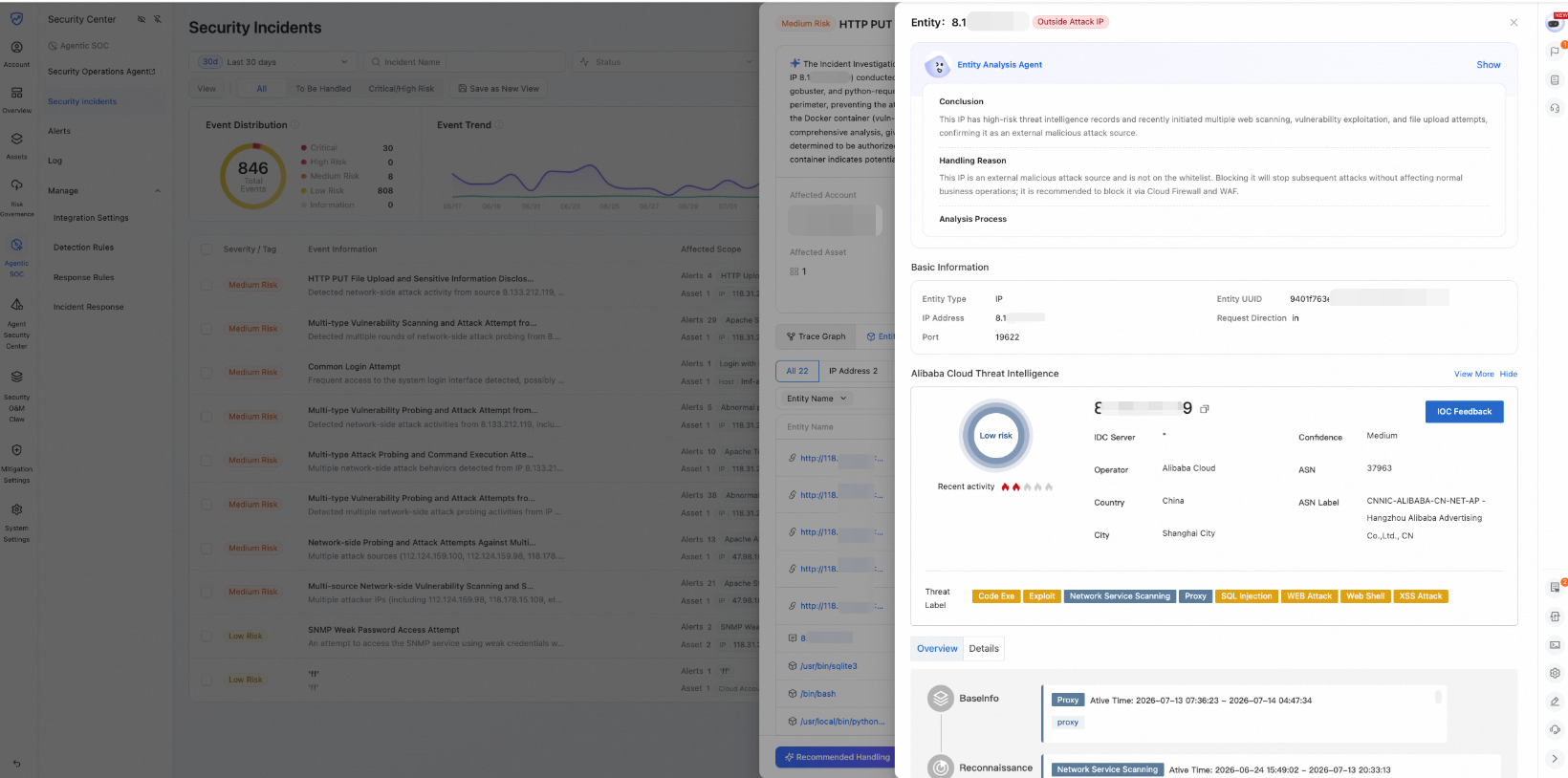
Entity type expansion: In addition to IP addresses, files, and processes, the Entity Investigation Agent now supports URL, domain, and container entity investigation.
-
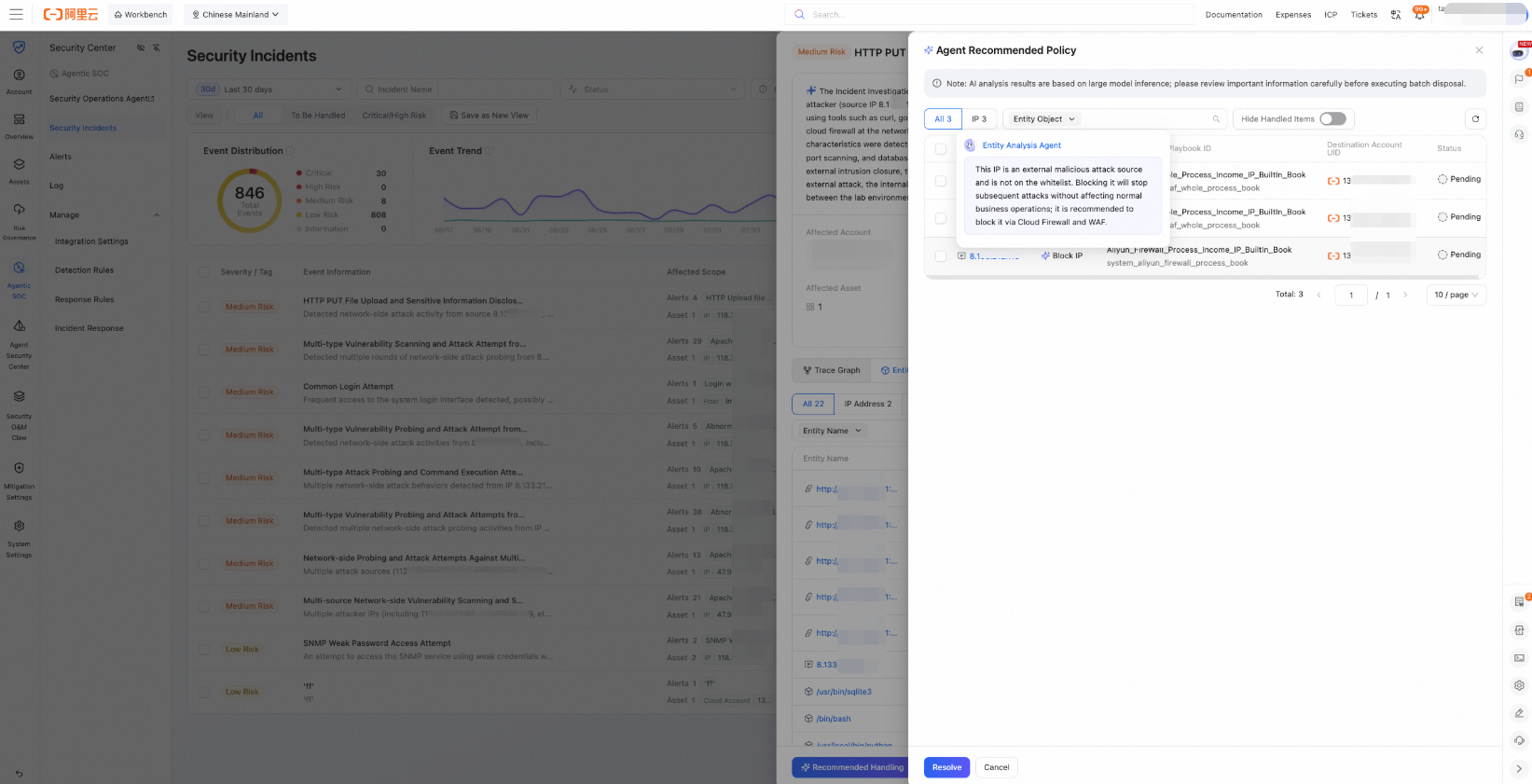
Investigation information enhancements: Supports displaying entity tags, recommended remediation, investigation conclusions, remediation root cause, analysis process, and evidence source descriptions.
-
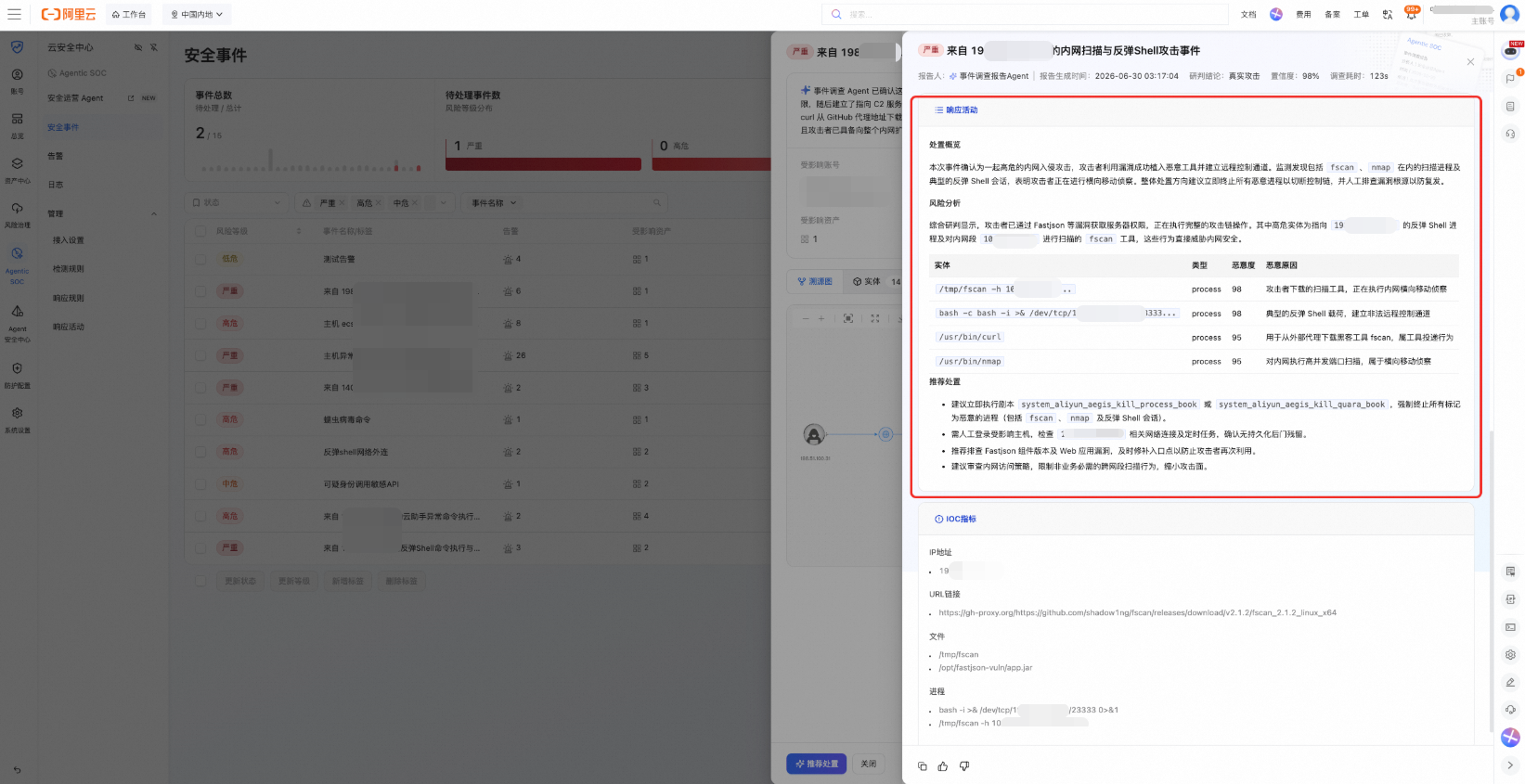
Response report generation: Supports generating response activity reports based on incident and related entity analysis results, summarizing the investigation process, remediation rationale, and response conclusions.
-
Internationalization support: Entity tags, entity analysis reports, and incident response reports support international language display.
These capabilities help security teams conduct entity risk review, remediation decision-making, and incident response retrospectives.
Other improvements
Data ingestion and response improvements:
-
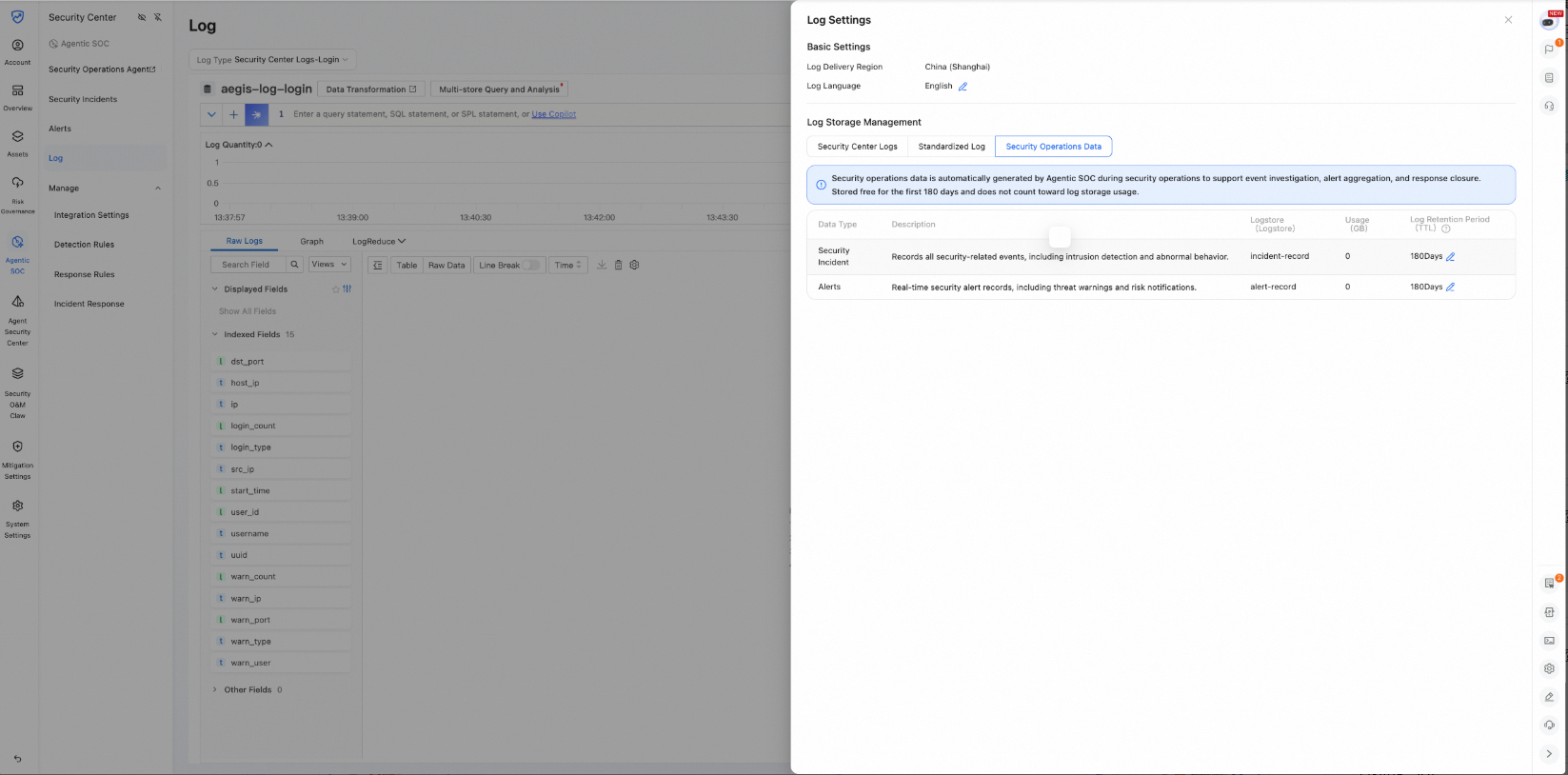
Data ingestion: Security operations data now defaults to a 180-day TTL for Logstore queries, tracking, and governance.
-
Data ingestion: Entity field configuration now shows system-generated attribute indicators to distinguish configurable fields from system fields and reduce configuration misunderstandings.
-
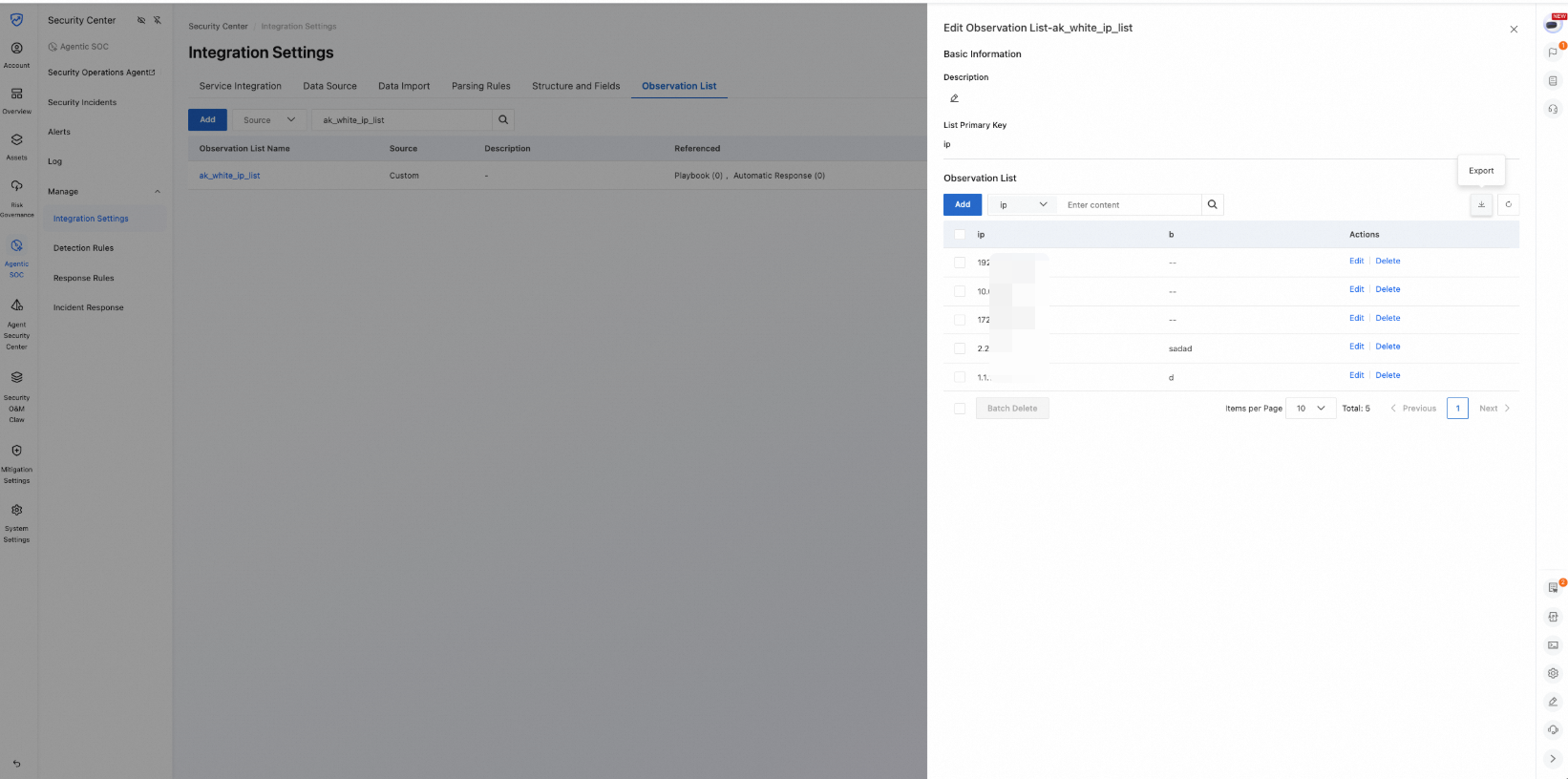
Data ingestion: Watchlists support export for security operations retrospectives and offline analysis.
-
Response: Remediation policy and remediation task statistics support linked filtering, improving consistency between statistics and list queries.
Bug fixes
-
Incident list visibility fix: Fixed an issue where incidents with associated alerts were not displayed. After the fix, incidents with associated alerts are properly displayed in the console, improving incident list visibility and incident investigation completeness.
-
Duplicate alert re-investigation fix: Fixed an issue where the Agent repeatedly triggered investigations for duplicate alerts, reducing unnecessary analysis and duplicate responses.
-
Investigation and report Agent stability fix: Fixed issues with investigation and report Agents including insufficient in-flight task timeout recovery, insufficient mid-execution filtering effectiveness, and large-entity-volume remediation playbook query timeouts. These fixes improve incident investigation and report generation stability.
-
Log ingestion account switch sync fix: Fixed an issue where switching ingestion accounts did not synchronize the dedicated collection channel Project, improving data synchronization consistency in multi-account ingestion scenarios.
-
Log standardization rule validation and normalization fixes: Fixed issues including parsing rule validation not blocking empty keys, native normalization schema not auto-normalizing in non-flat scenarios, and standardization rule creation API strictly validating security domain IDs. These fixes improve log standardization configuration reliability.
-
Azure log ingestion and display fixes: Fixed issues including Azure Blob log accountName value anomalies and Azure Entra ID frontend display anomalies, improving Azure log search and display quality after ingestion.
-
Detection rule configuration compatibility fixes: Fixed issues including insufficient special character support in custom rule names and descriptions, custom rule authorization display anomalies, and custom rate limiting not taking effect. These fixes improve detection rule configuration and execution stability.
-
Alert field anomaly and alert loss fixes: Fixed issues including WAF custom alert extended field database write overflow causing alert loss, EDR alert source field anomalies, and WAF alert affected asset and domain resolution anomalies. These fixes improve alert field quality and alert output reliability.
-
Alert correlation and incident visibility fixes: Fixed issues including incidents with associated alerts not being displayed, incidents generated with zero alerts, and alert aggregation filtering not taking effect. These fixes improve the accuracy of the alert-to-incident pipeline.
-
Incident display and sorting fixes: Fixed issues including incident response time update anomalies, risk level sorting not taking effect, risk level label style inconsistencies, and incorrect incident aggregation linked accounts. These fixes improve incident list and incident detail display consistency.
-
Entity identification and display fixes: Fixed issues including empty or null entities, IP/domain/asset type identification anomalies, entity malicious marking false positives, and entity-related incident and alert statistics anomalies. These fixes improve entity investigation result accuracy and readability.
-
Provenance graph and incident aggregation graph display fixes: Fixed issues including empty provenance graphs, insufficient provenance graph readability, inconsistency between incident descriptions and provenance graphs, and missing or incomplete incident aggregation graphs. These fixes improve investigation pipeline visualization.
-
Response remediation and playbook execution fixes: Fixed issues including inconsistent recommended remediation entity counts, empty remediation task statistics, remediation policy parameter writeback anomalies, SOAR playbook template sync failure without retry, and playbook parameter display interference. These fixes improve response remediation pipeline stability.
-
UI navigation, text, and internationalization display fixes: Fixed issues including label, incident name, and Agent analysis content display anomalies after Chinese-English language switching, as well as field truncation, button visibility, page navigation, Logstore shortcut navigation, and error message readability issues.