A simple application balancer is a server load balancer (SLB) designed for Simple Application Server. This topic describes the basics of simple application balancers. This topic also describes how simple application balancers are billed, the limits and use cases of simple application balancers, and the operations you can perform on simple application balancers.
Description
Simple Application Load Balancer distributes public network traffic to multiple backend Simple Application Servers. This feature increases the throughput capacity of your application, eliminates single points of failure, and improves application availability. The following figure shows the architecture.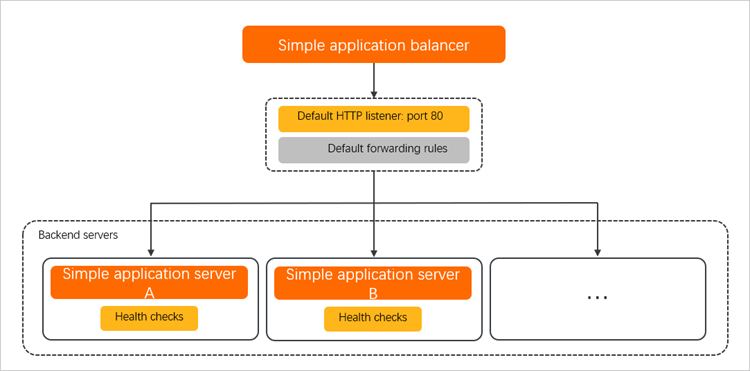 The components are described as follows:
Simple Application Load Balancer: Provides Layer 7 load balancing. It is easy to use and cost-effective.
Listener: Uses the HTTP protocol and listens on port 80 by default.
Forwarding rule: Uses the polling algorithm by default. In this mode, incoming requests are sequentially distributed to healthy backend servers.
Backend server: One or more Simple Application Servers that receive and process requests distributed by the Simple Application Load Balancer. You can add only Simple Application Servers as backend servers.
Health check: The load balancer automatically checks the service availability of attached backend servers. If a server is unhealthy, the load balancer stops distributing traffic to it.
Benefits
Simple application balancers work at Layer 7 of the OSI model. Compared with traditional load balancers that work at Layer 4 of the OSI model, simple application balancers provide streamlined features and easier operations, and are more cost-effective.
Billing
You are billed for simple application balancers on a subscription basis. When you create a simple application balancer, you must pay for a plan, which equals the plan unit price multiplied by the subscription period. A simple application balancer and its backend simple application servers communicate with each other over the virtual private cloud (VPC). The inbound and outbound internet traffic of the simple application balancer does not consume the Internet traffic of backend simple application servers. The plans for simple application balancers do not contain fees for the Internet traffic of the balancers.
Simple Application Load Balancer currently offers a plan for CNY 60/month. The plan includes the following configurations:
Maximum connections: 10,000
New connections per second: 3,000
Regions and network connectivity
Simple application balancers are available in the following regions: China (Beijing), China (Hangzhou), and China (Shenzhen).
Network connectivity details:
Simple Application Load Balancer forwards only public network traffic.
Simple Application Load Balancer and its backend Simple Application Servers are interconnected over a VPC private network.
Limits
Each Alibaba Cloud account can create a maximum of one Simple Application Load Balancer in each region.
Simple Application Load Balancer provides Layer 7 load balancing and forwards only HTTP requests.
You can add only Simple Application Servers that are in the same region as the Simple Application Load Balancer as backend servers.
Scenarios
High-traffic scenarios
If you have consistently high loads of traffic bound for your applications, you can use simple application balancers to forward traffic to backend simple application servers. You can also enable the session persistence feature to send requests from the same client to the same backend simple application server to improve access efficiency.
Single point of failure recovery
You can add multiple simple application servers as backend servers to a simple application balancer. When some simple application servers fail, the simple application balancer skips the failed servers and forwards requests to healthy simple application servers. This helps ensure business continuity.
You can elastically manage application service capacity.
You can add backend servers to a simple application balancer or remove backend servers from a simple application balancer as needed. This lets you flexibly manage the service capabilities of your applications. This scenario is applicable to Web servers and App servers.
Related operations
Operation | Description |
To distribute traffic to multiple Simple Application Servers, create a Simple Application Load Balancer and add the target servers as backend instances. | |
After you create a Simple Application Load Balancer, add backend instances to distribute traffic. The backend instances are Simple Application Servers. | |
Simple Application Load Balancer lets you resolve a domain name to its public endpoint. This makes it easier to access your application over the Internet. | |
Modify the name or configurations of a simple application balancer | After you create a Simple Application Load Balancer, you can modify its name. If you have added backend instances, you can also modify the configurations for session persistence and health check paths. |