Scenarios
This topic describes common scenarios for using API Gateway, such as decoupling front-end and backend systems, integrating heterogeneous systems, and implementing hybrid cloud environments.
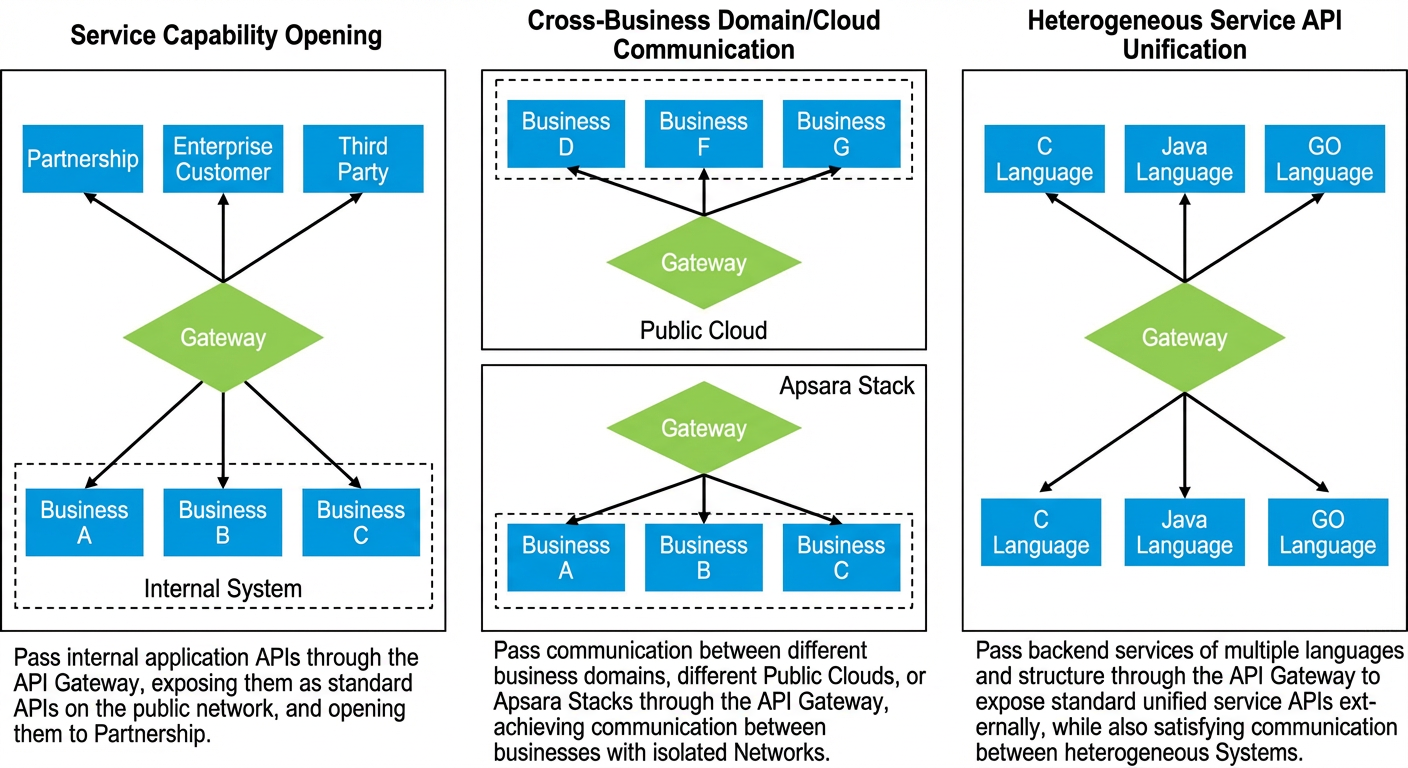
Decoupled front-end and backend
Standardized access
API Gateway provides clients with APIs that use a standard protocol. This allows IT teams to choose the best technology stack for their internal architecture.
Heterogeneous backend integration
API Gateway hides the differences between clients and servers. This lets you refactor services without affecting clients.
Reduced business logic complexity
API Gateway reduces direct calls between clients and servers. This means features such as throttling and load balancing do not need to be implemented in every service.
Improved development efficiency
API Gateway can simulate or virtualize services to validate design requirements or assist with integration testing. This improves development efficiency.

Heterogeneous system integration
Unified integration
Seamlessly connect different software applications to reduce internal system integration costs.
Legacy system compatibility
API Gateway allows IT teams to choose the best technology stack. Its compatibility with legacy systems during transformation accelerates enterprise upgrades.
Centralized management
IT teams can access all data from a centralized location, which improves development efficiency.
Hybrid cloud
API full lifecycle management
API Gateway provides full lifecycle management for APIs across interconnected clouds. This prevents APIs from being exposed externally and improves API security.
High-performance cross-cloud RPC calls
API Gateway supports Remote Procedure Calls (RPCs) in cross-cloud scenarios. The procedure for making these calls is the same as for calls within a single cloud.
Robust security
API Gateway provides multiple security features to ensure valid access and data security.
