Bill payment terms and due dates
This topic describes bill payment terms and the rules for calculating payment due dates on your bills.
What are payment terms
-
Payment terms are the rules in your contract with Alibaba Cloud that define when you must pay your bills for the services you use.
-
Payment terms are established in your credit control contract after you apply for credit control and take effect after you confirm the contract. You can view your current payment terms and their change history on the Payment Term Query page. To find this page, navigate to Expenses and Costs > Bills > Bill Overview.
-
The credit control contract specifies the rights and responsibilities of both parties regarding payment terms, but does not contain the specific details of the payment term agreement.
-
You can view the actual payment term agreement on the Payment Term Query page, which you can access from Expenses and Costs > Bills > Bill Overview. If the payment terms are changed, you are notified of the new terms by text message, email, or internal message.
What is a payment due date
-
A payment due date is the deadline for paying an outstanding bill for your Alibaba Cloud usage. This date is based on the payment terms agreed upon in your contract.
-
If you do not pay your bill in full by the due date, the unpaid amount becomes overdue. Alibaba Cloud has the right to charge a late fee for overdue payments, as specified in the contract.
-
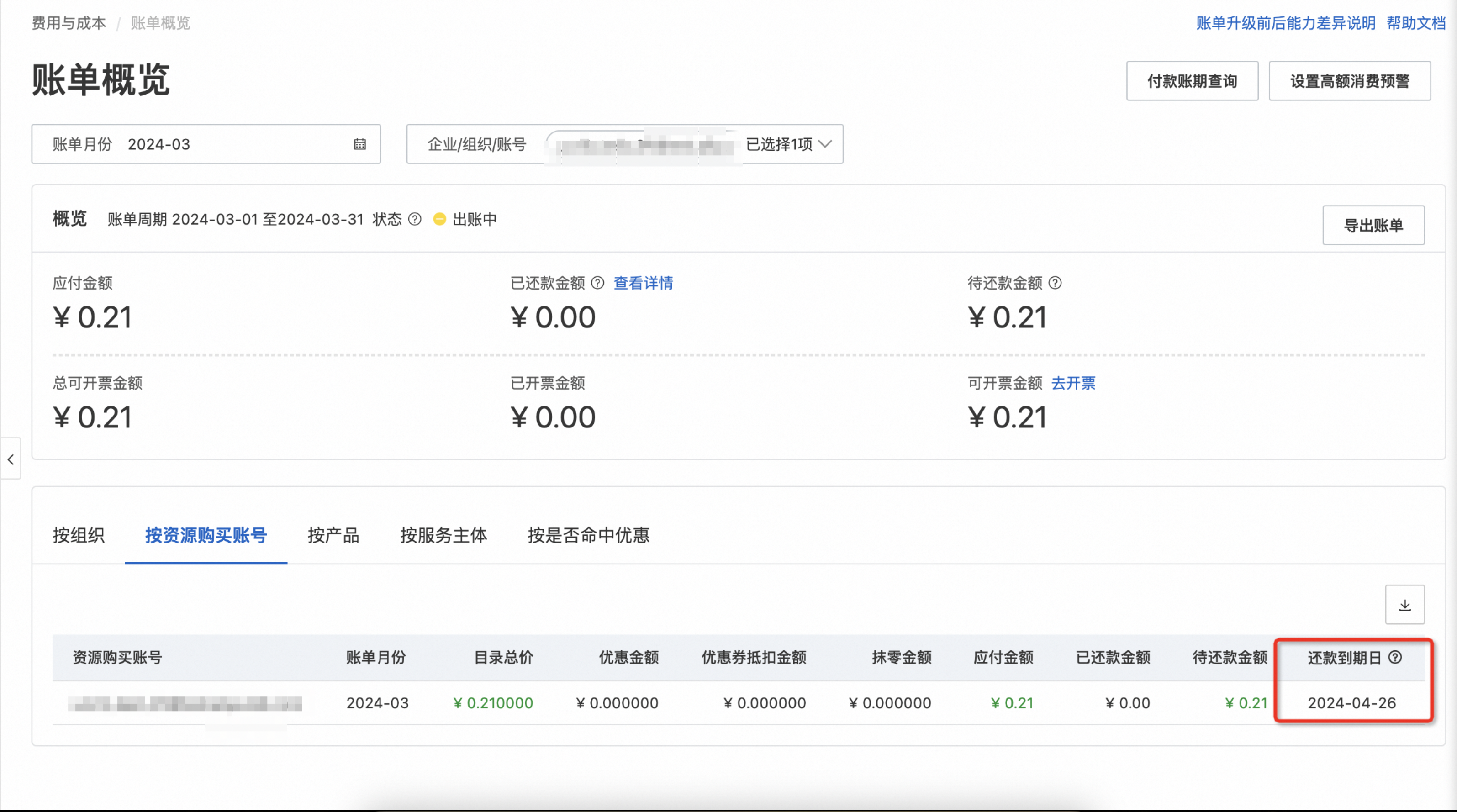
You can find the payment due date for a bill on the Bill Overview page. Navigate to Expenses and Costs > Bills and query by the resource-purchasing account.
How to sign up for payment terms
-
You sign up for payment terms when you apply for credit control for your Alibaba Cloud account. After applying for credit control, you can also modify the payment terms based on your agreement.
-
For the initial application, the management account of the payment account must log on, navigate to Expenses and Costs > Bills > Bill Overview > Payment Term Query, and then confirm the agreement to activate it.
-
For subsequent changes to payment terms, you do not need to confirm the agreement again. After the new settings take effect, the system notifies you of the updated payment terms by text message, email, or internal message.
-
-
The payment term agreement consists of a settlement cycle and a payment time. Together, they determine the payment due date for your Alibaba Cloud bills.
-
Settlement cycles include monthly, bimonthly, trimonthly, quarterly, semi-annually, and annually. The cycle is configured based on your discussion with your account manager.
-
Payment time can be set to calendar days, calendar months, or business days. The number of days or months is configured based on your discussion with your account manager.
-
-
Users without credit control do not need to sign up for payment terms. For these users, the bill generation date is the payment due date.
How payment due dates are calculated
-
The settlement cycle and the payment time together determine how the payment due date of a bill is calculated.
-
Settlement cycle: Determines the start date for the payment due date calculation.
-
Payment time: Determines the number of days allowed for payment before the due date.
-
-
The final due date for the bill is calculated by adding the number of payment days to the payment start date.
-
Note that bills are always generated on the 2nd of the following month, regardless of the settlement cycle or payment time. The system uses the settlement cycle and payment time only to calculate the payment due date. The rights and responsibilities of both parties are subject to the contract.
-
Different settlement cycles have different rules for calculating the payment due date start time, as follows:
-
Monthly: Settlement is based on the bill's calendar month. The due date calculation starts on the bill generation date in the following month (Bill Month + 1). For example, for a March 2023 bill, the calculation starts on April 2, 2023. If the payment time is 24 calendar days, the due date for the March bill is April 26, 2023.
-
Bimonthly: Settlement is based on the bill's calendar month. The due date calculation starts on the bill generation date two months after the bill month (Bill Month + 2). For example, for a March 2023 bill, the calculation starts on May 2, 2023. If the payment time is 24 calendar days, the due date for both March and April bills is May 26, 2023.
-
Trimonthly: Settlement is based on the bill's calendar month. The due date calculation starts on the bill generation date three months after the bill month (Bill Month + 3). For example, for a March 2023 bill, the calculation starts on June 2, 2023. If the payment time is 24 calendar days, the due date for bills from March to May is June 26, 2023.
-
Quarterly: The bill month is grouped into its corresponding quarter of the calendar year for settlement:
-
For bills issued in January, February, and March, the due date calculation begins on April 1 of that year. For example, if the payment period is 24 calendar days, the due date for all bills issued in these months is April 25 of that year.
-
For bills issued from April to June, the due date calculation begins on July 1 of the billing year. For example, if the payment period is 24 calendar days, the due date for these bills is July 25 of that year.
-
For bills issued from July to September, the due date is calculated from October 1 of the billing year. For example, if the payment period is 24 calendar days, the due date for these bills is October 25 of the billing year.
-
For bills issued in October, November, or December, the due date is calculated from January 1 of the following year. For example, if the payment period is 24 calendar days, the due date for these bills is January 25 of the following year.
-
-
Semi-annually: The bill month is grouped into its corresponding half of the calendar year for settlement:
-
For bills issued from January to June, the due date is calculated from July 1 of that year. For example, if the payment period is 24 calendar days, the due date for these bills is July 25 of that year.
-
The payment period for bills issued between July and December starts on January 1 of the following year. For example, if the payment period is 24 calendar days, the due date is January 25 of the following year.
-
-
Annually: All bill months within a calendar year are grouped for settlement:
-
For all bills issued in a calendar year, the due date is calculated from January 1 of the following year. For example, if the payment period is 24 days, all bills issued in that year are due on January 25 of the next year.
-
-
-
Different payment terms specify the number of days to pay before a bill is due, including the following:
-
Calendar days: A specified number of calendar days is added to the due date calculation start time.
NoteExample: The settlement cycle is monthly, and the payment time is 24 calendar days.
For a March 2023 bill, the calculation starts on April 2, 2023. After adding 24 calendar days, the payment due date is April 26, 2023.
-
Business days: The calculation is the same as for calendar days, but weekends and public holidays are automatically excluded.
-
Calendar months: A specified number of months is added to the due date calculation start time to determine the payment due date.
NoteExample: The settlement cycle is monthly, and the payment time is 3 calendar months.
For a March 2023 bill, the calculation starts on April 2, 2023. After adding 3 months, the payment due date is July 2, 2023.
-